
Cyber insurance for healthcare providers in 2026 costs 60–120% more than equivalent policies in almost every other industry — and it still routinely leaves critical HIPAA-specific gaps that convert a covered incident into a partial payout or a coverage dispute. Healthcare drove 22% of all cyber insurance policy payouts in 2025, making it the highest-claims vertical in a market that S&P Global Ratings projects will reach $16.4 billion globally in 2026. Underwriters have responded by tightening application requirements substantially — approximately 73% of small healthcare organizations now fail their first cyber insurance assessment, and three out of four carriers run external attack surface scans before quoting rather than relying on self-attestation.
This guide covers what a healthcare cyber policy actually needs to say to be useful, how HIPAA riders work and where they fall short, the sub-limits that gut ransomware claims, the eight controls underwriters treat as non-negotiable going into 2026, and how the five most commonly cited carriers — Coalition, At-Bay, Cowbell, Resilience, and Beazley — position themselves for healthcare buyers.
// 01 Why Cyber Insurance for Healthcare Providers Costs More Than Every Other Sector
Healthcare cyber insurance premiums carry a 60–120% premium differential over the national SMB (small and medium-sized business) average. That differential is structural, not arbitrary, and it maps to three underwriting factors that do not diminish regardless of your organization's size:
PHI (Protected Health Information) density. Every healthcare organization, from a two-physician practice to a 20-hospital system, holds PHI — patient names, diagnoses, Social Security numbers, insurance identifiers, and in most cases financial account data. HIPAA (the Health Insurance Portability and Accountability Act, enacted 1996 and substantially amended by HITECH in 2009) treats each individual record as a potential enforcement action. HIPAA civil monetary penalties range from $141 to $71,162 per violation, with an annual cap per violation category of $1,919,173. A single 10,000-record breach can generate multi-million-dollar regulatory exposure before a single dollar of litigation cost is added.
Ransomware claims frequency. Healthcare organizations experience more than twice the number of ransomware attacks compared to other industries, according to Coalition's healthcare underwriting data. Threat actors target EHR (Electronic Health Record) systems deliberately: operational downtime creates immediate patient safety risk — delayed labs, postponed surgeries, rerouted ambulances — which drives ransom payment rates far above other verticals. The average healthcare data breach cost reached $7.42 million in 2025, making healthcare the most expensive breach vertical for the fourteenth consecutive year.
Regulatory complexity. Healthcare organizations face overlapping enforcement authorities — the HHS OCR (Office for Civil Rights), state attorneys general, and in some cases the FTC — each with independent penalty structures. Most standard cyber policies written for retail or manufacturing do not explicitly reference HIPAA or HITECH, leaving regulatory defense coverage subject to carrier interpretation at exactly the wrong moment.
The premium impact is concrete: a small medical practice with 10 physicians pays roughly $3,000–$7,500 per year for $1 million in cyber coverage under current market conditions. The quality of security controls creates a $4,000–$20,000 annual swing on a $20,000 policy — meaning organizations that implement the eight controls covered in this guide frequently recover their remediation investment through lower premiums in year one. S&P Global Ratings projects 15–20% premium increases across the cyber insurance market in 2026, with healthcare trending toward the upper bound of that range.
// 02 What Standard Cyber Policies Cover — and the Healthcare-Specific Gaps
A standard cyber policy written for a non-healthcare buyer typically covers seven coverage categories: forensic investigation, breach notification, credit monitoring, business interruption, ransomware and extortion, legal defense, and regulatory fines. For a healthcare organization, each of those categories requires explicit contractual language before it is reliably useful at claim time.
| Coverage Category | What Standard Policies Say | What Healthcare Requires |
|---|---|---|
| Forensic investigation | "Network security event" | Must include EHR breach investigation |
| Regulatory fines | "Privacy regulation fines" | Must name HIPAA and HITECH explicitly |
| Business interruption | "Network outage" | Must cover EHR system downtime specifically |
| Third-party liability | "Customer data" | Must cover patient liability claims |
| Business associate liability | Rarely included | Must address BA/covered-entity relationships |
| Breach notification | Generic language | Must align with HIPAA's 60-day notification clock |
| PHI restoration | May be excluded | Must include EHR data and audit-log recovery |
The most dangerous coverage gap in standard policies is regulatory defense language. A policy that covers "privacy regulation penalties" without naming HIPAA and HITECH creates a coverage dispute during an active OCR investigation — which is precisely when your legal and forensic bills are compounding daily. Healthcare buyers should require policy language explicitly naming HIPAA civil monetary penalties, HITECH corrective action plan costs, and state-level health data privacy statutes (California CMIA, New York SHIELD Act, Texas Health & Safety Code Section 181).
The second most consequential gap is business associate (BA) liability. Under HIPAA, a covered entity that shares PHI with a business associate — a billing company, cloud EHR host, or revenue cycle vendor — remains liable when the BA breaches that data. Indemnification clauses in BA agreements often fail at claim time when the BA lacks adequate resources. Healthcare-specific policies can extend coverage to BA indemnification scenarios that standard policies leave entirely unaddressed.
// 03 HIPAA Cyber Liability Riders: What They Cover
A HIPAA cyber liability rider (also called an endorsement) is an add-on to a base cyber policy that explicitly extends coverage to HIPAA-specific exposures. The term describes a category rather than a standardized product — rider scope varies substantially across carriers — so every rider must be evaluated line by line.
A well-structured rider should cover four elements:
HIPAA breach notification costs. The HIPAA Breach Notification Rule requires covered entities to notify affected individuals within 60 days of discovering a breach. For breaches affecting 500 or more individuals in a state, media notification is also required. For breaches affecting 500 or more individuals nationally, HHS must be notified within 60 days and the breach posted to HHS's public breach portal immediately. Notification costs — printing, mailing, call center setup, credit monitoring enrollment — for a 50,000-record breach routinely reach $500,000–$1.5 million. A rider should cover these costs without applying a separate sub-limit below the main aggregate.
OCR investigation defense. An HHS OCR investigation following a reportable breach requires dedicated healthcare privacy counsel, forensic documentation of the breach timeline, and often multi-year engagement including corrective action plans. Legal defense costs alone can reach $500,000 before any penalty is assessed. The rider should explicitly cover OCR defense under regulatory defense coverage — not under a catch-all "government inquiry" provision that carriers can dispute.
HIPAA Safe Harbor credit. HHS's Safe Harbor provision under HITECH Section 13401(c) reduces penalties when organizations can demonstrate adoption of recognized security frameworks: NIST CSF (Cybersecurity Framework), HITRUST CSF (Common Security Framework), or ISO 27001. Some carriers offer enhanced regulatory defense coverage and premium discounts for policyholders who can document Safe Harbor-eligible control implementations. If your organization has completed a NIST CSF assessment or HITRUST certification, disclose it during underwriting.
What riders typically exclude. Riders rarely cover criminal penalties assessed personally against individuals who knowingly violated HIPAA. They also typically exclude intentional violations and — unless specifically negotiated — state privacy law penalties that exceed HIPAA's floor. Buyers with operations in California, New York, or Texas should confirm state-law coverage is addressed in the rider or in the base policy.
// 04 Coverage Sub-Limits Healthcare Buyers Must Negotiate
Sub-limits are policy provisions that cap reimbursement for specific claim categories below the overall policy aggregate limit. Healthcare organizations frequently discover sub-limits only after a claim — buying $2 million in aggregate coverage and learning at the worst possible time that their ransomware sub-limit is $250,000.
Ransomware sub-limits. Standard market practice is to apply sub-limits of $250,000–$500,000 to ransomware-specific incidents. A health system with $2 million in aggregate coverage and a $250,000 ransomware sub-limit facing a $1.5 million ransom demand has effectively purchased $250,000 in ransomware coverage — 12.5% of the aggregate limit. Many policies layer on co-insurance provisions requiring the policyholder to bear 40–50% of ransom payments above a threshold, reducing the insurer's actual exposure further. Some carriers have faced court challenges over ransomware sub-limits, but the majority of standard market policies retain them.
Social engineering and business email compromise (BEC) sub-limits. BEC is the single most common cyber insurance claim driver across all industries. Resilience's analysis of its healthcare claims portfolio found that social engineering — wire fraud, fake invoice payments, and impersonation attacks — drives 88% of material financial losses in healthcare, ahead of ransomware by frequency. Despite this, social engineering coverage often appears as a separate sub-limit, sometimes as low as $50,000 on a $1 million policy, because it is classified as a "crime" rather than a "cyber" event under older policy forms.
Business interruption waiting periods. Most cyber policies activate business interruption coverage only after a waiting period — typically 8–24 hours. For hospitals and health systems where ransomware-induced EHR downtime creates immediate patient care risk, an 8-hour waiting period represents meaningful uninsured exposure. Negotiate for the shortest available waiting period; 8 hours is the current industry floor for healthcare-attentive policies.
Hardware bricking coverage. Certain ransomware strains — particularly wiper variants used against healthcare targets — destroy endpoint firmware rather than encrypting files. Standard ransomware coverage addresses encrypted-data recovery; hardware destruction may be classified as a property loss and excluded from the cyber policy. Ask specifically whether firmware-level hardware destruction is covered.
The negotiation lever. Request a complete sub-limit exhibit from your broker listing every coverage category with its specific limit before binding. Most brokers will not produce this exhibit proactively; you must ask for it by name. Compare each sub-limit against your average daily revenue and your worst-case EHR recovery timeline. Any sub-limit that falls below 30 days of revenue for business interruption, or below your realistic ransom exposure, warrants negotiation or a separate coverage endorsement.
// 05 8 Controls Underwriters Now Require Before Issuing a Policy
The eight controls below appear on essentially every cyber insurance application for healthcare organizations in 2026. Approximately 75% of carriers now run external attack surface scans during underwriting to independently verify claims — misrepresenting controls on an application is grounds for coverage rescission at claim time. Organizations that cannot demonstrate all eight controls active and documented will be declined, quoted at non-standard (high) rates, or issued policies with sub-limits that make coverage functionally inadequate.
Control 1: Multi-Factor Authentication (MFA)
  ├── All remote access: VPN, RDP (Remote Desktop Protocol), SSH
  ├── All email accounts, including shared/admin mailboxes
  ├── All privileged and admin accounts
  ├── All cloud service consoles: AWS, Azure, GCP, Microsoft 365
  └── $5M+ policies: phishing-resistant MFA required (FIDO2 hardware keys or biometrics)
Control 2: Endpoint Detection and Response (EDR)
  ├── Deployed on: every workstation, laptop, and server
  ├── Monitoring: 24/7 alerting to an active SOC (in-house, MDR, or MSSP)
  └── Note: traditional antivirus is explicitly insufficient — carriers ask directly
Control 3: Immutable, Tested Backups
  ├── Strategy: 3-2-1 (3 copies, 2 media types, 1 off-site or cloud)
  ├── Isolation: backup credentials separated from production environment
  └── Testing: quarterly restore tests for EHR and core clinical systems
Control 4: Documented Patch Management
  ├── SLAs: defined remediation timelines for Critical and High CVEs
  ├── Baselines: CIS Benchmark-aligned configurations for servers and endpoints
  └── Evidence: patch logs available for underwriting review on request
Control 5: Written Incident Response Plan (IRP)
  ├── Scope: defined roles, escalation procedures, communication protocols
  ├── HIPAA alignment: 60-day breach notification timeline built into the plan
  └── Testing: tabletop exercise conducted within the past 12 months
Control 6: Network Segmentation
  ├── Clinical networks isolated from office and administrative networks
  ├── IoMT (Internet of Medical Things — connected medical devices) on isolated VLAN
  ├── NGFW (Next-Generation Firewall) enforcement with access control lists
  └── ZTNA (Zero Trust Network Access) or VPN for all remote clinical access
Control 7: Privileged Access Management (PAM)
  ├── No standing admin accounts with persistent elevated privileges
  ├── JIT (Just-in-Time) access: privileges granted when needed, auto-revoked after
  ├── Session recording for all privileged administrative sessions
  └── MFA required at every privileged access checkpoint
Control 8: Email Security and Security Awareness Training
  ├── Technical: SPF, DKIM, DMARC enforced and verified for all sending domains
  ├── Technical: advanced anti-phishing layer (beyond basic spam filtering)
  ├── Process: dual authorization for wire transfers — second approver required
  └── Training: documented annual security awareness program with phishing simulation
Controls 1 and 2 (MFA and EDR) function as hard gates — applications lacking either are routinely declined outright or quoted at rates that make coverage economically non-viable. Controls 3 through 8 determine underwriting tier (preferred, standard, or non-standard) and directly affect which sub-limits apply. Organizations at the preferred tier frequently receive ransomware coverage at full aggregate rather than at the $250,000–$500,000 sub-limit that standard-tier buyers face.
The 2026-specific change in underwriting practice is external verification. Carriers now conduct external attack surface assessments during underwriting, scanning publicly visible services for unpatched software, exposed RDP and management interfaces, email configuration failures, and cloud misconfiguration signals. An organization that attests to MFA on remote access but has an exposed RDP port on the public internet will receive a deficiency notice — and potentially a rescission clause on the resulting policy.
// 06 Carrier Comparison: Coalition, At-Bay, Cowbell, Resilience, and Beazley
The five carriers most commonly considered for cyber insurance for healthcare providers in 2026 occupy distinct positions by organization size, security maturity, and service model. No single carrier dominates every buyer profile.
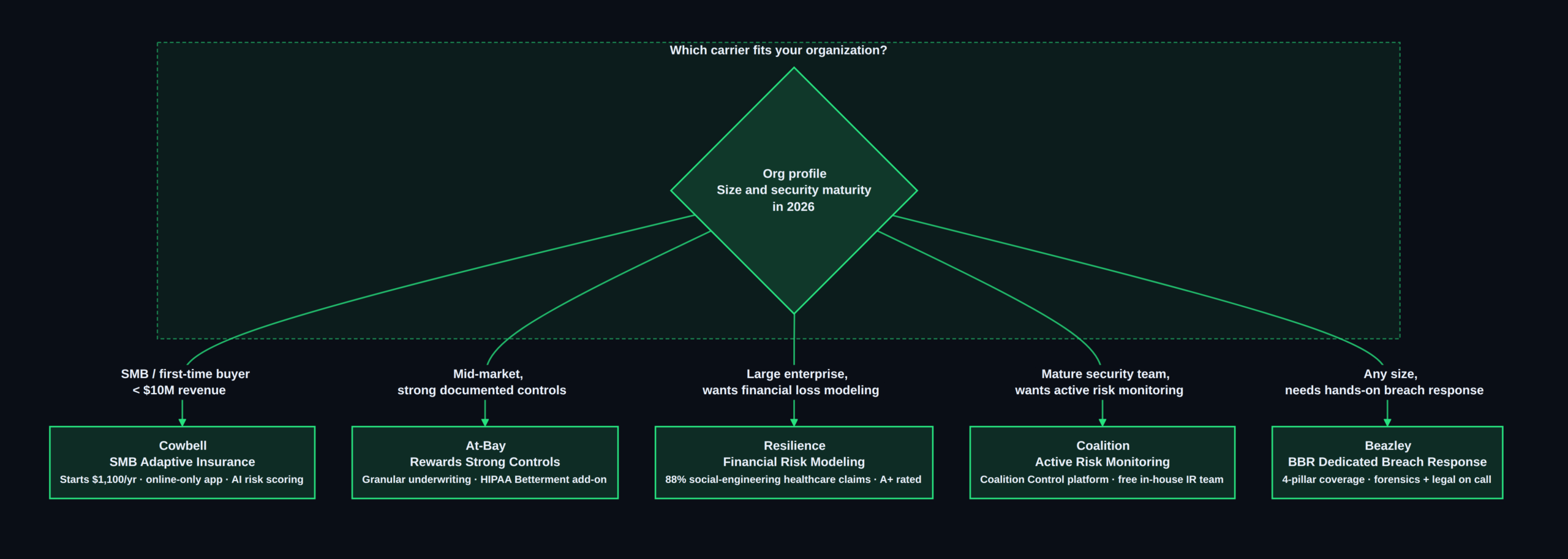
Coalition is positioned for healthcare organizations with mature security programs that want pre-incident risk reduction built into the policy relationship. The Coalition Control platform provides continuous attack surface monitoring — scanning for exposed services, unpatched software, and misconfigured cloud resources — and delivers step-by-step remediation guidance between policy periods. Coalition's in-house CIR (Coalition Incident Response) team handles forensics, ransomware negotiation, and BEC investigation at no additional cost during an active incident. The trade-off: security posture monitoring means that a declining security posture between issuance and renewal affects renewal pricing. Coalition also publishes healthcare-specific policy terms that explicitly address HIPAA compliance.
At-Bay takes a granular underwriting approach that rewards documentation over self-attestation. Organizations that can produce evidence of MFA implementation percentages, EDR coverage logs, backup restore test records, and IRP tabletop exercise outcomes receive better pricing than those relying on checkbox answers. At-Bay offers healthcare-specific surplus options including HIPAA Betterment (covering the gap between actual damages and HIPAA regulatory exposure) and Contingent Bodily Injury (patient harm liability linked to a cyber event). The At-Bay Stance platform delivers ongoing threat intelligence calibrated to the policyholder's specific technology stack. The application process is demanding for organizations with poorly documented controls — that rigor is the mechanism that produces accurate pricing.
Cowbell was designed for SMBs buying cyber insurance for the first time or replacing bundled coverage that came with an MSP contract. The application requires only an organization name and domain — Cowbell's AI-powered Cowbell Factors tool assesses external risk signals and generates a quote without a lengthy questionnaire. Premiums start at $1,100 per year for $1 million in aggregate coverage. The trade-off relative to At-Bay or Resilience: policy customization is more limited, and sub-limits on smaller policies tend to reflect standard market terms rather than negotiated healthcare-specific terms.
Resilience is the strongest option for mid-market and large healthcare organizations that want to understand their cyber risk in financial terms before committing to a coverage amount. Resilience quantifies potential loss in dollar figures — not risk scores — based on the policyholder's specific control profile and industry claims data. Its healthcare portfolio analysis is among the most operationally specific published by any carrier: social engineering drives 88% of material financial losses in its healthcare book, which has concrete implications for coverage prioritization (BEC sub-limits matter more than many buyers realize). Resilience pairs insurance with integrated security services, including pre-incident security assessments and post-incident response coordination.
Beazley built its healthcare cyber market position on Beazley Breach Response (BBR) — a dedicated business unit that coordinates breach response services from the moment a claim is filed. BBR provides legal services to evaluate HIPAA notification obligations, forensic services to determine breach scope, and assigned case managers through the full incident lifecycle. Beazley's four-pillar coverage structure — Breach Response, First Party, Third Party, and eCrime — creates clear coverage buckets that simplify claims management when multiple coverage types activate in a single incident. Beazley is particularly well-suited for smaller and mid-market healthcare organizations with revenues under $35 million that need hands-on incident support more than continuous pre-incident monitoring.
// 07 How to Benchmark Coverage Limits Against Your Actual Exposure
Healthcare organizations frequently under-insure relative to their actual breach cost exposure, often because coverage limits are set by premium budget rather than by risk calculation. A practical benchmarking formula for minimum coverage:
Minimum coverage = (Daily revenue × 30 days) + (PHI record count × $200 per record)
The $200 per-record figure accounts for HIPAA notification, credit monitoring, legal, and breach response costs at the low end of current industry averages. Per-record costs in healthcare breach incidents average higher than $200 once regulatory defense and business interruption are included.
For a mid-sized practice with $10,000 in daily revenue and 50,000 patient records:
($10,000 × 30) + (50,000 × $200) = $300,000 + $10,000,000 = $10.3 million minimum
Most healthcare buyers purchasing $1–2 million in coverage are materially under-insured against this benchmark. The appropriate response is not always to buy $10 million in coverage — co-insurance provisions, deductibles, and premium costs make that impractical for smaller organizations. The practical response is to ensure that the coverage you do purchase does not have sub-limits that reduce effective protection to a fraction of the aggregate limit.
Leverage for better terms: Underwriters reduce premiums and relax sub-limits for organizations that can demonstrate formal security framework adherence. HITRUST CSF certification is the most recognized healthcare-specific security framework and directly supports HIPAA Safe Harbor claims. NIST CSF self-assessments are lower-cost and increasingly accepted as underwriting documentation. A SOC 2 Type II audit — while not healthcare-specific — provides independent attestation of security controls that most carriers will factor into preferred-tier placement. Organizations that complete any of these before renewal should present the documentation during the application process rather than waiting for the carrier to ask.
The ransomware cost breakdown matters here: our full analysis of ransomware attack economics in 2026 shows that ransom payments are typically the smallest component of total incident cost — remediation, business interruption, legal, and reputational costs combined regularly exceed ransom payments by a factor of four. A policy with a $250,000 ransomware sub-limit but adequate business interruption and forensics coverage addresses the larger cost categories even when the ransom itself exceeds the sub-limit.
For teams evaluating tools to document the security controls that underwriters now verify, our DSPM tools comparison for regulated industries covers solutions built specifically for healthcare and insurance environments.
// 08 Conclusion
Cyber insurance for healthcare providers in 2026 requires more specificity than any other vertical — both in the policy language you accept and in the controls you implement before applying. The premium differential healthcare organizations pay reflects genuine claims exposure, and the underwriting process now includes independent verification of the controls that determine which coverage tier you qualify for. Standard cyber policies without explicit HIPAA and HITECH references, healthcare-specific riders, and negotiated sub-limits create coverage that looks adequate on paper but fails at claim time. The eight controls above are the baseline for a viable application; organizations that document all eight and pursue a formal framework attestation gain the most negotiating leverage on sub-limits — which is where the real coverage risk lives for most healthcare buyers.
For teams evaluating full market options beyond the five carriers covered here, see our SaaS cyber insurance comparison → for context on how healthcare premiums compare to other high-risk verticals, and subscribe to our weekly threat digest for coverage of new carrier requirements as underwriting standards evolve through 2026.
For any query contact us at contact@cipherssecurity.com