
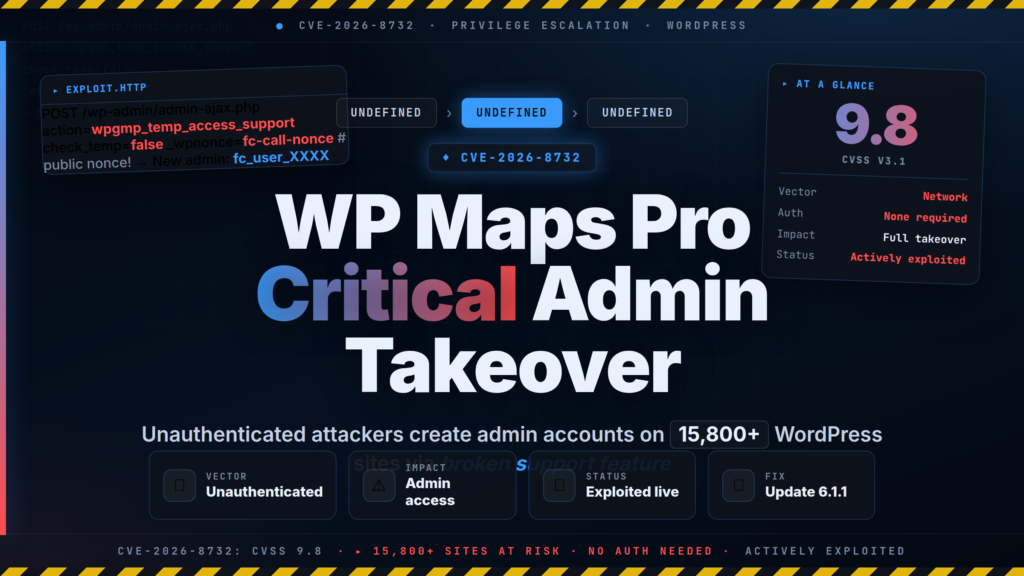
CVE-2026-8732 (a critical unauthenticated privilege-escalation vulnerability in the WP Maps Pro WordPress plugin) is under active exploitation, with attackers creating rogue administrator accounts on sites that have not yet patched to version 6.1.1. The flaw carries a CVSS v3.1 score of 9.8 (Critical — the top rating on the scale, indicating the vulnerability is remotely exploitable with no authentication or user interaction required), and Wordfence researchers blocked more than 3,600 exploitation attempts in a single 24-hour window following public disclosure on May 29, 2026.
// 01 CVE-2026-8732: Technical Details
CVE-2026-8732 affects WP Maps Pro, a premium WordPress plugin developed by Flipper Code (weplugins.com) and sold through Envato Market. It is classified under CWE-306 (Missing Authentication for Critical Function) — meaning a sensitive code path that should be protected behind a login wall can be reached by any anonymous visitor.
CVSS v3.1 vector: AV:N/AC:L/PR:N/UI:N/S:U/C:H/I:H/A:H
Breaking down what each component means for real-world risk:
- AV:N (Attack Vector: Network) — the attacker does not need physical access or a foothold on the same network; the exploit works over the open internet
- AC:L (Attack Complexity: Low) — no special timing, race conditions, or prior knowledge of the target site required
- PR:N (Privileges Required: None) — zero existing privileges on the WordPress site needed
- UI:N (User Interaction: None) — no administrator action is required to trigger the vulnerability
- C:H / I:H / A:H — complete compromise of confidentiality, integrity, and availability once exploited
The vulnerability lives inside WP Maps Pro's "temporary support access" feature, a mechanism designed to let Flipper Code's support staff log into customer sites for troubleshooting. The implementation has two interacting flaws that together create a completely open exploit path.
First, the AJAX handler wpgmp_temp_access_ajax_callback() is registered using WordPress's wp_ajax_nopriv_ hook — the hook explicitly reserved for endpoints that unauthenticated users can call. Any competent WordPress plugin developer registering a support-access feature should use wp_ajax_ instead, which enforces an existing authenticated session. Second, the only access control present is a nonce check using the fc-call-nonce value, but this nonce is embedded in the page's frontend JavaScript via wp_localize_script, making it publicly visible to any visitor of the site. The nonce prevents replay attacks in theory, but provides no authentication control whatsoever.
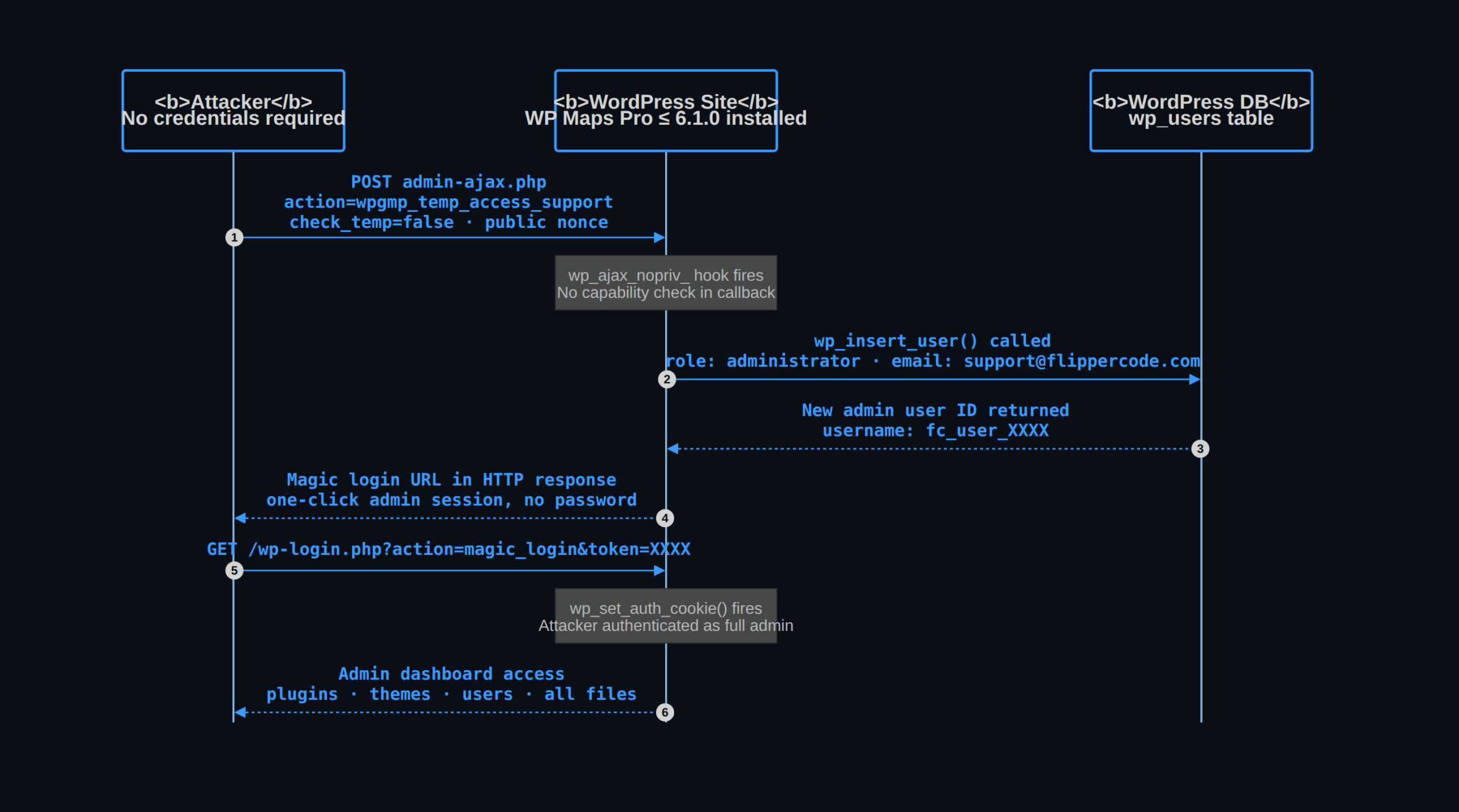
The complete attack sequence requires a single HTTP request:
POST /wp-admin/admin-ajax.php HTTP/1.1
Host: target-wordpress-site.com
Content-Type: application/x-www-form-urlencoded

action=wpgmp_temp_access_support&check_temp=false&_wpnonce=<public_nonce>
The plugin's callback calls wp_insert_user() with a hardcoded administrator role, creates a new account with a randomized username prefixed fc_user_ and the email support@flippercode.com, generates a passwordless magic login URL, and returns it in the HTTP response. The attacker visits that URL, wp_set_auth_cookie() fires, and they are logged in as a full administrator — no password ever required.
Affected versions: All versions of WP Maps Pro through and including 6.1.0.
Patched version: 6.1.1, released May 20, 2026. The fix adds a current_user_can('administrator') capability check before the handler executes. The updated plugin is available on Envato Market (CodeCanyon).
// 02 Exploitation Status and Threat Landscape
CVE-2026-8732 is under confirmed active exploitation. Wordfence researchers recorded over 3,600 blocked exploitation attempts within 24 hours of the May 29, 2026 public disclosure — a rate characteristic of automated mass-scanning tools systematically probing every reachable WordPress site for the vulnerable endpoint.
No standalone PoC (Proof-of-Concept — working exploit code published publicly) has been released, but the attack mechanism is fully documented across multiple security advisories, and reproduction requires only basic HTTP request crafting skills. The barrier to exploitation is effectively zero for any attacker with awareness of the vulnerability.
Exploitation is opportunistic and untargeted. No named threat actor or criminal group has been linked to the campaign. The timing pattern — exploitation spiking within hours of disclosure — is consistent with automated tools that monitor security feeds and immediately begin scanning whenever a new unauthenticated vulnerability is published.
CVE-2026-8732 is not currently listed on the CISA KEV catalog (U.S. Cybersecurity and Infrastructure Security Agency's Known Exploited Vulnerabilities list — inclusion on this list confirms active exploitation and triggers mandatory patching deadlines for U.S. federal agencies), but the exploitation volume observed by Wordfence suggests a KEV listing is possible if exploitation continues.
Wordfence firewall coverage:
- Premium, Care, and Response customers: firewall rule deployed May 18, 2026 (before public disclosure)
- Free Wordfence users: firewall rule scheduled for June 17, 2026 — meaning free-tier users remain unprotected by Wordfence alone for nearly three more weeks
// 03 Who Is Affected
WP Maps Pro is a commercial plugin with approximately 15,800 purchases at the time of disclosure — a floor estimate, as purchases do not equal live installations. Because the plugin is distributed through Envato Market rather than the free WordPress.org repository, no precise active-install count is available.
All WordPress sites running WP Maps Pro at version 6.1.0 or earlier are vulnerable. Any site reachable from the internet — which describes most WordPress deployments — is at immediate risk. The exploit requires no knowledge of the target site beyond its URL.
Typical users of a premium Google Maps integration plugin include e-commerce platforms, real estate listings sites, restaurant and hospitality businesses, event directories, and any organization embedding interactive maps in WordPress content.
// 04 What You Should Do Right Now
- Check your plugin version now. In the WordPress admin panel, go to Plugins > Installed Plugins and confirm the version number for WP Maps Pro.
- Update to WP Maps Pro 6.1.1 immediately. Log in to your Envato Market account, download version 6.1.1, and install it via Plugins > Add New > Upload Plugin. This is the only complete remediation.
- Audit administrator accounts. Navigate to Users > All Users, filter by Administrator role, and look for any accounts with usernames starting
fc_user_or with the emailsupport@flippercode.com. Delete any you did not create. - Check access logs for exploitation attempts. Look for POST requests to
wp-admin/admin-ajax.phpwith the parameteraction=wpgmp_temp_access_support. Any hit indicates your site was targeted. - Run a malware scan. If your site was running a vulnerable version during the exploitation window (after May 29), treat it as potentially compromised. Use Wordfence, Sucuri, or your hosting provider's malware scanner to check for backdoors or malicious plugins installed by a rogue administrator.
- Restore from a clean backup if compromise is confirmed. If you find a backdoor or cannot verify your site is clean, restore from a pre-exploitation backup and apply the patch before bringing the site back online.
# Detect rogue fc_user_ admin accounts via WP-CLI
wp user list --role=administrator --field=user_login | grep "^fc_user_"

# Search for PHP files modified in the last 7 days
find /var/www/html/wordpress -name "*.php" -mtime -7 -ls
// 05 Background: Understanding the Risk
Unauthenticated privilege escalation is among the most critical classes of WordPress vulnerability because it requires nothing from the target site's legitimate users. There is no phishing component, no social engineering, and no need to exploit a browser or email client. The attacker interacts directly with the web server.
The specific failure mode here — a vendor "support backdoor" implemented with broken access controls — is a recurring pattern in commercial WordPress plugins. Flipper Code's intent was presumably benign: remote support saves time for both vendor and customer. But the implementation registered a capability-granting function under wp_ajax_nopriv_, WordPress's hook for public, unauthenticated AJAX calls. This single incorrect choice negated every other protection.
WordPress's AJAX system is an area where developers consistently make this mistake. The wp_ajax_nopriv_ hook exists for genuinely public functions — things like loading public search results or submitting contact forms. Functions that modify site configuration, create users, or grant access must use wp_ajax_ exclusively, which enforces an active authenticated session before the callback fires.
The 30-day gap between Flipper Code releasing the patch (May 20) and Wordfence's public disclosure (May 29) is the standard responsible disclosure window. During that window, Wordfence Premium users were protected by a firewall rule while others were not. That 30-day coordination window did not prevent mass exploitation — it simply moved the exploitation onset to the moment of public disclosure rather than before the patch. For premium plugin users, this underscores the value of maintaining plugin update disciplines: the patch was available for nine days before exploitation began.
WP Maps Pro is not an isolated case. Wordfence's vulnerability database tracks thousands of WordPress plugin CVEs per year, and unauthenticated privilege-escalation vulnerabilities appear in multiple plugins annually. With over 43% of all websites running WordPress, and tens of thousands of available plugins, the aggregate plugin attack surface is enormous. Commercial plugins — distributed outside the WordPress.org repository — often receive less community scrutiny and slower security response than popular free plugins, making them a disproportionately attractive target.
// 06 Conclusion
CVE-2026-8732 is a CVSS 9.8 unauthenticated vulnerability under live exploitation right now. WordPress administrators running WP Maps Pro must update to version 6.1.1 immediately, audit user accounts for rogue administrators, and treat any site that was exposed during the exploitation window as potentially compromised until a clean audit confirms otherwise.
For any query contact us at contact@cipherssecurity.com