
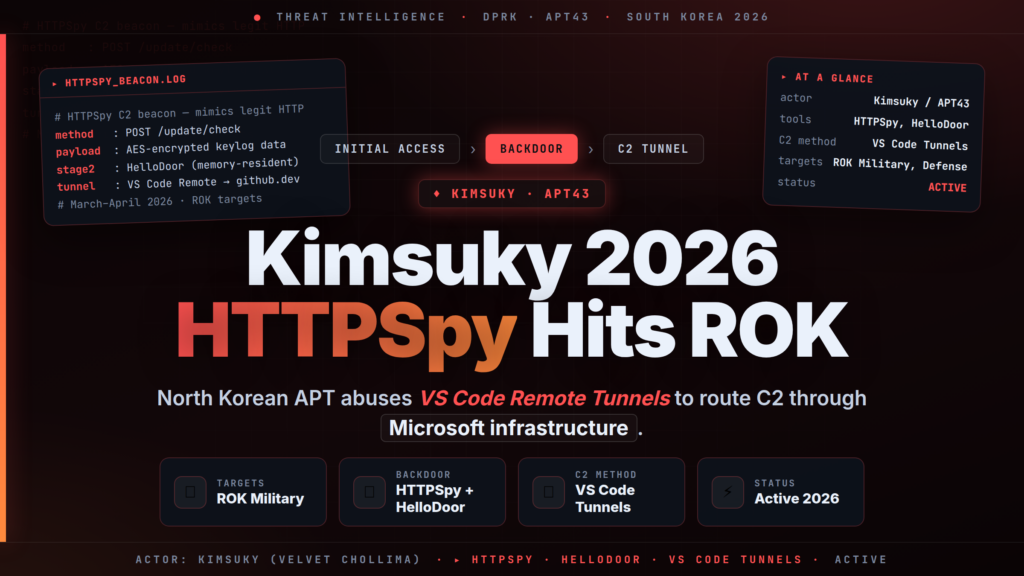
Kimsuky (also tracked as Velvet Chollima and APT43 — a North Korean state-sponsored threat actor operating under the Reconnaissance General Bureau, Pyongyang's primary foreign intelligence service), ran a targeted intrusion campaign between March and April 2026 against South Korean military personnel, defense contractors, and government-affiliated research institutions. The campaign, documented by Genians Security Center and reported by The Hacker News on May 29, 2026, introduced two new custom implants — HTTPSpy and HelloDoor — alongside a novel abuse of Microsoft's VS Code Remote Tunnels feature to route command-and-control traffic through trusted Microsoft and GitHub infrastructure.
// 01 Kimsuky: Technical Details of HTTPSpy and HelloDoor
The Kimsuky operators deployed two distinct backdoors across this campaign, each serving a different phase of the intrusion lifecycle.
HTTPSpy is a newly identified first-stage backdoor that communicates exclusively over HTTP and HTTPS, deliberately blending its traffic with normal web browsing. Rather than using dedicated ports or unusual protocols that would flag in firewall logs, HTTPSpy crafts requests that mimic legitimate software update checks — POST requests to attacker-controlled domains using standard browser-like headers. Once established, it delivers four core capabilities:
- File exfiltration: harvests documents, credentials, and configuration files and transmits them to the C2 (command-and-control — the attacker's remote server used to issue instructions to compromised machines) server in encrypted form
- Keylogging (MITRE ATT&CK T1056.001 — input capture via keyboard hook, recording every keystroke the victim types): intercepts credentials, authentication tokens, and sensitive communications in real time
- Screenshot capture (T1113 — periodic or on-demand capture of the victim's screen contents): provides the operator with visual confirmation of what the victim is doing
- Remote command execution (T1059 — use of system scripting interpreters such as cmd.exe or PowerShell to run attacker-supplied commands): gives the operator shell-level control of the host
HelloDoor is the second-stage full-featured backdoor deployed after HTTPSpy establishes initial foothold. Its defining characteristic is that it operates entirely in memory — it never writes a payload binary to disk. This memory-resident execution model (a technique designed specifically to defeat antivirus and EDR products that rely on scanning files on disk) makes HelloDoor significantly harder to detect than conventional implants. Capabilities include arbitrary command execution, bidirectional file transfer, and process enumeration and management. For a comparable North Korean memory-resident implant strategy, see the Lazarus Group's RemotePE RAT, which also avoids disk writes to survive endpoint detection.
The combination is deliberate: HTTPSpy handles initial staging and reconnaissance while HelloDoor lands as an in-memory payload, ensuring the most sensitive operational phase leaves the smallest possible forensic trace.
// 02 VS Code Tunnel Abuse: C2 Through Trusted Infrastructure
The most operationally novel technique in this Kimsuky campaign is the abuse of VS Code Remote Tunnels — a legitimate developer feature built into Microsoft Visual Studio Code that allows developers to connect to a remote machine through Microsoft's cloud relay infrastructure, using their GitHub or Microsoft account for authentication.
Attackers install a legitimate copy of VS Code on the victim's machine (via the initial access vector described below), then invoke the built-in tunnel feature:
code tunnel --accept-server-license-terms
This creates an authenticated tunnel from the victim's host back through Microsoft's servers at global.rel.tunnels.api.visualstudio.com. The attacker, logged in with an attacker-controlled GitHub account on a separate machine, connects to this tunnel as if it were a remote development session. From the network's perspective, all outbound traffic from the victim appears to be normal HTTPS communication with .visualstudio.com and .github.com — two domains that almost universally appear in corporate allow-lists.
The technique maps to MITRE ATT&CK T1572 (Protocol Tunneling — encapsulating C2 traffic inside a legitimate protocol to bypass network controls) and T1102 (Web Service Abuse — using a trusted third-party service as a C2 relay to make detection harder).
The result: perimeter firewalls, next-generation proxies, and DNS filtering solutions that rely on domain reputation see nothing but benign Microsoft developer traffic. Only behavioral analysis — specifically, detecting an interactive VS Code tunnel being established by a non-developer process or user account — has a realistic chance of catching this technique at the network layer.
The following sequence diagram shows the full attack chain from initial delivery through VS Code tunnel-based C2:
%% caption: Kimsuky 2026 — HTTPSpy + HelloDoor + VS Code Tunnel C2 chain (March–April 2026, ROK targets)
sequenceDiagram
  autonumber
  participant A as Attacker<br/>(DPRK / Kimsuky)
  participant V as Victim Host<br/>(ROK Military / Defense)
  participant MS as Microsoft / GitHub<br/>(VS Code Tunnel Relay)
  participant C2 as Attacker C2 Session<br/>(GitHub-authed browser)

  Note over A,V: T1566.001 · Spearphishing Attachment<br/>Job offer / gov form lure email sent to ROK target
  A->>V: Deliver malicious installer or<br/>weaponised document (March–April 2026)
  Note over V: T1059 · Command/Scripting Interpreter<br/>Macro or fake installer drops HTTPSpy first-stage
  V->>V: HTTPSpy executes in userspace,<br/>mimics HTTP update-check traffic
  Note over V,A: T1056.001 Keylogging + T1113 Screen Capture<br/>HTTPSpy harvests credentials and screenshots
  V->>A: Encrypted keylog/screenshot data<br/>exfiltrated via HTTPS POST
  Note over A: Operator confirms access,<br/>delivers HelloDoor second stage
  A->>V: HelloDoor injected into memory<br/>(never written to disk — evades AV/EDR)
  Note over V: T1572 Protocol Tunneling + T1102 Web Service Abuse<br/>VS Code installed silently; tunnel authenticated via attacker GitHub account
  V->>MS: code tunnel --accept-server-license-terms<br/>Outbound HTTPS to *.visualstudio.com (trusted domain)
  MS-->>C2: Tunnel relay established<br/>Traffic indistinguishable from dev tooling
  Note over C2,MS: Attacker now has interactive shell<br/>via GitHub-authenticated VS Code session
  C2->>V: Full bidirectional C2 over tunnel:<br/>file transfer, process mgmt, command execution
This chain illustrates why the campaign is particularly difficult to disrupt at any single control point: the initial delivery exploits human trust (spearphishing), the first-stage implant hides in normal web traffic, and the second-stage C2 routes through an infrastructure provider that most organisations explicitly trust.
// 03 Social Engineering and Initial Access
Kimsuky's initial access tradecraft (T1566.001 — Spearphishing Attachment, delivering malicious files via targeted email) in this campaign followed three documented lure patterns:
- Job offer emails: Messages impersonating South Korean defense industry recruiters or Korean-language job portals, carrying attached documents purporting to be application forms. Opening the document triggers macro or template injection execution.
- Government form impersonation: Emails mimicking official correspondence from South Korean government agencies, including realistic formatting and sender spoofing of trusted Korean organizations. Attachments present as tax forms, personnel questionnaires, or security compliance surveys.
- Fake software update installers: Trojanized installers disguised as updates for common Korean-language productivity or security software. These execute silently while displaying a fake update progress bar, installing both the legitimate software and the HTTPSpy loader.
All three lure types are consistent with Kimsuky's long-established pattern of conducting research on specific individuals before targeting — selecting lure content that is directly relevant to the target's role and organisation. This targeted approach, rather than mass distribution, is what classifies these operations as spear-phishing rather than generic phishing.
// 04 Who Is Affected
Genians Security Center's research identifies three primary victim categories in this campaign:
- South Korean military personnel: active-duty members and veterans with access to defence planning or operations documents
- Defense contractors: private-sector organisations holding classified or sensitive contracts with the South Korean military and Ministry of National Defense
- Government-affiliated research institutions: think tanks, policy institutes, and academic centers with ties to national security and foreign policy — a long-standing Kimsuky targeting priority
The geographic and sectoral focus is consistent with Kimsuky's established intelligence collection mandate: gathering military, political, and technical information to support North Korea's strategic decision-making. For comparison, the BlueNoroff fake Zoom malware campaign (a separate DPRK-affiliated cluster) focused on financial targets; Kimsuky's remit is squarely intelligence collection against political and military entities.
Organisations outside South Korea that partner with Korean defense or government entities — particularly those in the US, Japan, and Europe involved in joint exercises or technology transfer — should treat themselves as secondary targeting risk.
// 05 What You Should Do Right Now
- Block or restrict VS Code tunnel functionality at the endpoint. Disable the
code tunnelcommand for non-developer user accounts via application control policies (e.g., AppLocker or WDAC on Windows). At the network layer, consider blocking outbound connections toglobal.rel.tunnels.api.visualstudio.comfrom servers and workstations that have no legitimate developer use case.
- Deploy behavioral detection for in-memory implants. HelloDoor's memory-only execution model evades signature-based AV. Enable memory scanning in your EDR (Endpoint Detection and Response) platform, and configure alerts for unusual process injection patterns — specifically, processes injecting into
explorer.exe,svchost.exe, or browser processes without a corresponding on-disk binary.
- Audit outbound HTTPS traffic to Microsoft and GitHub infrastructure. A VS Code tunnel from an endpoint that has no developer software installed, or that is used by a non-technical staff member, is a strong anomaly indicator. Use your proxy or CASB (Cloud Access Security Broker) logs to baseline which hosts legitimately communicate with
*.visualstudio.comand alert on deviations.
- Harden spearphishing defenses for high-value individuals. Enforce macro blocking via Group Policy (disable VBA macros in all Office documents not originating from the organisation's own SharePoint or intranet). Implement DMARC, DKIM, and SPF on all domains to reduce sender spoofing success. Train personnel in roles that match Kimsuky's victimology (defence, policy, research) to treat unsolicited job offer and government-form emails as high-suspicion.
- Threat-hunt for HTTPSpy indicators. Search proxy and firewall logs for POST requests to unusual domains with update-check style URI paths (e.g.,
/update/check,/client/sync,/status/report) from endpoints that are not running update manager software. Correlate with DNS queries to recently registered or low-reputation domains.
- Review GitHub and Microsoft account access from corporate endpoints. Unusual GitHub authentication events — particularly OAuth device-code flows or new device registrations from corporate IP ranges — may indicate an attacker establishing the GitHub account link required for VS Code tunnel authentication.
// 06 Background: Understanding the Kimsuky Threat
Kimsuky has operated since at least 2012, when early variants of its malware were identified targeting South Korean think tanks. The group operates under the RGB (Reconnaissance General Bureau — North Korea's primary external intelligence apparatus, roughly analogous to a combined CIA and DIA), giving it state resources, operational cover, and strategic tasking.
The group is tracked under multiple names across the industry: Kimsuky is the most widely used designation (originating from early Kaspersky research), while Mandiant and Google Threat Intelligence track the broader cluster as APT43, and CrowdStrike uses the codename Velvet Chollima. The group has historically specialised in long-term espionage rather than destructive attacks — its value to the North Korean state lies in the intelligence it collects, not in the disruption it causes.
Previous Kimsuky campaigns have demonstrated consistent investment in custom tooling. The group developed and iterated on the BabyShark malware framework over several years, regularly added new spearphishing lure themes aligned with current events (COVID-19 pandemic, inter-Korean summits, US policy changes), and was among the first DPRK-affiliated groups to abuse cloud services for C2. The VS Code tunnel technique documented in this 2026 campaign is a logical evolution of that cloud-abuse trajectory — a pattern also visible in how state-sponsored groups route espionage traffic through trusted infrastructure to defeat network-layer controls.
The Ghostwriter campaign's Prometheus-based phishing infrastructure demonstrates that state actors across different geographies are converging on the same operational insight: trusted platforms and legitimate developer tooling are harder to block than dedicated C2 infrastructure.
// 07 Conclusion
Kimsuky's March–April 2026 campaign against South Korean military and defense targets demonstrates a clear maturation in the group's technical capabilities. HTTPSpy provides a low-visibility first-stage foothold; HelloDoor ensures the second stage leaves no disk artifacts; and VS Code Remote Tunnel abuse routes the entire C2 channel through infrastructure that most organisations' security controls are explicitly configured to trust. Organisations within the campaign's victimology — South Korean defense, government, and research entities, and their international partners — should treat VS Code tunnel restrictions and in-memory implant detection as immediate operational priorities, not future roadmap items.
Subscribe to the CiphersSecurity weekly threat digest to track Kimsuky and other DPRK-affiliated campaigns as new intelligence becomes available.
For any query contact us at contact@cipherssecurity.com