
HIPAA compliance for AI and ML systems now extends to every layer of your pipeline — from the PHI (Protected Health Information — any individually identifiable health data, including names, dates of birth, diagnoses, and medical record numbers) you use to train models, to the prompts you send to a cloud LLM (Large Language Model) inference endpoint, to the logs those API calls generate. The U.S. Department of Health and Human Services (HHS) published its proposed HIPAA Security Rule amendment in January 2025, with the final rule expected in May 2026 and a 240-day compliance window; once that clock runs, previously "addressable" safeguards — including encryption — become mandatory with no exceptions. For healthcare CISOs and ML engineering leads building regulated AI products, this guide covers what the amendment changes, BAA requirements per AI vendor, PHI handling in training pipelines, de-identification techniques, audit logging standards, and the Minimum Necessary Rule applied to prompt construction.
// 01 HIPAA Compliance AI ML Systems: What the 2025 Security Rule Amendment Changes
The HIPAA Security Rule has historically divided implementation specifications into two tiers: "required" (must implement exactly as written) and "addressable" (implement, document a rationale for not implementing, or adopt an equivalent alternative). The 2025 proposed amendment published in the Federal Register eliminates that distinction. HHS stated in the rulemaking notice that some covered entities and business associates (BAs — vendors that process PHI on behalf of a covered entity) had incorrectly interpreted "addressable" as "optional," resulting in pervasive gaps: unencrypted backup media, absent audit trails, and credentials that never rotated.
Under the amended rule, all implementation specifications become mandatory unless a specific narrow exception applies. The practical impact on AI/ML deployments:
- Encryption of ePHI at rest and in transit moves from addressable to required. This closes the gap where teams argued that on-premises model weights containing derived patient representations did not need encryption because the specification was merely "addressable."
- Multi-factor authentication (MFA) for any system accessing ePHI becomes mandatory — including API keys used by ML training pipelines. A service account calling an inference endpoint with PHI in the prompt must authenticate through MFA-gated key management, not a static secret stored in a
.envfile or CI/CD variable. - Biannual automated vulnerability scanning and annual penetration testing are now required for all systems that process ePHI. AI model servers, vector databases storing patient embeddings, and managed inference endpoints are explicitly in scope.
- Network segmentation is required. The rule directly names isolation of ePHI-processing systems from general-purpose networks — a response to incidents where flat network architectures let attackers pivot from compromised developer workstations into ePHI data stores.
According to Medcurity's 2026 HIPAA Security Rule update analysis, the final rule is expected in May 2026 with a 240-day implementation window. Teams building healthcare AI should treat these requirements as effective today — not as a future obligation.
// 02 PHI in Machine Learning Pipelines: Scope and Data Governance
The first question every ML team working with clinical data asks is whether HIPAA applies to their training pipeline. HHS guidance is unambiguous: ePHI maintained by a covered entity or BA as part of AI training data, prediction models, or algorithm datasets falls within the HIPAA Security Rule's scope. The fact that data has been transformed into embeddings or statistical representations does not automatically remove it from HIPAA coverage.
What constitutes PHI in an AI/ML context:
| Data Type | PHI? | Notes |
|---|---|---|
| Raw EHR records in training set | Yes | Classic ePHI — always in scope |
| Patient embeddings (vector representations) | Yes | If re-identifiable to a reasonable standard |
| Model weights trained exclusively on PHI | Treat as Yes | HHS has not yet issued specific guidance; treat as in scope pending clarification |
| Correctly de-identified training data | No | Loses HIPAA coverage only if Safe Harbor or Expert Determination methods were properly applied |
| Inference prompts containing name, DOB, or diagnosis | Yes | The prompt text is ePHI the moment it includes an identifier |
| System logs capturing prompts that contained PHI | Yes | Logs inherit the PHI classification of the data they record |
| Aggregate, fully anonymized population statistics | No | No individual is identifiable |
The most dangerous gap is log inheritance. Teams instrument inference calls for observability, their logging pipeline captures full prompt text, and suddenly a Splunk, Datadog, or OpenTelemetry workspace holds ePHI under weak access controls with no retention policy aligned to HIPAA's six-year requirement. Every ML observability tool in your stack must be evaluated for HIPAA compatibility before a single prompt containing PHI reaches it.
// 03 Business Associate Agreements with AI Vendors: OpenAI, Anthropic, Google
A Business Associate Agreement (BAA) is the contractual instrument that extends HIPAA's Security and Privacy Rule obligations to a vendor that creates, receives, maintains, or transmits ePHI on your behalf. Without a signed BAA, sending PHI to an AI provider is a HIPAA violation regardless of the vendor's internal security posture — and sending PHI to a product tier the vendor explicitly excludes from BAA coverage is equally prohibited.
BAA coverage in 2026 varies materially across product tiers, features, and sub-processor chains. The following is based on current vendor documentation and enterprise agreements as of Q2 2026.
OpenAI
OpenAI signs BAAs for the API (via the Data Processing Addendum / Privacy Addendum) and ChatGPT Enterprise. The following tiers are not BAA-eligible and cannot be used with PHI under any circumstances: ChatGPT Free, ChatGPT Plus, ChatGPT Team, and any OpenAI product accessed through the consumer web interface at chat.openai.com. OpenAI's enterprise privacy documentation confirms that enterprise API customers are not used for training general models by default.
# Verify your API key is associated with a BAA-eligible organization
curl https://api.openai.com/v1/organizations
  -H "Authorization: Bearer $OPENAI_API_KEY" | jq '.data[].settings.privacy_level'
# BAA-eligible orgs typically reflect enterprise-tier configuration
Anthropic (Claude)
Anthropic offers a HIPAA-ready Enterprise plan covering the Claude API. This is a sales-assisted offering — you must contact Anthropic enterprise sales rather than self-provisioning through the console. Paubox documents Anthropic's healthcare positioning, confirming that Claude for Healthcare operates under BAAs through three cloud platforms: AWS Bedrock, Google Cloud Vertex AI, and Microsoft Azure. These platform-side BAAs are the faster path to production for most healthcare engineering teams.
Explicitly excluded from BAA coverage: Claude Free, Claude Pro, Claude Max, Claude Team, Claude Workbench, Claude Console, and all consumer-tier Claude access. The Anthropic API accessed directly without an enterprise agreement is not HIPAA-covered.
Google Cloud
Vertex AI and the Google Healthcare API operate under the Google Cloud Healthcare BAA. The Medical Imaging Suite and Healthcare Natural Language API have additional purpose-built provisions. Consumer-tier Google products — Gemini in personal Google accounts, free-tier Google Workspace, and Google Search — are not covered and must not be used with PHI.
AWS Bedrock
AWS signs a BAA covering HIPAA Eligible Services, which includes Amazon Bedrock — the managed inference service hosting Claude (Anthropic), Llama, Titan, and other foundation models. This is often the lowest-friction path for healthcare teams already operating under an AWS BAA for other workloads. Verify that the specific Bedrock foundation model you intend to deploy appears on the HIPAA Eligible Services list — not every available model is covered.
Critical clause to require in every BAA:
Business Associate shall not use or disclose PHI for any purpose other than
performing the Services described in this Agreement and shall not use inputs
containing PHI to train, fine-tune, or improve Business Associate's general
AI models without explicit written consent.
Without this no-training clause, your PHI may enter the provider's global training loop — a direct HIPAA violation that no BAA automatically prevents unless the prohibition is explicit.
// 04 PHI De-identification for Training Data
HIPAA provides two legally recognized methods for de-identifying PHI so it loses protected status and can be used freely in training datasets.
Safe Harbor De-identification (§164.514(b))
Remove all 18 identifiers from the dataset and confirm no residual knowledge that the data can identify an individual:
# The 18 HIPAA Safe Harbor identifiers — all must be removed
HIPAA_18_IDENTIFIERS = [
    "names",               # First, last, middle, initials, suffix
    "geographic_data",     # All subdivisions smaller than state, except first 3 ZIP digits
    "dates",               # All dates except year; all dates for individuals age ≥ 90
    "phone_numbers",
    "fax_numbers",
    "email_addresses",
    "ssn",                 # Social Security Numbers
    "mrn",                 # Medical record numbers
    "health_plan_numbers",
    "account_numbers",
    "cert_license_numbers",
    "vehicle_identifiers", # License plate numbers, VINs
    "device_identifiers",  # Serial numbers, device IDs
    "web_urls",
    "ip_addresses",
    "biometric_ids",       # Fingerprints, voiceprints, retina scans
    "full_face_photos",    # And comparable images
    "unique_identifiers",  # Any other unique identifying number or code
]
Safe Harbor is rule-based and deterministic but coarse — it does not account for quasi-identifiers. Combinations of age, ZIP code, and diagnosis can uniquely identify a patient in a sparse-population county, even after all 18 identifiers are stripped.
Expert Determination (§164.514(b)(1))
A qualified statistical or scientific expert applies generally accepted principles and certifies that the re-identification risk is very small. This method is required when your training set is small, geographically specific, or covers rare diagnoses where the population is inherently identifiable.
Practical open-source tooling:
# Microsoft Presidio — NER-based PHI detection and redaction
from presidio_analyzer import AnalyzerEngine
from presidio_anonymizer import AnonymizerEngine

analyzer = AnalyzerEngine()
anonymizer = AnonymizerEngine()

clinical_note = "Patient John Smith, DOB 03/15/1972, MRN 8827441, presented with chest pain..."

results = analyzer.analyze(
    text=clinical_note,
    language="en",
    entities=["PERSON", "DATE_TIME", "MEDICAL_LICENSE",
              "US_SSN", "US_DRIVER_LICENSE", "IP_ADDRESS",
              "EMAIL_ADDRESS", "PHONE_NUMBER", "LOCATION"]
)
anonymized = anonymizer.anonymize(text=clinical_note, analyzer_results=results)
print(anonymized.text)
# Output: "Patient [PERSON], DOB [DATE_TIME], MRN [MEDICAL_LICENSE], presented with chest pain..."
Microsoft Presidio (Apache 2.0) is the most widely deployed open-source PHI detector in production healthcare ML pipelines. For higher recall on clinical entity types — medication names used as context, procedure codes, and facility-specific identifiers — pair Presidio with a medical NER model such as spaCy's en_core_sci_lg or allenai/scibert_scivocab_uncased.
// 05 Technical Safeguards: Encryption, Access Controls, and Network Architecture
The amended Security Rule mandates specific technical controls that translate directly to infrastructure requirements for AI/ML stacks:
Encryption:
- ePHI at rest: AES-256 per NIST SP 800-111. Applies to training data stores, model checkpoints trained on PHI, vector databases containing patient embeddings (e.g., Pinecone, Weaviate, pgvector collections), and inference logs.
- ePHI in transit: TLS 1.2 minimum, TLS 1.3 recommended. Every API call carrying PHI — including calls to OpenAI, Anthropic, Bedrock, and Vertex AI endpoints — must use TLS with certificate validation. Disable TLS 1.0 and 1.1 at the load balancer or API gateway.
Access controls:
- Unique user and service identities for every human and non-human principal accessing ePHI systems. No shared service accounts.
- MFA for all access. For pipeline service accounts, API keys must be issued from a secrets manager (AWS Secrets Manager, HashiCorp Vault) gated by IAM roles that require MFA for human control-plane access. Rotate API keys every 90 days maximum.
- RBAC (Role-Based Access Control) with least-privilege scoping. An ML engineer training a diagnostic model needs read access to the training dataset — not write access to the production EHR.
Network segmentation — the PHI firewall pattern:
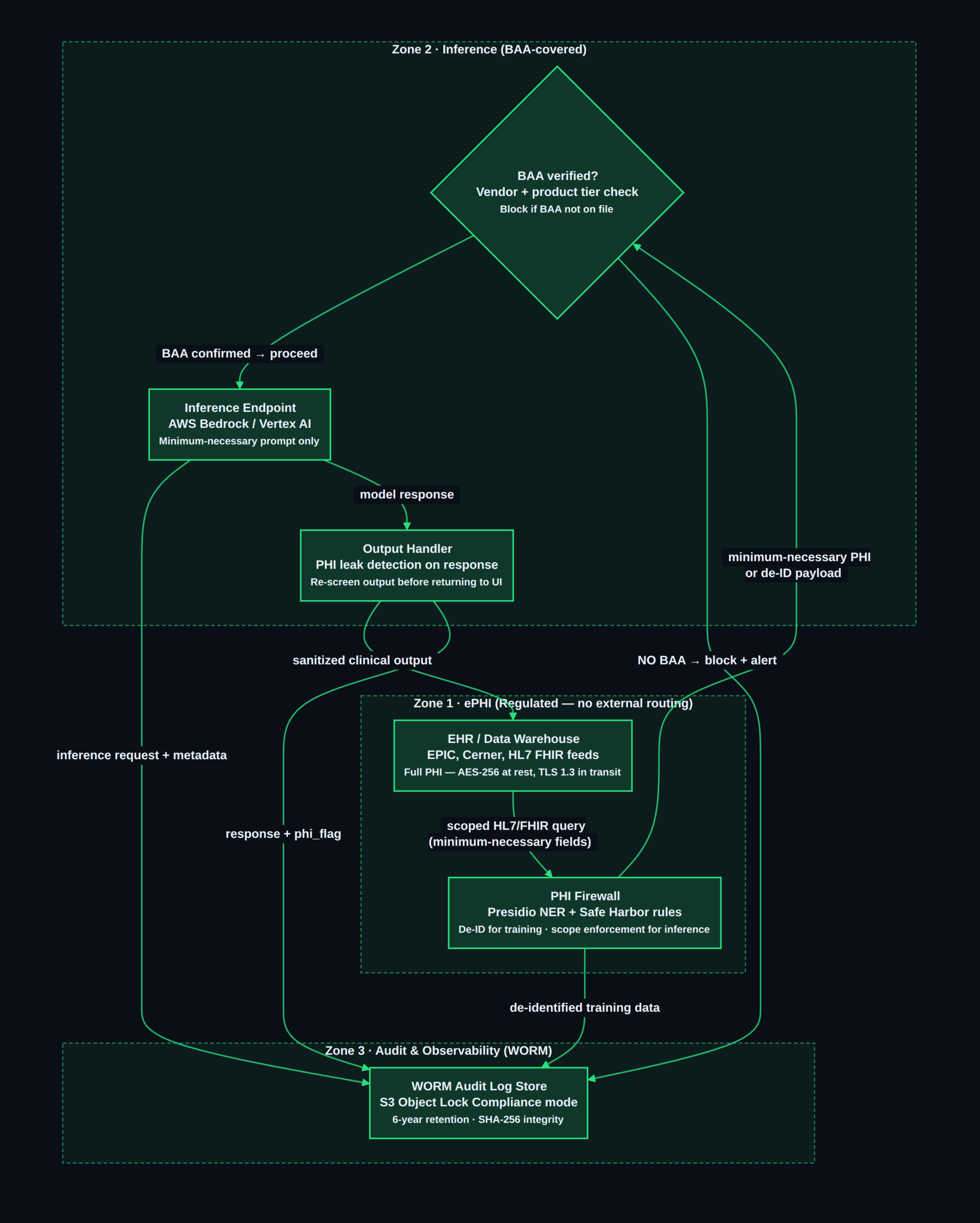
The PHI firewall sits between Zone 1 and Zone 2. Nothing crosses the zone boundary without passing through it.
// 06 Audit Logging for AI Inference Calls
Inference-level audit logging is one of the most underspecified areas in healthcare AI compliance programs. Many teams capture model inputs and outputs in general-purpose observability stacks without assessing whether those stacks meet HIPAA's audit controls requirements (§164.312(b)) or retain data for the mandated six years.
Required fields per inference audit record:
| Field | Description | Example |
|---|---|---|
timestamp | ISO 8601 with timezone | 2026-05-28T14:32:01.221Z |
request_id | Unique ID for correlation | req_7f3a1bc9d2e4 |
user_identity | Authenticated clinician or service | clinician:dr.jones@hospital.org |
patient_pseudonym | Hashed MRN — not raw PHI in the log key | MRN-HASH-4a3f8c1b… |
model_id | Exact model version | anthropic.claude-3-7-sonnet-v1 |
phi_flag | Whether prompt contained PHI | true |
prompt_hash | SHA-256 of prompt (not plaintext if PHI present) | a4b8c2d1e3f5… |
output_classification | Clinical / non-clinical | clinical-summary |
authorization_chain | For agentic calls: approving clinician | physician-on-call:dr.patel@hospital.org |
Storage requirements:
- Retention: 6 years minimum under HIPAA Privacy Rule §164.530(j).
- Tamper-evident: WORM (Write-Once, Read-Many) storage. AWS S3 Object Lock in Compliance mode, or Azure Immutable Blob Storage. Logs must not be modifiable or deletable by any user — including administrators — during the retention period.
- Integrity verification: SHA-256 checksums applied to log batches at write time and verified on a schedule. Document verification results in your HIPAA audit control records.
import hashlib, json, boto3
from datetime import datetime, timezone

def write_inference_audit_log(event: dict, bucket: str, prefix: str) -> None:
    """Write a tamper-evident inference audit log to S3 with Object Lock."""
    event["timestamp"] = datetime.now(timezone.utc).isoformat()
    raw = json.dumps(event, sort_keys=True).encode()
    event["record_hash"] = hashlib.sha256(raw).hexdigest()

    s3 = boto3.client("s3")
    key = f"{prefix}/{event['timestamp'][:10]}/{event['request_id']}.json"
    s3.put_object(
        Bucket=bucket,
        Key=key,
        Body=json.dumps(event),
        ObjectLockMode="COMPLIANCE",
        # 6-year retention from write date
        ObjectLockRetainUntilDate=datetime(2032, 6, 1, tzinfo=timezone.utc),
        ContentType="application/json",
    )
Note: The ObjectLockRetainUntilDate should be computed dynamically in production as write_date + 6 years, not a static future date.
// 07 Minimum Necessary Principle for Prompts and Agent Access
The HIPAA Privacy Rule's Minimum Necessary standard (§164.502(b)) requires that covered entities and their BAs access, use, or disclose only the PHI reasonably necessary to accomplish the intended purpose. Applied to AI systems, this is the most common compliance failure pattern in healthcare ML.
The violation: An AI clinical decision support agent is provisioned with read access to the full EHR because scoping permissions per query type takes engineering effort. The agent retrieves a patient's complete medical history, insurance records, social history, and entire medication list to answer a question about whether a single antibiotic is contraindicated given a known penicillin allergy. More than 90% of the PHI accessed was unnecessary.
Compliant prompt engineering — Minimum Necessary in code:
# NON-COMPLIANT: sends full patient record to inference endpoint
def recommend_antibiotic_bad(patient_mrn: str) -> str:
    patient = ehr.get_full_record(patient_mrn)  # returns 400+ fields of ePHI
    prompt = f"Given this complete patient record: {patient}nRecommend an antibiotic for UTI."
    return llm.complete(prompt)

# COMPLIANT: Minimum Necessary principle — only the fields the model needs
def recommend_antibiotic_good(patient_mrn: str, drug_class: str) -> str:
    allergies = ehr.get_allergies(patient_mrn)                        # allergy list only
    contraindications = ehr.get_contraindications(patient_mrn, drug_class)  # drug-class scoped
    prompt = (
        f"Patient allergies: {allergies}. "
        f"Known contraindications for {drug_class}: {contraindications}. "
        f"Is {drug_class} safe? Answer yes/no with clinical rationale."
    )
    return llm.complete(prompt)
For agentic AI systems (AI agents that use tool calling or function calling to query EHR APIs autonomously), implement a PHI access broker that intercepts every tool call the agent makes and enforces field-level access controls based on the clinical task authorized at session start. The authorization chain — which clinician approved the session, for which patient, and for which clinical purpose — must appear in the audit log for every EHR access the agent performs during that session. See our analysis of why AI agents keep over-accessing production data stores for the failure modes this pattern prevents.
// 08 Vendor Risk Assessment for AI Tools
Every AI tool, library, or service that touches ePHI must go through your Third-Party Risk Management (TPRM) process before deployment. Standard security questionnaires are insufficient for AI-specific risks. Add the following questions to your vendor assessment:
| Assessment Question | Why It Matters |
|---|---|
| Does the vendor use API inputs to train global models? | Direct PHI leakage risk — must be prohibited in BAA |
| What is the vendor's data retention period for API inputs/outputs? | PHI lingering in vendor logs beyond your 6-year policy creates breach liability |
| List all sub-processors that handle ePHI | The indirect BAA chain must cover each sub-processor; a gap voids your coverage |
| Does the vendor support deletion of specific input records? | HIPAA Privacy Rule access and amendment rights require the ability to purge PHI inadvertently sent to a model |
| Does the vendor hold SOC 2 Type II with an AI-scoped trust services criteria? | Provides evidence of continuous security monitoring; see our SOC 2 Type II Compliance Checklist for the overlapping controls |
| Does the vendor publish model training data sourcing? | Helps assess whether model outputs might reflect improperly sourced data from other customers |
| What is the vendor's breach notification SLA? | HIPAA Breach Notification Rule requires notification within 60 days of discovery; vendor must inform you fast enough to meet that window |
Healthcare data breaches caused by third-party AI vendors are no longer hypothetical — the Medtronic incident demonstrated how third-party access chains create exposure that an organization's internal controls cannot fully address. Vendors who cannot definitively answer questions 1, 3, or 7 should not receive PHI until they can.
// 09 Conclusion
HIPAA compliance for AI and ML systems in healthcare is not a box to check — it is an operational discipline applied at every layer from data ingestion to inference output. The 2025 Security Rule amendment closes the "addressable equals optional" gap that has allowed encryption gaps and missing MFA to survive in production healthcare AI stacks. Every AI vendor you deploy needs a BAA that explicitly prohibits training on your inputs; consumer product tiers from OpenAI, Anthropic, and Google are excluded from BAA coverage regardless of internal policies. Apply the Minimum Necessary standard in prompt construction at the code level, instrument every inference call with tamper-evident WORM audit logs retained for six years, run PHI through Safe Harbor or Expert Determination de-identification before it reaches any model trained on general data, and segment your ePHI zone from your inference zone with a PHI firewall that enforces BAA verification on every outbound call.
Start with the PHI firewall pattern — it addresses the BAA verification failure, the Minimum Necessary violation, and the audit logging gap in a single architectural intervention.
See also our guide to AI agent production security for the agentic access patterns that most commonly trigger Minimum Necessary violations in clinical deployments.
For any query contact us at contact@cipherssecurity.com