
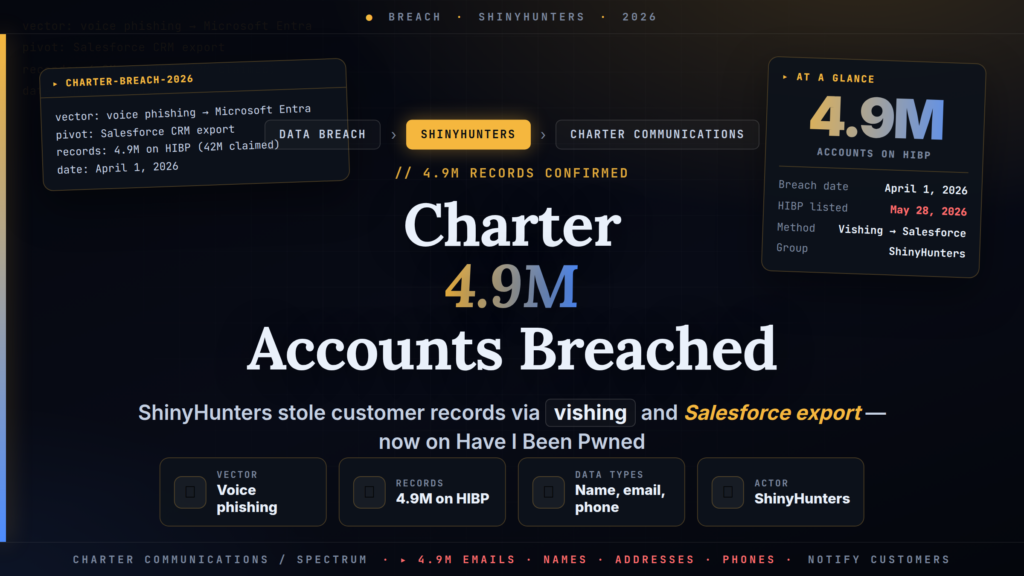
Charter Communications (the second-largest U.S. cable and internet provider, operating under the Spectrum consumer brand and serving approximately 32 million customers nationwide) confirmed in late May 2026 that the ShinyHunters extortion gang stole personal information from 4.9 million customer accounts after compromising the company through a voice phishing (vishing — a social engineering attack conducted over the phone rather than email) attack on April 1, 2026. The stolen dataset was added to Have I Been Pwned (HIBP — the authoritative public breach notification database maintained by security researcher Troy Hunt) on May 28, 2026, enabling affected customers to check their exposure. ShinyHunters initially claimed to have exfiltrated 42 million records — a figure that diverges sharply from Charter's confirmed count, leaving significant uncertainty about the full scope of the incident.
// 01 Charter Communications Data Breach: How the Attack Unfolded
The Charter Communications data breach followed a pattern increasingly common in 2026: voice phishing targeting employee credentials, followed by pivoting into cloud SaaS (Software as a Service — cloud-based business applications) infrastructure to exfiltrate customer data at scale.
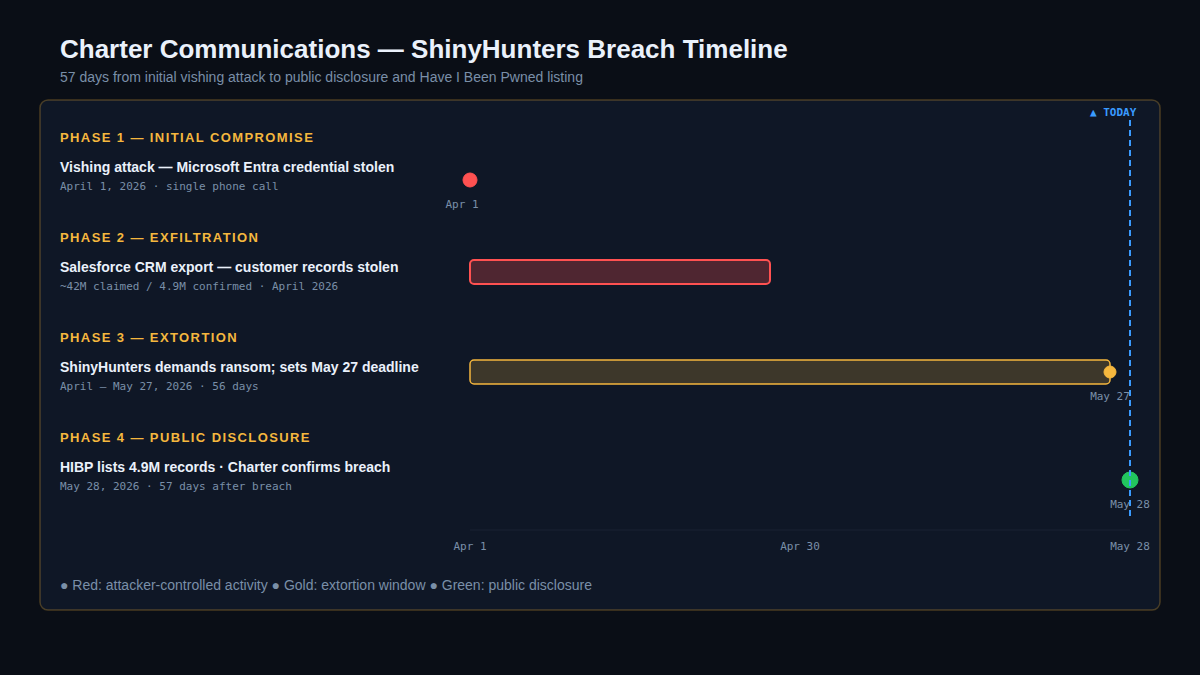
On April 1, 2026, ShinyHunters operators made phone calls to compromise a single Microsoft Entra (formerly Azure Active Directory — Microsoft's cloud identity and access management platform) account belonging to a Charter employee. Using the stolen credentials, the attackers accessed Charter's Salesforce CRM (Customer Relationship Management — the cloud platform Charter uses to manage customer accounts and support interactions) instance and exported millions of consumer and business customer records. The exfiltrated data was then transferred to attacker-controlled servers.
The attack required no malware, no vulnerability exploit, and no technical sophistication beyond the initial phone call. ShinyHunters' operators have refined this vishing-to-Salesforce pipeline across dozens of victims in 2025–2026, with the group claiming to have breached more than 1,000 organizations via compromised Salesforce environments.
Exposed data types confirmed in the HIBP listing:
- Full names
- Email addresses (4.9 million unique)
- Physical addresses
- Phone numbers and phone type information
- Account plan details
- Customer support ticket records
- Approximately 85,000 employee records from an internal directory, including job titles
Charter stated publicly that "no sensitive personal information (PI) or customer proprietary network information (CPNI — call records and service usage data that U.S. telecom providers are legally required to protect under FCC regulations) data was exfiltrated by the threat actor." However, the categories listed on HIBP — names, addresses, phone numbers, account details — constitute personal information under most U.S. state breach notification laws and EU GDPR (General Data Protection Regulation), regardless of how Charter classifies their regulatory sensitivity.
// 02 ShinyHunters: Background and Recent Victims
ShinyHunters is a financially motivated cybercriminal extortion gang that has operated since at least 2020 and has industrialized a vishing-to-SaaS-exfiltration attack chain that the group applies at scale across hundreds of organizations. The group's standard playbook involves: phone-based social engineering to compromise a single employee credential; pivoting through SSO (Single Sign-On — federated authentication that unlocks multiple systems with one credential set) into cloud platforms; bulk exporting customer data; demanding ransom under threat of public leak.
Recent ShinyHunters victims in 2026 before the Charter Communications data breach include:
| Target | Date | Records | Method |
|---|---|---|---|
| Instructure Canvas | May 2026 | 3.65 TB / 275M claimed | Cloud platform |
| Charter Communications | April 1, 2026 | 4.9M confirmed | Vishing → Salesforce |
| Carnival Cruise Line | April 2026 | Limited scope | Social engineering |
| ADT | April 2026 | Undisclosed | Social engineering |
The group's extortion tactics extend beyond data leak threats. ShinyHunters has documented history of harassing victims' family members, conducting swatting operations (false emergency calls to provoke armed police response), and making threatening phone calls to executives of organizations that decline to pay.
In the Charter case, ShinyHunters set a May 27, 2026 ransom deadline. After Charter declined to negotiate, the group published the stolen data. HIBP confirmed 4.9 million unique email addresses in the dataset on May 28.
The significant discrepancy between ShinyHunters' claimed count (42 million) and the confirmed HIBP figure (4.9 million) likely reflects a combination of factors: the group routinely exaggerates figures to maximize leverage, multiple data sources with varying uniqueness, and HIBP listing only the most verifiable subset of the full exfiltrated dataset.
// 03 Who Is Affected
Charter Communications operates the Spectrum brand of internet, cable TV, and mobile services, with approximately 32 million residential and business customers across 41 states. The 4.9 million accounts confirmed on HIBP represent a subset of Charter's full customer base, but the affected pool is geographically broad.
Employee records: approximately 85,000 internal directory entries including job titles and contact information were included in the exfiltrated data, creating secondary phishing risk for Charter's workforce.
Business customers who have submitted support tickets through Charter's Salesforce-linked CRM system may also have had support interaction data exposed, though Charter has not publicly addressed this category.
// 04 What You Should Do Right Now
- Check Have I Been Pwned. Visit haveibeenpwned.com and enter your email address to confirm whether your account is in the Charter dataset. HIBP is free, privacy-respecting, and authoritative.
- Change your Charter/Spectrum account password immediately. Use a unique password not shared with any other service. Enable multi-factor authentication (MFA — a second verification step beyond password, such as a one-time code) on your Spectrum account.
- Place a credit freeze at all three bureaus. Contact Equifax, Experian, and TransUnion to freeze your credit file. A credit freeze prevents new accounts from being opened in your name and is free under U.S. federal law.
- Place a fraud alert. Contact any one of the three bureaus to place a one-year fraud alert (it automatically extends to the other two). This requires lenders to verify your identity before extending credit.
- Watch for targeted phishing using breach data. With your name, address, phone number, and account plan details in hand, attackers can craft highly convincing phishing calls and emails impersonating Charter/Spectrum support. Be skeptical of any unsolicited contact about your account — call back through the official Spectrum number (1-855-757-7328) to verify legitimacy.
- Monitor bank and credit card statements. Review all accounts for unauthorized transactions, particularly small "test" charges that precede larger fraud.
// 05 Background: Understanding the Risk
The Charter Communications data breach is not an isolated incident — it is one data point in a sustained 2026 campaign by ShinyHunters and affiliated groups that have systematically targeted large-scale SaaS deployments with vishing as the entry point. The attack required no malware, no zero-day exploit, and no technical vulnerability in Charter's systems. A single employee answering a phone call was the security perimeter.
This attack pattern has specific regulatory consequences for Charter. The FCC's CPNI (Customer Proprietary Network Information) rules require telecommunications carriers to protect customer call detail records, location data, and service usage information. While Charter claims no CPNI was exfiltrated, the presence of account plan details in the confirmed dataset may trigger FCC inquiry. Additionally, California's CCPA (California Consumer Privacy Act), Virginia's CDPA, and at least 15 other state breach notification laws require notification to affected residents within 30–90 days of breach discovery — timelines that Charter has not publicly confirmed meeting.
The broader SaaS-vishing threat reflects a structural problem: cloud CRM platforms are extraordinarily powerful data aggregators, and their authentication security typically rests on a single credential layer protected only by MFA — which vishing attacks can bypass by convincing employees to approve MFA prompts or provide one-time codes over the phone. Organizations running Salesforce, ServiceNow, or similar CRM platforms at scale should treat their customer service and sales employee populations as high-value attack surfaces requiring phishing-resistant MFA (hardware security keys or passkeys, not SMS codes) and strict out-of-band verification procedures for any credential reset or remote access request.
ShinyHunters' operational continuity despite multiple arrests of alleged members (including prosecutions in France and the U.S. in 2022–2024) demonstrates that the group operates with enough organizational redundancy to sustain campaigns even as individual participants are apprehended.
// 06 Conclusion
The Charter Communications data breach exposed 4.9 million customer accounts through a single vishing call that bypassed technical controls entirely. Affected customers should immediately verify exposure on HIBP, freeze credit files, and enable MFA on all Spectrum accounts. For security teams: the attack is a reminder that Salesforce access tiers backed only by password-plus-SMS MFA represent an unacceptable risk surface for organizations holding millions of customer records — phishing-resistant MFA and anomaly detection on bulk CRM exports are minimum required controls.
For any query contact us at contact@cipherssecurity.com