
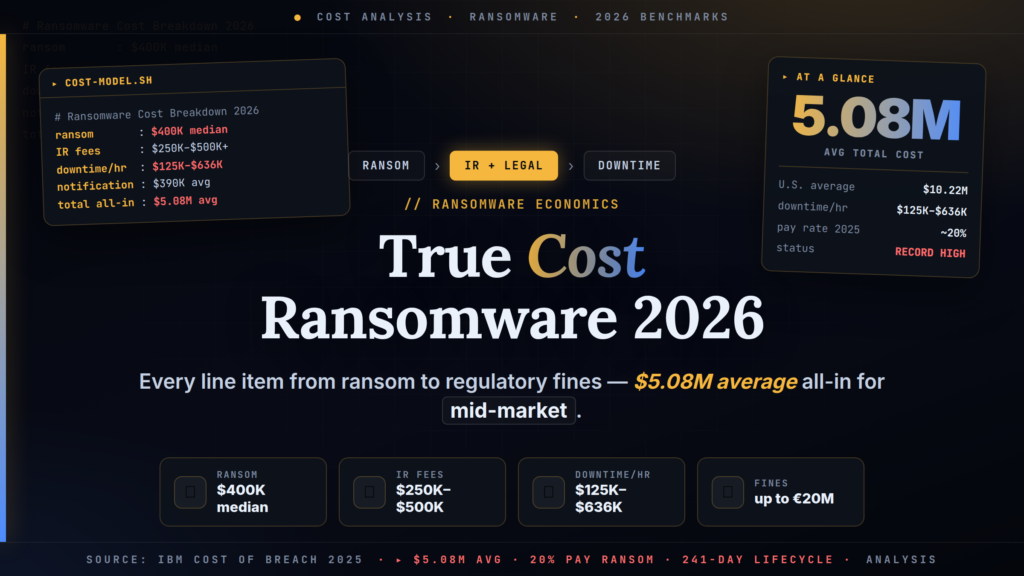
The true cost of a ransomware attack in 2026 is not the ransom — it is the $5.08 million all-in bill that lands after weeks of incident response, legal work, downtime, regulatory scrutiny, and insurance paperwork. According to the IBM Cost of Data Breach Report 2025, ransomware and extortion incidents now average $5.08 million per event for mid-to-large organisations. U.S. victims face a record-high average of $10.22 million when all cost components are tallied. This guide decomposes every line item, assigns dollar ranges to each, and gives CFOs, risk managers, and boards a framework to calculate their own exposure before an incident occurs.
// 01 True Cost of a Ransomware Attack in 2026: What the Numbers Actually Include
The confusion around ransomware cost figures stems from apples-to-oranges comparisons. Headline ransom figures come from cryptocurrency tracking firms like Chainalysis and measure only on-chain payments to attacker wallets. Remediation-only figures from vendors like Sophos strip out the ransom payment itself. IBM's all-in figure of $5.08 million includes detection, escalation, IR (incident response), legal, notification, lost business, and post-breach remediation — but not regulatory fines, which are imposed separately months or years later.
| Cost Component | Typical Range | Best Source |
|---|---|---|
| Ransom payment (median) | $110,890–$400,000 | Coveware Q4 2024–Q2 2025 |
| Ransom payment (average) | $554,000–$1,130,000 | Coveware Q4 2024–Q2 2025 |
| IR firm fees (total engagement) | $150,000–$800,000+ | IBM 2025; market estimates |
| Legal counsel | $50,000–$300,000 | Breach counsel billing data |
| Downtime (per hour, average) | $125,000–$336,000 | IBM 2025; Gartner |
| Healthcare downtime (per hour) | ~$636,000 | IBM/Ponemon sector data |
| Customer notification | $390,000 average | IBM 2025 |
| Regulatory fines | $0–€20M+ | HIPAA, GDPR, SEC data |
| Cyber insurance payout | Covers ~73% of IR costs | NAIC 2025; DeepStrike |
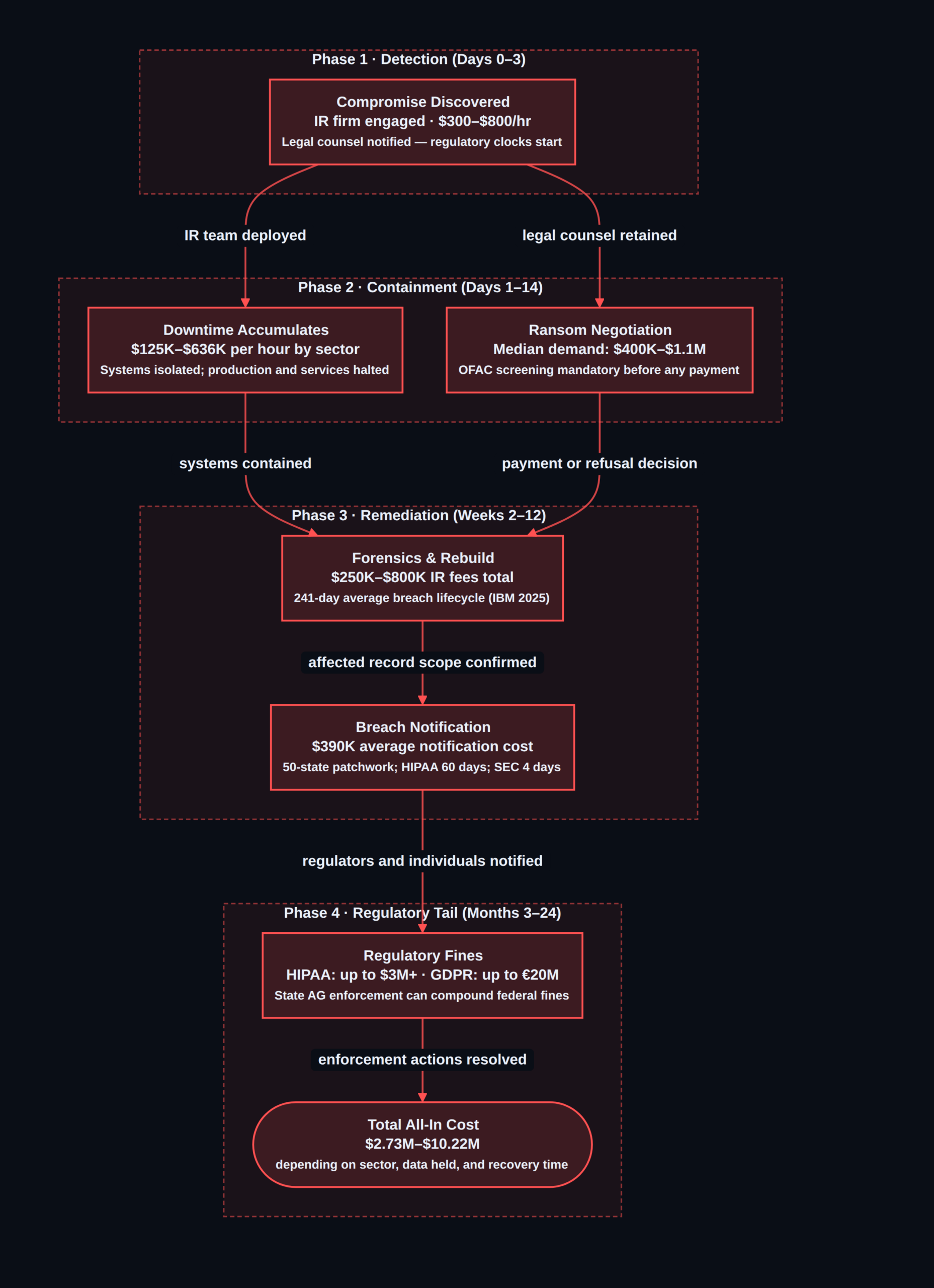
| Total all-in (mid-market) | $2.73M–$5.08M | Sophos 2024; IBM 2025 |
Understanding each component is the prerequisite for setting a meaningful insurance limit, retainer strategy, and board-level risk tolerance.
// 02 The Ransom Payment: One Line Item, Not the Whole Bill
Ransom payment data is the most widely cited — and most misunderstood — figure in ransomware economics. Coveware, one of the largest ransomware negotiation firms, publishes quarterly breakdowns of cases it handles.
In Q2 2025, the average ransom payment reached $1,130,070 — a 104% quarter-over-quarter surge driven by a handful of large enterprise settlements. The median payment was $400,000, a more representative figure for mid-market organisations. Q4 2024 data shows a lower median of $110,890, illustrating how volatile these figures are from quarter to quarter. The single largest known payment on record remains $75 million, paid to the Dark Angels ransomware-as-a-service (RaaS) group — a criminal network that licenses ransomware toolkits to affiliates in exchange for a revenue cut — in 2024.
Across the broader ecosystem, Chainalysis tracked $813.55 million in confirmed ransomware payments in 2024, down 35% from $1.25 billion in 2023. The decline reflects two trends: sustained law enforcement disruption of major RaaS operations and a dramatic drop in payment rates. By Q3–Q4 2025, only 20–28% of identified victims paid — a historic low, down from 78.9% in 2022.
Three additional facts shape financial planning:
- Negotiation compresses demands. IR firms and specialised negotiators routinely achieve 60% reductions from initial ransom demands. Budget for the demand, plan for the negotiated figure.
- Payment is not recovery. A decryption key does not restore backups, close the initial access vector, remove implanted persistence mechanisms (hidden backdoors attackers leave to return later), or prevent double-extortion data publication — the practice of threatening to publish stolen data even after the victim pays.
- OFAC screening is mandatory. The U.S. Treasury's Office of Foreign Assets Control (OFAC) prohibits ransom payments to sanctioned entities. Paying a sanctioned group — even unknowingly — exposes the victim to civil penalties. Qualified legal counsel must clear every payment before execution.
// 03 Incident Response Costs: The Largest Single Expense
Incident response — the process of identifying, containing, and eradicating the threat — is the single largest cost category in an all-in ransomware bill. IBM's 2025 report attributes $1.47 million on average just to detection and escalation activities, making it the dominant spend component even before remediation and rebuilding begin.
IR engagements bill at professional services rates. The market range of $300–$800 per hour for blended teams of forensic investigators, malware analysts, threat hunters, and project managers is consistent with insurance claims data. A typical engagement for a mid-market company runs 300–1,000 billable hours, placing the IR cost at $150,000–$800,000 before any ransom is considered.
Organisations with cyber insurance are commonly required to engage the insurer's pre-approved panel of IR providers at pre-negotiated rates. Uninsured victims face full open-market pricing under the worst possible conditions — a reactive hire with no prior relationship, made under extreme time pressure.
IR work breaks down into four phases that each generate billable hours:
- Forensic investigation: Establishing the initial access vector (how the attacker entered — phishing, exploited VPN credentials, compromised RDP), the dwell time (median: 9 days between initial compromise and ransomware deployment, per Mandiant), and the full scope of data accessed or exfiltrated
- Containment and eradication: Isolating affected systems, removing persistence mechanisms such as scheduled tasks, registry run keys, and implanted web shells, then rebuilding from verified clean backups
- Evidence preservation: Forensic imaging of affected systems for law enforcement referral or civil litigation; chain-of-custody documentation
- Post-incident hardening: Closing the initial access vector, resetting credentials with elevated privilege access, rebuilding Active Directory (Microsoft's directory service for managing users and permissions) if it was compromised — which it is in the majority of enterprise ransomware cases
The true cost of a ransomware attack in 2026 routinely includes IR fees that exceed the ransom itself, particularly when rebuilding a compromised Active Directory environment or migrating large server fleets to verified-clean infrastructure.
// 04 Legal Counsel: The Six-Figure Line Item Nobody Budgets For
Legal counsel appears as a billable participant in 55% of cyber insurance claims. Their role in a ransomware response spans four distinct workstreams:
Breach notification compliance. All 50 U.S. states have breach notification laws with varying timelines (30–90 days after discovery), notification thresholds, and required notice content. Coordinating multi-state notification for a breach affecting residents in 30+ states requires specialist counsel to avoid regulatory penalties from state attorneys general.
Federal regulatory reporting. HIPAA (the Health Insurance Portability and Accountability Act, which governs protected health information) requires notification of affected individuals and the Department of Health and Human Services within 60 days. The SEC's cybersecurity disclosure rules — effective December 2023 — require public companies to file a Form 8-K (a material event disclosure filing) within 4 business days of determining a breach is material. Failure to file on time exposes the company to civil penalties of up to $10,000 per day.
OFAC sanctions screening. As noted above, every ransom payment requires legal counsel to screen the receiving wallet against OFAC's Specially Designated Nationals list. Paying a sanctioned entity without prior OFAC clearance triggers civil penalties regardless of intent.
Litigation defence. Ransomware victims increasingly face class action lawsuits from affected customers and employees within weeks of a public disclosure. Outside counsel defends these actions; separately, disputes with cyber insurers over what constitutes a covered loss are litigated regularly and can take years to resolve.
BigLaw firms specialised in cybersecurity response — including Crowell & Moring, BakerHostetler, and Mullen Coughlin — bill partner rates of $500–$1,200 per hour and associate rates of $300–$600 per hour in major U.S. markets. Legal costs for a breach affecting 50,000 records routinely land in the $75,000–$300,000 range for notification work alone, before any litigation.
// 05 Downtime: The Cost Component That Dominates Every Model
Downtime is consistently underestimated because most organisations calculate only direct revenue loss. The full downtime cost comprises five elements:
- Lost revenue — transactions not processed, services not delivered, production lines halted
- Idle labour — employees who cannot work but continue to be paid
- Emergency IT spend — cloud-based recovery infrastructure, emergency software licensing, temporary hardware
- SLA (service-level agreement) breach penalties — contractual payments to enterprise customers for missed uptime guarantees
- Reputational cost — customer churn that begins during the incident and continues for months after
IBM's 2025 data estimates average downtime costs of $125,000 per hour across all industries. The widely cited Gartner figure of $336,000 per hour ($5,600 per minute) originates from a 2014 survey and likely understates current costs for data-intensive sectors given increased digital dependency and SLA complexity since then.
Industry Downtime Cost Benchmarks (2025)

Financial Services:    $500,000 – $1,000,000+ per hour
Healthcare:            ~$636,000 per hour (IBM/Ponemon sector data)
Manufacturing:         $260,000 – $500,000 per hour
Retail:                $60,000 – $120,000 per hour (off-peak periods)
Cross-industry average: $125,000 – $336,000 per hour
The average time to identify and contain a breach is 241 days (IBM 2025). Most organisations took over 100 days to fully recover; 25% needed more than 150 days. At $125,000 per hour and a conservative 72-hour operational outage, downtime alone reaches $9 million — before any other cost component is added.
Healthcare provides the starkest illustration: the Sandhills Medical ransomware incident showed how hospital ransomware events force patient diversions that compound financial loss with patient safety liability simultaneously. For technical analysis of how modern ransomware maximises operational disruption, see our VECT ransomware and wiper analysis.
// 06 Regulatory Fines: The Bill That Arrives Months Later
Regulatory fines are the most delayed and most variable cost component. They arrive months or years after the incident, imposed by separate enforcement agencies, and are frequently not covered by cyber insurance or are subject to separate sublimits.
HIPAA enforcement. The U.S. Department of Health and Human Services' Office for Civil Rights (OCR) — the federal agency responsible for HIPAA (Health Insurance Portability and Accountability Act) enforcement — fined four healthcare entities a combined $1,165,000 specifically for HIPAA violations that directly enabled ransomware attacks in 2025. Solara Medical Supplies received a $3,000,000 fine in 2025 for multiple ePHI (electronic protected health information) breaches. Per-violation penalties in 2025 range from $141 to $71,162 depending on culpability tier, with an annual cap of up to $2.13 million per violation category.
GDPR exposure. GDPR (the EU's General Data Protection Regulation, which applies to any organisation handling data of EU residents) imposes a maximum penalty of €20 million or 4% of global annual revenue — whichever is higher. A 2024 ransomware attack on a French hospital that exposed 500,000 patient records triggered a €3.2 million GDPR fine specifically for missing the 72-hour breach notification window. Cumulative GDPR fines exceeded €5.88 billion globally through early 2025.
SEC disclosure obligations. The SEC's (U.S. Securities and Exchange Commission's) cybersecurity disclosure rules require public companies to file Form 8-K within 4 business days of determining a breach is material. Failure carries civil penalties of up to $10,000 per day and potential securities fraud exposure. The SolarWinds enforcement action set the precedent that CISOs (Chief Information Security Officers) can face personal liability for inadequate disclosure.
State attorney general enforcement. Multi-state AG coalitions are increasingly coordinating enforcement actions following ransomware incidents. A single 2025 enforcement action resulted in over $6 million in penalties in one case alone.
For a view of how ransomware affiliates operate to maximise pressure before regulatory deadlines trigger, see our breakdown of the Interlock ransomware ClickFix campaign.
// 07 Cyber Insurance: Coverage Limits, Sublimits, and the Protection Gap
The global cyber insurance market reached $16.3 billion in 2025, projected to reach $29 billion by 2027. After seven consecutive years of premium increases, global rates declined 6–12% in 2024–2025 as insurer loss ratios improved. However, projections from major underwriters call for 15–20% premium increases in 2026 as ransomware claim severity rebounds.
What cyber insurance typically covers:
- IR and forensics — the dominant claims category, covering approximately 73% of incident response and crisis management costs
- Legal counsel and breach notification coordination
- Business interruption losses during the recovery period
- Extortion (ransom) payments — subject to sublimits and OFAC compliance requirements
The sublimit problem. Many policies include separate, lower caps for ransomware extortion payments, distinct from the overall policy aggregate. A mid-market policy with a $5 million aggregate limit might carry a $500,000–$2,000,000 ransomware sublimit. If the negotiated ransom exceeds the sublimit, the insured funds the difference from their own balance sheet.
Average claims data illustrates the wide spread across organisation sizes:
- Small business average claim: $79,000
- Large enterprise average: $228,000
- Ransomware-specific average claim severity (Resilience, H1 2025): $1.18 million per claim
Deductibles (self-insured retentions) by size:
| Organisation Size | Typical Retention |
|---|---|
| SMB (under 500 employees) | $10,000–$50,000 |
| Mid-market (500–5,000 employees) | $100,000–$500,000 |
| Enterprise (5,000+) | $1,000,000+ |
The protection gap. Industry data from Europe reveals a systemic coverage shortfall: while economic cybercrime losses increased 250%, insured losses rose only 70% — a 3:1 protection gap. Globally, only 47% of eligible organisations hold standalone cyber insurance policies. For those that do hold policies, coverage gaps around ransomware sublimits, exclusions for nation-state attacks (increasingly contested in court), and business interruption calculation disputes mean that even insured victims frequently absorb significant out-of-pocket costs.
// 08 Customer Notification and Remediation: The Hidden Six-Figure Line
IBM's 2025 Cost of Data Breach report puts average notification costs at $390,000 globally across all breach types, with U.S. costs materially higher given the 50-state notification law patchwork plus sector-specific federal rules.
Per-record notification costs break down as follows:
- Direct notification (mailed letters, email campaigns, regulatory filings): $6–$10 per affected individual
- Breach hotline staffing (call centres, FAQ management, escalation handling): $5–$15 per person
- Credit monitoring or identity protection offers: $10–$30 per person per year, typically offered for 1–2 years post-incident
For a breach affecting 100,000 records, direct notification costs reach $600,000–$1,000,000. Adding a standard two-year credit monitoring commitment at $15/person/year adds another $3,000,000 — bringing notification-plus-monitoring costs to nearly $4 million for a six-figure record breach alone.
Notification also triggers secondary costs that extend the financial tail: class action filings from notified individuals arrive within weeks of public disclosure; regulatory inquiries are initiated in response to the notifications themselves; and customer churn — measurable only months later — represents the most durable long-term revenue impact of a publicised ransomware event.
// 09 Building Your Organisation's Ransomware Cost Model
The variables that move the cost number most dramatically are within an organisation's control to measure — and in many cases, to reduce:
| Variable | Lower Cost | Higher Cost |
|---|---|---|
| Sector | Retail, logistics | Healthcare, financial services |
| Annual revenue | Under $50M | Over $500M |
| Data holdings | Internal systems only | Large customer PII/PHI/payment data sets |
| Backup posture | Immutable off-site backups, tested quarterly | No tested backups; long recovery time objective |
| Cyber insurance | $5M+ policy, adequate sublimits | Uninsured or sublimits under $500K |
| Regulatory exposure | Domestic U.S. only | HIPAA + GDPR + SEC disclosure obligations |
| IR readiness | Pre-negotiated retainer, tested playbooks | No retainer; cold-hire under active incident pressure |
A manufacturing company with $200M in annual revenue, no immutable backup strategy, and a $2 million cyber policy with a $500K ransomware sublimit faces this plausible worst-case scenario:
Cost Component                         Estimate
─────────────────────────────────────────────────
Ransom (negotiated from $700K demand): $280,000
IR engagement (600 hrs × $500/hr):    $300,000
Legal counsel:                         $175,000
Downtime (72 hrs × $300K/hr):       $21,600,000
Customer notification (80K records):   $640,000
GDPR fine (EU customer exposure):   $2,500,000
─────────────────────────────────────────────────
Gross exposure:                      ~$25,495,000
Cyber insurance covers (est.):        ~$1,850,000
Net out-of-pocket cost:             ~$23,645,000
Downtime dominates every model. The organisations that minimise total cost are those that minimise recovery time — through immutable off-site backups with tested restoration procedures, pre-negotiated IR retainers that eliminate the days-long "who do we call?" paralysis that follows initial discovery, and playbooks that define containment authority before an incident begins. The Karakurt ransomware prosecution documents precisely how extortion groups exploit slow organisational response to maximise dwell time and leverage — every additional day of dwell time is a day of additional cost for the victim.
// 10 Conclusion
The true cost of a ransomware attack in 2026 is not a number any single report captures cleanly. IBM's $5.08 million average is the most defensible all-in benchmark for a mid-market incident; U.S. healthcare organisations face $7.42 million averages; and downtime alone can exceed $9 million in a 72-hour manufacturing or financial services outage. Cyber insurance covers a fraction of real exposure when sublimits, deductibles, and the 3:1 protection gap are applied to actual claim data.
The actionable priority is to build your own number before an incident forces you to find it out under duress. Identify your downtime cost per hour, audit your policy's ransomware sublimit against realistic demand ranges, confirm your IR retainer is active and tested, and run a backup restoration drill. Those four inputs — not industry averages — determine what a ransomware incident costs your organisation specifically.
→ See our weekly threat digest for updated ransomware cost benchmarks as quarterly Coveware and Chainalysis data are published.
For any query contact us at contact@cipherssecurity.com