
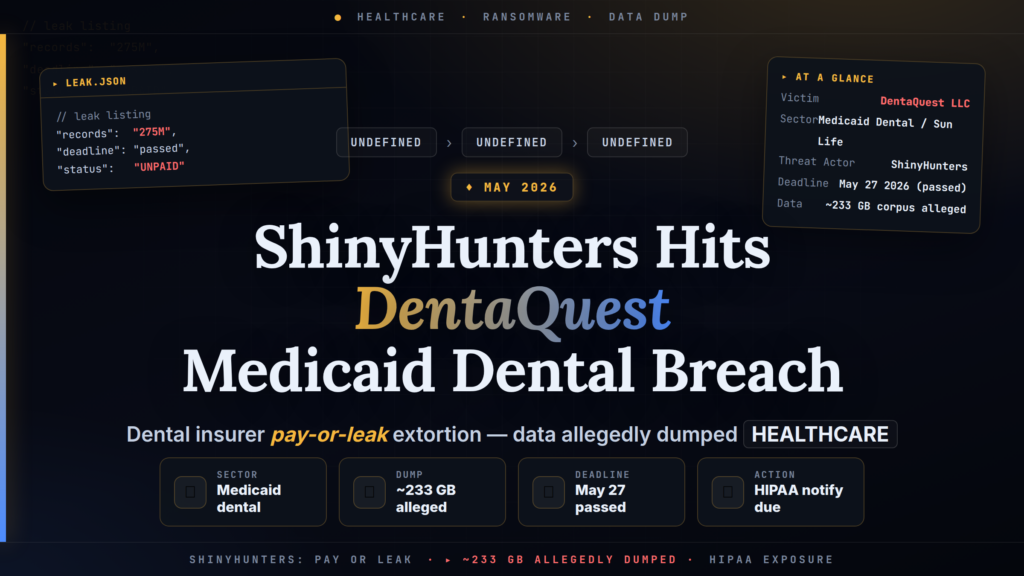
ShinyHunters — the ransomware and extortion group responsible for a string of major 2026 breaches including Charter Communications (49 million records), Carnival Corporation (6 million passengers), and Instructure Canvas (275 million records) — has claimed a "Pay or Leak" attack against DentaQuest, LLC, a Massachusetts-based company that administers Medicaid dental programs and managed dental benefits across the United States. According to breach researcher Troy Hunt, a roughly 233-gigabyte corpus of data allegedly from DentaQuest was dumped after the group's May 27, 2026 ransom deadline passed without confirmed payment. DentaQuest has acknowledged a "cybersecurity incident" and opened an investigation; neither the data types nor the number of beneficiaries affected have been officially quantified.
// 01 DentaQuest Breach: What ShinyHunters Claims
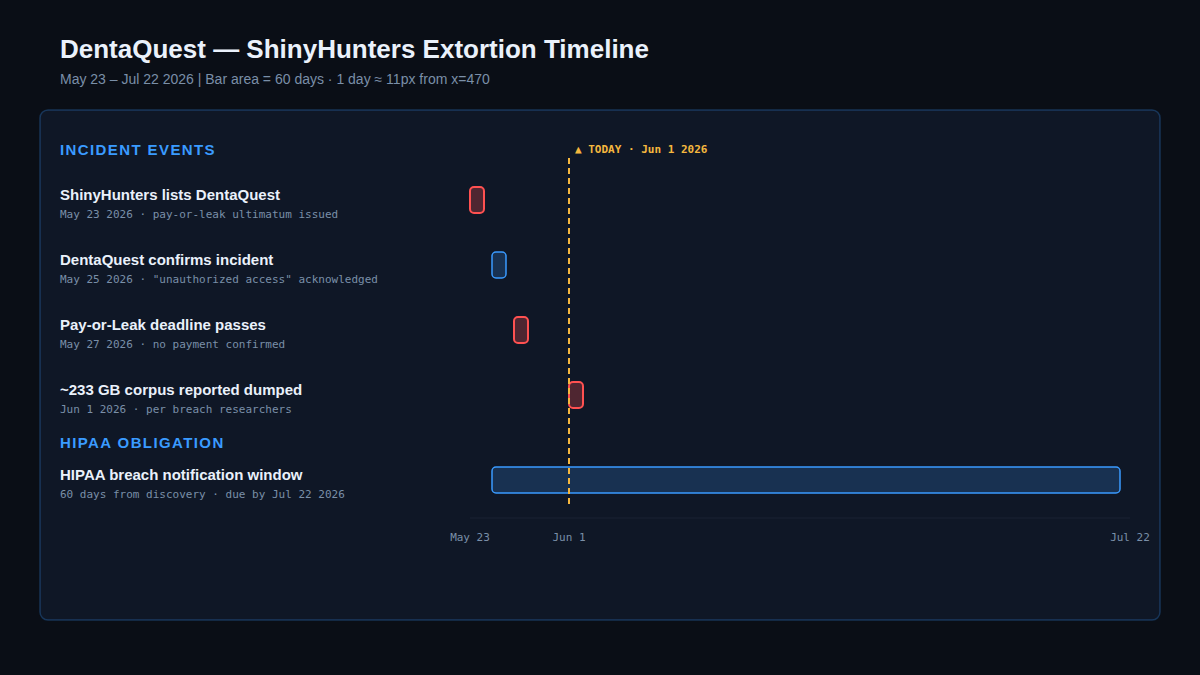
ShinyHunters posted DentaQuest to its extortion listing on Ransomware.Live on May 23, 2026. The message was deliberately opaque — a common ShinyHunters tactic to prevent the victim from calculating exposure before negotiating: "You wouldn't want us to describe what data and how much data was compromised publicly. It is in your best interests to reply to us or we are leaking it all by the deadline."
The deadline was May 27, 2026. Neither DentaQuest nor its parent company, Sun Life U.S. Dental, publicly confirmed payment. Breach monitoring sources place the listing status at "leaked" by May 28. By June 1, breach researcher Troy Hunt observed "a 233GB corpus allegedly from them" appearing in threat-intelligence circles.
DentaQuest confirmed a breach in a statement describing "unauthorized access to a portion of the company's network" and an ongoing investigation — consistent with organizations that have confirmed intrusion but not yet completed the forensic scope assessment required before filing a HIPAA breach notification. The company's parent, Sun Life U.S. Dental, has not issued an independent statement.
// 02 Timeline of the DentaQuest Extortion
// 03 Who Is DentaQuest and Who Is at Risk
DentaQuest, LLC is a managed dental benefits company headquartered in Boston, Massachusetts, operating as a subsidiary of Sun Life U.S. Dental — itself a division of the Sun Life Financial group. DentaQuest's primary business is administering Medicaid dental programs on behalf of state governments and providing managed care dental benefits to commercial and public-sector health plans. The company operates in dozens of U.S. states, serving both Medicaid beneficiaries and commercial plan members.
This organizational profile matters for breach impact assessment. Medicaid dental programs serve low-income individuals and families, many of whom have limited access to identity monitoring services or may not be watching for fraudulent use of their information. The categories of data a Medicaid dental administrator holds typically include:
- Names, dates of birth, and addresses (enrollment requirements)
- Social Security numbers (required for Medicaid eligibility verification)
- Medicaid ID numbers and state plan identifiers
- Dental procedure codes, treatment histories, and diagnosis records
- Insurance enrollment dates, plan IDs, and group numbers
- For covered dependents: additional family member information
Medical and dental records command the highest prices on criminal data markets — often ten times the value of a standard financial credential — because they combine stable identifiers (SSN, DOB) with healthcare fraud vectors (false claims, prescription fraud) and long-term identity theft potential. If the 233 GB corpus attributed to ShinyHunters reflects actual exfiltrated production data, the affected population could span millions of Medicaid beneficiaries across multiple states.
// 04 ShinyHunters' 2026 Healthcare Targeting Pattern
The DentaQuest breach does not exist in isolation. ShinyHunters has operated a sustained and escalating targeting campaign through 2026, with healthcare and insurance organizations prominently represented:
| Organization | Sector | Records Claimed |
|---|---|---|
| Instructure Canvas | Education / Healthcare adjacent | 275 million |
| Charter Communications | Telecom | 49 million |
| Carnival Corporation | Travel | 6 million |
| ADT | Home security | Not disclosed |
| Medtronic | Medical devices | Not disclosed |
| DentaQuest | Healthcare / Medicaid dental | Not confirmed |
The pattern reflects a deliberate strategy. Healthcare and insurance targets hold high-value PII at scale with relatively predictable security maturity — larger than small businesses but often less mature than major financial institutions. The "Pay or Leak" model ShinyHunters uses means even organizations with solid backup and recovery capabilities face a second-order threat: the reputational damage, regulatory penalties, and class-action exposure triggered by data publication.
ShinyHunters' historical track record also includes Ticketmaster (560 million records, 2024), AT&T (109 million records, 2024), and Santander Bank (2024), establishing the group as one of the most prolific and consequential extortion actors of the mid-2020s.
// 05 HIPAA Implications and Breach Notification Requirements
DentaQuest qualifies as a covered entity under the Health Insurance Portability and Accountability Act (HIPAA) — the U.S. federal law governing the privacy and security of protected health information (PHI). As a HIPAA covered entity, DentaQuest is subject to the Breach Notification Rule, which requires:
- Individual notification — affected individuals must be notified by first-class mail within 60 days of discovering the breach. If more than 500 individuals in any single state are affected, notification must also be provided to prominent media outlets in that state.
- HHS notification — the U.S. Department of Health and Human Services must receive written notice within 60 days of discovery.
- HHS Breach Portal ("Wall of Shame") listing — breaches affecting 500 or more individuals are publicly listed on the HHS Breach Portal, triggering OCR investigation scrutiny.
With DentaQuest confirming incident discovery around May 25, 2026, the HIPAA notification deadline falls approximately on July 22, 2026 — roughly seven weeks from today. Failure to meet notification timelines carries civil monetary penalties of up to $1.9 million per violation category per calendar year, enforced by the HHS Office for Civil Rights. State attorneys general may pursue additional penalties under state breach notification laws, some of which impose shorter timelines than HIPAA's 60-day window.
Class action attorneys have already begun investigating. Legal firms representing data breach plaintiffs typically file claims within weeks of a confirmed HIPAA breach of this scale, seeking damages under HIPAA, state consumer protection statutes, and negligence theories.
// 06 What DentaQuest Members and Partners Should Do Right Now
If you are a DentaQuest member, Medicaid dental beneficiary, or covered dependent:
- Place a free credit freeze with all three major bureaus — Equifax, Experian, and TransUnion — immediately. A freeze prevents new accounts from being opened in your name, does not affect your credit score, and can be temporarily lifted when you apply for new credit.
- Enable a fraud alert on your credit files. This requires creditors to verify your identity before issuing new credit, adding a layer of protection even if a freeze is not in place.
- Monitor your Explanation of Benefits (EOB) statements from DentaQuest and your state Medicaid program. Unauthorized dental procedure claims — billing for procedures you never received — are a specific risk when dental records are exposed.
- Watch for the official HIPAA breach notification letter. Federal law requires DentaQuest to mail you a notice if your PHI was confirmed in scope. The letter will specify the data types involved and the credit monitoring or identity protection services offered.
- File a report with the FTC at IdentityTheft.gov if you detect fraudulent activity — new accounts, false medical claims, or identity misuse — attributable to this breach.
If your organization has a Business Associate Agreement (BAA) with DentaQuest:
- Review your BAA terms to confirm DentaQuest's notification obligations to you and your own downstream obligations to affected plan members.
- Assess whether your organization's shared data was in scope of the alleged 233 GB exfiltration, and determine whether you have independent HIPAA or state breach notification obligations.
// 07 Background: How Double-Extortion Ransomware Works
Double-extortion ransomware evolved from traditional ransomware — which encrypts victim files and demands a decryption key payment — by adding a second lever: data exfiltration before or during the encryption event. The threat actor now holds two sources of leverage: the encrypted systems and the stolen data. Organizations with excellent backup programs may restore operations within hours, but the data is already gone.
In some current campaigns, including what ShinyHunters appears to operate, file encryption is optional or entirely absent. The group exfiltrates data, posts the victim on a dark web extortion site with a countdown, and demands payment. Organizations with strong backups are still fully exposed to the regulatory and reputational consequences of data publication — making prevention and early detection the only durable mitigations.
For healthcare organizations, this pressure is especially severe. A data breach notification to HHS is a public record. It triggers OCR investigation, state AG attention, and plaintiff attorney searches for class-action plaintiffs — all consequences that materialize from ShinyHunters publishing the data, independent of whether the victim organization ever restores systems or pays a ransom. The breach of an organization's security perimeter creates a liability trail that persists for years.
// 08 Conclusion
ShinyHunters' attack on DentaQuest adds a Medicaid dental provider to a growing list of 2026 healthcare sector victims. With a 233 GB corpus allegedly released after the May 27 ransom deadline passed, the immediate priorities are clear: DentaQuest must meet its HIPAA notification deadline of approximately July 22, 2026, and affected beneficiaries should freeze their credit and monitor their Explanation of Benefits statements now — well before the official notice letter arrives.
For any query contact us at contact@cipherssecurity.com