
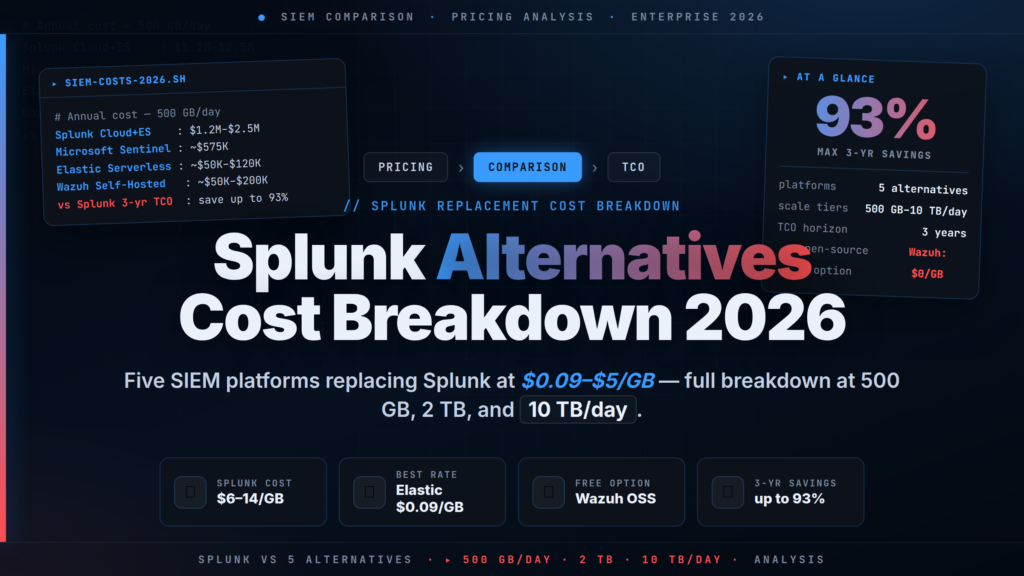
Splunk pricing alternatives 2026 are drawing serious evaluation from security buyers as Splunk Cloud combined with Enterprise Security (ES) — the add-on required for full SIEM functionality — runs $1.2 million to $2.5 million annually at 500 GB/day ingestion, with built-in renewal escalation averaging 9% per year. This guide breaks down five alternatives — Microsoft Sentinel, Elastic Security, Wazuh, Panther, and Sumo Logic — with verified per-GB rates at 500 GB/day, 2 TB/day, and 10 TB/day ingestion, plus a three-year total cost of ownership (TCO — the full cost to run a system over a defined period, including licensing, infrastructure, staffing, and migration) that includes migration cost amortization.
// 01 Why Splunk Renewal Pricing Hits Harder Each Year
Splunk (now under Cisco ownership) offers three licensing models: ingest pricing (charged per GB/day of data indexed), workload pricing (charged per Splunk Virtual Compute unit, abbreviated SVC), and entity pricing (per monitored host, primarily for observability). For SIEM deployments, ingest pricing is the dominant track.
Splunk does not publish a public rate card. All pricing requires direct sales engagement. Procurement data and analyst reports place Splunk Cloud at approximately $1,620–$1,860 per GB/day of licensed ingest capacity annually (directional figure sourced from Expanso's Splunk pricing analysis and AWS Marketplace listings). The Enterprise Security add-on — required for correlation rules, threat intelligence integration, risk-based alerting, and the full SIEM console — costs an additional $200–$450/GB/day above the base platform.
Combined, Splunk Cloud + ES carries an effective rate of roughly $2,000–$2,300 per GB/day of licensed capacity, which translates to approximately $6–$14 per GB actually ingested at mid-market volumes when annual spend is divided by total GB indexed. A real-world example: a financial services firm documented by Expanso was indexing 14.3 TB/day and paying $3.7M/year before data filtering reduced their effective ingest to 5.2 TB/day and cut the bill to $1.4M/year — a 62% reduction without changing platforms.
Renewal contracts include escalation clauses averaging 9% annually. At a $1.85M midpoint for 500 GB/day, year-over-year escalation alone adds $166,500 to each renewal without any ingest growth. Over three years, a flat-volume 500 GB/day Splunk deployment accumulates $6.07M in licensing spend.
// 02 Splunk Pricing Alternatives 2026 — At a Glance
The table below shows estimated annual licensing cost at three enterprise ingest scales. Figures are estimates derived from published pricing pages, analyst benchmarks, and procurement data; actual costs require vendor quotes.
| Platform | 500 GB/day | 2 TB/day | 10 TB/day | Effective $/GB ingested |
|---|---|---|---|---|
| Splunk Cloud + ES | $1.2M–$2.5M | $3.6M–$6.0M | $14M–$22M+ | $6.58–$13.70 |
| Microsoft Sentinel (commitment tier) | ~$575K | ~$1.77M | ~$8.86M | $3.15 |
| Elastic Security (serverless, Complete) | $50K–$120K | $180K–$420K | $900K–$2.2M | $0.27–$0.66 |
| Wazuh (self-hosted, all-in TCO) | $50K–$200K | $150K–$500K | $500K–$2M | $0.27–$1.10 |
| Panther Enterprise | $650K–$950K | Quote only | Quote only | $3.56–$5.21 |
| Sumo Logic (negotiated contract rate) | $350K–$600K | $1.2M–$2.0M | $5M–$10M | $1.92–$3.29 |
// 03 1. Microsoft Sentinel
Who It Fits
Organizations running Microsoft 365 (M365), Azure Active Directory (now Microsoft Entra ID), or the Microsoft Defender XDR (Extended Detection and Response) suite get outsized value from Sentinel. Native zero-cost ingestion of Defender alerts, M365 audit logs, and Azure Activity Logs means the effective per-GB rate is substantially lower than list price for Microsoft-heavy environments.
Pricing
Microsoft Sentinel uses a tiered analytics ingest model. The pay-as-you-go (PAYG) rate is $4.30/GB in East US (US average ~$5.22/GB across regions). Commitment tiers reduce the effective rate progressively:
| Commitment Tier | Effective $/GB | Daily Spend | Annual Spend |
|---|---|---|---|
| 100 GB/day | $3.43 | ~$343 | ~$125K |
| 200 GB/day | $3.31 | ~$662 | ~$242K |
| 500 GB/day | $3.15 | ~$1,575 | ~$575K |
| 1,000 GB/day | $3.06 | ~$3,060 | ~$1.12M |
| 5,000 GB/day | $2.79 | ~$13,950 | ~$5.09M |
Free data sources (ingested at $0, confirmed by Microsoft Learn): Azure Activity Logs, Microsoft 365 Audit Logs (SharePoint, Exchange, Teams), Microsoft Defender XDR security incidents and alerts, Defender for Endpoint alerts (the SecurityAlert table), Defender for Identity alerts, Defender for Cloud alerts, Microsoft Entra ID Protection alerts. Note: alerts are free; raw log streams (sign-in logs, Defender for Endpoint raw event tables) are billed at standard rates.
M365 E5 licenses include a 5 MB/user/day free ingest credit. For a 1,000-user organization, that is approximately 5 GB/day of free ingest — worth ~$2,200/month at PAYG rates before any commitment discount.
Retention: 90 days is included in the analytics tier. Log archive storage beyond 90 days costs $0.02–$0.10/GB/month depending on the access tier (Basic Logs vs. Analytics Logs).
SOAR and automation: Azure Logic Apps-based playbooks are included without a separate license, replacing the need for Splunk SOAR ($20,000+/year standalone). UEBA (User and Entity Behavior Analytics — ML-based detection of anomalous user and entity patterns) and Fusion AI threat detection are included at all commitment tiers.
Query language: KQL (Kusto Query Language), a structured query language optimized for time-series log data. KQL is also used across Azure Monitor and Microsoft Defender, reducing the re-learning curve for teams already in the Microsoft ecosystem.
Limitation: Sentinel is Azure-only. Organizations with AWS-native infrastructure or on-premises requirements cannot self-host it.
// 04 2. Elastic Security
Who It Fits
Organizations that want the lowest per-GB commercial rate, or those already running Elasticsearch for log management and APM (Application Performance Monitoring). The open-source core (Elasticsearch under the SSPL/Elastic License) means no lock-in at the data layer — you own the data format (ECS, Elastic Common Schema) and can switch query tools without re-indexing.
Pricing
Elastic's serverless Security Analytics tiers on Elastic Cloud:
| Tier | Ingest $/GB | Retention $/GB/month | Key Additions |
|---|---|---|---|
| Security Analytics Essentials | from $0.09 | from $0.017 | Core SIEM, endpoint detection, compliance |
| Security Analytics Complete | from $0.11 | from $0.019 | ML entity analytics, Elastic Workflows (SOAR) |
| Elastic AI SOC Engine (EASE) | from $0.11 | from $0.19 | AI-powered Attack Discovery, alert triage |
At 500 GB/day on the Complete tier using published minimums: ~$1,650/month ingest + ~$2,550/month for 90-day retention (15,000 GB × $0.019/GB/month) = approximately $4,200/month, ~$50,000/year at the floor rate. Real-world costs including compute for large-scale correlation and ML workloads run $50K–$120K/year at this volume.
"As low as" pricing represents the minimum committed spend tier; actual consumption-based compute for large detection rule sets at 10 TB/day can multiply the base figures significantly.
For enterprise self-managed deployments, Elastic Enterprise licensing is quote-based (Platinum and Enterprise subscription tiers). An independent TCO analysis by Underdefense places a 600-endpoint self-managed Enterprise deployment at $600K+ over three years when compute infrastructure and operations labor are included — still a fraction of Splunk at equivalent scale.
Key capabilities: ES|QL and EQL (Event Query Language — a pipe-based language designed for sequence detection in security events), Kibana-based detection engineering UI, native Kubernetes and container workload security, Attack Discovery (AI-generated natural-language summaries of multi-stage attack chains in the EASE tier).
Limitation: Serverless "as low as" pricing requires minimum committed spend; the entry-level rate is not guaranteed at low commitment levels. Self-managed Enterprise licensing is opaque without a sales conversation.
// 05 3. Wazuh
Who It Fits
Organizations with hard budget constraints, or security teams that want full ownership of every stack component with no per-GB or per-agent licensing fee. Wazuh is the most widely deployed open-source SIEM and XDR (Extended Detection and Response) platform, covering endpoint detection, FIM (File Integrity Monitoring — detecting unauthorized changes to files and directories), vulnerability assessment, cloud security posture management, and compliance reporting.
Pricing
Open-source self-managed: $0 in licensing. Every capability — SIEM correlation, XDR, FIM, active response, vulnerability detection, compliance dashboards for PCI-DSS, HIPAA, GDPR, NIST 800-53, and SOC 2 TSC — is included at no cost. There is no per-GB charge and no per-agent charge.
What "free" actually costs at enterprise scale annually:
| Cost Driver | Annual Estimate |
|---|---|
| Infrastructure (Wazuh Manager cluster, Indexer nodes, Dashboard) | $20K–$80K |
| Senior security engineer labor (deployment, tuning, rule writing, ops) | $150K–$200K |
| Optional commercial support contract | $1K–$10K |
| Log storage (hot + warm tier for 90-day retention) | $20K–$30K |
| Total self-hosted TCO | $50K–$200K |
Wazuh Cloud (fully managed service, pricing from wazuh.com/cloud):
| Plan | Active Agents | Indexed Retention | Archive Retention | Monthly Price |
|---|---|---|---|---|
| Small | Up to 100 | 1 month | 3 months | $571 |
| Medium | Up to 250 | 3 months | 1 year | $923 |
| Large | Up to 500 | 3 months | 1 year | $1,467 |
| Custom | 500+ agents | Custom | Custom | Quote required |
Wazuh Cloud is agent-count-based, not GB-based. Environments generating 10 TB/day of log volume typically involve thousands of endpoints and require the Custom plan; no public rate exists at that scale.
Key capabilities: VirusTotal and MISP (Malware Information Sharing Platform) threat intelligence integration, built-in compliance dashboards, agentless cloud security posture for AWS, Azure, and GCP, Docker and Kubernetes workload monitoring, XML-based detection rules with Python-based active response scripts.
Limitation: Detection rules are written in XML, which lacks the developer-friendly detection-as-code experience of Panther or the query-based approach of Elastic and Sentinel. Large-scale deployments require significant Elasticsearch cluster tuning expertise. No built-in SOAR capability — playbook automation requires external integration.
// 06 4. Panther
Who It Fits
Cloud-native organizations — primarily AWS-first, but also GCP and Azure — that want detection engineering treated as software: version-controlled in Git, unit-tested in CI/CD pipelines, and reviewed via pull requests. Panther's detection-as-code model uses Python for detection logic, SQL for scheduled queries, and YAML for rule metadata. Security teams with software engineering backgrounds adopt it fastest.
Pricing
Panther does not publish a rate card. Based on SIEMCostCalculator.com analyst benchmarks and Vendr procurement data:
| Profile | Daily Ingest Volume | Estimated Annual Cost |
|---|---|---|
| Mid-market cloud-first (25–40 log sources) | 50 GB/day | $110K–$170K |
| Enterprise cloud-native | 200 GB/day | $350K–$520K |
| Large enterprise | 500 GB/day | $650K–$950K |
| Multi-region enterprise | 1,000+ GB/day | Direct quote only |
Multi-year Enterprise Agreements (EAs — multi-year contract commitments) typically deliver 20–25% reductions off initial quotes. Schema normalization and per-source consolidation can reduce the effective GB count by 20–30%.
Key capabilities: Python and SQL detection rules with unit testing support, native AWS S3/SQS/SNS integrations, scheduled queries for proactive threat hunting, data lake querying for retrospective investigation over cold data, SOC 2 Type II certified. Detection rules ship as code — new detections go through review, test, and deploy cycles rather than being manually tuned in a UI.
Limitation: No published pricing above 1 TB/day; all large-volume deals require direct engagement. Best suited for cloud-native environments — on-premises log sources require additional connector work. No built-in SOAR; playbook automation relies on API integrations with external platforms (PagerDuty, Jira, Slack).
// 07 5. Sumo Logic
Who It Fits
Organizations that want a single platform bridging infrastructure observability and security analytics — eliminating a separate APM tool for the DevOps team while running SIEM for the SOC. Sumo Logic's Cloud SIEM Enterprise module sits on top of the same platform used for operational log analysis, reducing the total number of ingestion pipelines.
Pricing
Sumo Logic uses a Cloud Flex Credit consumption model. Credits are pre-purchased annually and consumed across all product variables. Cloud SIEM Enterprise Ingest costs 40 credits per GB ingested.
Effective per-GB rate by service plan tier:
| Service Plan | Price per Credit | Effective $/GB (SIEM) |
|---|---|---|
| Essentials | $0.15 | $6.00 |
| Enterprise Security | $0.225 | $9.00 |
| Enterprise Suite | $0.25 | $10.00 |
The published MSRP rates are a worst-case ceiling. Contracted enterprise rates for committed annual volumes typically run $2–$3/GB based on third-party procurement benchmarks (CubeAPM Sumo Logic pricing analysis). Estimated annual cost at 500 GB/day at negotiated rates: $350K–$600K/year.
Regional uplift applies: +10% for Federal/Dublin/Montreal deployments, +20% for Asia-Pacific, Frankfurt, and Switzerland.
Key capabilities: LogReduce (ML-based pattern clustering that groups similar log lines to surface anomalies), Cloud SOAR (Security Orchestration, Automation, and Response — available as an add-on), AWS, Azure, and GCP native log source integrations, multi-tenant architecture suited to MSSPs (Managed Security Service Providers), compliance coverage for SOC 2 Type II, PCI-DSS, HIPAA, and FedRAMP.
Limitation: The credit model obscures cost predictability — unexpected ingest spikes consume credits at list rates, not the negotiated effective rate, creating overage risk. The Cloud SIEM module is an add-on to an observability platform; teams that need pure-play SIEM capability without an observability use case may find better value elsewhere.
// 08 3-Year TCO with Migration Cost Amortization
Migration from Splunk typically costs $75K–$300K one-time, covering rule translation (converting SPL correlation rules to KQL, EQL, or Python), connector rebuilding (data source re-integration), playbook migration, and team training. This analysis uses $150K as the mid-range one-time migration cost, added to Year 1 for each alternative.
Splunk renewal escalation is modeled at 9% annually from a $1.85M midpoint. Alternative platform costs are modeled at modest 5–8% year-over-year growth.
3-Year TCO at 500 GB/day ingestion:
| Platform | Year 1 (incl. migration) | Year 2 | Year 3 | 3-Year Total | Savings vs. Splunk |
|---|---|---|---|---|---|
| Splunk Cloud + ES | $1.85M (no migration cost) | $2.02M | $2.20M | $6.07M | — |
| Microsoft Sentinel | $725K ($575K + $150K) | $610K | $645K | $1.98M | $4.09M (67%) |
| Elastic Security (serverless) | $235K ($85K + $150K) | $90K | $95K | $420K | $5.65M (93%) |
| Wazuh (self-hosted, incl. ops) | $275K ($125K + $150K) | $175K | $175K | $625K | $5.45M (90%) |
| Panther Enterprise | $950K ($800K + $150K) | $720K | $648K | $2.32M | $3.75M (62%) |
| Sumo Logic (negotiated) | $625K ($475K + $150K) | $520K | $570K | $1.72M | $4.35M (72%) |
Note: Wazuh self-hosted Year 2 and Year 3 figures include $125K/year infrastructure and operations labor. If your organization already has dedicated SIEM engineering headcount and existing server infrastructure, Wazuh's effective cost is significantly lower.
For a 2 TB/day deployment, the savings widen: Sentinel saves approximately $9M over three years versus Splunk. Elastic Security at 2 TB/day saves $13M or more over three years at serverless Complete rates.
// 09 Features That Determine the Final Call
| Feature | Splunk | Sentinel | Elastic | Wazuh | Panther | Sumo Logic | |
|---|---|---|---|---|---|---|---|
| Query Language | SPL | KQL | ES | QL / EQL | XML rules | Python / SQL / YAML | LogReduce / CQL |
| SOAR | Splunk SOAR (+$20K+/yr separate) | Logic Apps (included) | Elastic Workflows (Enterprise) | None built-in | API-based only | Cloud SOAR (add-on) | |
| ML / UEBA | UEBA, ML Toolkit | Fusion AI + UEBA (included) | ML entity analytics (Complete+) | Basic anomaly | Custom ML in code | Built-in anomaly detection | |
| Open-source core | No | No | Yes (Elasticsearch) | Yes (fully OSS) | No | No | |
| On-premises deployment | Yes | No (Azure only) | Yes | Yes | Yes (self-hosted tier) | No | |
| FedRAMP | Yes | Yes (High) | No | No | No | Yes | |
| Primary cloud strength | Multi-cloud | Azure / M365 | Multi-cloud + Kubernetes | AWS, Azure, GCP | AWS-native | AWS, Azure, GCP | |
| Detection engineering | SPL rules + ES apps | KQL analytics rules | EQL rules + custom | XML + Python | Python/SQL as code | UI-driven + CQL |
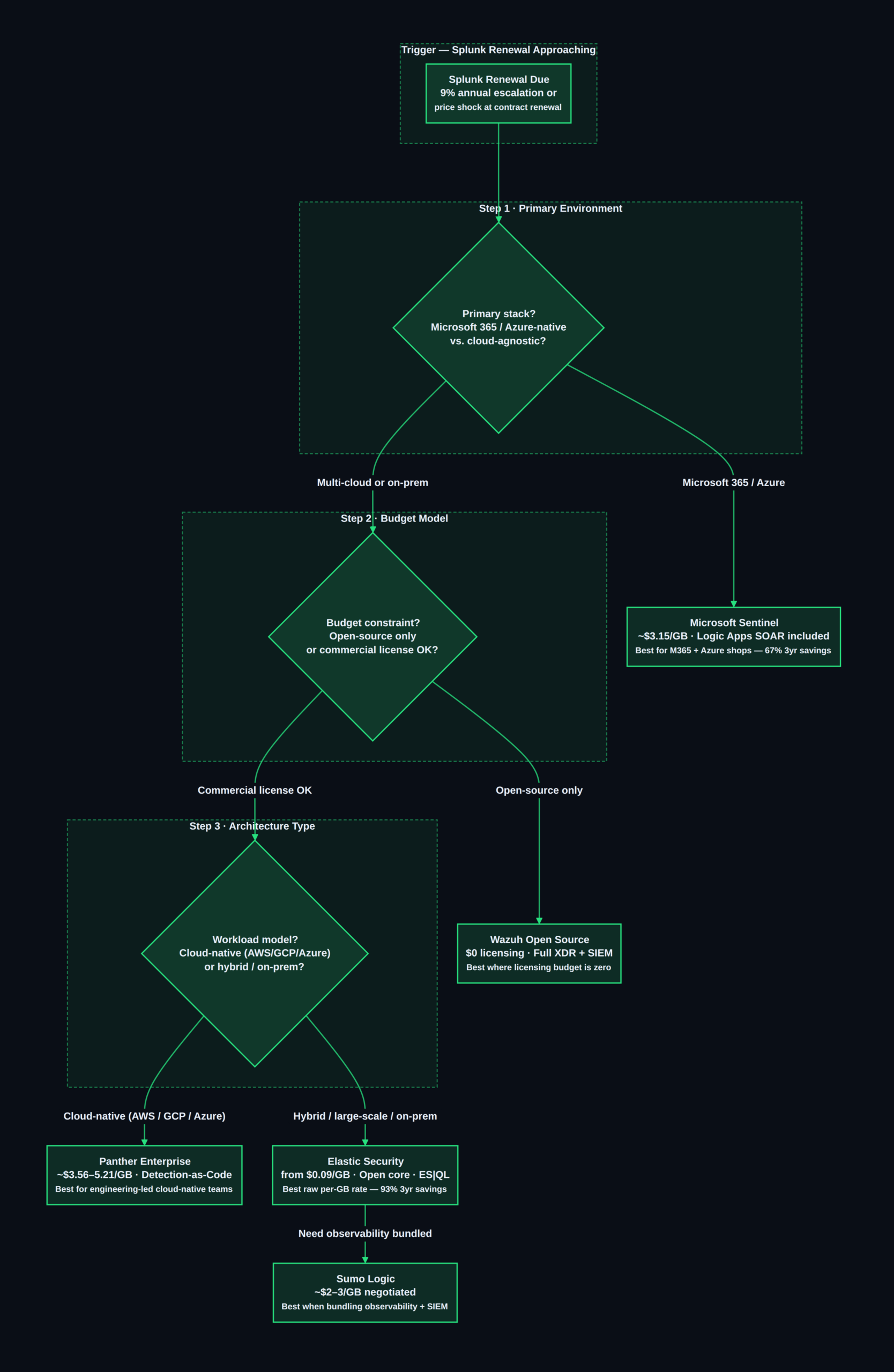
// 10 How to Choose: Decision Framework
Use the framework below to narrow the field before requesting vendor quotes.
// 11 Migration: What the $150K Actually Buys
The one-time migration cost used in the TCO model above covers four distinct work categories:
Rule translation (typically the largest effort, 40–60% of migration budget): SPL correlation rules do not map directly to KQL, EQL, or Python. A typical enterprise Splunk deployment has 200–500 active correlation rules; translating, testing, and tuning them in the target platform takes 6–12 weeks of a senior detection engineer's time. Automated translators exist for SPL-to-KQL (Microsoft provides tooling) but require manual validation on every rule.
Data source re-integration (20–30% of budget): Every log source needs a new connector, forwarder, or API integration in the target SIEM. Unsupported sources requiring custom connectors cost $10,000–$50,000 each. Sentinel's 200+ certified connectors and Elastic's agent ecosystem minimize custom work; Wazuh and Panther may require more custom development for non-standard sources.
Playbook migration (10–20% of budget): SOAR playbooks built in Splunk SOAR need to be rebuilt in Logic Apps (Sentinel), Elastic Workflows, or a third-party SOAR tool. Incident response workflows, escalation chains, and enrichment playbooks each require testing in the new environment.
Training and certification (10–15% of budget): Platform-specific certifications ($15,000–$25,000 per admin for year one) and hands-on lab time for the SOC team. KQL proficiency takes most SPL-fluent analysts 4–6 weeks to reach operational competency.
The $150K migration estimate is conservative for organizations with 100+ active use cases. Large enterprises with 500+ custom detection rules and extensive SOAR automation should budget $200K–$300K and a 6-month transition runway.
// 12 Conclusion
Splunk pricing alternatives 2026 deliver verified SIEM capability for 40–93% less than Splunk Cloud + Enterprise Security over a three-year horizon at 500 GB/day ingestion. Microsoft Sentinel is the strongest like-for-like replacement for Microsoft 365 and Azure environments, with SOAR and ML/UEBA included at no separate license fee. Elastic Security delivers the lowest per-GB commercial rate with an open-source data layer. Wazuh eliminates licensing cost entirely for teams able to staff the operational overhead. Panther serves engineering-led cloud-native teams who want detection logic in code, not UI workflows. Sumo Logic suits organizations consolidating security and observability under a single credit model.
The single most important step before signing a Splunk renewal: model your three-year TCO across at least two of these alternatives, including migration, staffing, and storage — not just the licensing line item. A $150K migration investment against $4M or more in cumulative savings is a straightforward FinOps calculation that security and finance can align on quickly.
See our Splunk to Microsoft Sentinel 60-day migration playbook for a step-by-step transition guide with connector priorities and rule translation strategies. If your SIEM must meet federal logging mandates, our 2026 federal cybersecurity logging requirements guide covering OMB M-26-14 covers which platforms satisfy mandatory log retention and forwarding requirements. For compliance reporting, our SOC 2 Type II checklist for SaaS companies maps SIEM event categories to Trust Services Criteria across each platform covered here.
For any query contact us at contact@cipherssecurity.com