
Selecting the best SIEM tools for mid-size enterprises in 2026 is harder than at any point in the past decade. The market has split into cloud-native AI-assisted platforms, legacy on-prem stalwarts rebuilt for hybrid deployments, and open-source challengers that now deliver production-grade detection without commercial licensing costs. At the same time, Cisco’s $28 billion acquisition of Splunk in March 2024 has reshaped enterprise pricing expectations, and AI-assisted detection — led by Microsoft Copilot for Security — is shifting evaluation criteria away from query language mastery toward analyst productivity at scale.
This guide evaluates eight platforms across detection quality, deployment model, cost structure, integration depth, and staffing requirements, using 2026 pricing benchmarks from publicly available vendor data and third-party procurement sources. The target audience: security managers and CISOs at organizations with 100 to 5,000 employees and SOC (Security Operations Center) teams numbering anywhere from two analysts to twenty.
// 01 Best SIEM Tools for Mid-Size Enterprises 2026: Evaluation Criteria
A SIEM — Security Information and Event Management — platform collects log data from across your environment (endpoints, network devices, cloud infrastructure, identity providers, and applications), correlates events into alerts, and surfaces suspicious activity for analyst investigation. Modern SIEMs extend into SOAR (Security Orchestration, Automation, and Response), meaning they can trigger automated playbooks in response to detections — enriching an alert with threat intelligence, opening a ticket, or isolating a compromised endpoint — without analyst intervention.
For mid-size enterprises in 2026, the evaluation criteria are:
- Detection quality: Pre-built rules, MITRE ATT&CK coverage (the MITRE ATT&CK framework is the industry-standard taxonomy cataloguing how attackers behave across 14 tactic categories and 196 sub-techniques), and false-positive rates in production
- Total cost of ownership: Per-GB ingestion, per-endpoint, flat ELA (Enterprise License Agreement), or infrastructure-only open-source models — and what professional services and tuning add on top
- Deployment model: Cloud-native, hybrid, on-premises, or self-hosted open-source
- Ecosystem fit: How cleanly the platform ingests data from your existing stack without custom parsers
- Staff requirements: Query language learning curve, tuning burden, and availability of managed service options for teams that cannot maintain a dedicated SIEM engineer
—
// 02 Splunk Enterprise Security: Market Leader at a Premium
Splunk Enterprise Security (ES) is the platform that defined the modern SIEM market. Its query language — SPL (Search Processing Language) — remains the most expressive in the industry for ad-hoc investigation, and the Splunkbase app ecosystem provides thousands of integrations, meaning nearly any data source has a pre-built connector and a community writing detection content against it.
Detection content: The ESCU (Enterprise Security Content Updates) package ships hundreds of detection rules mapped to MITRE ATT&CK, and SplunkSecurity publishes a continuous stream of community-validated detections covering threat actors from Lazarus Group to living-off-the-land ransomware precursors. For organizations with the expertise to tune this content, Splunk remains the most powerful analytics environment in the market.
Pricing in 2026: This is where Splunk creates friction for mid-size buyers. Post-acquisition, list pricing runs $150–$225 per GB/day for the base platform, with Splunk Enterprise Security typically priced at 1.5–2× the base platform rate — $250–$400 per GB/day. At a realistic 500 GB/day enterprise deployment, annual cost reaches $788,000 to $2.5 million depending on cloud versus on-premises, retention tier, and negotiated ELA terms. Cisco has pushed buyers toward bundled ELA structures that tie Splunk licensing to broader Cisco security product agreements, creating negotiation leverage but also long-term lock-in.
Verdict for mid-size enterprises: Teams with existing SPL expertise and budgets above $500,000/year have a clear case for Splunk. Organizations starting fresh, or whose budgets sit under that threshold, should complete a serious alternatives evaluation before committing. Self-hosted Splunk on-premises can reduce per-GB costs substantially, but shifts capacity planning, index management, and hardware refresh cycles onto your own team.
| Metric | Splunk Enterprise Security | |—|—| | Pricing model | Per GB/day (volume tiers) | | Est. annual cost (500 GB/day) | $788K – $2.5M | | Query language | SPL | | Deployment | Cloud, on-prem, hybrid | | AI features | Splunk AI / Cisco AI Assistant | | Best for | Large SOCs with existing SPL expertise |
—
// 03 Microsoft Sentinel: Best for Microsoft-Heavy Environments
Microsoft Sentinel is a cloud-native SIEM built on Azure Monitor infrastructure. For organizations standardized on Microsoft 365, Entra ID (formerly Azure Active Directory — Microsoft’s cloud identity platform), Defender for Endpoint, and Azure infrastructure, Sentinel is the most cost-effective platform among the best SIEM tools for mid-size enterprises in 2026 — often by a factor of two or more.
The economics: Sentinel ingests Microsoft 365 Defender, Entra ID sign-in and audit logs, and Defender for Endpoint telemetry at no additional charge for organizations on M365 E5 licensing. For Microsoft-centric environments, this free tier covers 30–50% of total log volume, dramatically reducing the paid ingestion bill. Paid ingestion runs $2.46–$5.20 per GB depending on commitment tier (PAYG is $5.20/GB; committing to 100 GB/day drops to $2.96/GB; 1,000+ GB/day enterprises reach $2.46/GB). At 500 GB/day, the effective annual cost is approximately $415,000 — roughly 47% less than a comparable Splunk deployment.
Query language: KQL (Kusto Query Language) — the same query language used across Azure Data Explorer and Log Analytics — is well-documented and easier to learn than SPL, though analysts still need 3–6 months to become productive at custom detection authoring.
AI integration: Sentinel’s native integration with Microsoft Copilot for Security is the most mature AI-SIEM integration on the market as of mid-2026. Analysts can query the environment in natural language (“show me all privileged identity changes in the last 72 hours”), generate automated incident summaries for triage handoffs, and produce remediation recommendations without writing a line of KQL. For under-staffed SOC teams, this is a genuine tier-1 productivity multiplier.
Limitations: Sentinel’s strength is its constraint. For heterogeneous environments — large Linux/Unix fleets, non-Microsoft SaaS applications, or bespoke application logs — the connector ecosystem lags Splunk. CEF (Common Event Format — a standardized log format used by most network appliances) and Syslog connectors cover most firewalls, switches, and routers, but normalizing custom application telemetry requires more engineering effort than comparable Splunk connectors.
| Metric | Microsoft Sentinel | |—|—| | Pricing model | PAYG or commitment tiers | | Est. annual cost (500 GB/day) | ~$415K (M365 E5 org) | | Query language | KQL | | Deployment | Cloud-native (Azure) | | AI features | Copilot for Security (native) | | Best for | Microsoft 365 / Azure-dominant environments |
—
// 04 Elastic Security: Best for Engineering-Led SOC Teams
Elastic Security combines SIEM, EDR (Endpoint Detection and Response — agent-based collection of and response to endpoint events), and cloud security posture management in a single platform. Its query language, EQL (Event Query Language), is purpose-built for sequence detection — correlating multiple events across time windows — which is essential for detecting multi-stage attacks that span initial access, privilege escalation, and lateral movement.
Cost advantage: Self-hosted Elastic on commodity hardware runs approximately $1/GB in infrastructure cost, making it the lowest-cost option among commercial-grade platforms. SIEMCostCalculator.com benchmarks Elastic Cloud (managed) at $3–$6/GB depending on cluster size — competitive with Sentinel, but without the free Microsoft telemetry benefit.
Detection content: Elastic ships thousands of pre-built detection rules via its public GitHub repository under an Apache 2.0 license. MITRE ATT&CK coverage is strong and improving with each release. Elastic also supports Sigma rules — a vendor-neutral detection rule format that can be compiled to EQL, SPL, KQL, or Splunk syntax, giving teams flexibility to maintain platform-neutral detection content.
Operational cost: This is Elastic’s hidden cost for mid-size enterprises. Self-hosted deployments require Elasticsearch cluster management, ILM (Index Lifecycle Management — policies that automatically move data through hot, warm, and cold storage tiers to control costs), capacity planning, and ongoing tuning of shard allocation and retention. Teams without a dedicated Elastic engineer — or a managed service contract — consistently underperform on their investment. Elastic Cloud (managed) removes infrastructure burden but narrows the cost advantage to the point where Sentinel is often cheaper for Microsoft shops.
| Metric | Elastic Security | |—|—| | Pricing model | Per GB (cloud) / infrastructure cost (self-hosted) | | Est. annual cost (100 GB/day, self-hosted) | $30K – $80K infra | | Query language | EQL / KQL | | Deployment | Managed cloud or self-hosted | | AI features | Elastic AI Assistant | | Best for | Engineering-led teams; cost-sensitive shops with ops expertise |
—
// 05 IBM QRadar: Best for Compliance-Heavy Verticals
IBM Security QRadar SIEM is one of the oldest enterprise SIEM platforms and retains strong positioning in compliance-heavy verticals — financial services, healthcare, and regulated government — where its 700+ pre-built integrations and long audit trail with compliance frameworks (PCI DSS, HIPAA, SOX, ISO 27001) carry weight with external auditors.
QRadar’s pricing scales from approximately $10,000/year for smaller deployments to $300,000+ for large organizations — making it accessible for mid-size enterprises that need proven compliance reporting without a blank-check budget. Its out-of-the-box offense detection quality (QRadar uses the term “offense” for correlated alerts) for network-based threats — using NetFlow (network traffic flow metadata exported by routers and switches showing source/destination IPs, ports, and byte counts) alongside log correlation — is a differentiation point over purely log-based SIEMs.
IBM has been transitioning QRadar to QRadar as a Service on AWS, and organizations evaluating QRadar should have a clear 3-year roadmap discussion with IBM about the on-premises versus cloud-hosted trajectory before signing.
—
// 06 CrowdStrike Falcon Next-Gen SIEM: Best for CrowdStrike-First Shops
CrowdStrike Falcon Next-Gen SIEM is built on LogScale (formerly Humio), which uses index-free ingestion — log data is stored compressed and parsed at query time rather than indexed at ingest, enabling near-linear storage scaling at very high data volumes without the index management overhead of traditional SIEM platforms.
For organizations that have already deployed CrowdStrike Falcon EDR, the integration is seamless: endpoint telemetry, process trees, network connections, and threat intelligence from CrowdStrike’s Counter Adversary Operations (the threat research unit that tracks 230+ named adversaries) all flow natively into the SIEM without custom parsers. FLTR (Falcon LogScale Query Language) is concise and fast, with a lower learning curve than SPL for analysts new to structured log querying.
The platform’s primary limitation is ecosystem coupling: Falcon Next-Gen SIEM reaches its potential when CrowdStrike Falcon is the primary EDR. Organizations with heterogeneous endpoint security stacks or where a different vendor owns endpoint coverage will lose a significant portion of the native integration value.
—
// 07 Wazuh: Best Open-Source Option
Wazuh is a free, open-source security platform that combines SIEM, XDR (Extended Detection and Response — a broader category that unifies endpoint, network, and identity telemetry into a single detection and response plane), and compliance monitoring under a single agent and manager architecture. It ships with pre-built compliance dashboards for PCI DSS, HIPAA, GDPR, and NIST CSF out of the box, FIM (File Integrity Monitoring — detecting unauthorized file changes on endpoints and servers), vulnerability detection against NVD (National Vulnerability Database) CVE data, and a rules engine covering common attack patterns.
For organizations under 50 GB/day log volume with internal Linux/infrastructure skills, Wazuh’s effective cost is infrastructure only — typically commodity servers or modestly sized cloud VMs. The Wazuh Manager pairs with an OpenSearch or Elasticsearch backend for indexing and visualization.
Detection depth: Wazuh ships with thousands of default rules covering Windows Event IDs, Linux auditd, web server access logs, and common security appliance log formats. The rules syntax is XML-based and extensively documented. Detection sophistication for complex multi-stage attacks lags behind Splunk’s ESCU or Elastic’s detection-rules library, but for a team building its first SOC or seeking to supplement a commercial SIEM with an open-source tier for high-volume, low-value log sources, Wazuh is a genuine production-grade option.
Wazuh is also increasingly used as a forward-deployed collector — agents on endpoints ship normalized alerts upstream to a commercial SIEM, reducing ingestion volume (and cost) by pre-filtering noisy telemetry at the edge.
—
// 08 LogRhythm and EXABEAM: Established Midmarket Option
LogRhythm acquired Exabeam in 2024 to create a combined entity (now operating under the EXABEAM brand) that pairs LogRhythm’s traditional SIEM strengths — detection, compliance, and analyst workflow in one package — with Exabeam’s leading UEBA (User and Entity Behavior Analytics — ML-based detection of anomalous user behavior, such as unusual login patterns or data access volumes that indicate a compromised account or insider threat) capabilities.
For midmarket organizations that want a conventional SIEM experience with on-premises data residency — a hard requirement in some regulated industries and jurisdictions — LogRhythm’s appliance-based deployment is an established option. The combined platform now competes more directly with Splunk UBA on behavioral analytics depth, while remaining accessible at subscription pricing points between $60,000 and $250,000/year for mid-size deployments.
—
// 09 Side-by-Side Pricing Summary (2026)
All cost estimates are approximate, based on publicly available benchmarks and industry procurement data. Actual costs vary significantly based on negotiated terms, existing vendor relationships, and deployment model.
| Platform | Pricing Model | Est. Annual Cost (100 GB/day) | Est. Annual Cost (500 GB/day) | Best For | |—|—|—|—|—| | Splunk ES | Per GB/day | $200K – $500K | $788K – $2.5M | Large SOCs; SPL expertise | | Microsoft Sentinel | Per GB (PAYG / tiers) | $90K – $160K | ~$415K (M365 E5 org) | Microsoft / Azure environments | | Elastic Security | Per GB (cloud) or infra | $30K – $80K (self-hosted) | $150K – $300K (cloud) | Engineering-led teams | | IBM QRadar | Subscription / appliance | $50K – $150K | $150K – $300K | Compliance-heavy verticals | | CrowdStrike Falcon SIEM | Platform-bundled | Vendor-quoted | Vendor-quoted | CrowdStrike EDR shops | | Wazuh | Infrastructure only | $5K – $20K | $20K – $60K | Budget-constrained; first SOC | | LogRhythm / EXABEAM | Subscription | $60K – $150K | $150K – $250K | Midmarket; UEBA focus |
—
// 10 SIEM Selection Decision Tree
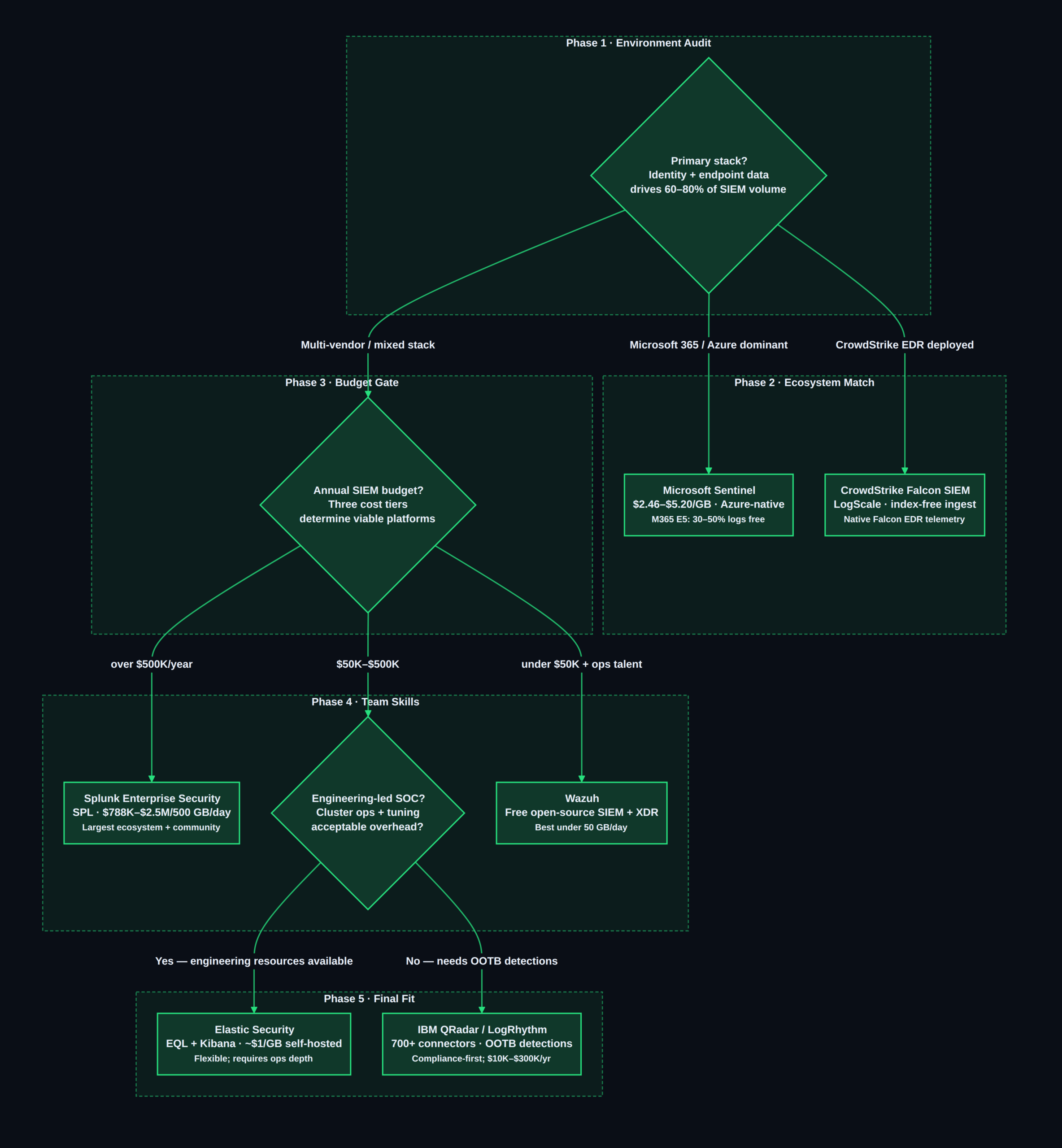
The diagram below maps the most common evaluation paths for mid-size organizations selecting a SIEM in 2026. Start at Phase 1 — your primary environment determines which platforms deserve the deepest evaluation.
—
// 11 Five Questions to Ask Every SIEM Vendor
Before shortlisting any platform, require concrete answers to these five questions. Vendors that deflect or respond with marketing material are telling you something.
- MITRE ATT&CK coverage depth: How many of the 196 ATT&CK sub-techniques have out-of-the-box detection rules mapped to them? Ask for the published detection-to-technique mapping spreadsheet, not a percentage claim. Coverage below 30% means your team will be writing most detection logic from scratch.
- False positive rate at your data volume: Request a reference customer at a similar daily ingest volume. An alert backlog exceeding 5% actionable rate is a staff burnout risk; vendors routinely demo against clean datasets that bear no resemblance to production telemetry.
- Total cost of ownership: Ask for a year-one and year-three TCO estimate that includes storage and retention costs, initial deployment professional services, annual tuning support, and query license costs if applicable. Vendors quote ingestion price; TCO is typically 1.5–3× that figure once professional services and storage retention are included.
- SOAR capability: Does the platform include native SOAR, or does tier-1 automation require a separate product license? For mid-size SOCs, native SOAR that handles alert enrichment, ticket creation, and basic isolation playbooks can offset the equivalent of a junior analyst headcount annually.
- Data residency and compliance certification: If your organization handles EU personal data under GDPR, US federal government data requiring FedRAMP authorization, or protected health information (PHI) under HIPAA, confirm which regions data is stored in and whether the vendor holds relevant certifications — and whether those certifications extend to your specific deployment configuration.
—
// 12 AI-Assisted Detection in 2026: What Works
Three platforms have moved meaningfully ahead of the field on AI-assisted SIEM capabilities, and the differentiation is real enough to factor into procurement decisions.
Microsoft Sentinel + Copilot for Security is the most production-ready AI-SIEM integration as of mid-2026. Natural-language incident summaries, automated triage reports, and KQL query generation from English-language questions are stable features in production. Analysts report 30–40% reductions in mean MTTR (Mean Time to Respond — the average time from alert to remediation) on incident types that previously required senior analyst involvement for initial triage.
Splunk AI delivers anomaly detection via the Splunk Machine Learning Toolkit and an AI assistant for SPL query generation. The feature set is mature but tightly coupled to Splunk’s licensing tiers; accessing AI-assisted detection requires specific Splunk Cloud or Splunk Enterprise license levels.
Elastic AI Assistant can explain why a specific detection fired, suggest remediation steps, and help analysts write new EQL detection rules against their own cluster data. It requires configuration and does not reach the natural-language depth of Copilot for Security out of the box, but for self-hosted Elastic deployments it is the most controllable option — the model operates against your local data without telemetry leaving your environment.
A clear-eyed assessment: AI features in 2026 accelerate tier-1 triage and reduce time-to-investigate for experienced analysts. They do not replace detection engineers who write and maintain custom rules tuned to your specific environment and adversary profile.
—
// 13 Conclusion
Identifying the best SIEM tools for mid-size enterprises in 2026 is ultimately an environment-fit exercise, not a universal ranking. Microsoft Sentinel wins for Microsoft 365 and Azure-heavy organizations where native ingestion economics and Copilot for Security’s AI triage are genuinely hard to beat. Splunk remains the most powerful analytics platform for organizations with SPL expertise and budgets above $500,000, but post-Cisco acquisition pricing pressure is accelerating migration conversations. Elastic Security is the right call for engineering-led teams that want flexibility, cost control, and open-source detection content — provided they staff for the operational overhead. Wazuh is a production-grade choice for organizations under 50 GB/day that cannot justify commercial licensing, or as a cost-reduction layer that pre-filters high-volume telemetry before forwarding to a commercial SIEM.
Whichever platform you select, the platform is only as effective as the detection content running on it and the analysts tuning it. Start from your environment’s primary data sources, set a realistic three-year TCO ceiling, and match the platform to your team’s actual skills — not the vendor’s benchmark environment.
See also:
- SOC 2 Type II compliance checklist for SaaS companies — the audit controls your SIEM evidence pipeline will need to satisfy
- Adversary-in-the-middle phishing detection for Microsoft 365 — SIEM detection rules for the most common initial access vector in 2026
- EDR vendor breach: downstream risk and response — what to evaluate when your security vendor itself is the breach surface
For any query contact us at contact@cipherssecurity.com