
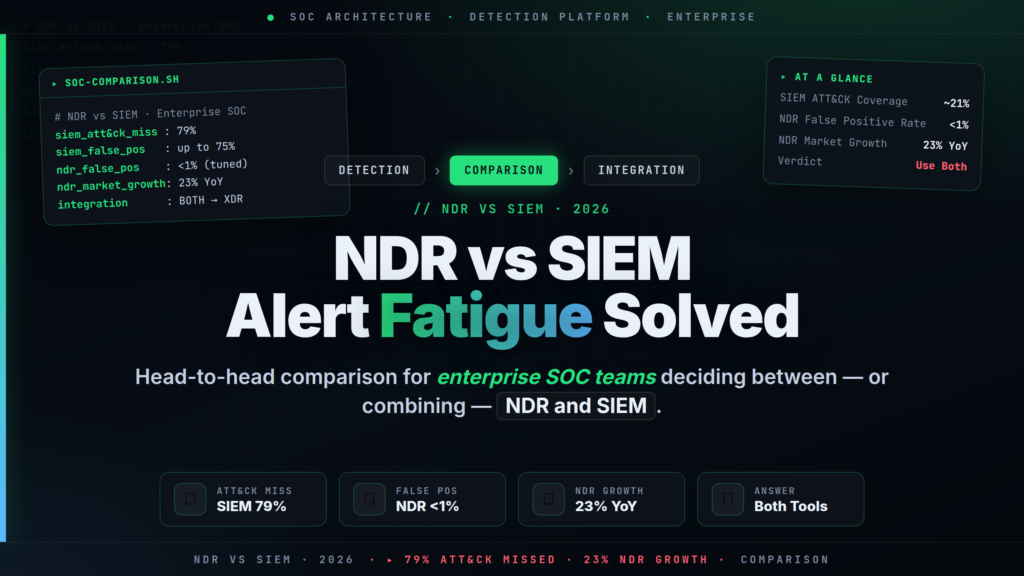
NDR vs SIEM enterprise SOC tooling is the most consequential platform decision security teams are making right now: between 42% and 63% of all security alerts go entirely uninvestigated, and alert fatigue is cited by security managers as a primary driver of SOC analyst attrition. This guide compares NDR (Network Detection and Response — a security technology that monitors raw network traffic and applies behavioral AI and machine learning to detect anomalous activity) and SIEM (Security Information and Event Management — a platform that aggregates, correlates, and stores log data from across the enterprise) across the dimensions that matter to SOC architects — detection coverage, false-positive rates, deployment complexity, total cost of ownership, and integration architecture.
—
// 01 The Alert Fatigue Problem: Why Your SIEM Is Burning Out Your Team
SIEM has been the backbone of SOC (Security Operations Center) operations for over two decades. But it was designed for a world of bounded log volumes and signature-based threat detection. In 2026, that world no longer exists.
According to SANS research, 73% of security teams cite false positives as their top detection challenge. Between 42% and 63% of all security alerts are never investigated. Gartner estimates that SIEM false-positive rates can reach 75% in enterprises without dedicated tuning teams. The result: analyst exhaustion, missed detections, and staff turnover that costs organizations $100,000–$300,000 per experienced analyst replaced.
The root causes are structural:
- Rule brittleness: Most SIEM correlation rules fire on individual log events. An estimated 13% of SIEM rules are entirely non-functional — they match no real data patterns but still generate alerts on matching criteria.
- Log-only visibility: SIEM sees only what generates a log. Encrypted network traffic, lateral movement over valid protocols, and credential misuse in east-west sessions are largely invisible.
- Volume without context: A typical enterprise SIEM ingests hundreds of gigabytes of logs daily. Correlation without behavioral baselines means every deviation from a rule triggers an alert — not just suspicious ones.
—
// 02 What Is NDR and How It Works Differently
NDR approaches the detection problem from the opposite direction. Rather than ingesting logs generated by other systems, NDR captures network telemetry at the packet or flow level and builds behavioral baselines for every host, subnet, and connection pattern.
The practical implication: NDR detects threats that never touch a log file.
Consider this production case published by Corelight: a sensor processed 847 network anomalies in 24 hours; machine learning flagged 312 as potentially malicious; after automated correlation and triage, only 4 required actual analyst action. Without behavioral correlation, those same 847 anomalies would land in a SIEM rule queue and generate hundreds of individual alerts requiring manual review.
NDR tools from vendors like Vectra AI, Corelight, and Fortinet FortiNDR share three core capabilities:
- Behavioral baselining: Every host, user, and subnet gets a normal traffic profile. Deviations — not just rule matches — trigger investigation priority scoring.
- Encrypted traffic analysis: 87% of modern cyberattacks use encrypted channels. NDR analyzes TLS metadata using JA3/JA4 certificate fingerprinting (techniques that identify the TLS client or server by the parameters they negotiate, even when session content is encrypted) and behavioral pattern deviation, without breaking encryption or requiring decryption infrastructure.
- East-west visibility: NDR monitors internal traffic between hosts — the communication paths attackers use after initial compromise, which firewalls and perimeter tools do not see.
—
// 03 NDR vs SIEM Enterprise SOC: Detection Coverage Head-to-Head
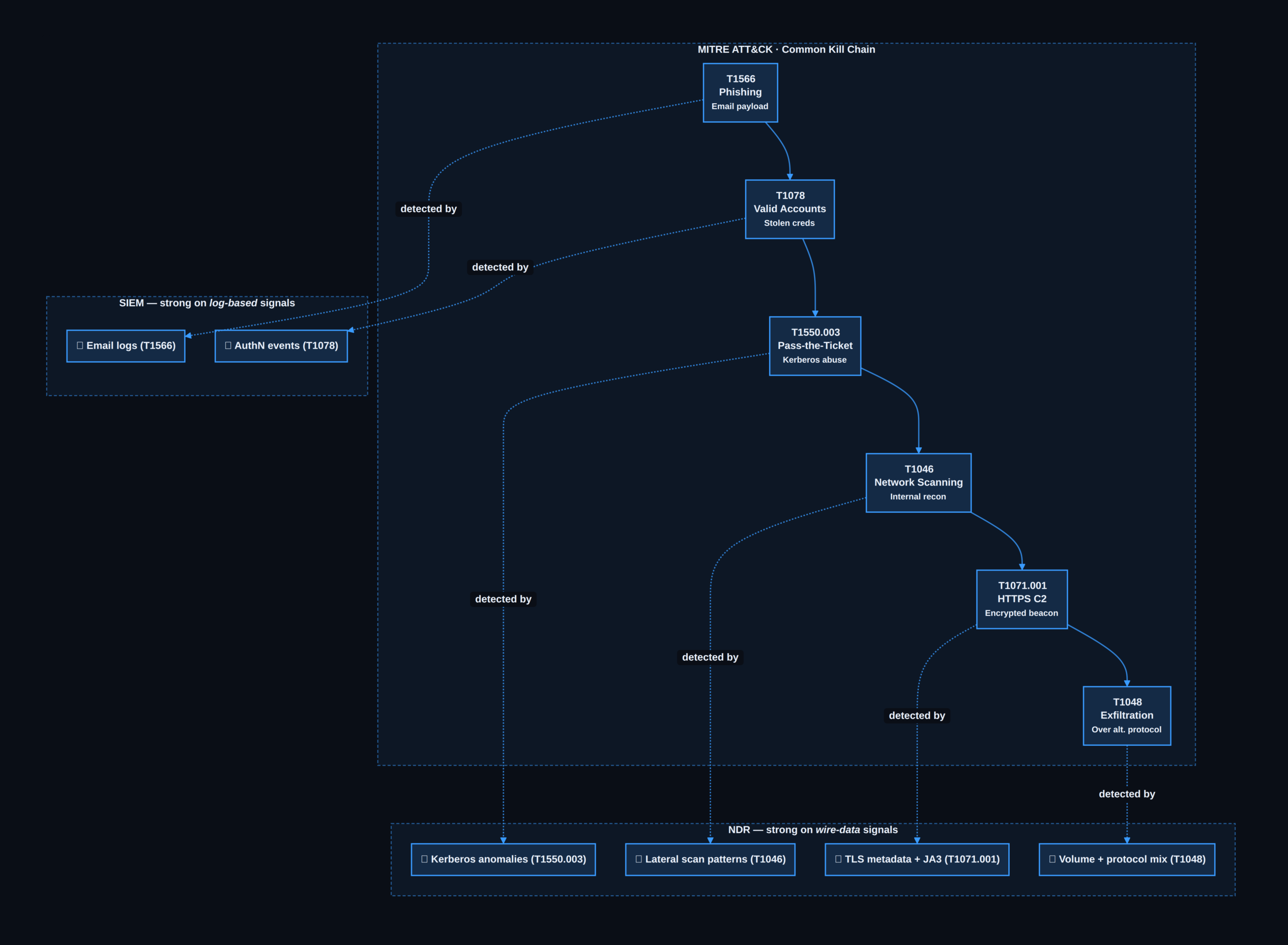
The most damaging statistic for legacy SIEM deployments: enterprise SIEMs miss 79% of MITRE ATT&CK techniques out of the box. That figure reflects a fundamental architectural gap, not a configuration failure.
The MITRE ATT&CK framework (the industry-standard taxonomy of adversary tactics and techniques, maintained by the MITRE Corporation and widely used by SOC teams worldwide) catalogs over 400 techniques across 14 tactic categories. SIEM detects most reliably in the initial access and credential-access categories, where authentication logs and firewall events generate clear signals. It struggles everywhere else.
NDR’s detection strengths map directly to SIEM’s blind spots:
| Technique Category | SIEM Detection | NDR Detection |
|---|---|---|
| Lateral Movement (TA0008) | Partial — requires endpoint logs | Strong — sees all east-west traffic |
| Command & Control (TA0011) | Weak — misses encrypted C2 | Strong — JA3/JA4 fingerprinting |
| Exfiltration (TA0010) | Log-dependent | Strong — volume/destination anomalies |
| Defense Evasion (TA0005) | Weak — LOTL bypasses rules | Moderate — behavioral deviation |
| Discovery (TA0007) | Moderate — Sysmon required | Strong — network scanning detected |
| Credential Access (TA0006) | Strong — auth logs | Moderate — Kerberos traffic patterns |
| Initial Access (TA0001) | Moderate — firewall/proxy | Moderate — beaconing detection |
The living-off-the-land (LOTL) gap deserves specific attention. LOTL attacks are intrusions that use built-in OS tools — PowerShell, WMI (Windows Management Instrumentation), RDP (Remote Desktop Protocol), PsExec — alongside valid credentials rather than malware. 79% of attacks are now malware-free, meaning attackers operate within the bounds of legitimate tooling. SIEM rule libraries are built around detecting malicious files and known-bad indicators; they offer limited coverage when nothing inherently suspicious touches disk.
NDR’s behavioral baseline approach closes this gap. When a domain admin account that normally connects to three servers suddenly begins authenticating to 40 endpoints in rapid succession — a technique called Pass the Ticket (T1550.003, where an attacker uses a stolen Kerberos ticket to impersonate a legitimate user) — NDR flags the statistical deviation. The SIEM, unless specifically tuned with a custom rule for that account’s historical baseline, typically does not.
Real-world validation: During a 2026 NDR evaluation at an energy company, security analysts uncovered 234 Declarations of Compromise across 20 active threat campaigns targeting 213 assets — none of which had been detected by the organization’s existing IDS (Intrusion Detection System), EDR (Endpoint Detection and Response — agent-based endpoint monitoring), or SOAR (Security Orchestration, Automation and Response — automated incident response workflow engine) tools.
—
// 04 Integration Architecture: The SOC Visibility Triad
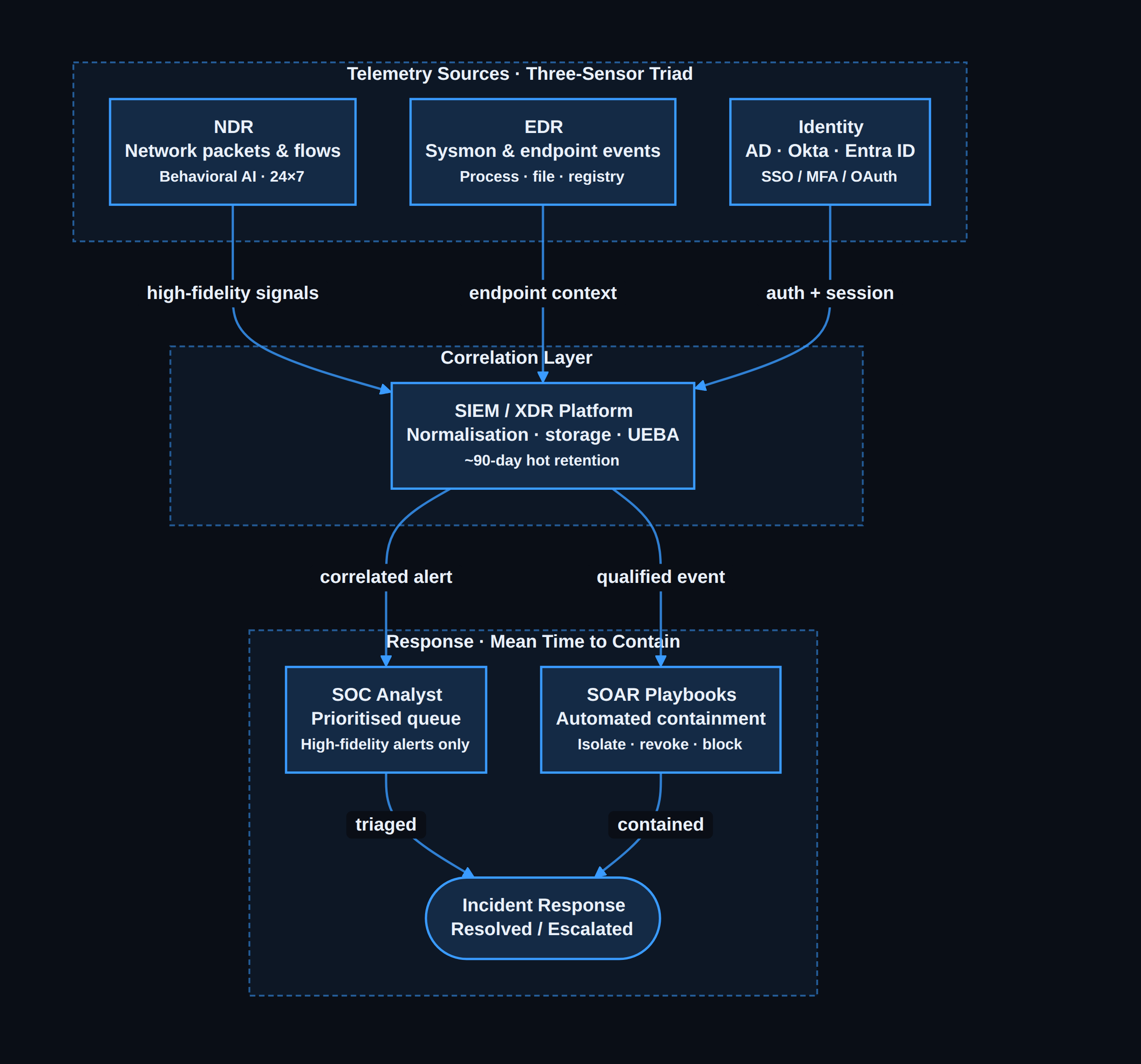
The 2026 consensus among enterprise security architects is that NDR and SIEM are complementary, not competing. The optimal deployment is the SOC Visibility Triad: NDR for network behavioral detection, EDR for host forensics, and SIEM for cross-source correlation, log retention, and compliance reporting.
In this architecture, the data flow works as follows:
- NDR sensors deploy passively on network taps or SPAN ports (mirror ports on switches that copy traffic to the sensor — no agents, no configuration changes on endpoints or servers) and begin baselining traffic behavior within hours of deployment.
- NDR outputs high-fidelity behavioral signals — not raw packet events — via API or native SIEM connector. What arrives in the SIEM queue is pre-correlated, pre-filtered, and ranked by a confidence score, not a rule match count.
- SIEM correlates NDR signals with authentication logs, endpoint events, and cloud activity, providing the cross-source enrichment and audit trail that compliance frameworks require. The SIEM becomes an investigation and compliance tool rather than a primary detection engine.
- SOAR playbooks trigger automated containment actions — network quarantine, account suspension, ticket creation — based on combined signal confidence thresholds, without requiring analyst approval for low-ambiguity events.
The result: SOC analysts stop triaging individual log events and start working confirmed behavioral detections with full context already assembled.
—
// 05 When to Deploy NDR First vs SIEM First
Not every organization starts from zero. The deployment sequence decision depends on where the current detection gap is most severe:
Deploy NDR first when:
- Your SIEM generates more than 1,000 alerts per analyst per day with no realistic path to reducing tuning debt
- Significant numbers of unmanaged devices, OT (Operational Technology) systems, or IoT endpoints cannot run EDR agents — network monitoring is the only visibility option
- A recent breach or red team engagement revealed lateral movement the SIEM missed entirely
- Time-to-value is critical — NDR sensors produce prioritized detections within days, not months
Extend SIEM before adding NDR when:
- Compliance mandates such as PCI-DSS, SOX, or FedRAMP primarily drive log retention requirements and your detection gap is secondary
- The environment is endpoint-heavy with mature Sysmon or EDR telemetry already feeding SIEM with quality data
- The primary detection gap is user behavior anomalies (insider threat, compromised accounts) where UEBA-enriched SIEM rules provide better coverage than network sensors
- Budget constraints require phased investment over 18–24 months with maximized use of existing licenses
Move to a unified XDR platform when:
- You are replacing a legacy SIEM license at renewal and can reset the architecture
- The SOC team is fewer than five analysts and cannot maintain two separate platforms operationally
- Cloud-native workloads now represent more than 40% of monitored infrastructure, where traditional network sensors provide limited coverage
—
// 06 Compliance Requirements: NIS2, DORA, and HIPAA
Regulatory pressure is increasingly pushing enterprises toward both detection layers simultaneously.
NIS2 (the EU’s updated Network and Information Systems Directive, which expanded mandatory security requirements across 18 critical sectors in 2024) requires both log retention — the domain of SIEM — and continuous monitoring with rapid incident detection — the domain of NDR. Organizations using only SIEM cannot demonstrate the real-time detection capability the directive requires.
DORA (the Digital Operational Resilience Act for EU financial services entities, effective January 2025) requires initial incident notification within 4 hours of detection. Achieving that window consistently requires NDR’s sub-minute detection speed feeding SIEM’s audit and ticketing infrastructure. Manual investigation of SIEM alert queues typically cannot meet that timeline.
HIPAA and ISO 27001 auditors are increasingly requesting evidence of both network-layer and log-layer monitoring coverage in their assessment questionnaires. Enterprises relying solely on SIEM are finding that auditors treat missing network behavioral monitoring as a material gap.
—
// 07 NDR vs SIEM Enterprise SOC: The 2026 Decision Framework
The market is moving in one direction. The SIEM market grew at 20% annually in 2024 and slowed to 4% in 2025. The NDR market is growing at 23% year-over-year. Gartner published its inaugural NDR Magic Quadrant in May 2025, signaling that NDR has graduated from a niche network monitoring discipline to a core SOC platform category. Forty-four percent of organizations surveyed in 2025 planned to replace their SIEM entirely — but the more accurate framing is consolidate: organizations replacing legacy SIEM with XDR platforms are collapsing the SIEM + NDR architecture into a single licensed product, not abandoning correlation or log retention.
For enterprise SOC architects, the practical question is not “NDR or SIEM” but “how do I structure the detection pipeline to reduce analyst burden while increasing MITRE ATT&CK coverage?” The answer in 2026 is network-layer behavioral detection feeding a high-fidelity correlation layer — whether that combination is two integrated point solutions or a unified XDR platform.
The single most important operational step for teams with active alert fatigue: deploy NDR sensors passively on core network segments (at minimum: internet egress, data center core, and Active Directory subnet traffic), integrate the output with your existing SIEM via the vendor’s native connector, and suppress SIEM rules that duplicate the detection logic the NDR already covers. Most organizations that follow this approach report SIEM alert volume dropping 40–70% within the first 30 days, without any reduction in actual detection coverage.
Subscribe to our weekly threat digest for ongoing coverage of SOC tooling and detection engineering developments →
—
See also:
- Zero Trust Architecture and Data Movement Gaps — network segmentation changes that make both NDR and SIEM more effective
- Criminal IP and Securonix ThreatQ: Enhancing Threat Intelligence Feeds — integrating threat intelligence into SOC detection platforms
- Threat Actor Opsec and Evasion Playbook — how adversaries evade SIEM rule-based detection and what NDR catches instead
For any query contact us at contact@cipherssecurity.com