
Zero trust vs SASE enterprise network security is the defining architectural decision for distributed organizations in 2026: Gartner projects that 60% of new SD-WAN purchases will integrate into a single-vendor SASE offering by year-end, while CISA’s Zero Trust Maturity Model v2.0 mandates that federal agencies reach the Advanced tier across all five pillars before FY2026 audit cycles close. These frameworks overlap, compete, and — in mature deployments — coexist. This guide breaks down exactly where each model applies, how leading vendors implement them, and which topology should drive your decision.
// 01 Zero Trust vs SASE Enterprise Network Security: Core Architectural Differences
The confusion between zero trust and SASE starts with scope. Zero trust is a security philosophy built around one axiom: never trust, always verify. Every access request — regardless of whether it originates inside or outside the corporate network — must be authenticated, authorized, and continuously re-validated against policy. NIST SP 800-207 formalizes this as the authoritative reference architecture. Zero trust prescribes a posture, not a product.
SASE (Secure Access Service Edge, pronounced “sassy”) is an architectural framework first defined by Gartner in 2019. It converges two traditionally siloed domains — network connectivity and network security — into a single cloud-delivered service fabric distributed across global Points of Presence (PoPs — cloud data centers positioned close to users and branch offices to minimize latency). Zero trust, specifically ZTNA (Zero Trust Network Access — the access-control layer that replaces VPN by granting per-application connectivity instead of network-level access), is one of SASE’s constituent components. It is not a competing model; it is a subset.
The key distinction: you can deploy ZTNA without SASE. You cannot deploy complete SASE without ZTNA.
// 02 How SASE Architecture Works: The Five Core Components
A full SASE deployment combines SD-WAN (Software-Defined Wide Area Network — technology that abstracts physical network links such as MPLS, broadband, and LTE into a software-managed overlay, routing traffic based on application policy rather than static routes) with a cloud-native security stack called SSE (Security Service Edge — the security-only slice of SASE, excluding the WAN layer). The equation is: SASE = SD-WAN + SSE.
Gartner’s original five components, all of which must be present in a platform to qualify as full SASE:
| Component | What It Does | What It Replaces | |———–|————-|—————–| | SD-WAN | Intelligent traffic routing across internet, MPLS, and LTE | Legacy MPLS WAN circuits | | ZTNA | Per-application access with continuous identity verification | Corporate VPN | | SWG (Secure Web Gateway) | Filters and inspects outbound web traffic; blocks malicious sites, enforces policy | On-prem web proxy appliances | | CASB (Cloud Access Security Broker) | Visibility and control over SaaS usage and cloud data flows | Shadow IT monitoring tools | | FWaaS (Firewall-as-a-Service) | Stateful packet and session inspection in the cloud | Physical branch NGFW appliances |
Modern platforms in 2025–2026 layer additional capabilities on top: RBI (Remote Browser Isolation — executing web browsing sessions inside a cloud container so any malicious page code never reaches the endpoint device), DLP (Data Loss Prevention), DEM (Digital Experience Monitoring), and DNS security filtering. Gartner’s 2026 forecast distinguishes between single-vendor SASE (one platform, one policy engine, one management console) and multi-vendor SASE (best-of-breed SSE layered on a separate SD-WAN solution from a different vendor). Single-vendor is gaining dominance in greenfield deployments because it eliminates integration complexity and provides unified telemetry.
// 03 Zero Trust Network Access (ZTNA) in Depth
ZTNA is the access layer of zero trust — the component that surgically replaces VPN by granting connectivity to specific applications rather than dropping users onto a routable network segment.
The Identity-Aware Proxy Model
Traditional VPN grants a user full Layer 3 (network-level) access to a subnet upon authentication. An attacker who steals those VPN credentials can then port-scan, pivot, and move laterally (the technique where an attacker compromises one system and uses it as a foothold to access additional systems on the same network) across the entire subnet. ZTNA inverts this model: a user never joins a network segment. Instead, an IAP (Identity-Aware Proxy — a cloud or on-premises enforcement point that brokers connections on behalf of users without exposing application IPs) evaluates four conditions before forwarding a session to a specific application:
- Identity: Is this user’s identity confirmed via the IdP (Identity Provider — a system such as Okta, Microsoft Entra ID, or Google Workspace that centrally manages and asserts user identities via SAML 2.0 or OIDC)?
- Device posture: Does this device satisfy policy? Checks include patch currency, endpoint detection agent status, disk encryption, and OS version.
- Context: Does the request match expected parameters — geolocation, access time, network type?
- Application entitlement: Does this user’s role permit access to this specific application?
Only when all four checks pass does the proxy broker the connection. The user’s device never receives the application’s internal IP address, and the application’s port is never exposed to the internet. This eliminates the VPN subnet exposure entirely, making ZTNA one of the most impactful controls for lateral movement prevention available in 2026.
CISA Zero Trust Maturity Model v2.0
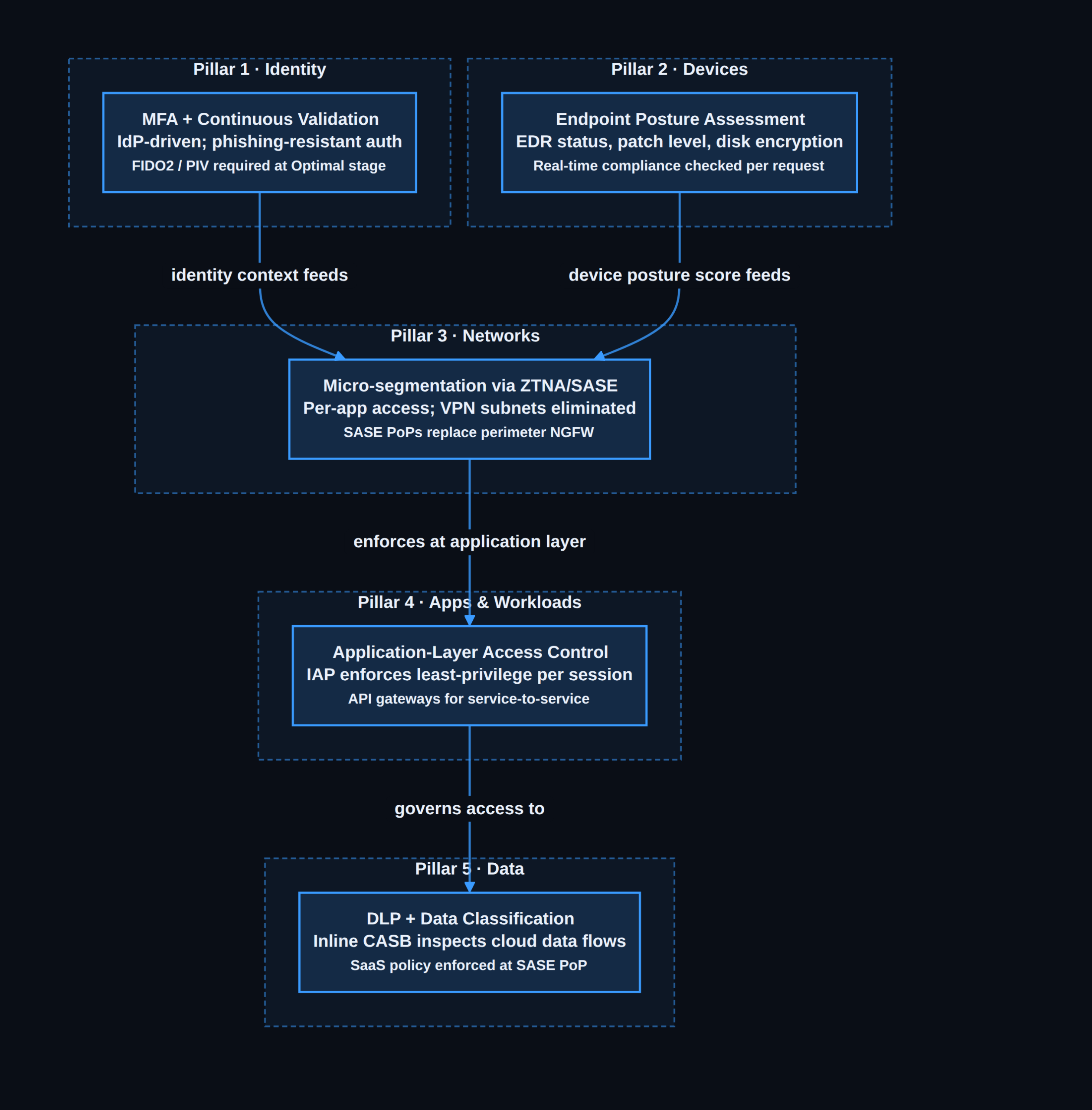
CISA’s Zero Trust Maturity Model v2.0 defines five security pillars — Identity, Devices, Networks, Applications & Workloads, and Data — with four maturity stages per pillar: Traditional, Initial, Advanced, and Optimal. OMB Memorandum M-22-09 directed federal agencies to meet the Advanced tier by the end of FY2024; 2026 FISMA (Federal Information Security Management Act) audit cycles are enforcing compliance with escalating consequence. CISA explicitly recommends private access service edges (SASE/SSE) over perimeter firewalls at the Advanced and Optimal stages for the Networks pillar. For non-federal enterprises, the model provides a structured maturity roadmap that maps cleanly to procurement decisions.
// 04 Zero Trust vs SASE: Head-to-Head for Enterprise Decision-Makers
The table below captures the operational realities for architects choosing between a ZTNA-first approach and a full single-vendor SASE migration.
| Dimension | ZTNA-First Deployment | Full Single-Vendor SASE | |———–|———————-|————————| | Scope | Application access control only | Full WAN + security convergence | | Replaces | VPN | VPN + MPLS + branch NGFW + web proxy | | Deployment speed | Weeks (agent-based or agentless) | Months (SD-WAN CPE at every branch) | | Initial cost | Low — no new network hardware | Higher — CPE hardware + licensing | | Lateral movement prevention | Strong — no network-level access granted | Strong — ZTNA component included | | Internet traffic inspection | Not included (SWG sold separately) | Built-in SWG + FWaaS + RBI | | CASB / SaaS visibility | Requires separate product | Built-in | | SD-WAN / WAN optimization | Not included | Core component | | Best topology | Cloud-first, VPN replacement | Multi-branch, MPLS migration | | CISA Advanced tier | Satisfies Networks pillar | Satisfies Networks + Data + Workloads | | Operational complexity | Low — single-function | Moderate — feature-rich, unified |
The critical insight for 2026: most enterprises will not choose between zero trust and SASE — they will start with ZTNA to eliminate VPN and achieve fast lateral-movement containment, then expand toward full SASE as they decommission MPLS circuits and consolidate branch security appliances. Gartner calls this the “SSE-first” on-ramp to SASE.
// 05 Vendor Landscape: Zscaler, Cloudflare One, and Palo Alto Prisma Access
Zscaler: The Enterprise Standard for SASE at Scale
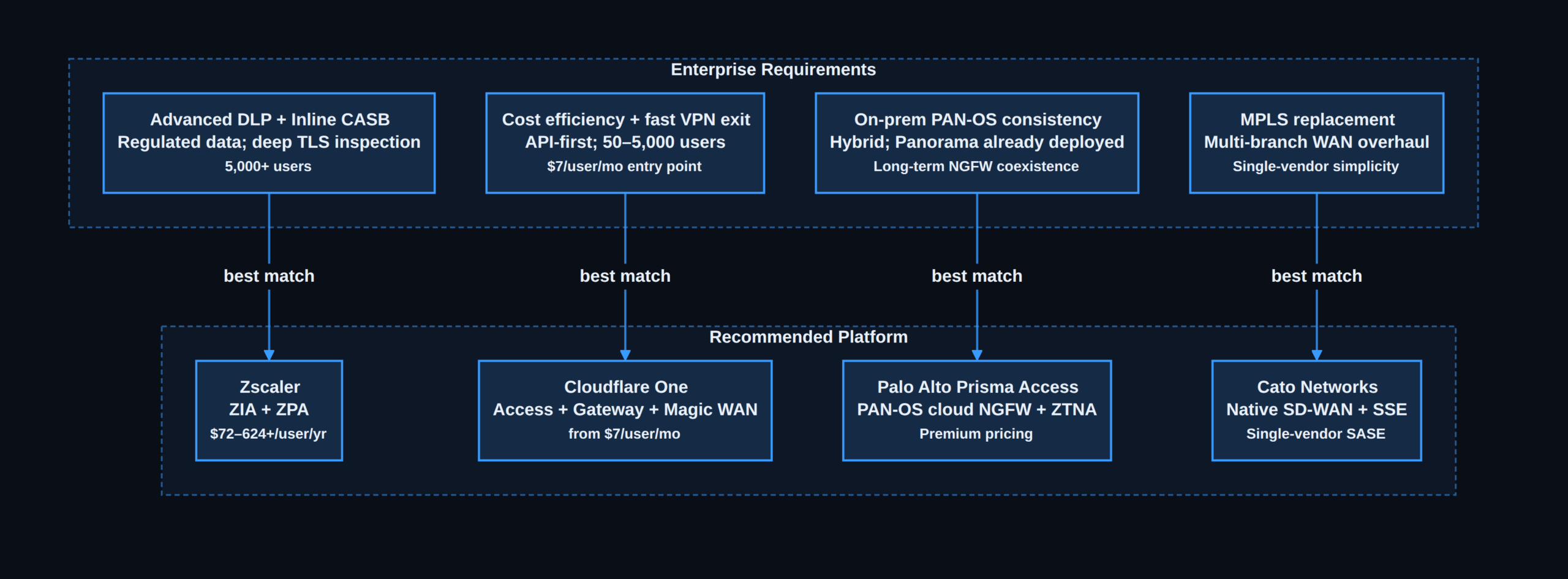
Zscaler Zero Trust Exchange delivers SASE through two core services: ZIA (Zscaler Internet Access — the SSE stack covering SWG, CASB, FWaaS, RBI, and inline sandboxing) and ZPA (Zscaler Private Access — the ZTNA layer for internal application access). All user traffic is backhauled to Zscaler’s 150+ global PoPs for inline TLS (Transport Layer Security) inspection — traffic is decrypted, inspected, and re-encrypted without ever touching the corporate data center. Zscaler’s proxy architecture eliminates the blind spot of encrypted traffic that network-layer firewalls cannot inspect without dedicated SSL inspection hardware.
Best for: Large enterprises (5,000+ users) requiring advanced inline CASB, behavioral DLP, inline sandboxing, and proven deployment at hyperscale. Pricing starts at approximately $72/user/year for the base bundle and scales to $624+ per user per year for full ZIA + ZPA + ZDX (Zscaler Digital Experience — a digital experience monitoring layer that measures end-to-end application performance from the user’s device to the application). Limitation: Zscaler has no native SD-WAN; it partners with VMware VeloCloud, Fortinet, and others for the WAN layer, making it a multi-vendor SASE play unless you integrate via the Zscaler ecosystem.
Cloudflare One: Speed, Cost Efficiency, and Developer-Friendly Deployment
Cloudflare One bundles ZTNA (Cloudflare Access), SWG (Gateway), CASB, and Magic WAN (an SD-WAN overlay that routes traffic over Cloudflare’s global Anycast network — a routing technique where a single IP address is announced from multiple locations and traffic is directed to the nearest PoP) into a single platform. Cloudflare’s 300+ PoP network was built primarily to serve its CDN (Content Delivery Network) business, which provides latency performance at global scale that dedicated security vendors cannot match at equivalent coverage.
Best for: Organizations with 50–5,000 users that need fast VPN replacement, API-first policy management, and significantly lower cost. Cloudflare One’s pay-as-you-go pricing starts at $7/user/month; at 1,000 users, the annual cost differential versus Zscaler can exceed $150,000. Limitation: DLP and advanced CASB capabilities are less mature than Zscaler’s or Netskope’s. Regulated industries — financial services, healthcare, government — that require granular inline content inspection typically choose Zscaler or Netskope over Cloudflare.
Palo Alto Prisma Access: Hybrid Consistency with On-Premises NGFWs
Palo Alto Networks Prisma Access delivers cloud-hosted NGFW (Next-Generation Firewall — a firewall that adds application awareness, intrusion prevention, SSL inspection, and threat intelligence beyond traditional port-based filtering) capabilities — App-ID, User-ID, Threat Prevention, and WildFire sandboxing — across a global PoP fabric using the same PAN-OS policy framework as on-premises Palo Alto hardware appliances. This consistency is the platform’s primary differentiator: a security team already managing Palo Alto hardware firewalls authors SASE policy in the same Panorama management interface.
Best for: Hybrid environments where on-premises PAN-OS firewalls will coexist with cloud-delivered security for two to five years. Organizations running Panorama (Palo Alto’s centralized management platform) gain unified visibility across physical, virtual, and cloud-delivered enforcement points. Limitation: Premium pricing and high operational complexity make Prisma Access the most expensive option in the market; smaller organizations rarely justify the investment relative to Cloudflare One or Cato Networks.
Cato Networks: Purpose-Built Single-Vendor SASE
Cato Networks is the clearest example of native single-vendor SASE — its SD-WAN and SSE components were built together from the ground up, sharing a single policy engine, data lake, and management console. Cato targets organizations replacing MPLS circuits with internet-first connectivity and consolidating branch security appliances into a cloud service. For multi-branch enterprises with 500–5,000 users that want to avoid the integration complexity of multi-vendor SASE, Cato is consistently the easiest operational deployment.
// 06 Which Architecture Fits Your Network Topology
Cloud-first organizations with no legacy WAN: Deploy ZTNA immediately — Cloudflare One or Zscaler ZPA eliminates VPN within weeks. Add SWG and CASB as a second phase to complete the SSE stack. Skip SD-WAN; your WAN is already the internet.
Multi-branch enterprises with legacy MPLS: Begin SD-WAN migration in parallel with SSE deployment. MPLS circuits cost 10–50x more per Mbps than internet broadband at equivalent reliability; SASE with SD-WAN turns that cost gap into the business case. Target Cato Networks for native simplicity or Zscaler + a partner SD-WAN for enterprise scale. Plan for a 12–18 month MPLS decommission timeline.
Hybrid environments with data center workloads: Prisma Access with Panorama provides unified policy across physical and cloud-delivered enforcement. Plan a phased 24–36 month migration: ZTNA for remote users first, branch offices next, then data center egress through Prisma SD-WAN.
Federal agencies under M-22-09: CISA’s guidance is unambiguous — implement SASE or SSE for the Networks pillar. Microsoft’s CISA Zero Trust Maturity Model mapping for the Networks pillar documents Entra ID + Defender for Endpoint + Azure Firewall as a Microsoft-native path. Agencies fully committed to Azure GovCloud can combine Microsoft’s native controls with a third-party SSE (Zscaler or Netskope) for internet-bound traffic inspection, satisfying both the Networks and Data pillar Advanced requirements simultaneously.
Note that SD-WAN appliances themselves can introduce material risk if unpatched — see the active exploitation of Cisco Catalyst SD-WAN CVE-2026-20182, a CVSS 10.0 authentication bypass that affected thousands of enterprise branch deployments. A SASE migration that moves enforcement to cloud PoPs reduces the attack surface of branch hardware.
// 07 Implementation Path: From Legacy Perimeter to ZTNA or SASE
A phased migration reduces disruption and builds operational muscle before decommissioning legacy infrastructure.
Phase 1 — Assess and baseline (Weeks 1–4)
- Inventory all applications, user populations, and current VPN usage patterns; tag applications as internet-facing, internal, or hybrid
- Identify which applications are suitable for agentless ZTNA (browser-based access via reverse proxy) versus those requiring a desktop agent for thick-client connectivity
- Deploy your CASB in API mode (read-only, no traffic interception) to map existing SaaS data flows and identify shadow IT before enforcing policy
Phase 2 — ZTNA pilot (Weeks 5–12)
# Example: Cloudflare Access policy — require Okta group membership + device posture
# Policy JSON via Cloudflare API (simplified)
{
  "name": "Engineering Internal Apps",
  "include": [{"email_domain": {"domain": "company.com"}}],
  "require": [
    {"okta": {"identity_provider_id": "<okta_idp_id>", "group_ids": ["eng-team"]}},
    {"device_posture": {"integration_uid": "<warp_posture_check_uid>"}}
  ],
  "session_duration": "8h"
}
- Roll out ZTNA to 50–200 pilot users, replacing VPN access to two or three high-value internal applications
- Configure device-posture requirements: endpoint detection agent running, OS patch currency within 30 days, disk encryption active
- Integrate with your existing IdP via SAML 2.0 or OIDC (OpenID Connect — a modern identity federation standard built on OAuth 2.0 that adds an identity layer on top of authorization)
Phase 3 — SSE expansion (Months 4–6)
- Redirect all user internet-bound DNS and web traffic through the SWG at the cloud PoP; this is typically done via a lightweight connector agent or DNS redirect for BYOD (Bring Your Own Device) users
- Expand CASB from API mode to inline mode for your highest-risk SaaS applications — enable DLP policies for PII (Personally Identifiable Information) and credential data first
- Activate FWaaS for branch offices; begin deprecating physical NGFW appliances at the lowest-traffic branches first
Phase 4 — SD-WAN integration (Months 7–18, if applicable)
# Verify SD-WAN tunnel to SASE PoP (Zscaler example — check ZPA connector health)
curl -s -H "Authorization: Bearer <API_TOKEN>"
  "https://connector.private.zscaler.net/health" | jq '.status'

# Expected output: "healthy"
- Deploy SD-WAN CPE (Customer Premises Equipment — the physical router or software appliance at each branch office) at branch locations; configure internet as the primary path with MPLS as backup during transition
- Peer the SD-WAN fabric with SASE PoPs via IPSec tunnels or private interconnect (Zscaler’s Cloud Connector, Cato’s native site integration)
- Submit MPLS termination notices at the 12-month milestone once traffic patterns confirm stability on internet paths
// 08 Conclusion
Zero trust vs SASE enterprise network security is not a binary choice — it is a maturity progression. Begin with ZTNA to eliminate VPN, contain lateral movement risk, and satisfy the CISA Networks pillar requirement. Expand toward full SASE as you decommission MPLS circuits and legacy branch appliances, selecting a vendor whose capabilities match your data sensitivity requirements and operational budget. For most distributed enterprises in 2026, the answer is ZTNA now, single-vendor SASE by 2027.
For a deeper look at the access-control gaps that ZTNA alone does not close, see the guide on Zero Trust and data movement risks in distributed workloads. If your SASE evaluation must align with a compliance programme, the SOC 2 Type II checklist for SaaS companies maps overlapping access-control and monitoring requirements that feed directly into SASE policy design.
Subscribe to the CiphersSecurity weekly threat digest for vendor advisory updates, SASE product releases, and zero trust implementation guidance →
For any query contact us at contact@cipherssecurity.com