
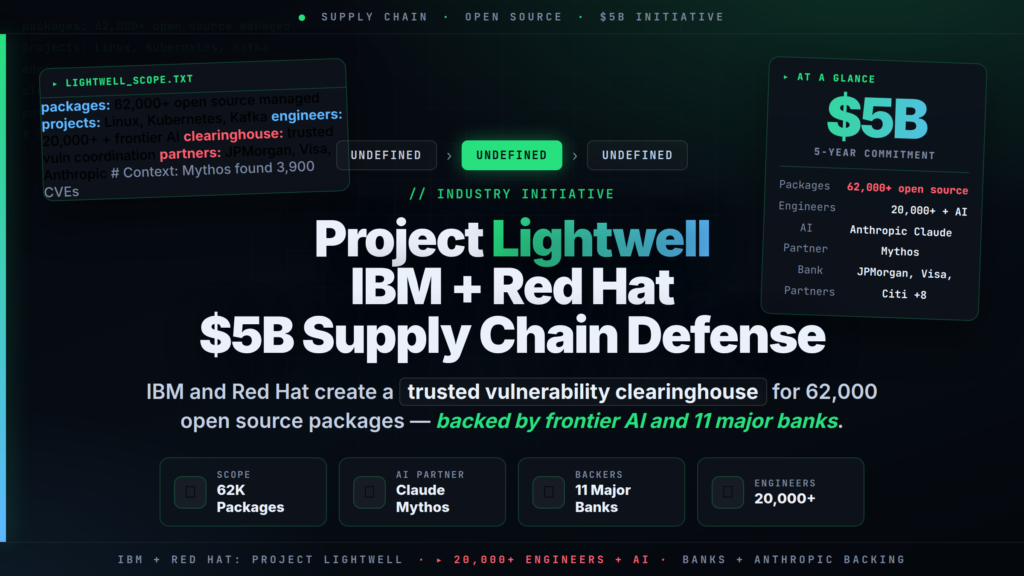
IBM and Red Hat announced Project Lightwell on May 28, 2026 — a $5 billion commitment to establish a trusted enterprise clearinghouse for open source vulnerability coordination, backed by a team of 20,000+ engineers augmented by frontier AI and supported by eleven of the world's largest financial institutions. The initiative directly addresses a gap that the XZ Utils backdoor (CVE-2024-3094 — a sophisticated two-year supply chain attack that inserted a backdoor into a widely used Linux compression library) and a string of AI-assisted vulnerability discoveries have made impossible to ignore: the security of the open source ecosystem that underpins more than 90 percent of enterprise software.
// 01 Project Lightwell: What It Is and How It Works
Project Lightwell is built around two interconnected components: a trusted enterprise clearinghouse and a global engineering force.
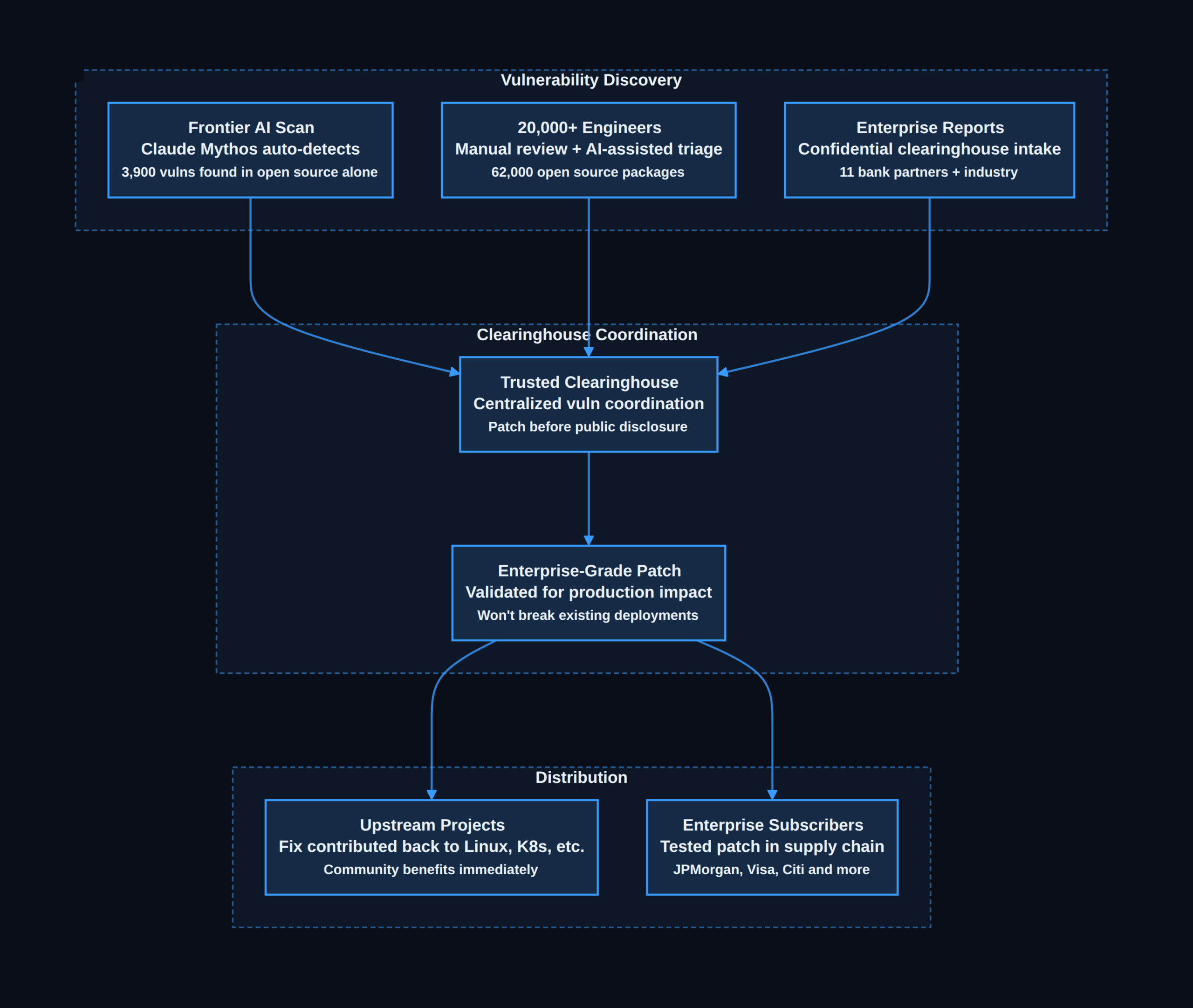
The clearinghouse functions as a centralised, confidential coordination hub where organisations can report security flaws in open source software, receive tested fixes, and share those fixes back into the upstream open source community — all without the patch-or-publish race conditions that characterise much of today's vulnerability disclosure process. The clearinghouse model is specifically designed to address the scenario where a vulnerability is discovered but the upstream maintainer is a volunteer with limited capacity to respond quickly (the exact scenario that allowed the XZ Utils backdoor to persist for two years).
The engineering force comprises more than 20,000 IBM and Red Hat engineers who will work alongside frontier AI systems — including integration with Anthropic's Claude Mythos model and learnings from OpenAI's Trust Access for Cyber initiative — to continuously monitor, detect, and remediate vulnerabilities across the 62,000+ open source packages that IBM and Red Hat currently manage. The portfolio includes foundational infrastructure projects:
- Linux kernel (the core of every Linux-based OS, used in 96 percent of top 1 million web servers)
- Java (used by hundreds of thousands of enterprise applications)
- Kubernetes (de facto standard for container orchestration — a system for managing containerised applications at scale)
- Apache Kafka (distributed event streaming platform used in financial transaction pipelines)
- Ansible (IT automation tool used for configuration management across millions of servers)
- Terraform (infrastructure-as-code tool used to provision cloud environments)
- Apache Flink and Cassandra (stream processing and distributed database systems)
// 02 The AI Factor: Why Now
The catalyst for Project Lightwell's urgency is AI-accelerated vulnerability discovery. Anthropic's Claude Mythos model — which IBM and Red Hat have integrated as a core scanning component — identified nearly 3,900 high- or critical-severity vulnerabilities in open source code during its initial analysis. OpenAI's frontier models have demonstrated similar capabilities through the Trust Access for Cyber programme.
This creates a fundamentally new threat landscape. For decades, the security of open source software depended partly on the assumption that finding vulnerabilities requires deep, time-consuming manual code review. That assumption no longer holds. A threat actor with access to a frontier AI model can now scan large codebases for vulnerability patterns in hours rather than months — and frontier AI models can also write working exploits for the vulnerabilities they find.
"Open source is the backbone of today's digital economy and the foundation of modern AI, and we are at an inflection point in how it is built, secured, and scaled," said IBM Chairman and CEO Arvind Krishna in the Project Lightwell announcement.
The exploit timeline is compressing as a result. In 2020, the average time from public CVE disclosure to first exploitation was approximately 15 days. In 2025–2026, with AI-assisted exploit development, that window has collapsed to hours for vulnerabilities with publicly available technical details. Project Lightwell is designed to close the gap between discovery and patch availability before that window can be exploited.
// 03 Industry Backing: Financial Sector Early Adopters
Eleven major financial institutions have signed on as Project Lightwell early adopters — a significant endorsement for an initiative that is still in its pilot phase:
Bank of America, BNY (Bank of New York Mellon), Citi, Goldman Sachs, JPMorgan Chase, Mastercard, Morgan Stanley, Royal Bank of Canada, State Street, Visa, and Wells Fargo.
The financial sector is a natural early adopter for several reasons. Financial institutions run enormous Java, Kafka, and Linux-based infrastructure that directly maps to Project Lightwell's target portfolio. They also operate under stringent regulatory frameworks (DORA, PCI-DSS, SOC 2) that require documented patch management programmes — exactly what Lightwell's clearinghouse model provides.
The participation of Mastercard and Visa is particularly significant, as payment networks are high-value targets for supply chain attacks. A vulnerability in a widely deployed Java library used in payment processing could, if exploited, affect millions of transactions across multiple financial institutions simultaneously.
// 04 What Security Teams Should Do
- Assess your open source dependency exposure against Project Lightwell's portfolio. Run a software composition analysis (SCA — a tool that scans your codebase to identify open source libraries and their versions) against your current applications to identify dependencies on the 62,000+ packages in Lightwell's scope. Tools like Syft, Grype, or OWASP Dependency-Check can generate a Software Bill of Materials (SBOM — a structured inventory of all software components in an application) for this purpose.
- Subscribe to Lightwell's clearinghouse notifications when the service opens. The programme is currently in early-adopter phase with financial institution partners. IBM and Red Hat will open broader enterprise subscriptions in subsequent phases — monitor IBM Newsroom and Red Hat's press releases for enrollment announcements.
- Prioritise patching Linux, Kubernetes, and Java dependencies. These three form the highest-risk tier in the Lightwell portfolio — they are universal dependencies with large attack surfaces and high exploitation value. Ensure your patch pipeline can apply upstream fixes within 72 hours of availability.
- Implement an SBOM policy now. Project Lightwell's enterprise patch distribution model works best when organisations know exactly which versions of which packages they are running. If you do not yet maintain an SBOM for your production systems, start now — it is also a requirement under the U.S. Executive Order on Improving the Nation's Cybersecurity and the EU Cyber Resilience Act.
- Follow CISA's guidance on software supply chain risk. CISA's Secure Software Development Attestation Form and related guidance documents provide a practical framework for assessing and improving supply chain security posture.
// 05 Background: Understanding the Risk
The open source supply chain attack surface has been largely invisible in corporate risk frameworks because open source is free, ubiquitous, and — critically — not owned by any single accountable vendor. When a critical flaw appears in OpenSSL, there is no one to call; fixes propagate through a voluntary, community-driven process that operates on timeline unpredictability.
The XZ Utils backdoor (CVE-2024-3094) demonstrated the full scope of this risk. An attacker using the pseudonym "Jia Tan" spent two years building credibility as a legitimate open source contributor to the XZ Utils project before injecting a sophisticated backdoor into liblzma.so — a compression library present in nearly every major Linux distribution. The backdoor was designed to give the attacker remote access to any system running the compromised SSH daemon. It was discovered almost by accident by a Microsoft engineer noticing unexpected CPU usage in a test environment. Without that observation, the backdoor might have shipped to hundreds of millions of Linux systems undetected.
Project Lightwell represents the first attempt to address this structural vulnerability at industry scale. Whether a $5 billion, 20,000-engineer programme can meaningfully secure 62,000 open source packages faster than AI-assisted attackers can find vulnerabilities in them is an open question — but the alternative of continuing with the current fragmented, volunteer-dependent model is increasingly untenable.
// 06 Conclusion
Project Lightwell is IBM and Red Hat's $5 billion answer to an existential supply chain security challenge: the open source ecosystem that most of the digital economy runs on is poorly defended against AI-accelerated vulnerability discovery. The initiative's clearinghouse model, financial sector backing, and frontier AI integration represent the most significant coordinated investment in open source security in the industry's history. Security teams should audit open source dependencies now and prepare to integrate with Project Lightwell's patch distribution pipeline when it opens to broader enterprise enrollment.
For any query contact us at contact@cipherssecurity.com