
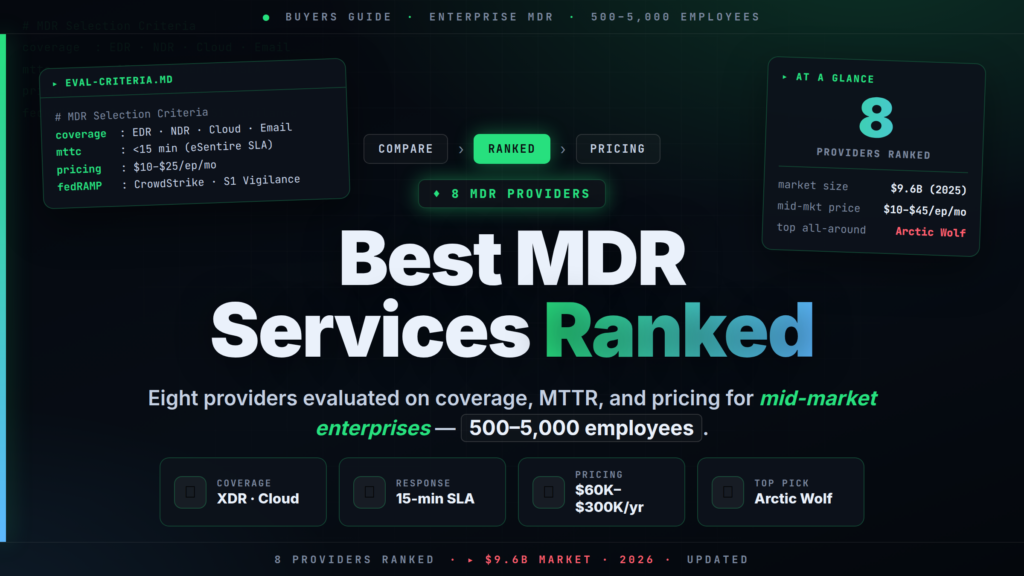
The best MDR service mid-market 2026 buyers should shortlist depends less on brand recognition and more on three auditable factors: whether the provider takes action on confirmed threats (not just sends alerts), whether Mean Time to Contain is contractual, and whether telemetry coverage spans endpoint, cloud, identity, and network. MDR — Managed Detection and Response, a service where a vendor's 24×7 SOC (Security Operations Center) actively investigates and contains threats on your behalf rather than forwarding validated alerts to your team — has crossed $9.6 billion in global market size in 2025, growing at 12.72% CAGR as mid-market organizations realize a two-person security team cannot match adversaries who operate at 3 a.m. on a Tuesday. This guide ranks eight providers — Arctic Wolf, Expel, ReliaQuest, eSentire, Red Canary, CrowdStrike Falcon Complete, Sophos MDR, and SentinelOne Vigilance — across coverage scope, MTTR (Mean Time to Respond), analyst transparency, and realistic pricing for organizations with 500 to 5,000 employees.
// 01 MDR vs. MSSP: Why the Distinction Matters
An MSSP (Managed Security Service Provider) monitors your environment and delivers validated alerts — your internal team investigates and responds. An MDR provider monitors, investigates, and acts: endpoint isolation, threat containment, and remediation happen on the vendor's side, not yours. For a 500-employee organization with a two-person security team, that distinction is not semantic — it is the difference between receiving a breach notification and waking up to a contained one.
The problem: dozens of MSSPs have rebranded as "MDR" without changing their operational model. The audit question that separates genuine MDR from rebranded MSSP: "Do your analysts isolate endpoints and kill malicious processes without calling us first, or do you escalate to us?" Concrete indicators of genuine MDR capability:
- Contractual MTTC (Mean Time to Contain) — a numerically defined SLA with financial remedies for breach, not a marketing target on a slide deck
- Active threat hunting — proactive analyst searches for threats not yet detected by automated rules, not just reactive alert triage
- Documented containment authority — the analyst's permission scope (what they can do without customer approval) is defined in the contract, not an informal verbal agreement
// 02 How These 8 Providers Were Evaluated
To identify the best MDR service mid-market 2026 buyers are comparing, each provider was scored across four dimensions:
- Coverage — Which telemetry domains are natively supported vs. integration-dependent: EDR (Endpoint Detection and Response — agent-based monitoring of endpoint behaviour), NDR (Network Detection and Response — monitoring of network traffic for lateral movement and C2 communications), cloud workloads, identity (Active Directory/Entra ID), and email?
- Response speed — Published or contractual MTTR/MTTC SLAs. Contractually backed, auditable metrics score materially higher than marketing statements.
- Transparency — Can your team observe analyst investigations in real time? Are detection logic and investigation notes accessible in a customer portal?
- Pricing — All-in annual cost for a 500–2,000 endpoint mid-market deployment, including platform licenses where required by tied providers.
// 03 Best MDR Services for Mid-Market 2026: At a Glance
| Provider | Best For | Coverage | MTTC SLA | Est. Annual (500 ep) | FedRAMP |
|---|---|---|---|---|---|
| Arctic Wolf | No existing tooling, broad coverage | EDR · NDR · Cloud · Identity · Email | None published | $36K–$96K | ✗ |
| Expel | Microsoft 365 stacks, analyst visibility | EDR · Cloud · SaaS · Identity | None published | $72K–$144K | ✗ |
| eSentire | Contractual SLA, regulated industries | EDR · NDR · Cloud · Identity · Email | 15 minutes | $60K–$150K | ✗ |
| Red Canary | Detection engineering, ATT&CK depth | EDR · Cloud · Identity | None published | Competitive | ✗ |
| CrowdStrike Falcon Complete | Falcon platform users, federal | EDR · Cloud · Identity | None published | $90K–$150K | ✓ High (IL5) |
| Sophos MDR | Value pricing, MSP-delivered | EDR · Cloud · Email · NDR (Secureworks) | None published | Budget-tier | ✗ |
| SentinelOne Vigilance | Existing Singularity users, federal | EDR · Cloud · Identity · NDR | 4-hour target | $90K–$150K | ✓ High (IL4) |
| ReliaQuest GreyMatter | In-house SOC augmentation | Aggregates existing tools | None published | $150K–$600K | ✗ |
// 04 Arctic Wolf MDR
Arctic Wolf is the most widely adopted MDR provider in the mid-market segment, and its structural differentiator is the Concierge Security Team (CST) model: named, dedicated analysts assigned per customer account rather than a shared anonymous SOC pool. Over time, CST analysts learn an organization's environment — its normal business traffic patterns, peak activity windows, and legitimate admin tools — which materially reduces false positives and improves detection fidelity for environment-specific threats.
Coverage breadth is the widest among mid-market-focused providers: EDR, NDR, cloud (AWS, Azure, GCP), identity (Active Directory, Microsoft Entra ID), and email are all native telemetry sources ingested into the Aurora platform. Arctic Wolf does not require displacing existing security tools — it aggregates signals across your current environment and supplements gaps.
Pricing: Per-user model; approximately $3,000–$8,000/month. Annual contracts range from roughly $36,000–$96,000+ for mid-market deployments. Pricing is negotiated, not publicly posted; expect 15–25% discount from initial quotes at 500+ user volumes.
Weaknesses: No contractual MTTC SLA — response time is outcome-oriented, not numerically guaranteed in writing. Not FedRAMP authorized; organizations with federal contracts or government data handling requirements must evaluate CrowdStrike or SentinelOne Vigilance instead.
Verdict: The strongest all-around pick for mid-market organizations building security capability from scratch with no existing tool stack and no FedRAMP requirement.
// 05 Expel MDR
Expel's primary differentiator is real-time analyst transparency. Its Workbench platform lets customer teams observe every detection, investigation step, and analyst verdict in real time as incidents unfold — with the ability to add context, dispute decisions, or configure detection preferences. No other provider in this comparison offers this level of operational visibility into what the SOC is actually doing on your behalf.
Expel is natively optimized for Microsoft 365 environments, with deep integrations into Microsoft Sentinel, Defender for Endpoint, Defender for Identity, and the full M365 telemetry stack. It is also platform-agnostic for EDR: Expel and Red Canary are the two providers in this guide that do not require replacing your existing endpoint agent, making them the natural choice for organizations that have already invested in endpoint tooling.
Pricing: $20–$40/user/month, 50-user minimum. Annual estimate for a 500-seat deployment: $72,000–$144,000.
Weaknesses: Not FedRAMP authorized. Email and NDR coverage are secondary to endpoint and cloud telemetry. Less suited for environments exceeding 5,000 seats where ReliaQuest's orchestration model becomes more relevant.
Verdict: Best-in-class for mid-market organizations running heavy Microsoft 365 stacks who want SOC-level coverage with full visibility into analyst work.
// 06 eSentire MDR
eSentire holds the most specific contractual response guarantee in this comparison: a 15-minute MTTC SLA backed into customer contracts with defined remedies for breach. This is not a marketing benchmark — it is an auditable, contractually enforced performance target that appears in the service agreement. For organizations in financial services, life sciences, or healthcare, where breach containment timelines feed directly into regulatory reporting obligations (SEC cyber incident disclosure rules, HIPAA breach notification, etc.), this contractual specificity has direct compliance and cyber insurance value.
The underlying platform is Atlas XDR, covering endpoint, network, cloud, identity, and email telemetry natively. Customer-dedicated analyst pairing — similar to Arctic Wolf's CST model — provides continuity of expertise across incidents.
Pricing: $10–$25/endpoint/month depending on tier. Essentials: ~$10–$15/endpoint/month; Advanced/Complete: ~$15–$25/endpoint/month. Annual estimate for 500 endpoints: $60,000–$150,000.
Weaknesses: Canada-headquartered; data sovereignty implications for U.S. buyers with strict data residency requirements. Not FedRAMP authorized. Advanced and Complete tier pricing is higher than Sophos or Red Canary at comparable coverage levels.
Verdict: The top pick when you need contractual accountability for response time — particularly for regulated mid-market buyers who must answer to compliance auditors and cyber insurers.
// 07 Red Canary MDR
Red Canary built its brand on detection engineering depth. It maintains Atomic Red Team, the open-source adversary simulation library with over 1,000 atomic tests mapped to MITRE ATT&CK (the industry-standard adversary behaviour framework that codes attacker techniques by T-number — e.g., T1059.001 for PowerShell execution, T1566.001 for spearphishing attachments, T1078 for valid account abuse). This community investment reflects genuine commitment to detection quality rather than alert volume and is an auditable proxy for the provider's detection engineering rigour.
Red Canary is platform-agnostic: it integrates with CrowdStrike Falcon, Microsoft Defender for Endpoint, SentinelOne Singularity, and other EDR vendors, making it the best fit for organizations that have already purchased endpoint tooling and want MDR coverage without displacing existing investments.
Pricing: Positioned as cost-competitive for mid-market; per-endpoint pricing is not publicly disclosed but is cited across third-party comparisons as lower upfront than CrowdStrike Falcon Complete and SentinelOne Vigilance. Red Canary is the default choice for organizations that prioritize detection depth over price parity.
Weaknesses: Not FedRAMP authorized. NDR and email coverage are secondary to endpoint and cloud. Smaller customer base than Arctic Wolf or Sophos. MITRE ATT&CK coverage of network-layer techniques is narrower than eSentire or Arctic Wolf.
Verdict: Best for organizations with existing EDR investments who prioritize MITRE ATT&CK detection fidelity and low false-positive rates over broad multi-domain telemetry.
// 08 CrowdStrike Falcon Complete
Falcon Complete layers CrowdStrike's 24×7 managed response team on top of the Falcon platform — the EDR agent widely regarded as the benchmark for endpoint telemetry depth, with CrowdStrike Intelligence tracking attribution and TTPs (Tactics, Techniques, and Procedures) for over 230 named adversary groups globally. The combination is the most mature enterprise-grade MDR in this comparison.
The defining 2025 event: FedRAMP High reauthorization completed March 2025 on AWS GovCloud, with DoD IL5 (Impact Level 5 — the U.S. Department of Defense classification tier for Controlled Unclassified Information) eligibility confirmed. For mid-market organizations with federal contracts, Falcon Complete is currently the most mature federal-capable MDR option available.
Pricing: $15–$25/endpoint/month for Falcon Complete alone; combined Falcon platform + MDR runs $25–$45/endpoint/month (Bellator Cyber benchmark). Annual estimate for 500 endpoints: $90,000–$150,000 all-in.
Weaknesses: Requires the Falcon platform — not tool-agnostic; organizations not running Falcon EDR must budget for platform migration. The July 2024 Falcon sensor content update that caused a global IT outage remains a standard reference in vendor risk discussions, though the incident is unrelated to the MDR service specifically and CrowdStrike has since introduced staged deployment controls.
Verdict: The definitive option for organizations already running Falcon EDR or holding federal contracts requiring FedRAMP High or DoD IL5 authorization.
// 09 Sophos MDR
Sophos became the largest MDR provider by customer count in February 2025, when its acquisition of Secureworks closed and the combined entity took the top position globally for mid-market MDR footprint. Secureworks' Taegis XDR platform — which includes mature NDR capabilities built around Secureworks' deep network forensics heritage — is being integrated into Sophos MDR, adding network-layer detection to Sophos' established Intercept X EDR and Sophos Email coverage.
For mid-market buyers purchasing through managed service providers, Sophos has the most developed MSP channel program in this comparison. Pricing is the most competitive — Sophos is consistently benchmarked as the best-value MDR option for the 500–2,000 employee segment.
Pricing: Specific per-endpoint pricing is not publicly disclosed. Consistently benchmarked below CrowdStrike Falcon Complete and SentinelOne Vigilance at 500–2,000 endpoint volumes across third-party comparisons.
Weaknesses: UK-headquartered (GDPR and data residency implications for some U.S. buyers). Not FedRAMP authorized. The Secureworks-Taegis integration is ongoing as of mid-2026 — some operational inconsistency between the two platforms should be anticipated and verified during proof-of-concept evaluation. Less detection engineering depth than Red Canary.
Verdict: The value pick for budget-conscious mid-market organizations or those purchasing through an MSP channel. Verify Taegis integration maturity during evaluation — ask specifically which NDR capabilities are live vs. roadmap.
// 10 SentinelOne Vigilance
SentinelOne Vigilance achieved FedRAMP High authorization in September 2024 (Package FR1919071020A, AWS GovCloud, DoD IL4 — Impact Level 4, the tier covering Controlled Unclassified Information not designated IL5), making it one of only two commercial MDR services at this certification level alongside Falcon Complete. The Singularity platform's autonomous AI detection engine is particularly strong for cloud workload protection (Singularity Cloud Workload Security) and identity-based threat detection (Singularity Identity).
Vigilance publishes a 4-hour response target for 24×7 coverage — more aggressive than the unstated industry norm, though less specific than eSentire's 15-minute contractual MTTC guarantee. Volume discounts at 500+ endpoints (20–30% off list) make mid-market all-in pricing materially better than list rates suggest.
Pricing: Vigilance MDR adds $17–$50/endpoint/year on top of the Singularity platform license ($70–$230/endpoint/year combined, per MDRCost.com). Volume discounts: 500–2,000 endpoints = 20–30% off list; multi-year contracts add a further 30–40%. Annual estimate for 500 endpoints: $90,000–$150,000 all-in.
Weaknesses: Adding Vigilance effectively doubles per-endpoint cost at lower Singularity tiers — cost-prohibitive for organizations not already licensed on Singularity. Email coverage is weaker than full-stack competitors. The 4-hour response target is considerably less aggressive than eSentire's contractual 15-minute MTTC guarantee.
Verdict: Strong for existing SentinelOne customers and organizations requiring FedRAMP High. Not the right choice for greenfield mid-market deployments when Sophos or Red Canary offer competitive pricing without platform lock-in.
// 11 ReliaQuest GreyMatter
ReliaQuest occupies a distinct position in this comparison — it is not a standalone MDR service but a managed SOC orchestration platform that sits above your existing security tools. GreyMatter aggregates telemetry from across your current tool stack, automates L1/L2 analyst tasks (entry-level alert triage, enrichment, and initial investigation) via AI-driven "agentic personas," and provides ReliaQuest analysts for threat hunting, incident escalation, and strategic advisory. In 2025–2026, ReliaQuest has heavily invested in agentic automation — AI agents that execute the repetitive tasks that consume junior analyst capacity.
This model delivers its value to organizations that already have a functioning security team and existing tool investments, but need to scale analytical capacity without additional headcount. An organization with no in-house security staff will not extract full value from GreyMatter — the platform assumes operational maturity to orchestrate.
Pricing: Average contract approximately $172,500/year; enterprise packages range $300,000–$600,000/year. This price point effectively disqualifies most sub-1,500 employee mid-market organizations.
Weaknesses: Highest price point in the comparison by a significant margin. Requires existing in-house security capability to operate effectively. Not FedRAMP authorized. Deployment complexity is substantially higher than turnkey MDR competitors.
Verdict: Best for upper-mid-market organizations (2,000–5,000 employees) with an existing SOC that needs automation and analyst augmentation — not a replacement for absent in-house security capability.
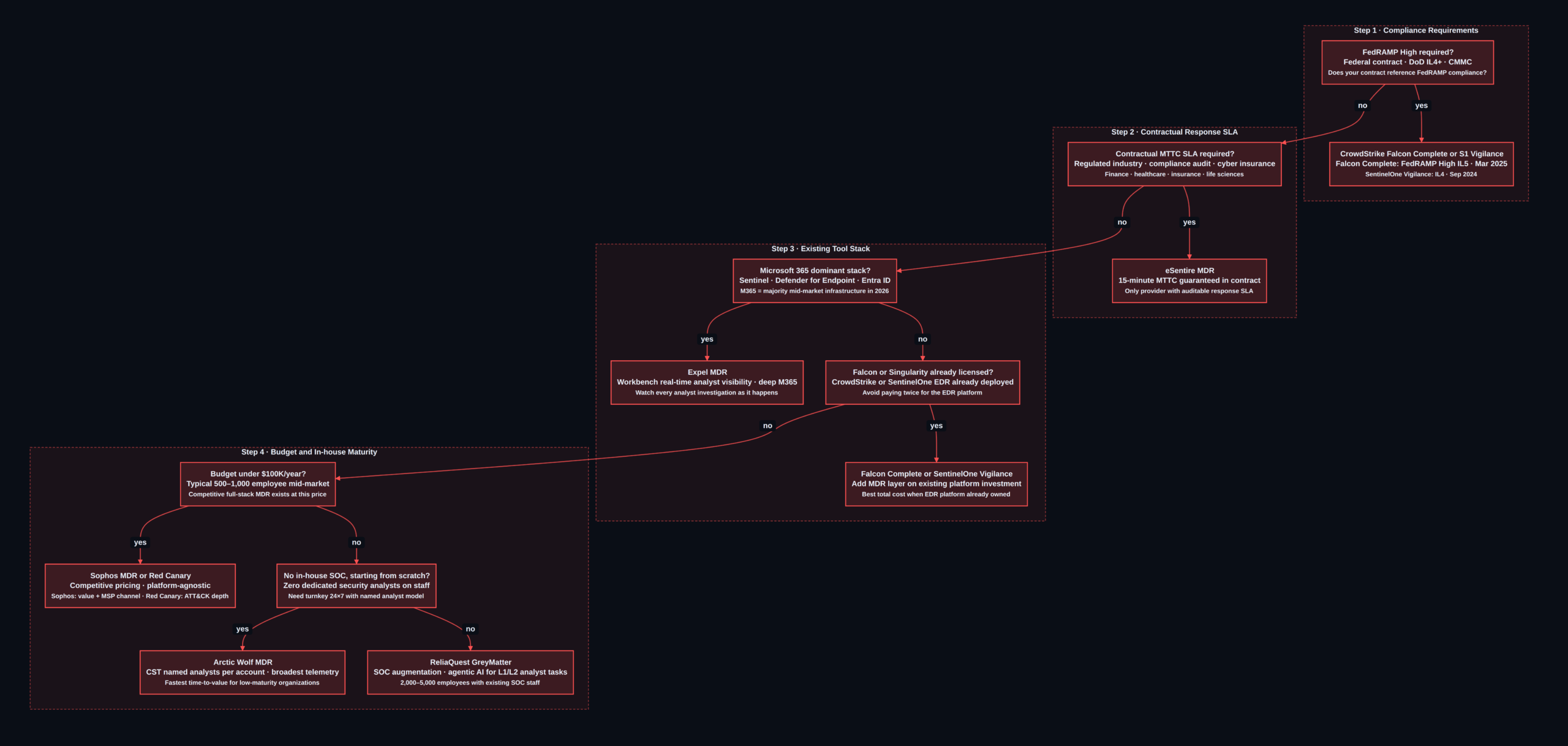
// 12 Best MDR Service Mid-Market 2026: Decision Framework
The right provider for the best MDR service mid-market 2026 evaluation depends on four compounding variables: regulatory requirements, existing tool investments, budget, and internal security maturity. This decision tree covers the most common paths.
// 13 MDR Evaluation Checklist: 10 Questions to Ask Every Vendor
Before signing any MDR contract, put these questions to every shortlisted provider — in writing, with contractual answers rather than verbal assurances:
- What is your contractual MTTC SLA, and what are the financial remedies for breach? A marketing target without financial consequences is not an SLA. Get the penalty structure in writing.
- Which telemetry domains do you cover natively vs. via third-party integration? Native telemetry (direct sensor or first-party API) is lower latency and more reliable than integration-dependent coverage that can break during vendor updates.
- What is your analysts' default containment authority? Can they isolate an endpoint without calling your team first? Who grants that permission scope, and where is it documented in the contract?
- What was your false-positive rate over the last 90 days, and how do you measure it? High alert volume with low fidelity shifts triage burden back to your team — which defeats the purpose of MDR.
- How do we observe your analysts' work? Request a live demo of the customer investigation portal and the alert investigation timeline.
- What is your published MITRE ATT&CK technique coverage map? Most reputable providers publish a coverage map. Compare coverage for the specific technique families relevant to your industry (e.g., T1486 data encryption for ransomware; T1078 valid accounts for identity attacks; T1190 exploit public-facing application for internet-exposed assets).
- Are you FedRAMP authorized, and at what impact level? If your organization handles Controlled Unclassified Information or federal contract data, this is a binary requirement.
- What contractual remedies apply when SLAs are missed? If the answer is "we'll do better next time," treat the SLA as a marketing claim.
- What is the all-in annual cost for our specific environment? For platform-tied providers (CrowdStrike, SentinelOne), demand the combined platform + MDR price — not just the MDR add-on rate. Sticker shock often arrives at contract renewal.
- What is the offboarding process and data retention policy? How long is detection and investigation history retained? In what format can you export your alert history and threat intelligence when switching providers?
// 14 Conclusion
Selecting the best MDR service mid-market 2026 organizations should prioritize comes down to five variables: regulatory requirements (FedRAMP High is a binary filter for federal-adjacent organizations, and only CrowdStrike Falcon Complete and SentinelOne Vigilance clear it), contractual response guarantees (eSentire's 15-minute MTTC is the industry reference standard), existing platform investment (Falcon and Singularity users have a natural path to their respective MDR add-ons), annual budget, and internal security maturity. Arctic Wolf is the strongest all-around pick for organizations building security capability from scratch; eSentire wins when contractual accountability is non-negotiable; CrowdStrike and SentinelOne are the only options for DoD-adjacent and federally regulated buyers; and ReliaQuest applies only once an in-house SOC already exists.
For most 500–2,000 employee organizations without platform lock-in, start the shortlist with Arctic Wolf, Expel, and eSentire — then narrow using the ten evaluation questions above and proof-of-concept trials against your specific environment.
For related mid-market security program guidance, see our SOC 2 Type II compliance checklist for SaaS companies, our CSPM vs. CWPP cloud security comparison, and our federal cybersecurity logging and SIEM requirements guide for the logging infrastructure MDR providers depend on to deliver detections. Organizations evaluating GRC (Governance, Risk, and Compliance) platforms alongside MDR will find our Drata vs. Vanta vs. Tugboat Logic comparison directly relevant.
Subscribe to the CiphersSecurity weekly threat digest for ongoing MDR market updates and provider news →
For any query contact us at contact@cipherssecurity.com