
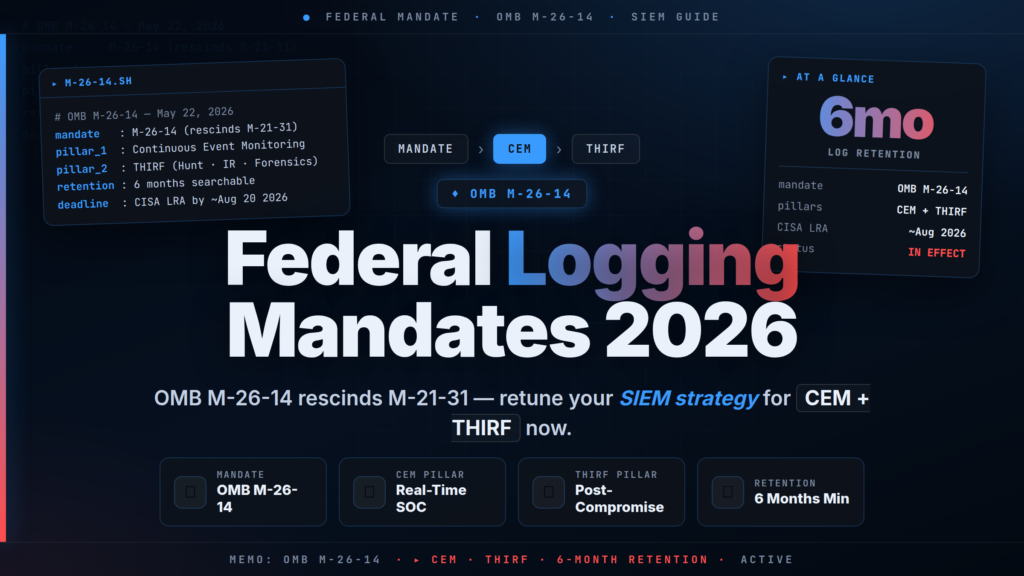
Federal cybersecurity logging requirements 2026 SIEM compliance shifted on May 22, 2026, when the Office of Management and Budget (OMB) — the White House office that sets binding policy across all U.S. executive branch agencies — issued Memorandum M-26-14, "Ensuring Effective and Efficient Agency Logging and Network Visibility to Defend Against Evolving Cyber Threats." Signed by OMB Director Russ Vought, the memo immediately rescinds M-21-31 — the Biden-era federal logging directive that emerged from the 2020 SolarWinds supply chain breach — and replaces blanket data-collection mandates with a two-pillar, risk-based framework built around Continuous Event Monitoring (CEM) and Threat Hunting, Investigation, Response and Forensics (THIRF).
For federal agencies, the compliance clock is already running. For SOC architects, compliance engineers, and government contractors whose enterprise customers mirror federal mandates, M-26-14 defines the new floor: six months of searchable, NTP-synchronized logs, accessible in real time to the agency Security Operations Center (SOC). This guide translates those requirements into concrete SIEM configuration steps for the three dominant platforms — Microsoft Sentinel, Splunk Enterprise Security, and Elastic Security — so your team can move from policy language to production detection rules.
// 01 OMB M-26-14: Why the Federal Logging Mandate Changed
The previous federal logging framework, M-21-31, was issued in August 2021 in direct response to Executive Order 14028 (EO 14028, "Improving the Nation's Cybersecurity"), which President Biden signed after the SolarWinds SUNBURST campaign demonstrated that inadequate log coverage gave attackers months-long dwell time inside federal networks. Section 8 of EO 14028 directed OMB to formulate specific logging requirements; the result was M-21-31, a four-tier maturity model requiring agencies to log virtually every category of event across their infrastructure.
The practical outcome, as OMB's M-26-14 explicitly acknowledges, was that M-21-31 generated "vast quantities of logging data without clear utility." A 2023 Government Accountability Office (GAO) audit found over a dozen federal agencies failed to meet the directive's most basic logging requirements — not from neglect, but because the volume-first mandate was neither technically feasible nor cost-justified at scale. Agencies were spending heavily on storage infrastructure for log data that no analyst ever queried, while the detection coverage gaps that actually matter — real-time alerting and forensic-grade reconstruction — remained unaddressed.
M-26-14 shifts the frame from how much are you logging? to can you detect threats and reconstruct attacks? The directive does not enumerate specific log types or retention tiers the way M-21-31 did. Instead, it sets two operational objectives — CEM and THIRF — and requires agencies to demonstrate that their logging posture meets those objectives. CISA (the Cybersecurity and Infrastructure Security Agency, the operational arm of DHS responsible for defending federal civilian networks) is directed to publish a Logging Reference Architecture (LRA) within 90 days of the memo's issuance to provide detailed technical implementation guidance.
// 02 federal cybersecurity logging requirements 2026 SIEM: CEM and THIRF Defined
OMB M-26-14 structures the entire federal cybersecurity logging requirements 2026 SIEM framework around two capabilities. Every log source you collect, every retention policy you set, and every detection rule you write should map back to one or both pillars.
Continuous Event Monitoring (CEM) is defined in the memo as the ability to monitor network activity in real time, automatically flag anomalous behaviour, and respond to that activity in a timely manner — typically through the SOC. CEM is the real-time detection plane. It answers the question: Is something bad happening right now? CEM requirements drive log ingestion pipelines, alert thresholds, and SOC response SLAs (Service Level Agreements — the defined maximum time between detection and analyst acknowledgement).
Threat Hunting, Investigation, Response and Forensics (THIRF) encompasses the agency's ability to investigate and analyse network activity after a suspected or confirmed compromise. THIRF is the historical forensic plane. It answers: What exactly did the attacker do, and for how long? THIRF requirements drive retention policies, search performance, and the fidelity of forensic artifacts stored in your log platform.
These two objectives are not redundant — they have opposing data requirements. CEM favours low-latency, high-signal event streams: authentication failures, anomalous process launches, lateral movement indicators. THIRF favours high-volume, high-fidelity archives: raw DNS queries, full HTTP request logs, packet metadata, that you may rarely touch until an incident forces your hand.
Getting both right in a single SIEM architecture requires deliberate data tiering: hot and warm storage for THIRF historical depth, and a curated high-signal index optimised for CEM real-time alerting. The sections below show exactly how to implement this in each major platform.
// 03 Minimum Baseline: What M-26-14 Requires Right Now
While agencies await the CISA LRA for detailed implementation guidance, M-26-14 establishes three non-negotiable baseline requirements that apply immediately upon the memo's issuance:
- Six-month searchable retention. All logs must be retained and searchable for a minimum of six months. This is a critical distinction from cold-archive approaches: the data must be indexed and queryable by the SOC, not simply stored in compressed blob storage that requires hours to restore before analysis.
- NTP-synchronized timestamps. Every log source must synchronize its clock against Network Time Protocol (NTP — the internet standard for distributing accurate time across networked systems) before generating events. Desynchronized timestamps undermine the entire THIRF objective: forensic timeline reconstruction requires a trustworthy, consistent time source across all systems.
- SOC accessibility. Logs must be readily accessible to the top-level agency SOC in real time. This eliminates siloed log management where individual business units collect logs that never reach the centralised security team.
These three requirements define the compliance floor. Any logging architecture that cannot deliver searchable, time-consistent, SOC-accessible logs for six months fails M-26-14 from the first day of assessment.
// 04 The Five Maturity Categories Unpacked
M-26-14 structures agency progress through a five-category maturity model, each containing four performance benchmarks. The categories form a logical dependency chain — you cannot achieve high-fidelity collection without first knowing what assets exist.
| # | Category | What It Measures | Why It Matters | |—|———-|—————–|—————-| | 1 | Inventory Visibility | Do you know every system that exists and what logs it generates? | You cannot collect what you cannot see — unknown assets are blind spots | | 2 | Collection Coverage | Are all critical assets actually forwarding logs to the SOC? | Coverage gaps are attacker dwell-time; M-21-31 frequently failed here | | 3 | Collection Operations | Is the log pipeline reliable, low-loss, and monitored for health? | Dropped logs create forensic holes precisely when incidents occur | | 4 | Data Retention | Are logs stored for the required six-month period and kept searchable? | THIRF forensic analysis depends on historical depth and query performance | | 5 | Log Management | Can the SOC access, query, correlate, and act on logs efficiently? | CEM depends on analyst tooling speed — slow SIEM means slow response |
Each category has four benchmark tiers (Levels 1–4). Agencies must demonstrate measurable progress through phased targets tied to the compliance timeline below.
// 05 M-26-14 Compliance Timeline
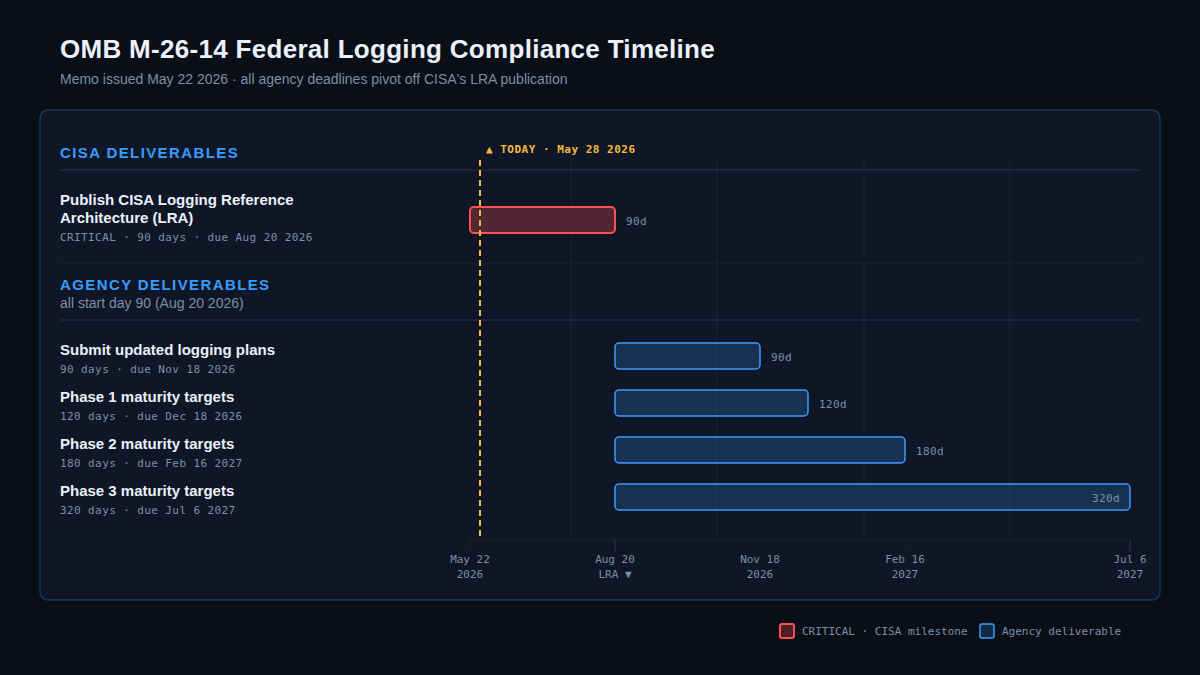
The memo structures all deadlines around CISA's LRA publication rather than the memo issuance date, creating a rolling compliance window:
Key dates to calendar now:
- ~August 20, 2026: CISA publishes the LRA (90 days from M-26-14 issuance)
- ~November 18, 2026: Agency updated logging plans due (90 days after LRA)
- ~December 18, 2026: Phase 1 maturity checkpoint (120 days after LRA)
- ~February 17, 2027: Phase 2 maturity checkpoint (180 days after LRA)
- ~June 7, 2027: Phase 3 maturity checkpoint (320 days after LRA)
Agencies that invested in logging infrastructure under M-21-31 retain an advantage: existing collection pipelines and asset inventories transfer to the new framework. The key change is the analytical overlay — demonstrating CEM and THIRF capability rather than raw log volume.
// 06 Log Sources Your SOC Must Prioritise
Until the CISA LRA defines the authoritative log category list, NIST SP 800-92 Rev. 1 (draft) — "Cybersecurity Log Management Planning Guide" — provides the most current federal guidance on source prioritisation. For most enterprise and federal environments, critical log categories break down as follows:
Authentication and Identity (highest priority for CEM)
- Windows Security Event Log: Event ID 4624 (successful logon), 4625 (failed logon), 4648 (logon using explicit credentials — common in Pass-the-Hash attacks), 4672 (special privilege assigned, indicating admin-level logon), 4768/4769 (Kerberos TGT and service ticket requests — the protocol Windows networks use for authentication)
- Azure Active Directory (Entra ID) sign-in logs, risky sign-in alerts, and audit logs
- LDAP (Lightweight Directory Access Protocol) bind and search operations against Active Directory
Endpoint Activity (essential for THIRF forensics)
- Sysmon (System Monitor — a free Windows system service from Microsoft Sysinternals that logs detailed process, network, and file activity beyond what the native Security Event Log captures): Event ID 1 (process creation with full command-line arguments), Event ID 3 (outbound network connection with process context), Event ID 7 (image/DLL load, detecting DLL hijacking), Event ID 11 (file creation), Event ID 13 (registry value modification)
- EDR (Endpoint Detection and Response) platform telemetry from your vendor
Network Visibility
- DNS query logs — every hostname resolution request is essential for detecting C2 (Command and Control — the channel an attacker uses to send instructions to compromised systems) beaconing patterns
- HTTP/HTTPS proxy logs with full URL, user-agent string, and response code
- Firewall and NAT logs with the five-tuple (source IP, destination IP, source port, destination port, protocol)
- VPN session establishment, teardown, and failed authentication attempts
Cloud Environments
- AWS CloudTrail (all API calls across all regions), VPC Flow Logs (network traffic metadata), CloudWatch Logs (application and service output)
- Azure Activity Log and Diagnostic Logs from every resource group
- GCP (Google Cloud Platform) Cloud Audit Logs: Admin Activity and Data Access logs
Email and Collaboration
- Mail gateway logs including sender, recipient, subject line hash, and attachment SHA256 hash
- Microsoft 365 Unified Audit Log covering Exchange, SharePoint, Teams, and OneDrive activity
// 07 Mapping federal cybersecurity logging requirements 2026 SIEM to Your Platform
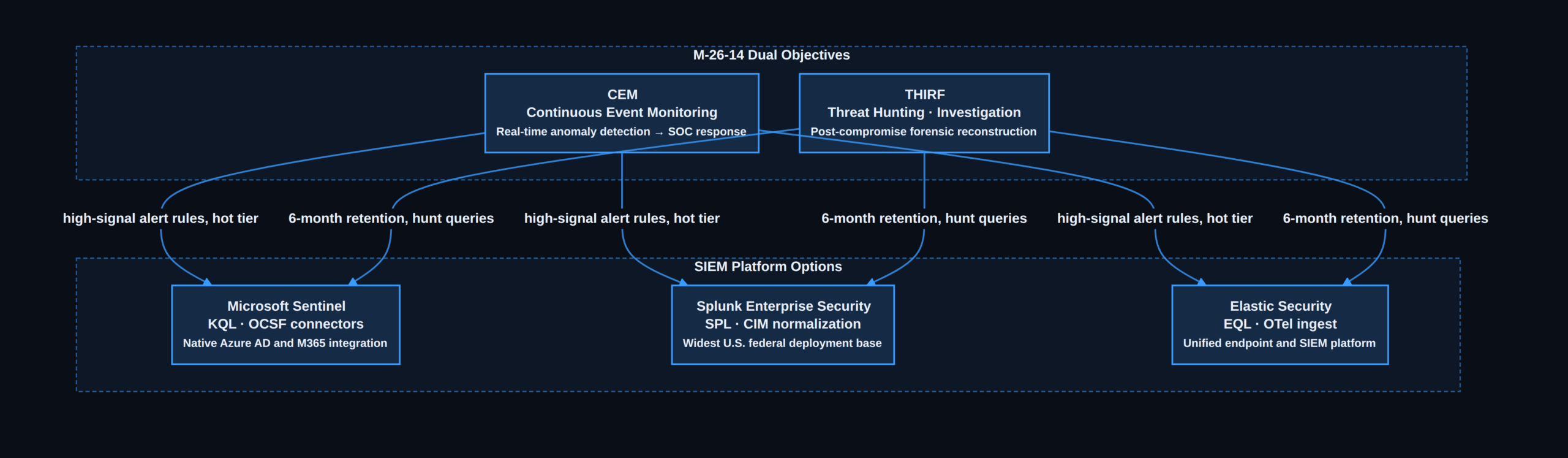
The following section maps M-26-14's CEM and THIRF objectives to the three most widely deployed SIEM platforms in U.S. federal and enterprise environments. Every query below uses real, copy-pasteable syntax.
Microsoft Sentinel (KQL)
Microsoft Sentinel's Kusto Query Language (KQL) is optimised for Azure Log Analytics' column-store architecture. The following query addresses CEM by detecting credential spraying — MITRE ATT&CK T1110.003, Password Spraying, where an attacker tries a single common password across many accounts to stay below lockout thresholds:
SigninLogs
| where TimeGenerated > ago(1h)
| where ResultType != "0"
| summarize FailedAttempts = count(), UniqueAccounts = dcount(UserPrincipalName)
    by IPAddress, Location
| where FailedAttempts > 20 and UniqueAccounts > 5
| project IPAddress, Location, FailedAttempts, UniqueAccounts
| order by FailedAttempts desc
For THIRF — hunting lateral movement via Pass-the-Hash (MITRE ATT&CK T1550.002, using stolen NTLM credential hashes to authenticate without the cleartext password):
SecurityEvent
| where EventID == 4624
| where LogonType == 3
| where AuthenticationPackageName == "NTLM"
| where AccountName !endswith "$"
| summarize LogonCount = count()
    by Computer, AccountName, IpAddress, bin(TimeGenerated, 1h)
| where LogonCount > 5
| project TimeGenerated, Computer, AccountName, IpAddress, LogonCount
For data tiering to meet M-26-14's 6-month searchable retention requirement, configure Sentinel's Auxiliary Logs tier for high-volume THIRF sources such as DNS, proxy, and firewall logs. This reduces ingestion cost by up to 65% while maintaining full query access through the 6-month window via the search KQL operator.
Splunk Enterprise Security (SPL)
Splunk's Search Processing Language (SPL) is the most widely deployed SIEM query language in U.S. federal environments. Splunk supports OCSF (Open Cybersecurity Schema Framework — a vendor-neutral log normalisation standard backed by AWS, Splunk, and 16 other vendors) through its CIM (Common Information Model), ensuring cross-source correlation functions correctly when logs from different vendors use different field names.
For CEM — detecting a failed authentication spike consistent with brute-force activity (T1110.001):
index=wineventlog EventCode=4625
| bucket _time span=15m
| stats count AS failed_logins, dc(src_ip) AS unique_ips BY user, _time
| where failed_logins > 15 OR unique_ips > 3
| eval risk_score=case(failed_logins>50, "CRITICAL", failed_logins>15, "HIGH", 1==1, "MEDIUM")
| table _time, user, failed_logins, unique_ips, risk_score
| sort - failed_logins
For THIRF — hunting DCSync attacks (MITRE ATT&CK T1003.006, OS Credential Dumping via Directory Services Replication, where an attacker with sufficient AD privileges replicates the entire Active Directory password database to extract every credential hash):
index=wineventlog EventCode=4662
| search ObjectType="*domainDNS*"
| search Properties="*1131f70-c0cc-11d0-ac1d-00c04fb96705*"
    OR Properties="*19195a5b-6da0-11d0-afd3-00c04fd930c9*"
| stats count BY src_ip, user, Computer
| where count > 3
| table src_ip, user, Computer, count
For THIRF data tiering in Splunk, use the Dynamic Data Active Archive (DDAA) to move cold-tier indices to S3 or Azure Blob at significantly lower cost while retaining full searchability through Splunk's federated search capability. Set a 182-day (six-month) retention policy on all CEM and THIRF indices as the minimum.
Elastic Security (EQL)
Elastic Security's Event Query Language (EQL) is purpose-built for sequence-based detection — ideal for THIRF hunting where you need to reconstruct multi-step attack chains across a time window. Elastic Endpoint also ships pre-built detection rules aligned to the MITRE ATT&CK framework T-numbers most relevant to M-26-14 environments.
For CEM — detecting suspicious PowerShell execution (MITRE ATT&CK T1059.001, Command and Scripting Interpreter: PowerShell), a technique used in the majority of post-exploitation stages across both APT and commodity threat actor campaigns:
process where event.type == "start"
  and process.name : "powershell.exe"
  and (
    process.args : ("-enc", "-encodedcommand", "-noprofile", "iex", "invoke-expression")
    or process.parent.name : ("winword.exe", "excel.exe", "outlook.exe", "mshta.exe")
  )
For THIRF — hunting lateral movement via WMI (Windows Management Instrumentation — a built-in Windows administration framework, MITRE ATT&CK T1047, widely abused for remote command execution without dropping a file to disk):
sequence by host.name with maxspan=2m
  [process where event.type == "start" and process.name : "wmiprvse.exe"]
  [process where event.type == "start"
    and process.parent.name : "wmiprvse.exe"
    and not process.name : ("WmiPrvSE.exe")]
  [network where destination.port in (445, 135, 3389, 22)]
For THIRF retention in Elastic, configure Index Lifecycle Management (ILM) with a hot phase of 7 days, warm phase of 30 days, and a cold phase extending to 180 days minimum, all with searchable_snapshot enabled so every tier remains queryable without manual restore operations.
// 08 EO 14028 and NIST SP 800-92: The Regulatory Foundation
Understanding where M-26-14 sits in the broader policy stack is necessary for compliance reporting and contract documentation:
- EO 14028 (May 2021) — directed all federal executive agencies to improve logging capability and set the foundational policy authority for all subsequent logging mandates
- M-21-31 (August 2021, now rescinded) — operationalised EO 14028 Section 8 with a four-tier maturity model and specific log category requirements
- M-26-14 (May 2026, in effect) — replaces M-21-31, institutes a two-pillar CEM/THIRF risk-based framework with a five-category maturity model
- NIST SP 800-92 Rev. 1 (draft) — "Cybersecurity Log Management Planning Guide" — provides the technical framework underpinning all of the above; agencies and contractors are expected to align log management practices with SP 800-92's guidance on log generation, collection, storage, and analysis
Government contractors operating under FedRAMP (Federal Risk and Authorization Management Program — the compliance framework for cloud services sold to U.S. government agencies) and FISMA (Federal Information Security Modernization Act — the law requiring federal agencies to maintain a documented information security programme) should anticipate M-26-14's CEM and THIRF requirements propagating into contract modifications within 12–18 months, following the same adoption curve M-21-31 followed after EO 14028.
// 09 What Enterprise and Contractor Teams Should Do Now
Even if your organisation is not a federal agency, the following steps apply to any SOC that needs to demonstrate CEM and THIRF capability — whether for contract compliance, cyber insurance underwriting, or internal security programme maturity:
- Audit log coverage against the five maturity categories. Begin with Category 1 (Inventory Visibility): does your current asset inventory include every system that is generating — or failing to generate — security logs? Shadow IT and unmanaged cloud workloads are the most common Category 1 gaps.
- Verify 6-month searchable retention today. In your SIEM, run a query for the oldest indexed event. If it is less than 180 days ago, adjust your index lifecycle policy or retention settings before compliance assessments begin. Do not confuse archived-but-not-searchable storage with the searchable retention M-26-14 requires.
- Enforce NTP synchronization on every log source. On Windows endpoints, run
w32tm /query /statusand confirm an authoritative time source is configured. In cloud environments, NTP synchronization is typically provider-managed but should be explicitly validated in your security baselines.
- Tier your log data by pillar. CEM sources (authentication, process creation, network anomalies) belong in a hot-tier, low-latency index optimised for alert rules. THIRF sources (DNS, proxy, raw endpoint telemetry) can move to warm or cold storage as long as they remain searchable within the 6-month window.
- Deploy Sysmon on Windows endpoints. Sysmon is free from Microsoft Sysinternals and provides the process creation, network connection, and file operation logs that THIRF forensic investigations depend on. The SwiftOnSecurity Sysmon configuration is a well-maintained community baseline suitable for most environments.
- Enable full cloud audit logging in every region. AWS CloudTrail, Azure Activity Logs, and GCP Audit Logs are frequently disabled or region-scoped incorrectly in enterprise cloud deployments. Enable API-level logging for all services across all deployed regions — this is a single-afternoon configuration change that closes a disproportionately large forensic gap.
- Document at least one THIRF hunt query per MITRE ATT&CK tactic. Build and schedule weekly scheduled searches covering Initial Access (T1190, T1133), Execution (T1059), Persistence (T1053), Credential Access (T1003, T1110), and Lateral Movement (T1021, T1550). Documented hunt queries are a required deliverable in most federal logging plans.
- Draft your logging plan now — before the LRA publishes. When CISA releases the LRA (~August 2026), agencies have only 90 days to submit updated logging plans. Teams that have already documented their CEM and THIRF posture, their log source inventory, and their maturity category scores will file compliant plans on day one rather than scrambling through the final weeks.
// 10 Conclusion
OMB M-26-14 is a genuine improvement over the volume-first approach of M-21-31: it prioritises operational outcomes — detection and forensic reconstruction — over checkbox compliance measured in terabytes stored. For SOC teams, the new federal cybersecurity logging requirements 2026 SIEM framework translates directly into a CEM plane (real-time alerting on high-signal, low-noise events) and a THIRF plane (deep, searchable forensic archives that answer exactly what an attacker did and for how long). The minimum floor — six months of searchable, NTP-synchronized, SOC-accessible logs — is achievable this quarter in Sentinel, Splunk, and Elastic using the configurations above. Start with the baseline, validate your five maturity category scores, and treat the phased agency deadlines as a forcing function to close the coverage gaps that a 2023 GAO audit found across a dozen federal agencies.
See our analysis of federal incident response lessons from the GeoServer exploitation campaign for a real-world case study of what inadequate logging looks like when a federal agency faces an active breach. For the operational technology dimension of federal security posture, our CISA advisory breakdown on pro-Russia hacktivist OT attacks covers detection strategies that complement the SIEM tuning steps above. For the broader architectural context, our guide on Zero Trust and data movement gaps addresses how log-driven visibility fits into a defence-in-depth posture.
Subscribe to the CiphersSecurity weekly threat digest for compliance updates as the CISA LRA publishes and M-26-14 maturity deadlines approach →
For any query contact us at contact@cipherssecurity.com