
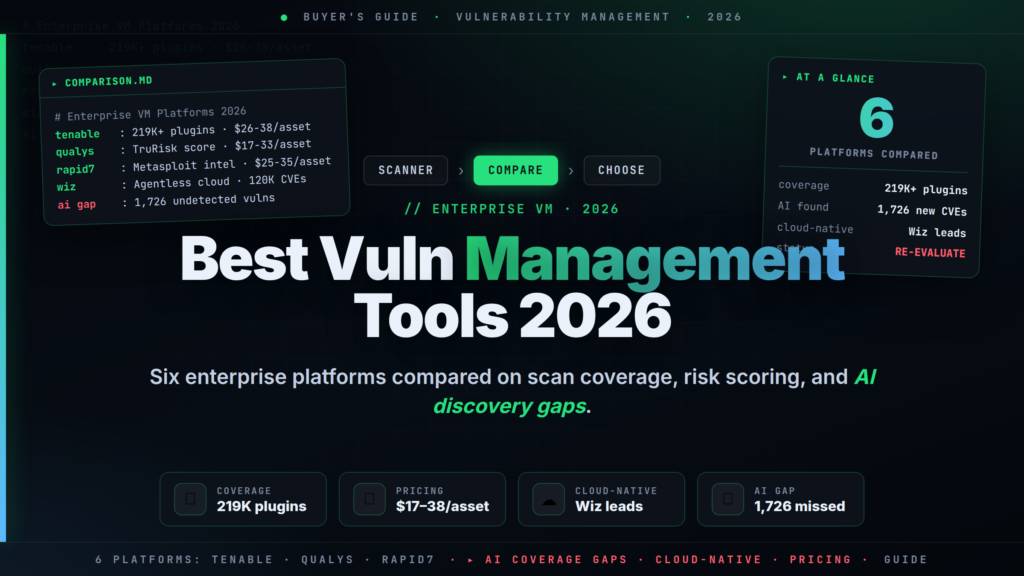
The best vulnerability management tools enterprise 2026 security teams rely on are facing a legitimacy test. Anthropic's Claude Mythos AI scanner — part of Project Glasswing, an AI-powered security research initiative — recently confirmed 1,726 true-positive vulnerabilities across 1,000+ open-source projects, including 1,000+ rated high or critical severity, that traditional network scanners had not caught. For teams locked into multi-year contracts with Tenable, Qualys, or Rapid7, that finding demands a harder look at whether their current platforms are still fit for purpose.
This guide compares six enterprise vulnerability management (VM — the practice of continuously finding, prioritizing, and remediating security weaknesses across your infrastructure) platforms on the criteria that matter at scale: scan coverage, CVSS prioritization accuracy, asset inventory breadth, cloud-native support, and realistic pricing. The six: Tenable, Qualys VMDR, Rapid7 InsightVM, Microsoft Defender Vulnerability Management, CrowdStrike Falcon Spotlight, and Wiz.
// 01 What to Look For in an Enterprise VM Platform
Defining your requirements before evaluating vendors prevents expensive mistakes. Four capabilities should be non-negotiable:
Scan coverage refers to the percentage of your actual attack surface that the scanner can see. Traditional network scanners miss agentless cloud workloads, ephemeral containers, and open-source software components embedded in your applications. The Mythos findings — 10,000+ high/critical-severity flaws identified across systemically important software since the tool launched — are a concrete measure of how large that gap is.
CVSS prioritization accuracy: CVSS v3.1 (Common Vulnerability Scoring System, the industry-standard 0–10 severity scale where 9.0–10.0 is Critical and 7.0–8.9 is High) scores alone are unreliable triage signals. A CVSS 9.8 flaw in a service you don't expose externally, with no public exploit, is less urgent than a CVSS 6.5 flaw with active in-the-wild exploitation on your internet-facing load balancer. Look for platforms that overlay threat intelligence — exploit-in-the-wild data, CISA KEV (the U.S. Cybersecurity & Infrastructure Security Agency's Known Exploited Vulnerabilities catalogue — inclusion confirms active exploitation) correlation, and asset criticality context — on top of the raw score.
Asset inventory depth: Continuous, accurate discovery is the foundation of any VM program. A scanner that misses 20% of cloud instances because they're ephemeral, or ignores containers because it has no agent in the pipeline, produces a false sense of coverage.
Cloud-native and hybrid support: Enterprises now run a mix of on-premises data centers, IaaS (Infrastructure-as-a-Service — rented cloud compute such as AWS EC2 or Azure VMs), containers, Kubernetes clusters, and CI/CD (Continuous Integration/Continuous Deployment) pipelines. Platforms architected before 2020 typically bolt cloud support on as modules; newer entrants built cloud coverage natively from the start.
// 02 Tenable Nessus / Tenable Security Center
Best for: Hybrid on-premises and cloud environments with deep network scanning requirements and OT/ICS asset coverage.
Tenable offers two enterprise-grade products: Tenable.io (cloud-managed SaaS) and Tenable Security Center (on-premises deployment), both powered by Nessus scanners. With a plugin library exceeding 219,000 detection checks — the largest of any vendor in this comparison — Tenable has the broadest raw coverage for known CVEs across network devices, operating systems, databases, web servers, and application frameworks.
Key strengths:
- 219,000+ detection plugins updated daily; Tenable's research team is one of the most prolific CVE reporters in the industry
- Predictive Prioritization generates a VPR (Vulnerability Priority Rating, a 0–10 contextual score) that combines CVSS with Tenable's proprietary threat intelligence, significantly reducing the noise of a raw CVSS-sorted vulnerability list
- Strong compliance reporting for PCI DSS 4.0, HIPAA, CIS Benchmarks, and DISA STIGs
- OT (Operational Technology — industrial control systems, SCADA, PLCs) support via integrated Tenable OT Security
- Supports credentialed and uncredentialed network scanning, agent-based scanning, and passive network monitoring
Weaknesses:
- Agentless cloud workload discovery is maturing but still requires agents for accurate coverage of cloud instances
- Reporting console feels dated compared to cloud-native alternatives
- False-positive rates on certain network device checks require tuning to avoid alert fatigue
Pricing: $26–$38 per asset per year at enterprise scale for cloud deployment. On-premises Security Center licensing scales by IP count and varies with support tier.
// 03 Qualys VMDR
Best for: Large enterprises with heavy compliance audit requirements, multi-site asset inventories, and ITSM integration needs.
Qualys VMDR (Vulnerability Management, Detection and Response) is a cloud-delivered platform whose single-agent architecture covers VM, policy compliance, web application scanning, patch management, and container security under one console. The platform's cloud-agent model provides continuous, near-real-time scanning without traditional scheduled scan windows.
Key strengths:
- TruRisk score combines CVSS, CISA KEV data, active exploitation signals, and configurable business context for contextual prioritization
- Deep ITSM (IT Service Management) integrations with ServiceNow, Jira, BMC Remedy, and others — critical for organizations that route remediation through change management workflows
- Widest compliance library of the platforms reviewed: CIS Level 1/2, DISA STIGs, PCI DSS 4.0, SOC 2, ISO 27001, NIST CSF
- Patch management included in the base price tier — a cost advantage over competitors
Weaknesses:
- False-positive rates up to 30% reported in some enterprise deployments; ongoing tuning is required and expected
- Cloud-native container and serverless scanning lags behind dedicated cloud-security platforms like Wiz
- The unified console is intentionally broad, which means no single capability is as deep as a best-of-breed tool
Pricing: $17–$33 per asset per year with patch management included — the most cost-competitive of the three legacy VM vendors.
// 04 Rapid7 InsightVM
Best for: Teams that want exploit-informed risk prioritization and tight remediation workflow integration.
Rapid7 InsightVM is a cloud-managed VM platform that differentiates on its Real Risk Score — a contextual priority score backed by live data from the Metasploit Framework, the world's most widely used penetration testing (T1190 — Exploit Public-Facing Application, the MITRE ATT&CK technique for weaponizing internet-facing flaws) framework. When a Metasploit exploit module exists for a CVE, InsightVM immediately reflects that in its risk score — a direct, practitioner-grade signal that the flaw is demonstrably exploitable in the real world.
Key strengths:
- Real Risk Score is the strongest exploit-context signal of the three legacy platforms, drawing on live Metasploit module telemetry and Rapid7's threat intelligence
- Integrated remediation project tracking with SLA (Service Level Agreement) monitoring and assignee dashboards
- InsightConnect SOAR (Security Orchestration, Automation, and Response — automated workflows for triage and ticketing) integration for automated remediation ticket creation
- Live, drag-and-drop risk dashboards with executive-facing summary views
- Most transparent published pricing of the three major vendors
Weaknesses:
- Scan speeds on large, geographically distributed networks can lag behind Tenable
- OT/ICS (Industrial Control Systems) coverage is weaker than Tenable's
- Above ~1,500 assets, pricing requires direct negotiation
Pricing: $25–$35 per asset per year; entry-level pricing around $175/month for smaller environments.
// 05 Microsoft Defender Vulnerability Management
Best for: Organizations heavily invested in Microsoft 365, Azure, and Defender for Endpoint who want VM without deploying a separate agent.
Microsoft Defender Vulnerability Management is available as a standalone add-on to Microsoft 365 E3/E5 or Defender for Endpoint Plan 2. It provides continuous, agent-based vulnerability assessment for Windows, macOS, Linux, iOS, and Android endpoints — with agentless scanning for Azure virtual machines via direct cloud API integration.
Key strengths:
- Zero additional agent deployment on Windows endpoints already running Defender for Endpoint — a major operational advantage in large Windows estates
- Vulnerability prioritization correlates directly with Microsoft Threat Intelligence and breach-likelihood predictions generated from Microsoft's telemetry across 1 billion+ devices
- Browser extension inventory and vulnerability scanning — an attack surface often invisible to traditional network scanners
- Integrated with Microsoft Intune for automated patch deployment and remediation workflows
- Software and OS inventory updated in near-real-time across all managed endpoints
Weaknesses:
- Coverage drops sharply outside the Microsoft ecosystem — limited for Linux servers at scale, network appliances, cloud-native workloads, and third-party SaaS
- Not competitive as a standalone enterprise VM product in heterogeneous environments
- Compliance reporting is Microsoft-benchmark-centric; limited support for CIS, DISA STIG, or PCI DSS frameworks compared to Qualys or Tenable
Pricing: Included in Microsoft 365 E5 Security; available as an add-on for Defender for Endpoint Plan 2 customers.
// 06 CrowdStrike Falcon Spotlight
Best for: Organizations that have deployed CrowdStrike Falcon broadly and want VM without a second agent or scan traffic.
CrowdStrike Falcon Spotlight takes a fundamentally different approach to VM: instead of active network scanning, it reads vulnerability data passively from the lightweight Falcon sensor already running on endpoints. There is no scan traffic on the network, no scan window scheduling, and no additional agent to deploy or manage — vulnerability state is continuously streamed from every Falcon-protected endpoint.
Key strengths:
- Scanless, continuous assessment — zero network impact, zero scan windows, real-time vulnerability state
- Adversary-driven risk prioritization uses CrowdStrike threat intelligence on active exploit campaigns attributed to named threat actors
- Single-pane integration across Falcon EDR (Endpoint Detection and Response — technology for detecting and investigating threats on endpoints), identity protection, and threat hunting — VM in context of active attacks, not in isolation
- Covers Windows, macOS, and Linux endpoints comprehensively
Weaknesses:
- Coverage is strictly limited to endpoints running the Falcon sensor; network devices, legacy OT systems, cloud workloads without Falcon agents, and web applications are invisible
- No web application, API, or container image scanning
- Requires existing CrowdStrike Falcon platform investment — not viable as a standalone VM purchase
Pricing: Available as a Falcon platform module; direct quote required from CrowdStrike.
// 07 Wiz
Best for: Cloud-first organizations running multi-cloud IaaS, containers, or Kubernetes who need rapid, agentless inventory and context-aware risk prioritization.
Wiz is an agentless cloud security platform with a vulnerability catalog covering 120,000+ CVEs across 40+ operating systems and cloud environments. It achieves full inventory without deploying agents by connecting to cloud provider APIs (AWS, Azure, GCP, Oracle Cloud) and reading disk snapshots at the hypervisor level — scanning happens outside the workload entirely.
Key strengths:
- Full cloud asset inventory in hours, not weeks, with zero agent deployment
- Wiz Security Graph correlates CVEs with runtime network exposure, IAM (Identity and Access Management — who can do what with which resources) permission paths, and data sensitivity classifications to surface exploitable attack paths, not just raw vulnerability lists
- Native container image and Kubernetes workload scanning, including registry scanning and CI/CD pipeline integration for shift-left security
- Developer-facing remediation workflows with pull-request-level context and ownership assignment
Weaknesses:
- Primarily a cloud security platform — limited value for on-premises data centers or air-gapped environments
- No active network protocol scanning; relies entirely on API access to cloud providers
- High price point for smaller organizations
Pricing: Direct quote required; enterprise contracts typically start at $150,000+ annually for large cloud footprints.
// 08 Best Vulnerability Management Tools Enterprise 2026: Side-by-Side Comparison
| Platform | Scan Method | Cloud Coverage | Prioritization Model | Best Fit | Price/Asset/Year | |—|—|—|—|—|—| | Tenable | Active + agent | Hybrid | VPR (threat intel overlay) | Hybrid / OT environments | $26–$38 | | Qualys VMDR | Agent + cloud | Hybrid | TruRisk score | Compliance-heavy enterprises | $17–$33 | | Rapid7 InsightVM | Active + agent | Hybrid | Real Risk (Metasploit live data) | Exploit-focused programs | $25–$35 | | Microsoft Defender VM | Agent | Azure/Windows | Breach likelihood (Microsoft TI) | Microsoft 365 / Azure shops | M365 E5 add-on | | CrowdStrike Spotlight | Scanless (Falcon sensor) | Endpoint only | Adversary campaign intel | CrowdStrike-deployed estates | Platform module | | Wiz | Agentless API | Cloud-native | Security Graph (attack path risk) | Cloud-first / multi-cloud | Quote ($150K+) |
// 09 How to Choose: A Decision Framework
The right platform depends on your environment composition and program maturity. Use this decision tree to map your estate to the best starting point:
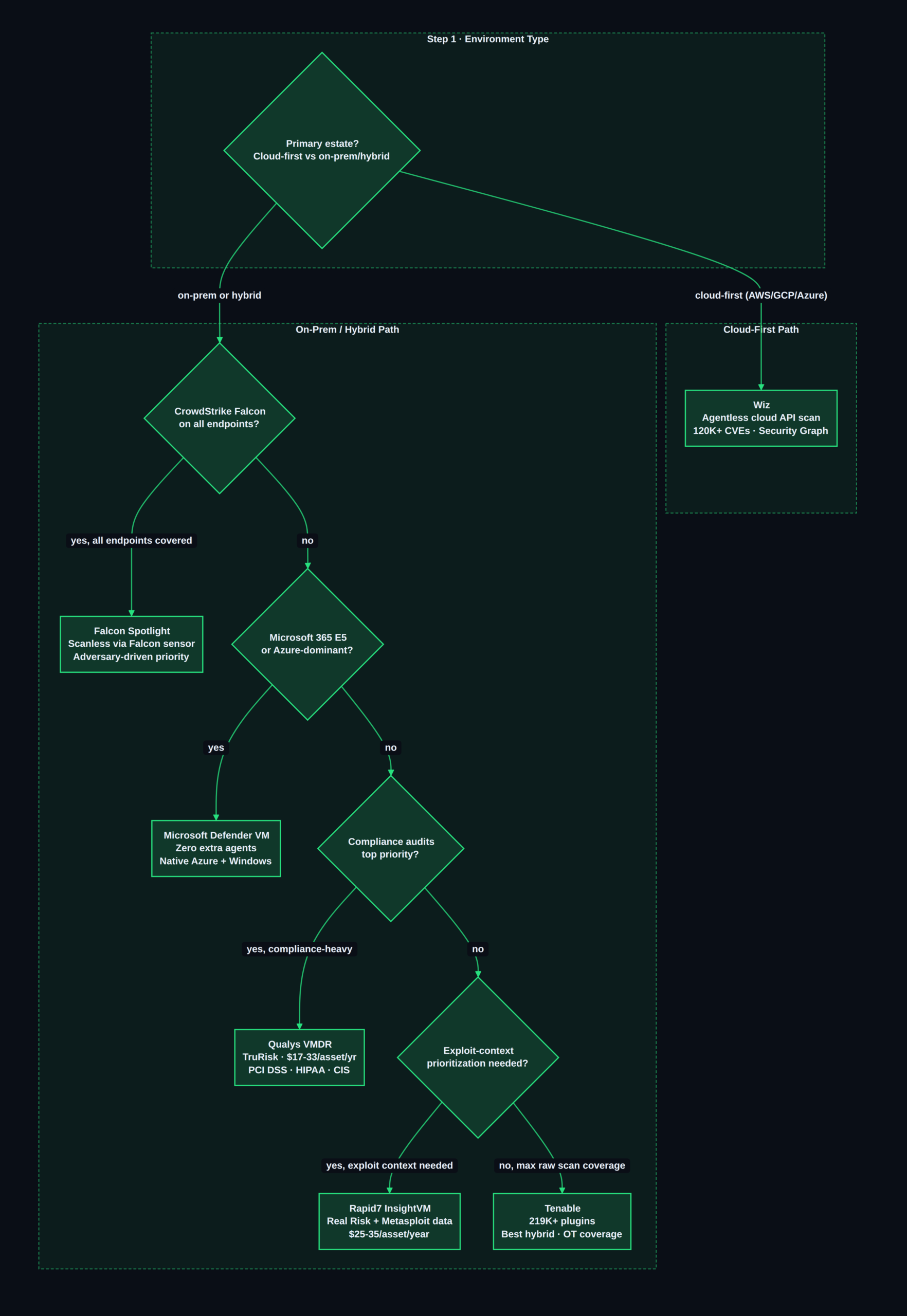
For mature enterprise programs that span hybrid and cloud: combining a legacy scanner (Tenable or Qualys) with Wiz for cloud coverage is an established pattern that closes the most common inventory gaps without replacing either platform.
// 10 The AI Coverage Gap: What Mythos Revealed About Scanner Blind Spots
No enterprise VM platform in this comparison closes the gap that Project Glasswing and Claude Mythos exposed. The reason is architectural: traditional VM platforms work by comparing installed software version numbers against a CVE database. They find vulnerabilities that have already been discovered, assigned a CVE identifier, and added to the vendor's plugin or signature library.
Mythos found vulnerabilities through source code analysis — examining the actual logic of programs for exploitable defects, without waiting for a CVE to be filed. The 23,000 potential findings across 1,000+ OSS projects included flaws in Firefox (271 findings), Palo Alto Networks software, and curl. WolfSSL CVE-2026-5194 (CVSS 9.1 — a critical flaw enabling TLS certificate forgery) is a concrete example: it had no CVE, no plugin, and no prior disclosure until Mythos identified and reported it. No scanner in this guide would have flagged it before Anthropic's disclosure.
The operational implication is structural: a scanner subscription covers known vulnerabilities. For OSS (Open-Source Software) components in your application dependency chains — runtime libraries, embedded SDKs, and middleware that a network scanner never touches — coverage requires a dedicated SCA (Software Composition Analysis) tool. As covered in our guide on CVE blind spots in SCA tooling and EOL dependencies, SCA tools like Snyk, Mend (formerly WhiteSource), and Black Duck analyze software bills of materials (SBOMs) and flag known CVEs in third-party packages — but they too depend on CVEs already being assigned. AI-assisted source code analysis represents a third layer that neither traditional VM nor SCA currently provides.
The practical recommendation: add an SCA tool to your stack regardless of which VM platform anchors your program, and monitor AI-assisted vulnerability research channels (Mythos advisories, GitHub Security Advisories, OSS security mailing lists) as an early-warning layer for zero-day findings in your OSS dependencies.
// 11 Conclusion
The best vulnerability management tools for enterprise security in 2026 are no longer defined by plugin count or scan speed alone — they are defined by how well they map to your actual attack surface. Tenable leads on raw detection breadth; Qualys wins on compliance coverage and pricing; Rapid7 excels at exploit-driven prioritization; Microsoft and CrowdStrike win decisively when you are already inside their ecosystems; Wiz is the default choice for cloud-native estates. No single platform covers every layer of the modern attack surface — the Mythos findings confirm that AI-assisted source code analysis now represents a coverage category that none of these platforms address.
Review your scanner's asset inventory completeness against your cloud and container footprint before your next renewal. That gap is where the next Mythos-class disclosure will land.
See our full coverage of AI-driven vulnerability discovery: Project Glasswing: Claude Mythos Finds 10,000 Flaws in Critical Software and Anthropic Mythos Confirms 23,000 Vulnerabilities Across 1,000 OSS Projects →
For any query contact us at contact@cipherssecurity.com