
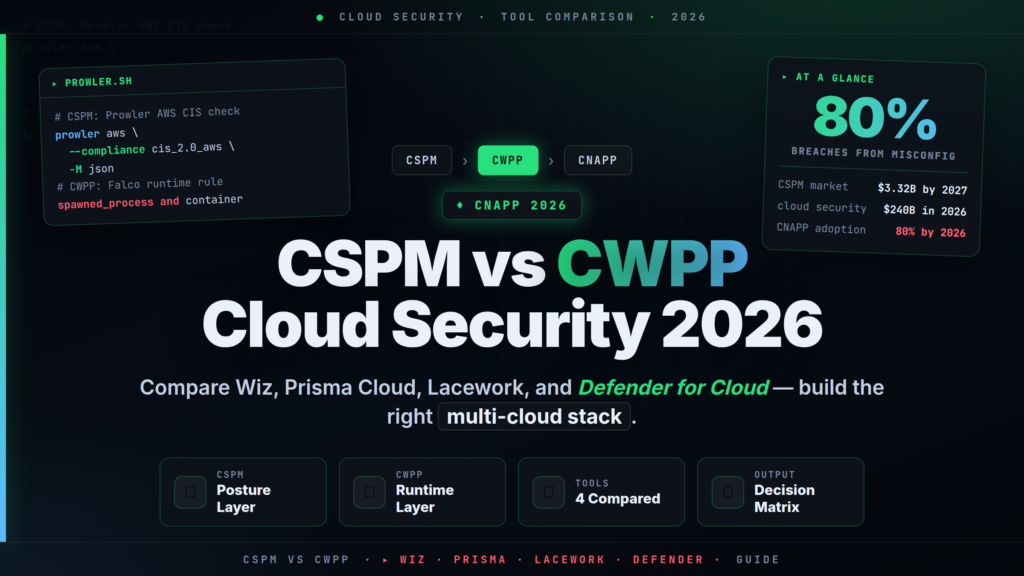
CSPM vs CWPP cloud security 2026 is the decision keeping cloud security engineers awake: misconfigurations caused 65–80% of cloud breaches in recent years, yet most organisations still run posture management and workload protection as separate, siloed tools with no shared data model. This guide breaks down both categories architecturally, compares the leading platforms — Wiz, Prisma Cloud, Lacework, and Microsoft Defender for Cloud — and delivers a decision matrix to help DevSecOps leads choose the right stack for multi-cloud deployments on AWS, Azure, and GCP.
// 01 What Is CSPM (Cloud Security Posture Management)
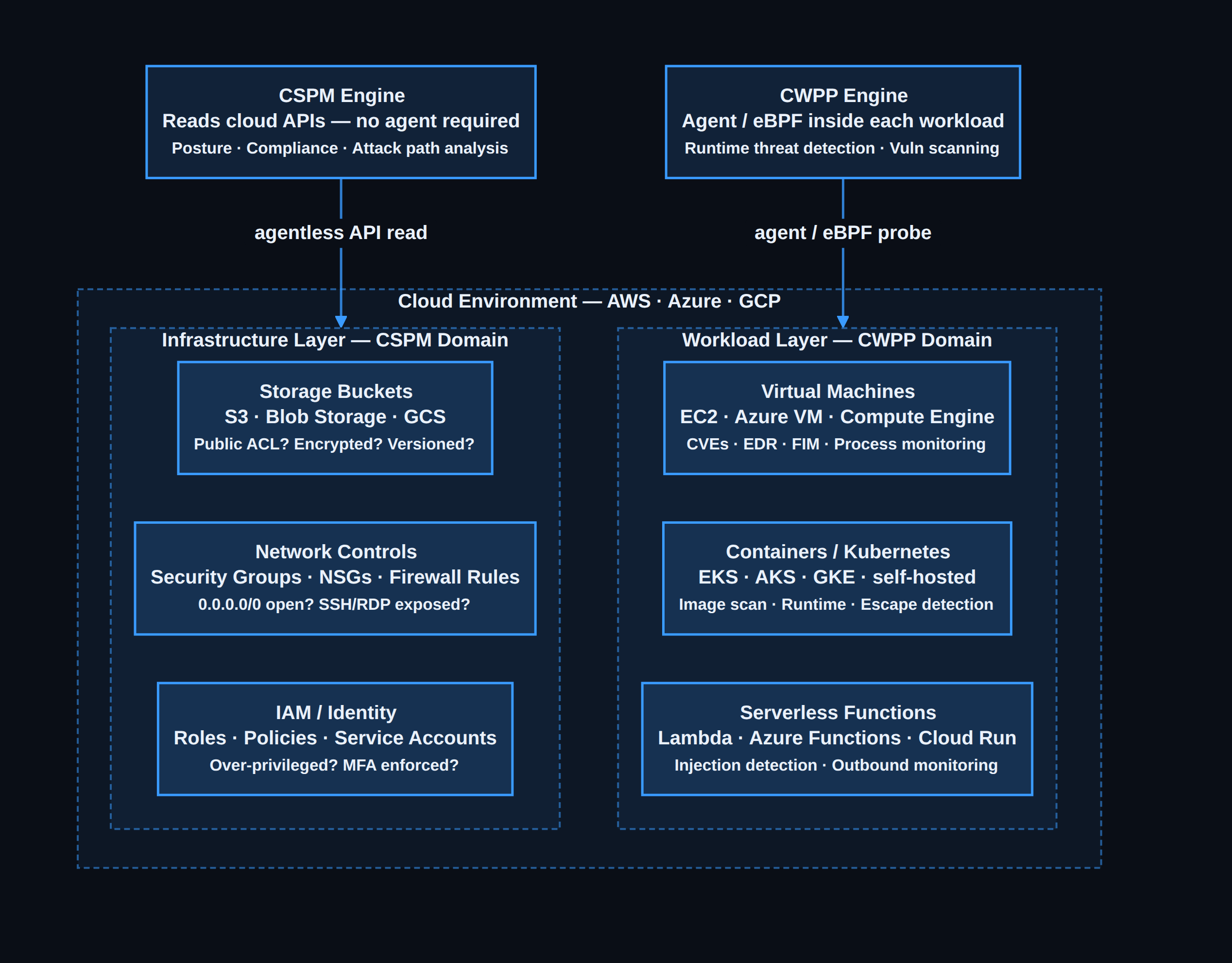
Cloud Security Posture Management (CSPM) is a class of tools that continuously reads your cloud provider's APIs — no agent required on individual workloads — and compares every configuration setting against a defined security baseline. Think of it as a continuous internal auditor: it knows your AWS S3 buckets, Azure Storage accounts, GCP firewall rules, IAM (Identity and Access Management) policies, and Kubernetes RBAC (Role-Based Access Control) settings, and it flags anything that drifts from secure configuration.
The core CSPM capabilities that matter in 2026:
- Misconfiguration detection: Identifying exposed storage buckets (
public-readACLs on S3), overly permissive security groups (0.0.0.0/0ingress on port 22 or 3389), or unencrypted data volumes. - Compliance posture: Mapping configurations to frameworks such as CIS (Center for Internet Security) Benchmarks, NIST 800-53, SOC 2, PCI-DSS, HIPAA, and ISO 27001. The tool generates pass/fail findings per individual control.
- Attack path analysis: Modern CSPM tools do not alert on misconfigurations in isolation. They model your cloud graph — identity, network, compute, data — and surface toxic combinations: chains of individually minor issues that together create a realistic path to a crown-jewel resource. Example: a misconfigured EC2 instance with an over-privileged IAM role attached, sitting on a subnet reachable from the internet, represents a complete lateral movement path even if no single finding scores as Critical.
- IaC (Infrastructure-as-Code) scanning: Catching Terraform, CloudFormation, Pulumi, or Bicep misconfigurations before they reach production. This is the point where CSPM intersects directly with the developer workflow.
CSPM is preventive and infrastructure-layer: it protects the configuration of the environment, not what runs inside it.
// 02 What Is CWPP (Cloud Workload Protection Platform)
Cloud Workload Protection Platform (CWPP) operates inside the workload — the virtual machines, containers, serverless functions, and microservices running in your cloud environment. Where CSPM reads cloud APIs from the outside, CWPP runs an agent, kernel module, or eBPF (extended Berkeley Packet Filter — a Linux kernel technology that lets tools inspect system calls without modifying the kernel source) probe inside the workload to observe behaviour at runtime.
Core CWPP capabilities:
- Vulnerability management: Scanning OS packages, application libraries, and container images for known CVEs (Common Vulnerabilities and Exposures — the industry-standard catalogue of software flaws), scored against CVSS v3 (Common Vulnerability Scoring System version 3, a 0–10 scale used to rate severity).
- Runtime threat detection: Detecting anomalous process execution, unexpected outbound network connections, privilege escalation attempts, and lateral movement inside a running container or VM.
- File Integrity Monitoring (FIM): Alerting when critical system files or configuration files change unexpectedly — a key indicator of post-exploitation tampering.
- Container and Kubernetes security: Enforcing admission policies (e.g. blocking images with Critical CVEs at deploy time), monitoring pod behaviour, and detecting container escape attempts at the kernel level.
- Serverless protection: Monitoring AWS Lambda, GCP Cloud Functions, and Azure Functions for injection attacks and unusual outbound calls that indicate function compromise.
CWPP is reactive and workload-layer: it protects what runs in the environment, in real time.
// 03 CSPM vs CWPP Cloud Security 2026: Core Differences
The architectural divide between CSPM and CWPP maps cleanly to two different threat models:
| Dimension | CSPM | CWPP | |———–|——|——| | Protection target | Cloud infrastructure configuration | Running workloads (VMs, containers, serverless) | | Threat type | Misconfiguration, compliance drift, excessive IAM access | Malware, runtime exploits, lateral movement | | Data source | Cloud provider APIs (agentless) | Agent, eBPF, or kernel module inside the workload | | Deployment model | Read-only cloud API integration (hours to connect) | Agent rollout across every workload (days to weeks at scale) | | Primary output | Findings, risk scores, compliance reports | Real-time alerts, behavioral detections, threat response | | When it fires | Before a workload is compromised | During or after a compromise attempt | | AWS native equivalent | AWS Security Hub + AWS Config | AWS GuardDuty + Amazon Inspector |
The critical insight is that CSPM and CWPP protect different layers of the same environment. A misconfigured security group that CSPM flags as internet-exposed creates the opportunity; the runtime exploit that CWPP detects is the attacker walking through it.
// 04 CNAPP: When CSPM and CWPP Converge
In 2026, standalone CSPM or CWPP tools are increasingly rare at the enterprise level. Gartner predicts that 80% of enterprises will consolidate into a CNAPP (Cloud-Native Application Protection Platform) — a unified platform that integrates CSPM, CWPP, CIEM (Cloud Infrastructure Entitlement Management — the discipline of controlling which identities can access which cloud resources and under what conditions), and DSPM (Data Security Posture Management — extending posture management to data stores and sensitive data flows) under a single data model.
The business case for CNAPP is attack path correlation. When CSPM data (open port, over-privileged IAM role) and CWPP data (anomalous process spawn, suspicious outbound connection) flow into a single security graph, the platform can determine that a behavioral alert in a container is a live exploitation attempt on the misconfigured path CSPM surfaced three days ago. Separate tools require a human analyst to make that connection manually — a process that routinely takes hours and often never happens at all.
Cloud security spending is projected to reach $240 billion in 2026, and the CSPM segment alone is forecast to exceed $3.32 billion by 2027. That spending pressure is accelerating vendor consolidation toward the CNAPP model and pushing buyers away from point solutions.
// 05 Tool Comparison: Wiz, Prisma Cloud, Lacework, and Defender for Cloud
Wiz
Wiz is the current CNAPP market leader, defined by its agentless-first architecture. It connects to AWS, Azure, and GCP using read-only cloud roles — no software deployed on hosts — takes snapshots of workloads, and builds a cloud Security Graph that maps every resource relationship across identity, network, data, and compute. Attack path analysis runs across the full graph and surfaces chained risk findings rather than individual misconfiguration alerts.
Wiz covers CSPM, vulnerability management, CIEM, DSPM, container security, and IaC scanning from a single console. For deep runtime protection, Wiz offers Wiz Defend — an eBPF-based runtime module deployed selectively on workloads where CWPP-grade coverage is required.
Best for: Teams that need CNAPP coverage across AWS + Azure + GCP, prioritise fast deployment (agentless connects in hours, not weeks), and want attack path analysis as the primary risk prioritisation mechanism. Wiz's pending acquisition by Google (announced at $32 billion) makes it the natural fit for GCP-heavy environments going forward.
Limitation: Wiz Defend (runtime agent) is a separate add-on. Pure agentless coverage misses in-memory threats that never touch disk or the filesystem — an increasingly common attacker technique.
Prisma Cloud (Palo Alto Networks)
Prisma Cloud offers the broadest CNAPP feature set of any single platform: CSPM, CWPP, CIEM, DSPM, API security, AI-SPM (AI Security Posture Management), and code security under one console. Its defining capability is code-to-cloud traceability: when the platform detects a misconfigured S3 bucket in production, it traces the configuration back to the specific Terraform module, the pull request that introduced it, and the developer who authored the change.
The Twistlock-derived Defender agent — Twistlock being the container security company Palo Alto Networks acquired in 2019 — remains the primary path for deep container, host, and serverless runtime protection. This agent provides host-level FIM, network micro-segmentation enforcement, and runtime process whitelisting that agentless tools cannot match.
Best for: DevSecOps programs already invested in the Palo Alto stack (Cortex XDR, XSOAR), or teams requiring IaC-to-runtime traceability to attribute cloud findings to specific code changes. Prisma Cloud's module licensing means you pay only for the capabilities you activate.
Limitation: Breadth comes with operational complexity. The multi-module console has a steep learning curve and can overwhelm smaller teams without a dedicated cloud security engineer.
Microsoft Defender for Cloud
Defender for Cloud is Microsoft's native CSPM + CWPP offering, built directly into the Azure portal and extended to AWS and GCP via multi-cloud connectors. The free tier provides foundational CSPM — a security score aligned to CIS Benchmarks. The paid tiers, Defender for Servers P1 and P2, add vulnerability assessment (powered by either Qualys or Microsoft's own Defender Vulnerability Management) and runtime threat detection via the Azure Monitor Agent.
Its differentiating capability is attack path analysis built on the Security Graph — a model of identity, network, data, and compute relationships across your Azure tenant and connected AWS/GCP accounts. Attack paths surface the realistic exploitation routes an adversary could follow from an internet-exposed entry point to a sensitive data store, without the analyst needing to manually correlate individual findings.
Best for: Azure-first or Microsoft-heavy organisations that want native CSPM + CWPP without a third-party deployment. Defender for Cloud's integration with Microsoft Sentinel (SIEM — Security Information and Event Management), Entra ID, and Defender XDR makes it the strongest choice when the full Microsoft security stack is already in place.
Limitation: AWS and GCP support exists but trails Azure depth significantly. Agentless AWS coverage requires the CSPM P2 plan, and GCP connector capabilities lag behind AWS by at least one feature generation.
Lacework
Lacework takes a behavioural-first approach to both CSPM and CWPP. Its machine learning engine establishes a dynamic baseline of normal activity — process executions, network connections, API calls, and user behaviour — and surfaces deviations as composite threat findings rather than individual rule-based alerts. This dramatically reduces alert fatigue in environments where traditional CWPP tools generate thousands of individual detections daily, making it difficult to identify which alerts represent genuine threats.
Best for: Cloud-native organisations where behavioral anomaly detection is the primary unmet need — specifically teams that have already solved misconfiguration management and are struggling to distinguish legitimate automation from attacker tooling inside containerised workloads.
Limitation: Lacework's CSPM coverage is shallower than Wiz or Prisma Cloud. It functions best as a CWPP-first, behavioral detection platform rather than a full CNAPP replacement.
// 06 CSPM vs CWPP Cloud Security 2026: Decision Matrix
// 07 Open-Source Options for Budget-Constrained Teams
Commercial CNAPP platforms carry significant per-resource pricing. For smaller teams or environments where cloud spend is tightly controlled, a combination of open-source tools can approximate CSPM and CWPP coverage — at the cost of operational effort and integration complexity.
Prowler is an open-source CLI (command-line interface) tool that runs AWS, Azure, and GCP security checks against CIS, NIST, SOC 2, PCI-DSS, and GDPR controls. Run it from a CI/CD pipeline or on a schedule for continuous CSPM posture data. Output formats include JSON, HTML, and OCSF (Open Cybersecurity Schema Framework).
# Install Prowler via pip
pip install prowler

# Run CIS AWS Foundations Benchmark v2.0 checks
prowler aws --compliance cis_2.0_aws -M json

# Run GCP checks using a service account
prowler gcp --project-ids my-project-id
Falco is a CNCF-graduated (Cloud Native Computing Foundation — the open-source body that maintains projects like Kubernetes and Prometheus) runtime security tool that uses eBPF and kernel module probes to detect anomalous behaviour inside containers and VMs. Falco rules define expected process and network behaviour; violations generate real-time alerts routed to Kafka, Slack, Elasticsearch, or a SIEM.
# Falco rule: detect a shell spawned inside a container with an attached terminal
- rule: Terminal Shell in Container
  desc: A shell was spawned inside a container with an attached terminal
  condition: >
    spawned_process and container
    and shell_procs and proc.tty != 0
  output: >
    Shell in container with terminal
    (user=%user.name container=%container.name
     image=%container.image.repository proc=%proc.cmdline)
  priority: WARNING
  tags: [container, shell, mitre_execution, T1059.004]
Open Policy Agent (OPA) is a general-purpose policy engine where you define security policies in Rego — a declarative query language for policy evaluation. OPA integrates with Kubernetes admission controllers, Terraform Cloud, and CI/CD pipelines to enforce configuration policies before resources are provisioned.
OpenSCAP implements the SCAP (Security Content Automation Protocol) standard for automated compliance assessment. Best applied for VM-level compliance scanning against DISA STIG (Defense Information Systems Agency Security Technical Implementation Guide) and CIS benchmarks on Linux hosts.
The core limitation of open-source combinations is integration. Prowler does not share a data model with Falco, which does not correlate with OPA findings. Aggregating these into a unified risk view requires a SIEM, custom scripting, and ongoing engineering investment that commercial CNAPP platforms eliminate. Open-source is viable for small teams with strong engineering bandwidth; it is not a realistic alternative for organisations operating at enterprise scale.
// 08 Choosing the Right Tool: Operational Recommendations
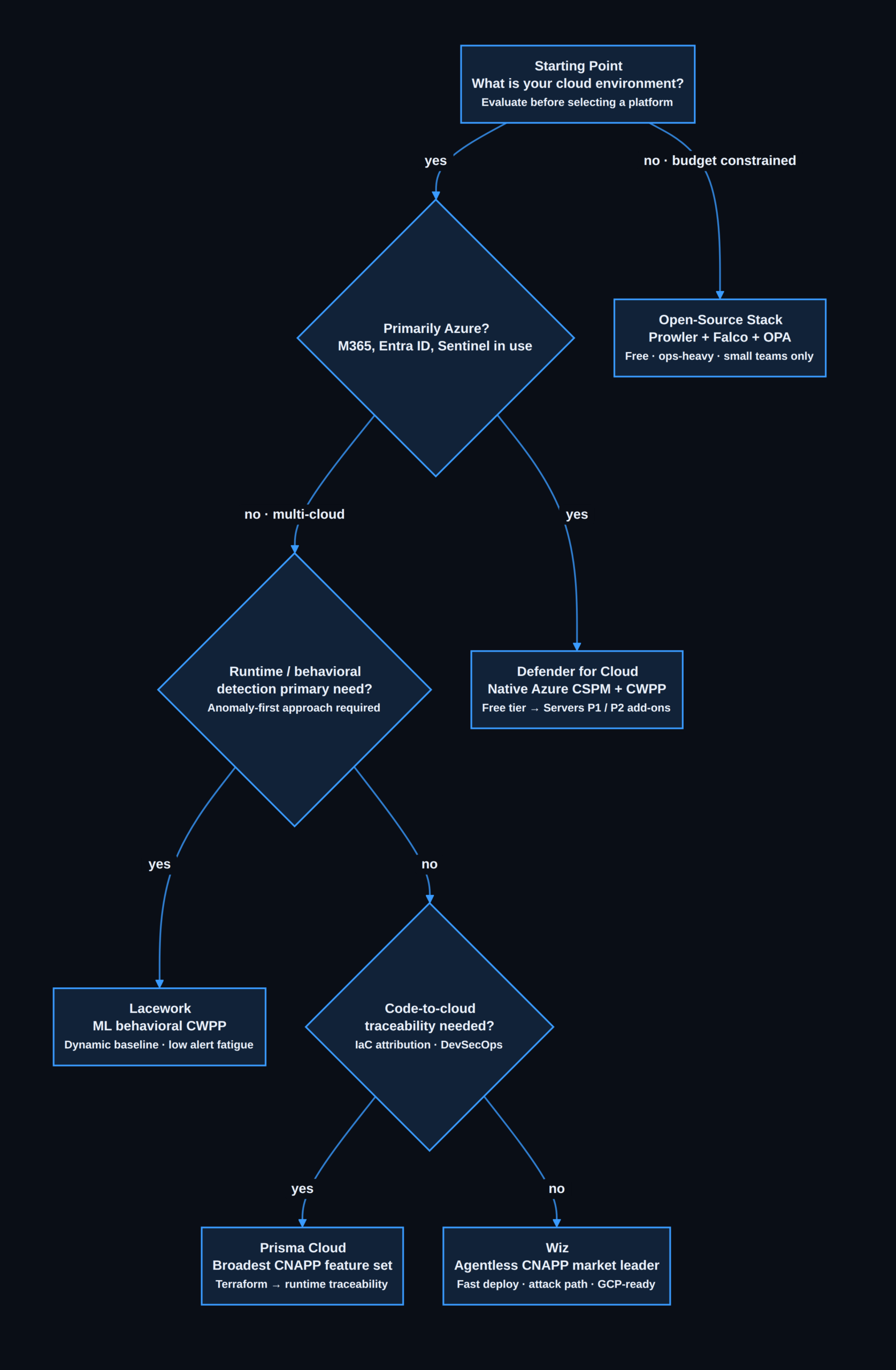
Based on the architectural analysis above, five decision points cover the majority of real-world scenarios:
- Azure-first organisations with Microsoft 365, Entra ID, and Sentinel already deployed should start with Defender for Cloud. The free CSPM tier provides immediate value — security score, CIS alignment, attack path analysis — before any budget is committed.
- Multi-cloud organisations (AWS + Azure + GCP) that need fast deployment and unified attack path analysis should evaluate Wiz. Agentless architecture connects to all three providers within hours and the Security Graph is immediately queryable.
- DevSecOps programs that require IaC-to-production traceability and operate within an existing Palo Alto environment should evaluate Prisma Cloud. The code security module brings SAST (Static Application Security Testing) and IaC scanning into the same console as runtime findings, eliminating the manual handoff between security and engineering teams.
- Container-heavy, cloud-native teams struggling with alert fatigue from rule-based CWPP tools should evaluate Lacework. Its ML behavioral baseline reduces false positive volume by correlating multiple weak signals into composite findings.
- Budget-constrained small teams can combine Prowler (CSPM), Falco (CWPP), and OPA (policy enforcement) for foundational coverage — accepting the integration overhead and the absence of cross-tool correlation.
// 09 Conclusion
CSPM vs CWPP cloud security 2026 is not a binary choice: most organisations operating at scale need both layers, and the market has moved decisively toward CNAPP platforms that deliver them from a single data model with shared attack path analysis. The question for practitioners is not which category to buy, but which vendor's CNAPP architecture fits their deployment model, cloud provider mix, and existing security stack. Trial the shortlisted platform against your actual environment — most vendors offer 30-day POCs — and validate that attack path findings reflect your genuine threat model before signing a multi-year contract.
See our analysis of PCPJack cloud worm credential theft targeting Docker and Kubernetes for a real-world example of the runtime threats that CWPP is designed to catch. Teams working toward compliance posture should also read SOC 2 Type II Checklist for SaaS Companies in 2026 — CSPM compliance mapping is a core component of the SOC 2 evidence collection process. For network-layer context, see Zero Trust and Data Movement Security Gaps — CSPM misconfiguration findings feed directly into zero-trust policy enforcement decisions.
For any query contact us at contact@cipherssecurity.com