
The best EDR/XDR tools for automated incident response in 2026 are defined by a capability that was a premium differentiator just two years ago: the ability to contain a threat without waiting for an analyst to approve the action. Microsoft's announcement in May 2026 that Defender for Endpoint now auto-isolates compromised endpoints confirms the market has reached a tipping point—automated containment is a baseline expectation, not a selling point. Security teams evaluating or replacing their EDR/XDR platform in 2026 need a neutral breakdown of how the leading platforms actually perform before writing a purchase order.
This guide benchmarks five platforms—CrowdStrike Falcon, SentinelOne Singularity, Microsoft Defender XDR, Palo Alto Cortex XDR, and Sophos Intercept X with MDR—across MTTD (Mean Time to Detect), autonomous response capability, SOAR integration, and total cost per endpoint.
// 01 EDR vs XDR: What the Labels Mean for Containment Scope
EDR (Endpoint Detection and Response) covers telemetry and response actions scoped to individual endpoints—workstations, servers, laptops. XDR (Extended Detection and Response) expands that data plane to include network traffic, cloud workloads, identity providers, email, and SaaS applications, then correlates signals across all of them into unified incidents. MDR (Managed Detection and Response) layers a human analyst team on top of either, which matters when in-house SOC capacity is thin.
The distinction is critical for containment depth. An EDR platform can isolate a single endpoint from the network. An XDR platform can simultaneously isolate the endpoint, block the associated compromised user account in Active Directory, quarantine the phishing email that delivered the payload, and revoke cloud session tokens—all triggered by a single detection event. That breadth of automated action is why XDR commands a premium and why the market is accelerating in that direction.
Two metrics dominate 2026 procurement discussions:
- MTTD — Mean Time to Detect: how fast the platform identifies a threat from first compromise. Historically the key benchmark; still important for stopping fast-moving ransomware.
- MTTR — Mean Time to Recover: how long it takes to restore full normal operations. Cyber insurers, boards, and regulators now prioritise MTTR, because fast detection followed by slow recovery is still an expensive incident.
// 02 Best EDR/XDR Tools for Automated Incident Response in 2026
CrowdStrike Falcon Insight XDR
CrowdStrike Falcon Insight XDR is the enterprise market leader, holding approximately 50% share of high-end enterprise endpoint security. Its core competitive advantage is scale: the platform processes up to one petabyte of security telemetry daily through Threat Graph, a cloud-native graph database that correlates signals from CrowdStrike's global sensor fleet—trillions of events per week. That pooled intelligence produces the fastest published MTTD benchmark in independent testing: 18.2 seconds from initial compromise to detection.
The Falcon agent is approximately 40 MB and runs on Windows, macOS, Linux, and containerised workloads. Automated response capabilities include network containment, process termination, registry rollback, and SOAR workflow triggers via Fusion SOAR—CrowdStrike's built-in orchestration engine that supports no-code playbooks and API connectors to Splunk, Microsoft Sentinel, IBM QRadar, and ServiceNow.
In the 2025 MITRE ATT&CK Round 6 evaluation—the industry's most rigorous independent benchmark—CrowdStrike achieved a 98% technique detection rate, the highest of any major platform tested in that round.
The limitation worth acknowledging: Falcon's response automation relies on cloud connectivity. In environments with unreliable WAN links or strict air-gap requirements, the platform's detection latency increases. Ransomware rollback to a clean state is not a native Falcon capability—recovery depends on backup systems and Fusion SOAR-orchestrated remediation workflows.
Best for: Enterprise organisations requiring the broadest threat intelligence coverage, cross-tenant multi-site containment, and maximum detection speed.
Pricing: Falcon Go starts around $8.99/endpoint/month; Insight XDR is enterprise-negotiated, typically in the $20–35/endpoint/month range at volume.
—
SentinelOne Singularity
SentinelOne Singularity is built around on-device AI inference—the agent makes autonomous threat decisions locally, without requiring a cloud round-trip. This architecture delivers two capabilities no cloud-dependent platform can match: response during network disruption, and pre-isolation action before connectivity is even required.
Singularity's Storyline technology stitches all process creation, file operation, network connection, and registry modification events on an endpoint into a causal chain. An analyst reviewing an incident sees the complete attack narrative—not thousands of raw log entries—reducing triage time substantially. Automated response includes process termination, network isolation, file quarantine, and automated volume shadow copy recovery: the agent rolls back encrypted files to a clean snapshot without analyst approval. In published incident documentation, Singularity reversed active ransomware encryption before the on-call analyst received the initial alert, achieving full recovery in under four minutes.
SentinelOne scored a 96% technique detection rate in MITRE ATT&CK Round 6, equal to Microsoft Defender XDR. On G2's product review platform, Singularity Endpoint holds a 4.7/5 average across thousands of enterprise reviews—one of the highest ratings in the endpoint security category.
The trade-off: SentinelOne's on-device AI model is trained on global telemetry, but the model update cadence means newly emerging threats may take hours to days longer to reach the agent than a platform with continuous cloud-sourced intelligence updates.
Best for: Organisations requiring autonomous offline response, ransomware rollback without analyst gating, or deployment in air-gapped or industrial environments.
Pricing: Singularity Core around $69.99/endpoint/year; Complete (full EDR, Storyline, SOAR connectors) approximately $159.99/endpoint/year.
—
Microsoft Defender XDR
Microsoft Defender XDR is the most cost-effective choice for organisations already licensed on Microsoft 365 E5—the endpoint security capability is bundled, effectively adding zero marginal cost per device compared to a standalone EDR purchase. In MITRE ATT&CK Round 6, Defender achieved a 96% technique detection rate.
The headline addition in 2026 is auto-isolation: when Defender's attack disruption engine detects a high-confidence compromise, it automatically severs the endpoint's network access while maintaining a management-plane connection to Defender for Endpoint for continued telemetry and investigation. The isolated device remains visible and controllable in the Defender console; analysts release it via the Device Inventory page or the Device action menu once investigation is complete. The feature currently supports end-user workstations and Linux devices and is in public preview as of May 2026.
As a native XDR platform, Defender correlates signals across five product lines simultaneously: Defender for Endpoint (EDR), Defender for Office 365 (email), Defender for Identity (Active Directory and Entra ID), Defender for Cloud Apps (SaaS), and Microsoft Sentinel (SIEM/SOAR). A phishing email delivering a credential-stealing payload can trigger automated disruption across the email, the endpoint, and the identity layer simultaneously—no cross-vendor API calls required.
The gap: Microsoft does not publish global average MTTD or MTTR benchmarks for Defender Experts for XDR (its managed MDR tier), and the auto-isolation threshold is a fixed high-confidence gate in preview—organisations cannot currently tune the sensitivity per asset group the way CrowdStrike and SentinelOne permit.
Best for: Organisations on Microsoft 365 E5 seeking tight native integration and automated multi-product response without additional licensing cost.
Pricing: Included in Microsoft 365 E5 at $57/user/month; standalone Defender for Endpoint P2 at approximately $5.20/device/month.
—
Palo Alto Cortex XDR
Palo Alto Cortex XDR is the natural choice for organisations already running Palo Alto NGFW (Next-Generation Firewalls) or Prisma cloud-security products. The platform ingests firewall logs, DNS security telemetry, and cloud audit events natively, eliminating the connector overhead that other XDR platforms require when pulling in Palo Alto network data.
In 2026, Palo Alto added AgentiX Assistant—AI agents that autonomously investigate alerts by querying threat intelligence feeds, enriching IOCs (Indicators of Compromise—file hashes, IP addresses, and domains linked to the active attack), and executing response actions including endpoint isolation and firewall rule updates, without requiring an analyst to initiate each step. AgentiX brings Cortex XDR's autonomous capability closer to SentinelOne's posture, though its offline response remains cloud-dependent.
Cortex XSOAR—Palo Alto's dedicated SOAR platform—integrates natively with Cortex XDR and provides enterprise-grade playbook orchestration across 900+ security tool integrations. For organisations with complex, multi-step response workflows—cross-team Jira ticket creation, firewall policy changes, cloud instance quarantine, and identity revocation executed in sequence—the Cortex XDR + XSOAR combination is the most capable orchestration stack on the market.
Best for: Organisations with existing Palo Alto infrastructure that require deep SOAR orchestration and native network telemetry correlation.
Pricing: Cortex XDR Prevent starts around $7/endpoint/month; Pro (full EDR) at approximately $14/endpoint/month. Cortex XSOAR is separately licensed.
—
Sophos Intercept X with MDR
Sophos Intercept X is the strongest option for mid-market organisations—typically 200 to 2,000 employees—that cannot sustain a 24/7 internal SOC. The platform's key differentiator is its vendor-agnostic MDR service: Sophos MDR ingests telemetry from 40+ third-party security platforms and integrates with more than 350 third-party security technologies. An organisation running a competitor's firewall or a legacy SIEM can add Sophos MDR without ripping out existing infrastructure.
Sophos's AI resolves 52% of alerts automatically within 89 seconds, keeping analyst queues manageable. For cases that escalate to the human SOC, Sophos MDR includes incident response coverage as part of the service agreement—no separate IR retainer required. For mid-market organisations without dedicated IR capabilities, this inclusion represents meaningful risk transfer.
The built-in SOAR capability ships with pre-built analyst-maintained playbooks, ready for deployment or customisation. The trade-off versus enterprise platforms: Sophos lacks the raw threat intelligence scale of CrowdStrike's Threat Graph, and MTTD for novel threats may lag behind platforms with larger global sensor networks.
Best for: Mid-market organisations seeking vendor-agnostic MDR, included incident response coverage, and accessible per-endpoint pricing.
Pricing: Intercept X Advanced from approximately $28/endpoint/year; XDR adds around $14/endpoint/year; MDR Complete from approximately $200/endpoint/year.
—
// 03 How Automated Containment Works: The Decision Pipeline
Every platform follows the same logical pipeline from telemetry to containment, but the automation threshold—the confidence score above which the platform acts without human approval—varies significantly by vendor and configuration.
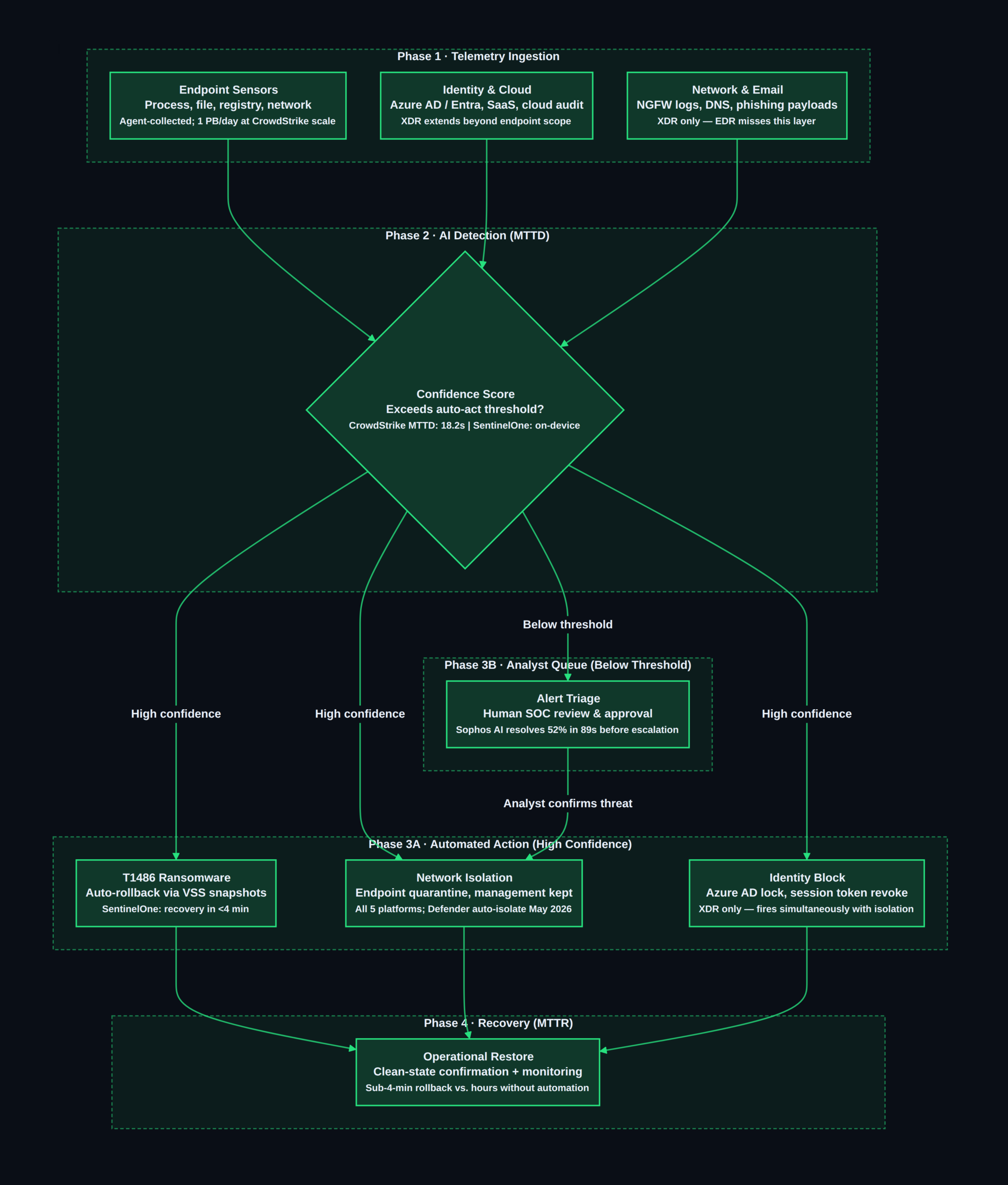
The critical fork is the confidence threshold. Platforms calibrated too conservatively alert but don't act—leaving the attacker active while an analyst reviews. Set too aggressively, they isolate legitimate production endpoints, triggering outages. CrowdStrike and SentinelOne allow granular policy tuning per asset group; Microsoft Defender's auto-isolation is currently a preview feature operating at a fixed high-confidence threshold with no per-group tuning available.
// 04 MTTD and MTTR Benchmarks Compared
| Platform | Best Published MTTD | MITRE ATT&CK R6 Detection | Autonomous Response | Rollback Capability | |—|—|—|—|—| | CrowdStrike Falcon Insight XDR | 18.2 seconds | 98% | Semi-auto via Fusion SOAR | No native rollback | | SentinelOne Singularity | Sub-2 seconds (on-device AI) | 96% | Full autonomous, offline-capable | Yes — automated VSS rollback | | Microsoft Defender XDR | Not published | 96% | Auto-isolate (preview, May 2026) | No native rollback | | Palo Alto Cortex XDR | Not published | Not in R6 | AgentiX agents (2026 release) | No native rollback | | Sophos MDR | MDR SLA: MTTD < 5 min | Not in R6 | AI auto-resolves 52% of cases | No native rollback |
MITRE ATT&CK Round 6 (2025) covered CrowdStrike, SentinelOne, and Microsoft Defender XDR. Palo Alto and Sophos participated in earlier evaluation rounds. The 18.2-second CrowdStrike MTTD figure comes from independent third-party efficacy testing; vendor-published figures should be verified against your own environment telemetry during proof-of-concept.
// 05 SOAR Integration and Playbook Automation
SOAR (Security Orchestration, Automation and Response) platforms execute multi-step response playbooks that coordinate actions across multiple security tools from a single incident trigger: closing a phishing ticket in Jira, isolating an endpoint in the EDR console, updating a firewall deny-list, and notifying the compromised user's manager—all in sequence, without human intervention at each step.
| Platform | Native SOAR Engine | Key Integrations | Playbook Authoring | |—|—|—|—| | CrowdStrike Falcon | Fusion SOAR (built-in) | Splunk, Sentinel, ServiceNow, Slack | No-code + Python | | SentinelOne Singularity | SOAR via Marketplace | 200+ connectors | No-code + REST API | | Microsoft Defender XDR | Microsoft Sentinel | Full Azure ecosystem, 100+ connectors | KQL automation rules | | Palo Alto Cortex XDR | Cortex XSOAR (separate SKU) | 900+ integrations | Full enterprise SOAR | | Sophos MDR | Built-in analyst playbooks | 350+ third-party tools | Pre-built, customisable |
A Microsoft Sentinel automation rule that triggers Defender isolation on high-confidence ransomware alerts looks like:
SecurityAlert
| where AlertSeverity == "High"
| where ProviderName == "Microsoft Defender for Endpoint"
| where AlertName contains "Ransomware"
| project DeviceId, DeviceName, AlertName, TimeGenerated
This query feeds a Logic App playbook that calls the Defender for Endpoint isolateDevice API—bridging the detection event to containment action within seconds of the KQL match firing, without analyst interaction.
For organisations evaluating Cortex XSOAR's orchestration depth, the 900-integration library covers the broadest toolchain—relevant for enterprises running heterogeneous security stacks where a single playbook must touch firewalls, identity providers, ticketing systems, and cloud platforms in one run.
// 06 Pricing by Organisation Size
Licensing is one component of TCO; SIEM storage, analyst headcount, professional services for deployment, and annual tuning costs are others. The table below reflects per-endpoint licensing only.
| Organisation Size | Recommended Platform | Approx. Annual Per-Endpoint Cost | |—|—|—| | 1–200 seats (SMB) | Sophos MDR Complete | $80–$200 | | 200–2,000 seats (mid-market) | SentinelOne Singularity Complete or Sophos MDR | $160–$200 | | 2,000+ seats (enterprise) | CrowdStrike Falcon Insight XDR | $240–$420 ($20–$35/month) | | Microsoft 365 E5 customers | Microsoft Defender XDR | Included in E5 bundle ($57/user/month) | | Palo Alto NGFW customers | Cortex XDR Pro + XSOAR | $168/endpoint/year ($14/month) + XSOAR |
For organisations already on Microsoft 365 E5, Defender XDR is the lowest-incremental-cost option—standalone EDR licensing on top of E5 is redundant spend. For pure-play security buyers without stack lock-in, CrowdStrike offers the strongest enterprise coverage at premium cost; SentinelOne offers the strongest autonomous capability at a mid-range price point.
// 07 Key Evaluation Criteria for 2026 Procurement
Security teams evaluating the best EDR/XDR tools for automated incident response in 2026 should weight these criteria during proof-of-concept testing:
- MTTD in your environment. Run a red team simulation using MITRE ATT&CK techniques, then time detection against your own telemetry. Published vendor benchmarks are measured on standardised datasets; your network topology will differ.
- Automated containment scope. Endpoint isolation alone is insufficient if lateral movement is already in progress via valid credentials (T1078 — Valid Accounts, a MITRE ATT&CK technique covering abuse of legitimate credentials). Verify whether containment extends to identity and cloud simultaneously, or only to the network-isolated endpoint.
- Autonomous vs. analyst-gated response. For ransomware scenarios (T1486 — Data Encrypted for Impact), every second of analyst gating is seconds of active encryption. Autonomous response is preferable for high-confidence ransomware detections. Understand each vendor's default threshold and whether it can be tuned per asset group.
- Offline response capability. If endpoints operate in air-gapped environments or on unreliable WAN connections, on-device AI (SentinelOne) outperforms cloud-dependent platforms that require a management-plane round-trip before acting.
- SOAR integration depth. Map your existing toolchain—SIEM, ITSM, identity provider, cloud platform—to each vendor's connector library before signing. Cortex XSOAR's 900-integration library is the broadest; CrowdStrike Fusion and Microsoft Sentinel cover most enterprise stacks natively.
- False positive rate under adversarial conditions. A platform with aggressive auto-containment and high FP rates will isolate production systems during normal business hours. Request FP data from the vendor's reference customers, not from marketing collateral.
- Incident response inclusion. Sophos MDR includes IR in the service agreement. CrowdStrike (CrowdStrike Services) and SentinelOne (Vigilance MDR + IR) offer retainer-based IR separately. Factor IR retainer cost into 3-year TCO when comparing total cost.
// 08 Conclusion
Microsoft Defender's entry into automated endpoint isolation closes the feature gap that once separated it from dedicated EDR platforms—but the gap between the five platforms profiled here is still meaningful. CrowdStrike leads on threat intelligence scale and detection speed. SentinelOne leads on autonomous offline response and native ransomware rollback. Microsoft Defender delivers the best ROI for E5-licensed organisations. Palo Alto Cortex XDR is the right choice when SOAR orchestration depth and native Palo Alto network telemetry matter most. Sophos MDR wins for mid-market teams that need managed coverage and included IR without an enterprise budget.
The single most important step before signing any of these contracts is running a live simulation—at minimum a one-day tabletop exercise—against the platform's auto-containment capability using real MITRE ATT&CK techniques from your threat model. Detection rates on standardised benchmarks are a starting point; your production telemetry will reveal the gaps that marketing datasheets never mention.
For attack-chain context that sharpens EDR/XDR evaluation, see our analysis of dual ransomware attack tactics and how enterprise IR teams responded and how adversary-in-the-middle phishing bypasses MFA in Microsoft 365 environments. For teams also reviewing their overall security architecture posture, our coverage of zero trust data movement gaps outlines where XDR containment alone is insufficient.
For any query contact us at contact@cipherssecurity.com