
Drata vs Vanta vs Tugboat Logic — the three names that come up most often when founders and security leads start budgeting for SOC 2 or ISO 27001 — differ fundamentally in pricing model, integration depth, framework breadth, and who they are built for. This guide breaks down each platform on the dimensions that actually determine audit readiness in 2026: evidence collection automation, supported frameworks, auditor portal features, trust center publishing, and total cost of ownership for SaaS companies at different growth stages.
// 01 What Is Compliance Automation and Why It Matters
SOC 2 (Service Organization Control 2 — an audit framework that verifies a vendor's data security controls meet the AICPA Trust Services Criteria), ISO 27001 (the international standard for information security management systems), HIPAA (the U.S. Health Insurance Portability and Accountability Act — required for companies handling protected health information), and PCI DSS (Payment Card Industry Data Security Standard — required for any company processing payment card data) each demand systematic evidence collection, continuous control monitoring, and structured audit trails.
Gathering that evidence manually from AWS, GitHub, Okta, Jira, and dozens of other tools is a multi-month project with a high error rate. Compliance automation platforms connect directly to those systems via API, pull evidence automatically, map it to framework controls, and alert you when something drifts out of scope. The difference between a managed compliance tool and a spreadsheet-based process is typically the difference between four weeks to audit-ready and six months.
The market has matured significantly since 2020. Three names dominate the top of every shortlist: Drata, Vanta, and Tugboat Logic (now operating as OneTrust Certification Automation). Each takes a different bet on who its customer is and what they value most.
// 02 Drata vs Vanta vs Tugboat Logic: Platform Overview
Drata was founded in 2020 and targets mid-market and enterprise SaaS companies that need deep control customization, multi-framework support, and high-touch audit guidance. The platform connects to 270–300+ cloud services, identity providers, HR tools, and development platforms to collect evidence continuously. Drata acquired SafeBase in 2023, adding a standalone trust center product used by companies including OpenAI and LinkedIn. G2 reviewers rate Drata's support quality at 9.6 out of 10 — the highest of any platform in this category.
Vanta was founded in 2018 and is named a Leader in the 2025 IDC MarketScape for Worldwide GRC Software. It supports 35+ frameworks and 375–400+ integrations — more than any other platform on this list. Its monitoring runs every hour (compared to once daily for Drata), and it is engineered for speed: most new customers reach audit readiness in two to four weeks. Vanta is the largest standalone compliance automation platform by customer count and the default choice for cloud-native SaaS companies at seed to Series B stage.
Tugboat Logic was founded in 2018 as a startup that made compliance accessible to small teams through AI-powered policy generation and security questionnaire automation. OneTrust acquired Tugboat Logic in September 2021 to expand its security assurance capabilities. The tugboatlogic.com domain now redirects to OneTrust's broader trust intelligence platform. The standalone Tugboat Logic product no longer exists for new customers. What exists today is OneTrust Certification Automation — an enterprise-tier module inside the OneTrust ecosystem, quoted as part of a broader OneTrust deployment.
// 03 Framework Coverage Compared
Framework breadth is a critical selection criterion, particularly as companies stack compliance requirements across multiple geographies and buyer segments.
| Framework | Drata | Vanta | OneTrust (formerly Tugboat Logic) | |—|—|—|—| | SOC 2 Type I / Type II | Yes | Yes | Yes | | ISO 27001 | Yes | Yes | Yes | | HIPAA | Yes | Yes | Yes | | PCI DSS | Yes | Yes | Yes | | GDPR | Yes | Yes | Yes | | CMMC 2.0 | Yes | Yes | Partial | | NIST 800-53 | Yes | Yes | Partial | | FedRAMP | Yes | Yes | No (not standalone) | | ISO 42001 (AI safety) | Yes | Limited | No | | NIS 2 | Yes | Limited | No | | DORA | Yes | Limited | No |
Drata leads on emerging EU frameworks. ISO 42001 is the new international standard for AI management systems — increasingly required by enterprise buyers in the EU as part of AI Act compliance programs. NIS 2 (the EU's Network and Information Security Directive 2, in force from October 2024) is mandatory for critical infrastructure operators and their supply chains. DORA (the EU Digital Operational Resilience Act, mandatory from January 2025) applies to financial services firms and their technology vendors. If your company sells into regulated EU markets or is building toward FedRAMP authorization for U.S. federal sales, Drata's framework coverage advantage matters.
Vanta supports 35+ frameworks and covers all the major global certifications. Its weakness is the EU-specific frameworks that arrived after 2024. Tugboat Logic's pre-acquisition framework catalog was solid for its time; under OneTrust, the compliance automation module does not extend to FedRAMP or the newer EU regulatory frameworks as a standalone feature.
// 04 Integrations and Evidence Collection
Integration count determines how much evidence you collect automatically versus how much you enter manually. Manual evidence collection is where compliance projects stall.
Integration count (2026):
  Vanta:         375–400+ integrations  (monitoring: hourly)
  Drata:         270–300+ integrations  (monitoring: daily)
  Tugboat/OT:    Limited native connectors (primarily manual uploads)
Vanta's 400+ integrations cover AWS, Azure, Google Cloud, GitHub, GitLab, Bitbucket, Okta, Azure AD, Google Workspace, Slack, Jira, Linear, Salesforce, HubSpot, Rippling, Workday, BambooHR, Jamf, Crowdstrike, SentinelOne, and hundreds more. The breadth means most companies can automate close to 100% of their evidence collection with no custom development.
Drata's 270–300+ integrations cover all the major cloud, identity, and DevOps platforms. Where Drata compensates for the lower count is control customization: if your infrastructure includes on-premises components, custom applications, or non-standard tool chains, Drata's custom control framework lets you build evidence collection workflows that Vanta's more prescriptive model does not support as cleanly. Drata also runs dedicated integrations for SOC 2 auditor workflows, giving audit firms direct read access to your evidence repository.
Tugboat Logic / OneTrust historically relied more on guided manual evidence uploads than automated API connectors. The OneTrust platform has broader integration capability at the enterprise level, but the compliance automation module specifically is not competitive on integration count with Drata or Vanta for standalone use.
// 05 Drata vs Vanta vs Tugboat Logic: Pricing Breakdown
None of these platforms publish list prices — every quote is custom, based on employee headcount, number of frameworks, and required add-ons. The figures below are drawn from aggregated buyer reports on Vendr, third-party pricing research, and community data.
| Cost Category | Drata | Vanta | OneTrust Certification Automation | |—|—|—|—| | Entry price (SOC 2 only, ≤50 employees) | $15,000–$25,000/yr | $10,000–$15,000/yr | $20,000–$40,000/yr (enterprise only) | | Mid-market (2–3 frameworks, 100–300 employees) | $30,000–$60,000/yr | $25,000–$50,000/yr | Custom enterprise quote | | Enterprise (5+ frameworks, 500+ employees) | $60,000–$100,000+/yr | $50,000–$80,000+/yr | Custom enterprise quote | | Per additional framework | ~$1,500 | ~$5,000 | N/A (bundled) | | Trust center | Included (via SafeBase) | $6,000+/yr add-on | Separately licensed |
The per-framework cost gap is the most important number for multi-framework buyers. A company managing SOC 2 + ISO 27001 + HIPAA + PCI DSS adds three frameworks beyond their base contract. On Drata, that adds roughly $4,500/year. On Vanta, that adds roughly $15,000/year. For any company stacking three or more certifications, Drata's pricing model is materially cheaper over a three-year horizon — even if Vanta wins on base price for a single-framework buyer.
Vanta's Trust Center, which lets you publish your security posture publicly for prospects and customers, costs approximately $6,000/year as an add-on. Drata includes its SafeBase-powered trust center in the base contract. For sales-driven organizations where the trust center is a key part of the deal cycle, that $6,000 delta matters.
The original Tugboat Logic price point no longer exists. Pre-acquisition plans started at approximately $500/year for small teams, scaling to $10,000–$17,500/year for mid-sized companies. That pricing model ended with the OneTrust acquisition. Today, OneTrust Certification Automation is enterprise-only and typically priced as part of a broader OneTrust platform contract in the $20,000–$40,000/year minimum range. It is not a viable option for startups or companies not already investing in the OneTrust ecosystem.
Auditor fees are separate from every platform. A SOC 2 Type II audit from a licensed CPA firm runs $8,000–$25,000 for companies under 200 employees and $20,000–$50,000+ for larger organizations. ISO 27001 certification from an accredited body runs $15,000–$40,000+. These fees apply regardless of which automation platform you use. See our SOC 2 Type II checklist for SaaS companies for a full breakdown of what auditors actually review.
// 06 Time to Audit-Ready
For first-time compliance buyers, time-to-audit-ready is often as important as features. Every month of delay is a month of blocked enterprise sales deals.
Vanta: 2–4 weeks — Vanta's opinionated, prescriptive setup process gets most new customers to audit readiness faster than any other major platform. The platform makes strong assumptions about what controls you need, which works well for cloud-native SaaS companies on standard infrastructure. The cost of that speed is flexibility: heavily customized environments or companies with on-premises infrastructure hit friction. But for a Series A company on AWS + GitHub + Okta, Vanta's pre-built control library maps your environment in hours, not weeks.
Drata: 4–12 weeks — Drata's more thorough setup process maps your specific environment to controls in more detail, producing a more defensible control environment for complex infrastructure. Security teams report fewer surprises during the actual audit. The longer timeline is a trade-off, not a flaw — it reflects how much more Drata customizes to your specific tech stack.
Tugboat Logic / OneTrust: Variable — Tugboat Logic originally marketed AI-assisted policy generation as its core speed advantage: auto-generate your information security policies in minutes rather than weeks. That capability carries forward into OneTrust's platform. However, onboarding complexity has increased with the enterprise product transition, and the time-to-readiness track record from the startup era does not translate directly to the current enterprise product.
// 07 Auditor Relationships and Trust Center Features
Both Drata and Vanta provide dedicated auditor portals where your CPA firm or ISO certification body can log in, review evidence, and mark controls as tested — eliminating the email attachment exchange that historically added weeks to every audit cycle.
Vanta maintains a network of 100+ audit firms through its Vanta Network, which simplifies auditor selection for first-time buyers who do not have an existing CPA relationship. The platform integrates directly into auditor workflows and reduces the back-and-forth dramatically.
Drata's auditor portal is similarly capable and includes direct integration with audit firm workflows. Drata's acquisition of SafeBase — used by OpenAI, LinkedIn, and other security-forward companies — adds a trust center that is more capable than what Vanta includes in base pricing. The SafeBase integration means your trust center can publish real-time compliance status, answer security questionnaires automatically, and provide tiered access for prospects at different stages of the sales cycle.
Vanta's Trust Center is a competent built-in feature but requires a separate $6,000/year add-on. It handles the standard use cases: publishing SOC 2 reports, ISO 27001 certificates, GDPR data processing addenda, and responding to vendor risk assessments. For companies where the trust center is a key sales enablement tool rather than a checkbox, the SafeBase feature set available through Drata is meaningfully more capable.
Tugboat Logic's original differentiator was security questionnaire automation — auto-answering vendor risk questionnaires (VRQs) using your existing compliance documentation. That capability exists in OneTrust's risk and questionnaire modules today, but as a separately licensed enterprise feature, not as an affordable startup add-on.
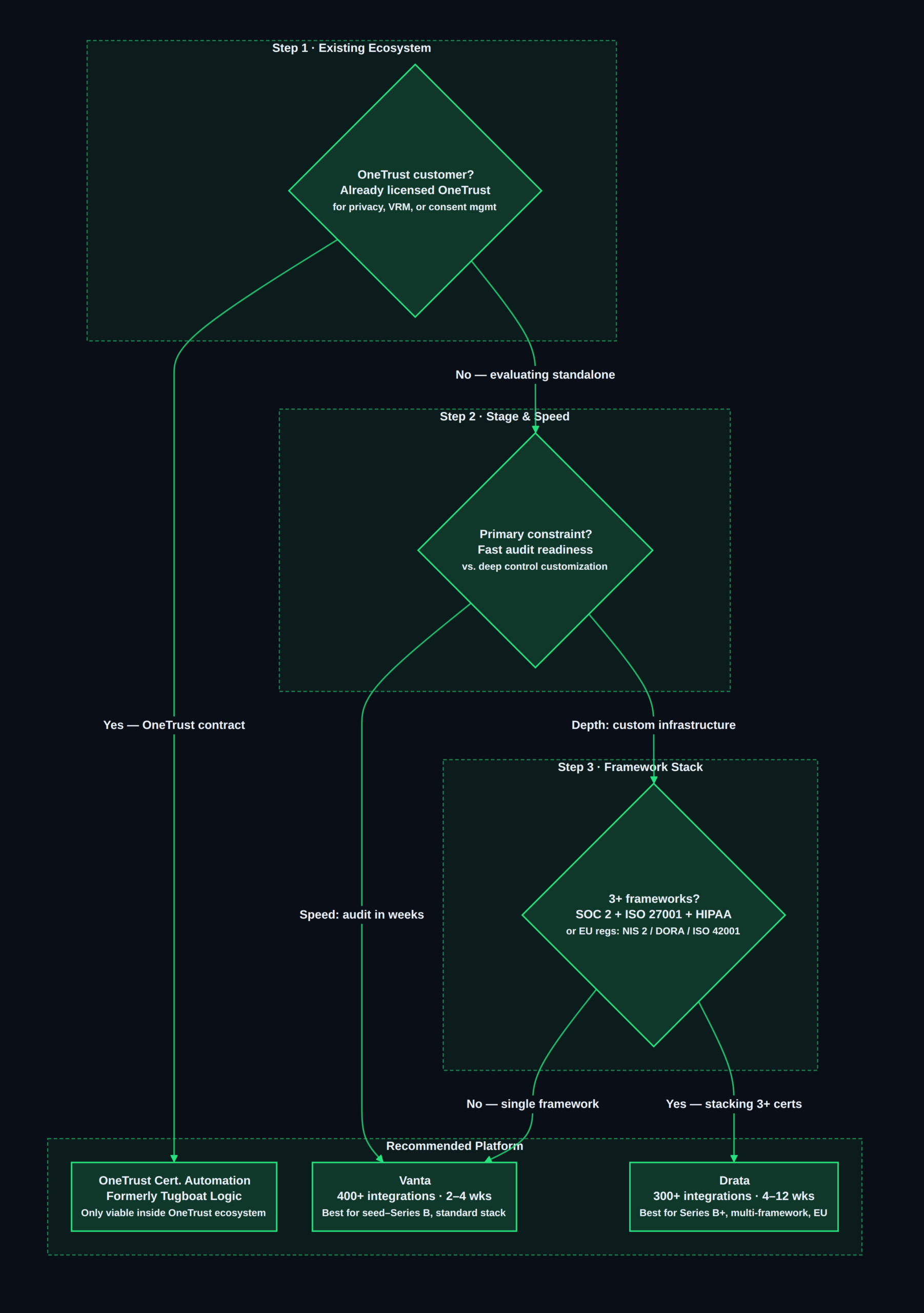
// 08 Platform Selection Decision Tree
// 09 Who Should Choose Which Platform
Choose Vanta if:
- You are a seed to Series B SaaS company pursuing your first SOC 2 audit
- Your infrastructure is cloud-native and standard (AWS/GCP/Azure + GitHub/GitLab + Okta or similar)
- Speed to certification is your primary constraint — you need to close enterprise deals
- You need the broadest possible integration coverage across your tool stack
- You are managing one or two frameworks and the per-framework pricing advantage of Drata does not yet apply
Choose Drata if:
- You are Series B or later with complex or mixed infrastructure (cloud plus on-premises)
- You are stacking three or more frameworks — the per-framework pricing difference ($1,500 vs $5,000 per additional framework) compounds quickly
- You need ISO 42001, NIS 2, or DORA coverage for EU market access or supply chain compliance
- You want SafeBase's trust center capability included without a separate add-on fee
- Support quality matters: Drata's 9.6/10 G2 support score leads the category
- You are working toward FedRAMP authorization as part of a federal sales strategy
Choose Tugboat Logic / OneTrust Certification Automation if:
- Your organization already uses OneTrust for privacy management, vendor risk management, or consent management and wants a single-platform compliance workflow
- You are an enterprise with an existing OneTrust contract and can add the certification module at incremental cost
- Consolidated vendor spend within the OneTrust platform is a business priority
Do not evaluate Tugboat Logic as a standalone option for new buyers. The startup-era Tugboat Logic product — accessible, beginning at $500/year, purpose-built for small teams — no longer exists. Comparison articles that reference those price points may be drawing from pre-2021 data. For cloud security context relevant to compliance automation infrastructure, see our CSPM vs CWPP comparison covering how security posture management tools integrate with compliance workflows.
// 10 Vanta vs Drata: Head-to-Head on the Details That Matter
For the majority of buyers who have narrowed to Vanta and Drata, the decision comes down to four specific questions:
1. How standard is your infrastructure? Vanta's pre-built control library assumes cloud-native infrastructure. If AWS + GitHub + Okta describes your stack, Vanta gets you there fastest. If your stack includes Kubernetes clusters with custom admission controllers, on-premises Active Directory, or in-house tooling with no SaaS equivalent, Drata's customization capability is worth the longer setup time.
2. How many frameworks will you manage in the next 24 months? If the answer is more than two, model out the per-framework cost difference. Adding ISO 27001 + HIPAA + PCI DSS on Vanta adds approximately $15,000/year versus $4,500 on Drata. Over three years, that gap exceeds the base price difference between the platforms.
3. Do you need a trust center for sales? If your sales team closes deals faster with a public security page — and most enterprise B2B companies do — Drata's included SafeBase integration is a concrete advantage. Vanta's trust center costs $6,000/year extra and is less capable for automated questionnaire response.
4. Do you sell into EU-regulated markets? For companies subject to NIS 2, DORA, or ISO 42001 requirements, Drata's framework coverage is currently ahead of Vanta's. Vanta is investing in these frameworks, but Drata has them in production today.
For companies managing FedRAMP authorization — which requires continuous monitoring across dozens of NIST 800-53 controls and direct auditor collaboration — both platforms support FedRAMP. Review your federal cybersecurity logging requirements alongside platform selection; the OMB M-26-14 SIEM guidance affects what evidence your platform needs to capture.
// 11 Conclusion
For most SaaS startups pursuing their first SOC 2 or ISO 27001 audit in 2026, Vanta is the right default: fastest time-to-readiness, most integrations, and the lowest entry price point. Drata earns the recommendation for companies managing multiple frameworks, operating in EU-regulated markets, or needing deeper control customization — particularly once you model the per-framework pricing over a multi-year horizon. Tugboat Logic, as a standalone platform, is effectively a 2021 story; in 2026 it exists only as part of an enterprise OneTrust deployment and is not a meaningful consideration for companies without an existing OneTrust relationship.
Whichever platform you choose, budget separately for your audit: $8,000–$25,000 for a SOC 2 Type II audit from a licensed CPA firm, $15,000–$40,000+ for ISO 27001 certification from an accredited body. What compliance automation buys you is the systematic evidence collection and control monitoring that makes those audits survivable rather than chaotic.
See our SOC 2 Type II checklist for SaaS companies for a step-by-step walkthrough of what auditors actually review →
For any query contact us at contact@cipherssecurity.com