
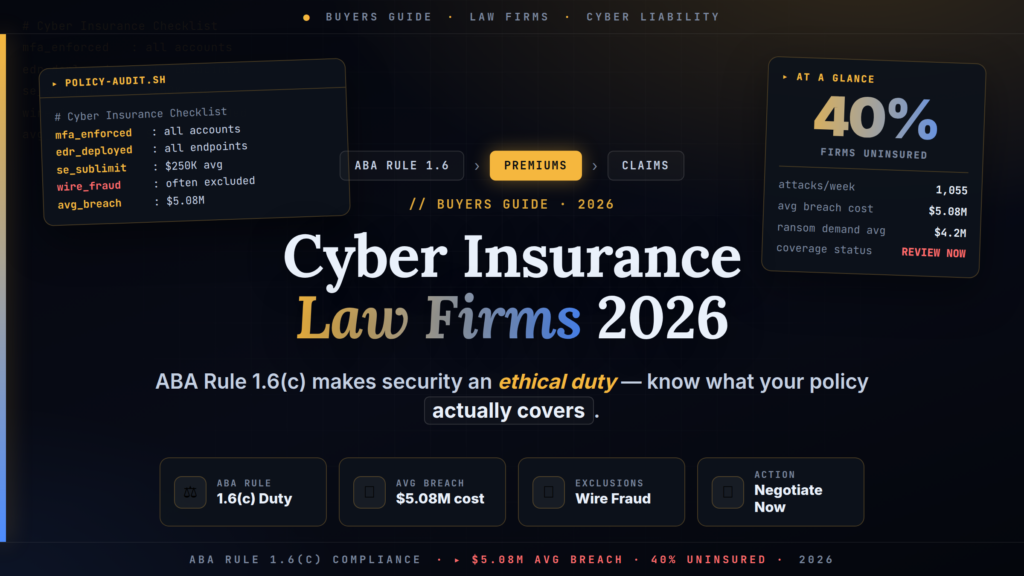
Cyber insurance for law firms has shifted from optional risk transfer to a baseline operational requirement — and ABA Model Rule 1.6(c) has made that shift a matter of professional ethics, not just financial prudence. The legal sector absorbs 1,055 cyberattacks per week, average data breach costs have reached $5.08 million, and only 40% of firms currently carry cyber liability insurance. This guide covers what policies actually pay, where claims get denied, what underwriters require before issuing a policy in 2026, and how to negotiate premiums down without sacrificing coverage.
// 01 ABA Rule 1.6 and the Ethics of Law Firm Cybersecurity
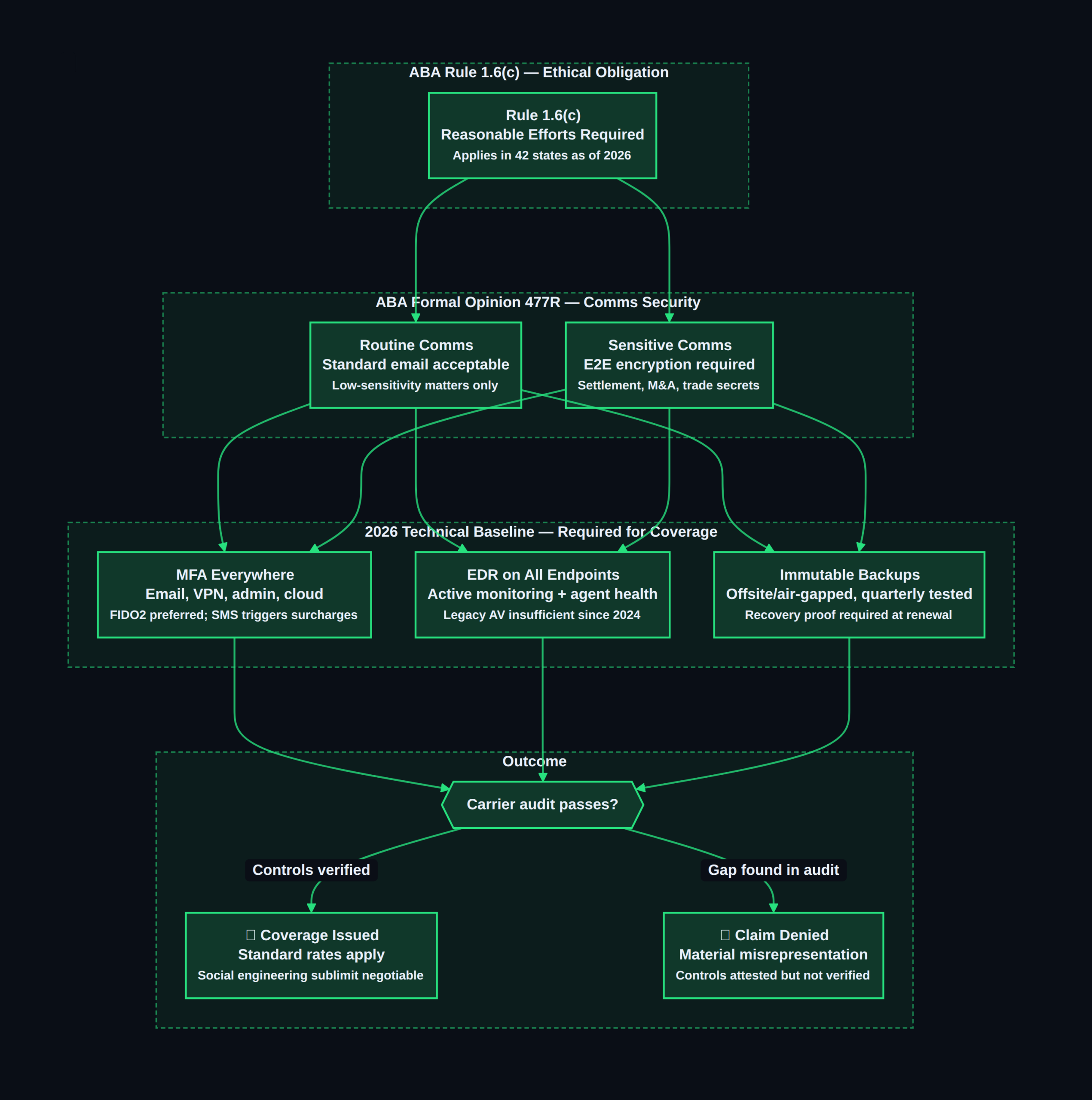
Rule 1.6(c) of the ABA Model Rules of Professional Conduct reads: "A lawyer shall make reasonable efforts to prevent the inadvertent or unauthorized disclosure of, or unauthorized access to, information relating to the representation of a client." As of 2026, 42 states have adopted Comment 8 — the technology competence provision — or an equivalent, making cybersecurity an enforceable ethical obligation in nearly every U.S. jurisdiction. A breach is no longer just an insurance event; it is a potential bar complaint.
ABA Formal Opinion 477R (originally issued 2017, still the controlling guidance) replaced a prior rule that treated unencrypted email as categorically acceptable. Under 477R, lawyers must apply a fact-specific, risk-based analysis to every communication channel. For routine, low-sensitivity matters, standard email is acceptable. For privileged strategy, settlement negotiations, M&A details, or trade secrets, the opinion requires either end-to-end encryption (S/MIME or PGP) or a secure client portal. Crucially, 477R requires periodic reassessment as the threat landscape evolves — a one-time compliance check does not satisfy the standard.
What "reasonable measures" means technically in 2026:
The ABA Standing Committee on Ethics and Professional Responsibility and state bar guidance now treat the following as the minimum technical baseline:
- MFA (Multi-Factor Authentication — a second verification step beyond a password) enforced on all email accounts, remote access (VPN/RDP), admin accounts, and cloud consoles; phishing-resistant FIDO2/hardware tokens are increasingly preferred over SMS one-time passcodes, which can be intercepted via SIM-swap attacks
- EDR (Endpoint Detection and Response — software that monitors devices for malicious behavior in real time) on every endpoint, replacing legacy antivirus
- Encrypted, immutable backups stored offsite or in air-gapped cloud storage, with documented quarterly recovery tests
- Annual security-awareness training for all attorneys and staff
- A written incident response plan (IRP)
A firm that suffers a breach without these controls faces a dual exposure: an insurance claim that may be denied because the carrier required these exact controls, and a bar complaint for violating Rule 1.6(c). The two consequences compound each other.
// 02 The 2026 Law Firm Threat Landscape
The legal sector is a high-value target for two compounding reasons: attorneys hold privileged communications that are worth more to adversaries than raw financial data, and legal practice routinely involves large multi-party wire transactions with tight deadlines — the exact conditions that BEC (Business Email Compromise — a fraud scheme where attackers impersonate trusted contacts to redirect wire payments) operators exploit.
Current threat volume, based on Embroker's 2025 law firm security analysis and Halcyon's ransomware tracking:
- 1,055 cyberattacks per week target the legal industry — up 13% since 2024
- 40% of firms report experiencing a security breach (Tech Advisors survey)
- 56% of breached firms lost sensitive client data
- $5.08 million average data breach cost — up 10% year-over-year
- 1.5 million legal records compromised in ransomware attacks in a single measured year
- Halcyon tracked 200+ ransomware incidents against legal sector entities between 2025 and early 2026; the INC Ransom Group ran a targeted campaign specifically against law firms in 2025, exploiting unpatched remote access vulnerabilities
On insurance adoption:
- Only 40% of U.S. law firms currently carry cyber liability insurance, according to ABA survey data
- Only 34% have a written incident response plan in place
- Only 43% conduct regular data backups
- 65% are unfamiliar with their post-breach legal notification obligations
The financial exposure is severe for small and mid-market firms: average ransomware demands have reached $4.2 million (a 70% year-over-year increase), with average payments of approximately $683,000. For a 20-attorney firm, a week of encrypted systems and a ransom demand can exceed annual revenue.
// 03 What Cyber Insurance for Law Firms Actually Covers
A standalone cyber liability policy — as opposed to a bolted-on endorsement to a general liability or legal professional liability (LPL) policy — typically provides the following coverage components:
| Coverage Component | What It Pays |
|---|---|
| Network security liability | Third-party claims from clients whose data was breached |
| Privacy liability | Regulatory fines, notification costs, credit monitoring for affected clients |
| Business interruption | Lost revenue during system downtime (waiting period applies — see below) |
| Data recovery | Forensic investigation, data restoration, public relations costs |
| Ransomware response | Ransom payment (where legally permitted), decryption vendor, crisis management |
| Cyber extortion | Threat-actor negotiation services |
| Regulatory defense | Legal costs defending bar complaints or state AG investigations arising from a breach |
| Media liability | Defamation, copyright, or similar claims from content published on firm website/email |
Three components deserve particular attention for law firms:
Regulatory defense is critical and often overlooked. A breach exposing client data can trigger a bar complaint under Rule 1.6(c), a state AG investigation under state breach notification law, and a potential FTC enforcement action if the firm handles healthcare or financial data. A policy that covers only network security liability but excludes regulatory proceedings leaves a firm exposed to its most likely post-breach legal headache. Confirm explicitly that bar complaint defense costs are covered.
Business interruption waiting periods can be firm-killing. Standard policies carry a 12–24 hour waiting period before business interruption (BI) coverage activates. For a 50-attorney firm billing $500 per hour per attorney, 48 hours of downtime represents $2.4 million in unbilled time. Negotiate the waiting period down — 6–8 hours for ransomware scenarios is achievable with the right broker.
The cyber/LPL boundary creates a coverage gap. If a breach leads to a missed deadline, a resulting malpractice claim, and a simultaneous bar complaint, you need to know which policy responds to which exposure — and whether your two carriers will dispute primary coverage between themselves while you wait. Get a written opinion from your broker on how the policies interact before a claim occurs.
// 04 Policy Exclusions That Catch Law Firms Off Guard
This is where most claim denials happen. Research from Wiley Law's 2026 cyber risk predictions and SeedPod Cyber's exclusion analysis identifies five exclusions that disproportionately affect legal practices.
1. Voluntary Transfer / Authorized Payment Exclusion
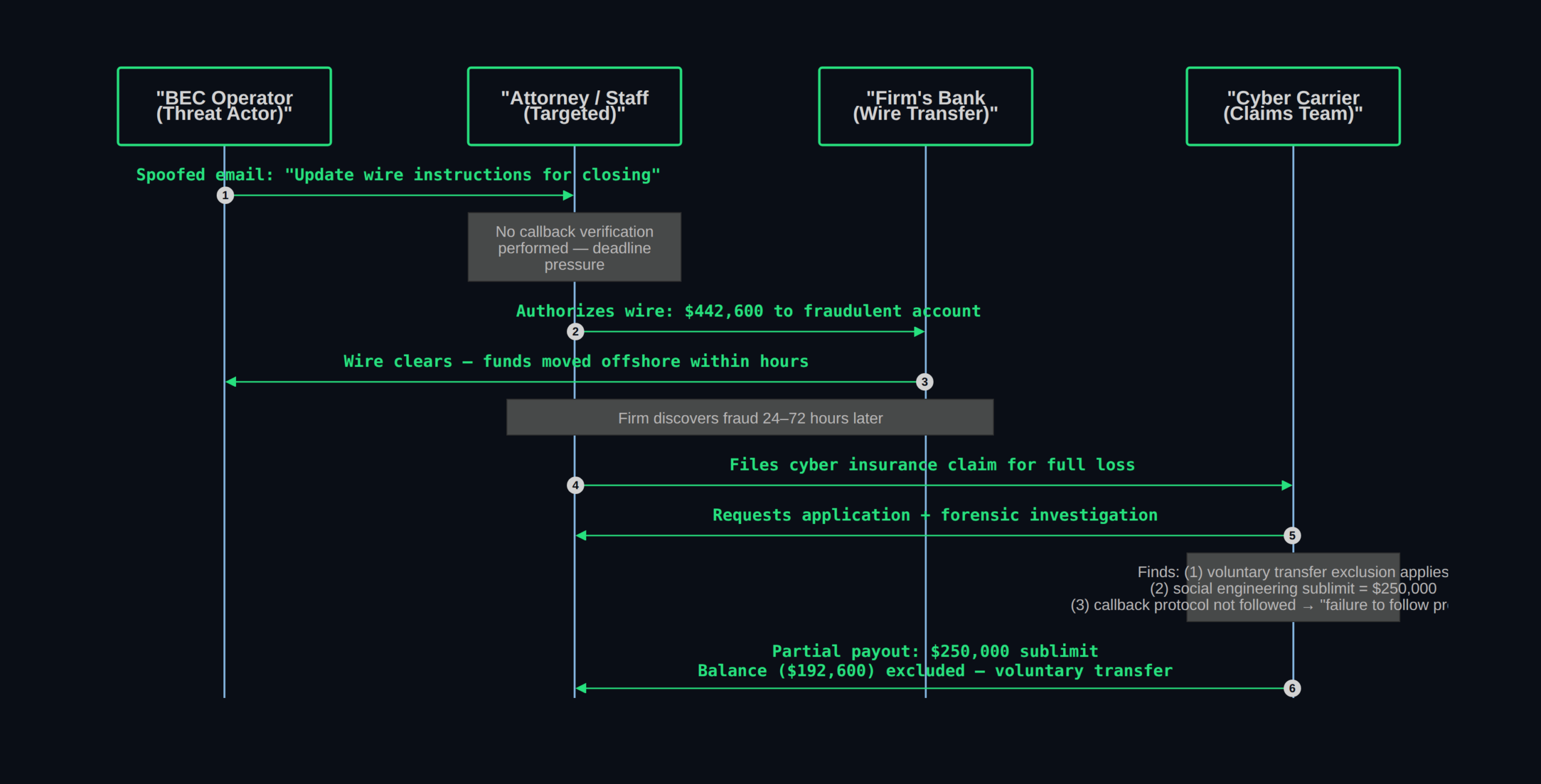
This is the most dangerous exclusion for law firms. If an attorney is deceived into authorizing a fraudulent wire — even by a sophisticated BEC impersonation — many policies classify the loss as an "authorized payment" and exclude it from the cyber policy entirely. The carrier's rationale: the firm's systems were not compromised; the attacker manipulated a human. In one documented case, a cybercriminal impersonated attorneys via email and tricked a firm into wiring $442,600 from a decedent's estate to a fraudulent account. The voluntary transfer exclusion may apply to the entire loss.
Critically, this exclusion can also appear on the crime/fidelity policy, creating a gap between both policies.
2. Social Engineering Sublimits
Where social engineering (manipulation of employees into taking harmful actions) coverage exists, it is almost universally written as a sublimit — not the full policy limit. The industry average social engineering sublimit is approximately $250,000, even on policies with $2 million in aggregate coverage. For a firm managing multi-million-dollar client trust accounts, a $250,000 sublimit provides minimal protection. Negotiate this number explicitly during placement; do not assume it equals the policy limit.
3. War Exclusion / Nation-State Carve-Out
Following Lloyd's of London's 2023 market guidance, most carriers now explicitly exclude losses caused by state-sponsored actors or "acts of war." The practical risk for law firms: if a mass exploitation event — for example, a zero-day in widely deployed legal practice management software — is later attributed to a nation-state, carriers may deny claims from firms that were collateral victims. Review the specific language in your policy form; some carriers have narrow carve-backs for "widespread" events that did not specifically target the insured.
4. Unencrypted Data Exclusion
Some policies reduce or exclude coverage when breached data was not encrypted at rest. This directly maps to Rule 1.6(c): a firm that cannot demonstrate encrypted storage simultaneously fails its ethical obligation and faces a coverage gap. If your document management system stores files unencrypted by default, this exclusion alone could void the bulk of a breach claim.
5. Material Misrepresentation
This is the fastest-growing claim denial ground in 2026. Carriers now run independent external attack surface scans during underwriting — approximately three out of four carriers do this, per Emerge ITS's underwriting analysis. Self-attestation on the application no longer ends the conversation.
In one documented case, a company suffered a $2.3 million ransomware loss after an attacker accessed systems via a VPN account without MFA. The carrier denied the claim, citing material misrepresentation — the insured had attested on the application that MFA was enforced on all remote access accounts. For law firms: do not attest to controls you have not verified are actually enforced on every account.
// 05 2026 Underwriting Requirements: What Carriers Now Demand
Underwriting for cyber insurance for law firms in 2026 functions more like a technical audit than an insurance application. The following controls are now effectively universal requirements to obtain coverage at standard rates, based on CyberDuo's 2026 renewal analysis and Sherlock Forensics' underwriting guide:
- MFA on all email, remote access, admin, and cloud accounts — FIDO2/hardware tokens preferred; SMS OTP may trigger surcharges or exclusions at some carriers
- EDR/MDR (Managed Detection and Response) on every endpoint with documented agent health monitoring and active alerting — legacy antivirus is insufficient
- Immutable or air-gapped backups with documented quarterly recovery test results — evidence of a successful restore test, not just a backup schedule
- Written incident response plan with documented tabletop exercises — carriers want: date, scenario description, participants by title, decisions made, and improvement actions taken
- Patch management program with documented SLAs (Service Level Agreements — defined timelines for applying patches based on severity) for critical vulnerabilities
- PAM (Privileged Access Management) for all admin accounts — controls that govern which users can access administrative credentials and under what conditions
Law firm-specific underwriting questions that now appear on applications:
- Written wire transfer verification procedures (callback to a verified phone number, not a number provided in the email requesting the wire)
- Segregation of duties for trust account disbursements (two-person authorization for high-value wires)
- Documentation of client portal security controls
- Attorney-specific phishing simulation completion rates
Firms that cannot answer these questions with documented evidence — not just "yes" checkboxes — will face either denial, premium surcharges, or restrictive endorsements that limit coverage for the scenarios most likely to cause a claim.
// 06 Premium Ranges and How to Negotiate Them Down
Premium benchmarks vary significantly by firm size, practice area, and demonstrated security posture. The following ranges reflect 2026 market conditions for firms with adequate security controls:
| Firm Size | Practice Area Risk Profile | Estimated Annual Premium |
|---|---|---|
| Solo / small (1–10 attorneys) | General practice | $1,500 – $5,000 |
| Mid-market (10–50 attorneys) | Litigation, M&A, real estate | $8,000 – $25,000 |
| Mid-market (10–50 attorneys) | Healthcare / financial / IP | $20,000 – $60,000 |
| Large (50–200 attorneys) | Mixed practice | $40,000 – $150,000 |
| Large regional / AmLaw-tier | High-value transaction work | $150,000 – $500,000+ |
Market trend: The market hardened sharply in 2021–2022, with premiums roughly doubling in 24 months as ransomware losses surged. 2023–2024 brought stabilization. While firms with strong loss histories saw rate reductions in Q4 2025, S&P Global projects 15–20% market-wide premium growth in 2026 for accounts with weaker security profiles, driven by AI-enhanced phishing, geopolitical risk, and expanded ransomware group capabilities.
Documented premium reduction example: A mid-market organization paying $20,000/year reduced its premium to $13,000–$15,000 by documenting MFA enforcement, EDR deployment, and immutable backup testing before renewal — a 25–35% reduction for demonstrable security hygiene versus self-attestation alone.
Negotiation tactics that work in 2026:
Engage a specialist broker. Law firm cyber insurance is a specialty line. A broker who places 20+ law firm policies per year understands carrier appetite differences: which underwriters are most competitive for litigation-heavy practices, which carriers offer strong social engineering sublimits, and which avoid the voluntary transfer exclusion entirely on their base form. A generalist commercial lines broker will not have this intelligence.
Document controls before renewal, not during. Pull your EDR health dashboard report, your MFA enforcement audit log, and your most recent backup recovery test certificate before the renewal conversation. Carriers that see evidence — not attestation — are the ones that compete aggressively on pricing.
Use MSSP (Managed Security Service Provider) attestations. If you work with an external MSSP that monitors your network 24/7, obtain a written security posture attestation from them. Some carriers accept MSSP attestations in lieu of an independent external scan, reducing renewal friction and potentially unlocking lower rates.
Negotiate social engineering sublimits explicitly. Ask every carrier for the complete sublimit schedule before binding. If a carrier offers only $100,000 social engineering coverage, ask what controls documentation would allow them to raise it to $500,000 or $1 million. In most cases, they will give you a specific answer — documented callback procedures, MFA on all email accounts, and phishing simulation training completion rates above 90% are common thresholds.
Run a competitive renewal every year. Do not accept an auto-renewal without going to market. Even a 10% difference on a $40,000 premium is $4,000/year, and the competitive tension from a formal RFP (Request for Proposal) process almost always produces pricing concessions.
// 07 Choosing the Right Policy: Key Questions Before You Buy
When comparing cyber insurance policy forms for law firms, demand written answers to these specific questions — vague verbal assurances do not hold up at claim time:
- Is social engineering covered at the full policy limit or as a sublimit? What is the exact sublimit dollar amount?
- Does the voluntary transfer / authorized payment exclusion apply? How does the policy define "authorized"?
- Is regulatory defense explicitly covered, including state bar disciplinary proceedings?
- What is the business interruption waiting period? Is it negotiable for ransomware scenarios?
- How does the war exclusion define state-sponsored attacks? Is there a carve-back for widespread events?
- If a single incident triggers both the cyber policy and the LPL policy, which is primary? Do both carriers acknowledge the interaction in writing?
- Is there a legal sector endorsement that adds coverage for client escrow or trust account losses from third-party fraud?
- What does the carrier require for MFA verification at renewal — self-attestation or independent scan?
The question about cyber/LPL policy interaction is particularly important for litigators and transactional attorneys. If a ransomware attack encrypts your case management system and you miss a filing deadline, you face a simultaneous cyber loss and a potential malpractice exposure. Knowing in advance that your LPL carrier treats the cyber policy as primary for the system-downtime component prevents a coverage dispute at the worst possible moment.
// 08 Conclusion
Cyber insurance for law firms in 2026 is not a commodity purchase — it is a technical and contractual negotiation that directly determines whether a claim actually pays when it matters. ABA Rule 1.6(c) creates an enforceable ethical obligation to maintain reasonable security controls; carriers independently verify those controls before issuing and before paying. The exclusions around voluntary transfers, social engineering sublimits, and material misrepresentation represent the three most likely denial scenarios for legal practices, and all three are addressable before a claim occurs.
Audit your current policy form for voluntary transfer language and your social engineering sublimit before the next renewal. Implement and document a written wire verification protocol — it costs nothing, directly addresses your Rule 1.6(c) exposure, and eliminates the single most common coverage gap in law firm cyber claims.
See our comparison of cyber insurance options for high-risk businesses in 2026 and our guide to automating compliance evidence collection to build the documented security posture that drives premium reductions at renewal.
For any query contact us at contact@cipherssecurity.com