
Elder fraud — the systematic targeting of senior citizens with financial scams exploiting their trust, savings, and cognitive vulnerability — claimed a major enforcement milestone on May 29, 2026. Troy Murray, a 57-year-old North Carolina man who operated under the alias "Steve Dixon," was sentenced to 121 months (just over ten years) in federal prison for selling the personal information of more than 7 million elderly Americans to Jamaican lottery scammers. Murray also faces three years of supervised release and forfeiture of $5.2 million — proceeds from a criminal lead list business he ran from 2016 through 2023. The case was prosecuted in the Western District of North Carolina, with reporting by BleepingComputer.
// 01 The Scheme: Building a Criminal Lead List Business
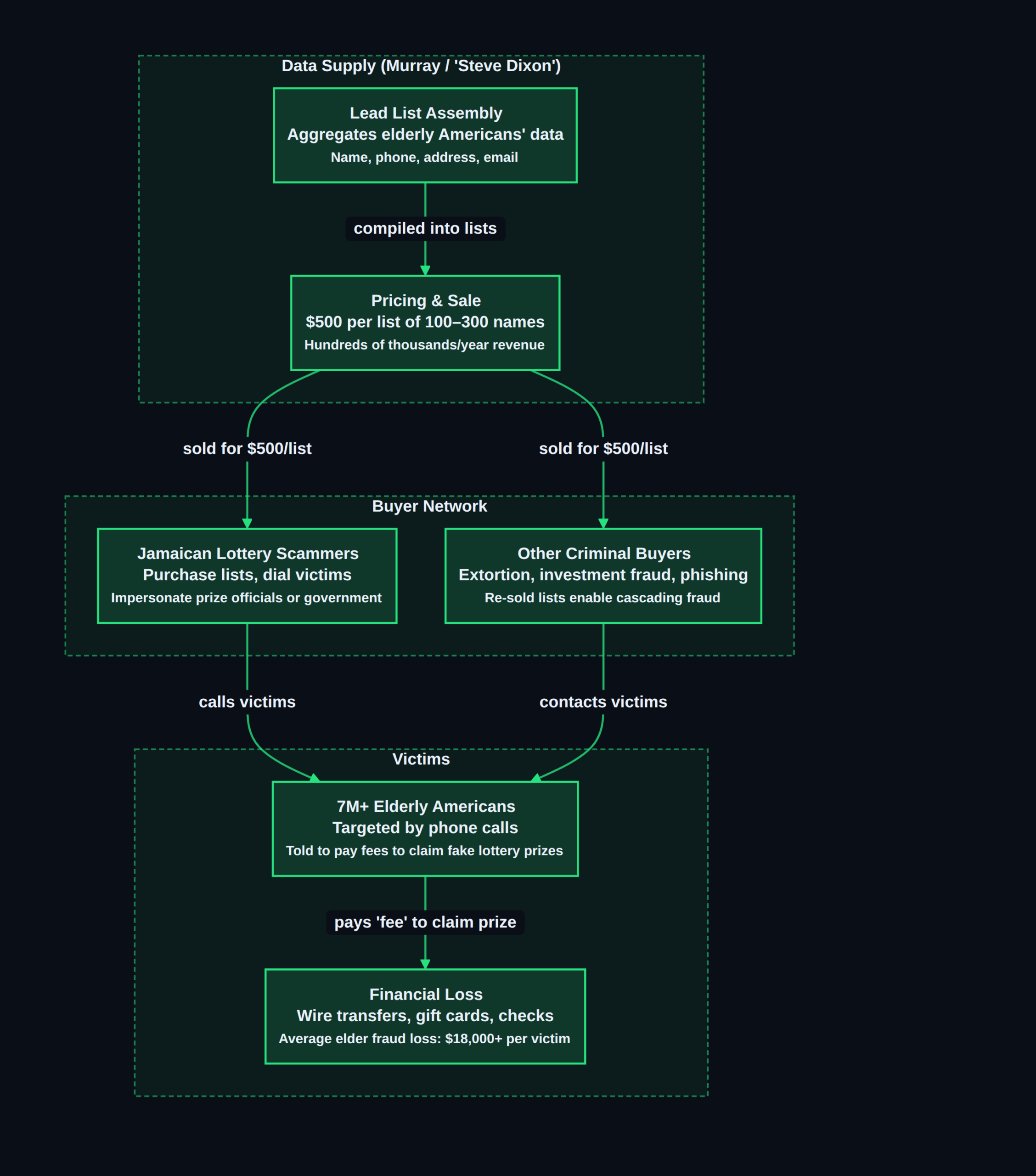
Murray's operation occupied a specific niche in the criminal supply chain: data supply. Rather than running lottery scams himself, Murray served as the infrastructure layer — sourcing and selling the raw material (elderly Americans' personal information) that scammers needed to select and contact their victims.
Murray sold lead lists — curated databases of names, phone numbers, physical addresses, and email addresses — to scammers based in Jamaica and elsewhere. Each list consisted of 100 to 300 names and sold for $500. Over the seven-year operation, Murray earned hundreds of thousands of dollars annually, accumulating the $5.2 million now subject to forfeiture.
The lists were not generic population databases. Prosecutors described them as targeted: the data specifically identified elderly Americans, making them purpose-built inputs for lottery fraud operations that depend on targeting victims with high disposable savings, lower fraud awareness, and greater phone responsiveness.
Murray's alias "Steve Dixon" became widely recognized within Jamaican scam networks — so recognized that it was referenced in a 2022 song lyric by a Jamaican musical artist. That level of notoriety indicates Murray was not a peripheral supplier but a primary data source for a large segment of Jamaican elder fraud operations over the period.
// 02 The Buyers: How Jamaican Lottery Scammers Used the Data
The purchasers of Murray's lists operated Jamaican lottery fraud schemes — a long-documented fraud pattern in which callers, typically based in Jamaica, telephone victims claiming they have won a large lottery prize but must first pay fees, taxes, or processing charges to collect their winnings. Victims who pay are told further fees are required, creating an escalating cycle that can drain savings accounts over months before the victim realizes no prize exists.
The scheme is particularly effective against elderly victims for several structural reasons:
- Phone-based interaction: Elderly Americans use telephone as a primary communication channel at higher rates than younger demographics, making phone-based fraud more accessible.
- Authority trust: Lottery fraud callers frequently impersonate government officials, tax authorities, or prize administrators — institutions many seniors were raised to trust.
- Reduced fraud skepticism: Cognitive changes associated with aging can reduce skepticism toward unsolicited prize notifications, particularly when callers are persistent and polished.
- Financial resources: Elderly Americans collectively hold the largest share of accumulated household wealth in the United States, making them high-value targets for fraud operations that scale with victim assets.
Murray's lead lists provided scammers with pre-selected elderly individuals, eliminating the random-dialing inefficiency of cold-calling the general population. The $500 price point per list represented a minimal customer acquisition cost for scammers who could extract thousands or tens of thousands of dollars from a single successful victim.
// 03 Elder Fraud by the Numbers: A Growing Epidemic
The FBI's Elder Fraud Report consistently ranks elder fraud as one of the highest-impact cybercrime categories by total financial loss. Key statistics from recent reporting:
- Americans over 60 lost more than $3.4 billion to fraud in 2023 — the largest category by age group
- The average per-victim loss for elder fraud exceeds $18,000
- Telephone-based fraud (of which lottery scams are a primary category) accounts for the largest share of elder fraud complaints by contact type
- Jamaican lottery scam operations have been a documented threat for over two decades, with U.S. law enforcement maintaining ongoing cooperation with Jamaican authorities
Murray's operation supplied 7 million individuals to this ecosystem over seven years. Even if only a small fraction of his lists resulted in successful frauds, the aggregate financial damage to victims is likely measured in the hundreds of millions of dollars.
// 04 Legal Outcome: Forfeiture, Prison, and Supervised Release
Murray pleaded guilty in January 2026 to one count of conspiracy to commit wire fraud (Title 18, U.S. Code, Section 1343). Wire fraud covers fraudulent schemes executed by wire communications — including telephone calls and electronic data transfers — and carries a maximum sentence of 20 years per count.
The sentence imposed on May 29:
- 121 months (10 years, 1 month) in federal prison
- 3 years of supervised release following prison term
- $5.2 million forfeiture of criminal proceeds
The forfeiture figure reflects Murray's documented earnings from the lead list operation over the 2016–2023 period. Federal forfeiture allows prosecutors to recover proceeds from criminal activity even when the underlying fraud was committed by Murray's buyers rather than Murray directly. Murray's role as a knowing data supplier — aware that his lists would be used for fraud — establishes sufficient criminal nexus for full proceeds forfeiture.
// 05 What You Should Do to Protect Elderly Relatives
- Register elderly family members with the National Do Not Call Registry at donotcall.gov. While fraudulent callers do not always respect this registry, many legitimate lead list buyers filter registered numbers, reducing exposure.
- Have a direct conversation about lottery fraud patterns. Explain specifically: any caller claiming a prize requires an advance payment is a scammer, regardless of how official they sound. No legitimate lottery requires payment to collect winnings.
- Set up call screening tools. Most modern carriers and smartphones offer spam call identification. Devices like the CPR Call Blocker are designed specifically to block known scam numbers on landlines — a common elderly household setup.
- Review bank account access and alerts. Fraud victims often wire money or purchase gift cards under scammer direction. Setting up low-threshold transaction alerts means unusual activity is flagged before a large transfer completes.
- Check whether your elderly relatives' data has been exposed using breach notification services. Murray's lists are not the only source of elder-targeted lead data — other criminal data brokers operate in the same market.
- Report suspected elder fraud to the FBI's Internet Crime Complaint Center at ic3.gov and the FTC at ReportFraud.ftc.gov. Reporting helps law enforcement identify high-volume scam operations and individual data suppliers like Murray.
// 06 Background: The Lead List Industry and Where Legal Becomes Criminal
Murray's operation exploited infrastructure that exists at the edge of a legal industry. Data brokers (companies that compile and sell consumer information) are a multi-billion-dollar legitimate business in the United States. Companies legally aggregate public records, purchase consumer data from loyalty programs and retailer databases, and sell curated lists to direct marketers, political campaigns, and financial services firms.
The distinction between legal and criminal data brokering lies in buyer intent and seller knowledge. A legally operating data broker selling a list of senior homeowners to an insurance company for direct marketing purposes is a regulated business activity. Murray selling lists to buyers he knew were running lottery fraud operations is conspiracy to commit wire fraud.
What Murray's case illustrates is the supply-chain nature of modern fraud infrastructure. Large-scale fraud operations — whether Jamaican lottery schemes, romance scams, or investment fraud targeting elderly victims — depend on data inputs to function efficiently. Disrupting the data supply layer, as the DOJ did in Murray's prosecution, attacks fraud operations at a point of leverage: remove the curated lists and scammers must revert to less efficient random-dial approaches that dramatically reduce their conversion rates.
Similar prosecutions targeting illegal data suppliers have accompanied major elder fraud enforcement actions in the Western District of North Carolina, Southern District of Florida, and Eastern District of Virginia — jurisdictions that have historically concentrated resources on Jamaican fraud network prosecution.
// 07 Conclusion
Troy Murray's 121-month sentence reflects the DOJ's recognition that data supply is a load-bearing element of large-scale elder fraud infrastructure. Supplying 7 million names to Jamaican lottery scammers is not a passive act — it is the enabling layer that turns a fraud operation from a random nuisance into a targeted, scalable criminal enterprise. The $5.2 million forfeiture and decade-long prison sentence signal that elder fraud data brokers face consequences equivalent to the fraud operators they supply.
For any query contact us at contact@cipherssecurity.com