
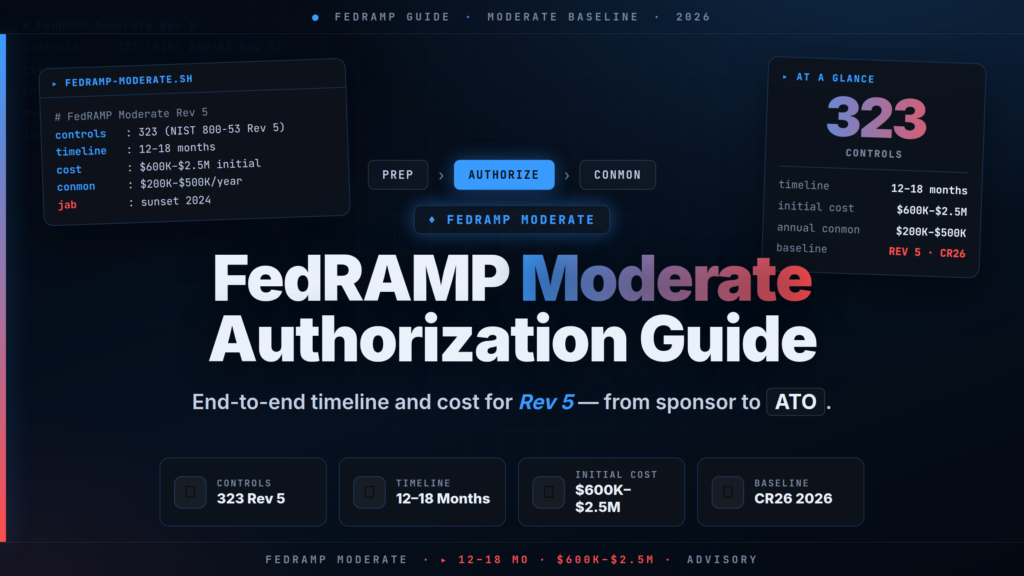
FedRAMP Moderate authorization timeline cost is the first real question every SaaS CTO asks when a federal contract opportunity surfaces: how long, how much, and where do you even start? The direct answer in 2026: budget 12–18 months and $600,000–$2,500,000 in initial spend, plan for $200,000–$500,000 per year in ongoing continuous monitoring, and understand that without a sponsoring federal agency committed in writing, nothing moves. This guide covers the complete Rev 5 agency authorization path — preparation, 3PAO assessment, ATO grant, and continuous monitoring — with specific cost ranges for each phase, the 2026 control set changes under CR26, sponsor agency selection strategy, 3PAO evaluation criteria, and an honest analysis of whether to start now or wait for FedRAMP 20x.
// 01 What FedRAMP Moderate Covers and Why It Matters
FedRAMP (Federal Risk and Authorization Management Program) is the U.S. government's standardized security authorization framework for cloud services used by federal civilian agencies. A CSP (Cloud Service Provider — any company offering software, platform, or infrastructure as a service) that wants to sell to civilian federal agencies must hold a FedRAMP ATO (Authority to Operate — the formal security authorization a federal agency grants before deploying your service).
The Moderate impact level is the most common baseline and applies to systems handling CUI (Controlled Unclassified Information — data whose unauthorized disclosure, modification, or destruction would have a "serious adverse effect" on government operations, assets, or individuals). In practice, this covers the vast majority of SaaS platforms: HR systems, financial and grants management tools, healthcare administration platforms, document management systems, and productivity tooling.
Under Rev 5 (the current authorization baseline), FedRAMP Moderate maps to 323 security controls drawn from NIST SP 800-53 Rev 5 — a net reduction of two controls from Rev 4, primarily through consolidation rather than any softening of requirements. NIST released SP 800-53 Rev 5.2.0 in August 2025; FedRAMP's Consolidated Rules 2026 (CR26) incorporate those updates and serve as the authoritative baseline through December 31, 2028.
The business case is straightforward: FedRAMP keywords command $50–$120 CPC (cost per click) in paid advertising, and individual federal software contracts routinely run $1M–$50M+. Authorization is expensive, but structural exclusion from the federal market is more so.
// 02 The 2026 Rev 5 Control Set: Key Changes from Rev 4
Rev 5 is not a cosmetic rebrand. Three changes materially affect the scope and cost of Moderate authorization:
Privacy controls are now mandatory for all Moderate systems. The PT (Privacy) control family requirements and RA-3(1) (Privacy Risk Assessment) apply to any Moderate system collecting or processing agency user data — not only platforms explicitly handling PII (Personally Identifiable Information). If your platform stores authentication logs, session data, or user preferences, you document privacy risk under Rev 5.
Supply chain risk management is now a formal control family. The SR (Supply Chain Risk Management) controls are new in Rev 5. You must maintain a documented SBOM (Software Bill of Materials — an inventory of all software components and their provenance), evaluate third-party libraries and open source dependencies against supply chain risk criteria, and formally document your IaaS/PaaS providers (AWS GovCloud, Azure Government) as leveraged authorizations within your SSP. For SaaS platforms built on commercial hyperscalers, this primarily means your vendor management procedures and dependency inventory must become authorization-scope artifacts.
Configuration baseline requirements are tightened. CM-6 (Configuration Settings) explicitly requires alignment with DISA STIGs (Defense Information Systems Agency Security Technical Implementation Guides) or CIS Benchmarks for all in-scope system components. If your containers, OS images, or database configurations do not pass a STIG benchmark scan, those findings go on your POA&M (Plan of Action and Milestones — a formal, tracked register of security weaknesses and their remediation timelines, required by FedRAMP throughout authorization and continuous monitoring).
FedRAMP's ongoing RFC process (RFC-0027 through RFC-0030, covering the CP, IA, IR, MA, MP, PE, PL, PM, PS, and PT control families) is finalizing additional CR26 baseline updates. CSPs entering authorization in mid-2026 should treat CR26 as authoritative and verify each RFC's final status before completing control narratives in the SSP.
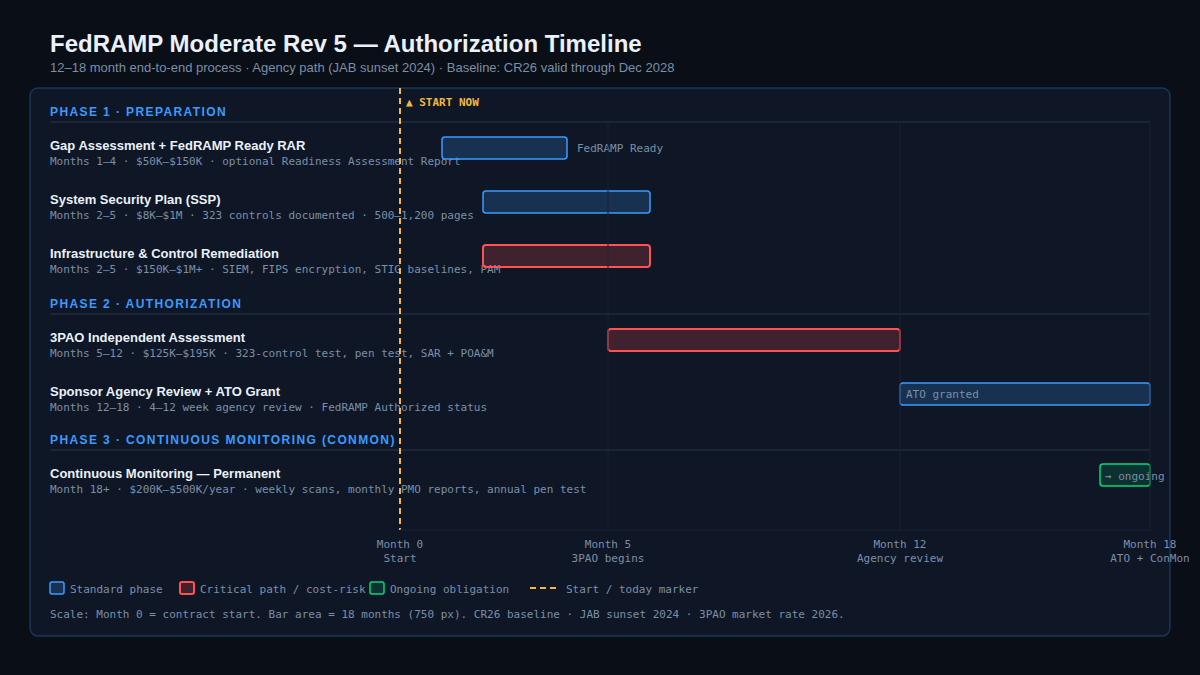
// 03 Phase 1: Preparation (Months 1–5)
The preparation phase is the period most teams underestimate. Every shortcut here becomes expensive rework during 3PAO assessment.
Security Categorization (Weeks 1–2)
Determine your system's impact level using FIPS 199 (Federal Information Processing Standard for Security Categorization). For Moderate authorization, you document that the confidentiality, integrity, and availability of your system data would cause a "serious adverse effect" if compromised. This categorization is not merely administrative — it locks in which baseline you authorize against, and an incorrect High categorization doubles your control scope and budget unnecessarily.
Authorization Boundary Definition (Weeks 2–4)
Define the exact set of systems, services, network segments, and interconnections that fall under FedRAMP assessment scope. Every component inside the boundary gets assessed. Every dependency outside the boundary must be documented as a leveraged authorization or external service with appropriate controls in your SSP.
In practice: your GovCloud VPC, CI/CD pipeline (if it touches production), SIEM, identity provider, backup infrastructure, and customer-support tooling each require an explicit boundary decision. Scope creep discovered during 3PAO assessment — "we forgot the build system has write access to production" — can add months to your timeline and cost.
Gap Assessment (Weeks 3–8)
Engage a FedRAMP-recognized 3PAO or a FedRAMP-specialized consultant to compare your current security posture against all 323 Moderate controls. The gap assessment produces a prioritized remediation list and an initial POA&M. Teams that skip this step and proceed directly to full 3PAO assessment routinely discover remediation work that delays their ATO by 6–12 months.
Gap assessment cost for Moderate systems: $50,000–$150,000.
Infrastructure Remediation (Months 2–5)
Implement the controls identified in the gap assessment. The most common remediation categories for Moderate authorization:
- SIEM deployment and log retention (NIST SI-4, AU-2, AU-12): FedRAMP requires specific log sources, retention periods, and event correlation. For CSPs subject to OMB M-26-14 federal logging mandates, see our guide on federal cybersecurity logging requirements — many of those controls overlap directly with FedRAMP Moderate requirements.
- FIPS 140-3 validated encryption (SC-28, SC-8): Encryption at rest and in transit must use FIPS 140-3 validated cryptographic modules. Standard commercial TLS certificates without a validated module do not satisfy this requirement.
- Privileged access controls (AC-2, AC-3, AC-6): PAWs (Privileged Access Workstations), just-in-time access provisioning, and MFA (Multi-Factor Authentication) for all privileged accounts.
- Vulnerability scanning cadence (RA-5): Weekly automated scans of all in-scope components, with remediation SLAs tracked in the POA&M.
- Incident response plan and tabletop test (IR-3, IR-4): Documented IR procedures with evidence of at least one tabletop exercise.
Remediation costs are highly variable. Organizations with mature SOC 2 Type II controls typically spend $150,000–$400,000 on FedRAMP-specific gaps — the access control, logging, and IR frameworks transfer, but FIPS modules, STIG baselines, and specific log format requirements require dedicated remediation. Greenfield platforms have exceeded $1,000,000 in infrastructure rebuild costs before their first assessment.
SSP Development (Months 2–5, parallel with remediation)
The SSP (System Security Plan) is the central documentation artifact of FedRAMP authorization. It describes your system architecture, authorization boundary, and a detailed implementation narrative for every one of the 323 Moderate controls. For Moderate systems, the SSP typically runs 500–1,200 pages.
Manual SSP development with a FedRAMP consultant costs $250,000–$1,000,000+. Automated GRC platforms with FedRAMP modules — Paramify, Drata, Vanta — compress tooling cost to $8,000–$60,000 per year, though you still need staff time, legal review, and a FedRAMP SME to validate control implementation narratives. The automation value is in evidence linking and continuous update workflow, not in eliminating the need for deep FedRAMP expertise.
// 04 Phase 2: Authorization (Months 5–18)
Sponsor Agency Engagement (Start in Month 1, run in parallel)
Since the JAB (Joint Authorization Board — the former multi-agency authorization body) was sunset in 2024, every FedRAMP authorization requires a single sponsoring federal agency. The agency's AO (Authorizing Official — typically the CISO or deputy CISO) must agree to review your security package, engage directly with your 3PAO, and grant an ATO. Without a committed sponsor, you have no authorization path.
Sponsor agencies do not advertise vacancies. Finding one is a sales and relationship process. Strategies that work in practice:
- Work backward from existing contracts: An agency that already has a pilot, SBIR, or small contract relationship with you is your most natural sponsor. Their CIO office has seen your product operate.
- Target agencies with active digital transformation mandates: Agencies under cloud-first or FITARA (Federal IT Acquisition Reform Act) compliance pressure have internal incentive to sponsor modern SaaS tools and start the authorization clock.
- Engage the CISO office directly: The ATO lives with the CISO, not the contracting officer. Most failed sponsorship attempts start with procurement and never reach the security team.
- Obtain FedRAMP Ready status first: A RAR (Readiness Assessment Report) from a 3PAO produces a "FedRAMP Ready" Marketplace designation — valid one calendar year — that signals authorization-readiness to agencies evaluating multiple vendors. This is optional but strongly recommended for teams without an existing agency relationship.
To formally enter the process, submit to intake@fedramp.gov: an IPR (In Process Request) letter naming your system and sponsoring agency, and a WBS (Work Breakdown Structure) with projected milestones. Upon acceptance, your FedRAMP Marketplace status moves to "In Process."
3PAO Independent Assessment (Months 6–12)
The 3PAO (Third Party Assessment Organization — an A2LA-accredited, FedRAMP-recognized independent assessor) conducts the formal security assessment. This is not a documentation review. A qualified 3PAO will:
- Test all 323 Moderate controls against FedRAMP assessment procedures
- Conduct penetration testing against your authorization boundary
- Execute automated vulnerability scans per FedRAMP scanning requirements
- Interview personnel responsible for each control family
- Test contingency plan and incident response procedures
- Produce a SAR (Security Assessment Report) and finalized POA&M
3PAO assessment fees for Moderate systems: $125,000–$195,000. Assessment duration: 8–14 weeks. Budget for in-flight remediation — gaps discovered during assessment require retesting, which extends timelines. A POA&M item discovered in week 3 of a 10-week assessment typically adds 3–6 weeks.
When selecting a 3PAO, evaluate on: Moderate-specific experience, average time-to-SAR for recent comparable engagements, fixed-fee vs. time-and-materials contract structure, named assessor staff continuity, and whether penetration testing is performed in-house or subcontracted. Interview at least three and compare written scope-of-work deliverable lists, not just price.
Sponsor Agency Review and ATO (Months 12–18)
Submit the complete Security Authorization Package — SSP, SAR, POA&M, and supporting documentation — to your sponsor agency. The agency security team reviews the package; typical review duration is 4–12 weeks depending on agency workload and package quality. Upon acceptance, the agency issues an ATO. FedRAMP recognizes that ATO as a FedRAMP Authorization and your Marketplace listing moves to "FedRAMP Authorized."
// 05 Full FedRAMP Moderate Authorization Timeline Cost Breakdown
Understanding the full FedRAMP Moderate authorization timeline cost requires examining each phase independently, since the variance within each category is wide enough to determine whether you land at $600,000 or $2,500,000.
| Cost Category | Low Estimate | High Estimate | Notes |
|---|---|---|---|
| Gap assessment | $50,000 | $150,000 | 3PAO or consultant-led |
| Infrastructure remediation | $150,000 | $1,000,000+ | Highly variable; depends on starting posture |
| SSP documentation | $8,000 | $1,000,000 | Automated tools vs. manual consultant |
| 3PAO assessment | $125,000 | $195,000 | Moderate baseline; typical market range |
| Security tool licensing (yr 1) | $50,000 | $200,000 | SIEM, vuln scanner, PAM, FIPS modules |
| Consulting and advisory | $100,000 | $500,000 | Varies by engagement model and scope |
| Initial authorization total | ~$483,000 | ~$3,045,000 | Most teams land $600K–$2.5M |
| Annual ConMon (scans + reports) | $120,000 | $300,000 | Weekly scans, monthly PMO reports |
| Annual penetration test | $20,000 | $60,000 | Required by FedRAMP every 12 months |
| Annual staff and training | $30,000 | $80,000 | Compliance FTE time, certifications |
| Annual ongoing total | $170,000 | $440,000 | Budget $200K–$500K/year |
The $600,000–$2,500,000 range most commonly cited for Moderate initial authorization reflects teams using automated SSP tooling to control documentation costs while still carrying meaningful remediation and 3PAO assessment expenses. Organizations entering with mature SOC 2 Type II or existing NIST 800-53 controls in place typically land at the lower end. Greenfield platforms with minimal prior compliance investment land at or above the high end.
// 06 Sponsor Agency Strategy: Finding and Securing a Partner
Sponsor agencies do not advertise availability. You find them through sales relationships and targeted outreach. The strategies that reliably produce sponsors:
1. Work backward from existing agency contracts. Any agency with an existing pilot, SBIR award, or small purchase relationship already has institutional knowledge of your product. That CISO's office is your most natural starting point.
2. Target agencies under cloud-first or FITARA pressure. Agencies facing digitization mandates have internal incentive to sponsor a modern SaaS tool and get the authorization clock running — authorization benefits them as much as it benefits you.
3. Approach the CISO office, not contracting. The ATO lives with the CISO. Contracting officers cannot sponsor. Most failed sponsorship attempts start with a contracting officer and stall before reaching the security team.
4. Establish FedRAMP Ready status on the Marketplace. A "FedRAMP Ready" listing signals to evaluating agencies that your platform passed an initial 3PAO gate review. Agencies using the Marketplace as a shortlist tool see Ready-designated CSPs as lower-risk sponsorship candidates.
5. Leverage GSA Schedule federal system integrators. Federal SIs on GSA Schedule often have existing CISO relationships across multiple agencies and will broker introductions in exchange for a teaming arrangement on the resulting contract.
// 07 3PAO Selection Criteria
FedRAMP-recognized 3PAOs are listed on the Marketplace. Not all 3PAOs are equal for Moderate work.
| Criterion | Why It Matters |
|---|---|
| Moderate-specific experience | Rev 5 Moderate has control implementation nuances; a 3PAO specializing in Low assessments may miss them |
| Average time-to-SAR | Ask for actual data from recent comparable engagements, not estimates |
| Fixed-fee vs. time-and-materials | T&M contracts expose you to cost overruns during remediation cycles; fixed-fee incentivizes accurate scoping |
| Named staff continuity | Lead assessor turnover mid-engagement adds weeks; confirm the named team is committed to your full timeline |
| In-house penetration testing | Some 3PAOs subcontract pen testing; verify the sub's FedRAMP recognition status independently |
Interview a minimum of three 3PAOs. Request written scope-of-work documents from each and compare deliverable lists, not just price. A $20,000 difference in assessment fees is irrelevant if one 3PAO scopes more thoroughly and avoids the surprise findings that cost $100,000 in remediation rework.
// 08 FedRAMP 20x: Start Rev 5 Now or Wait?
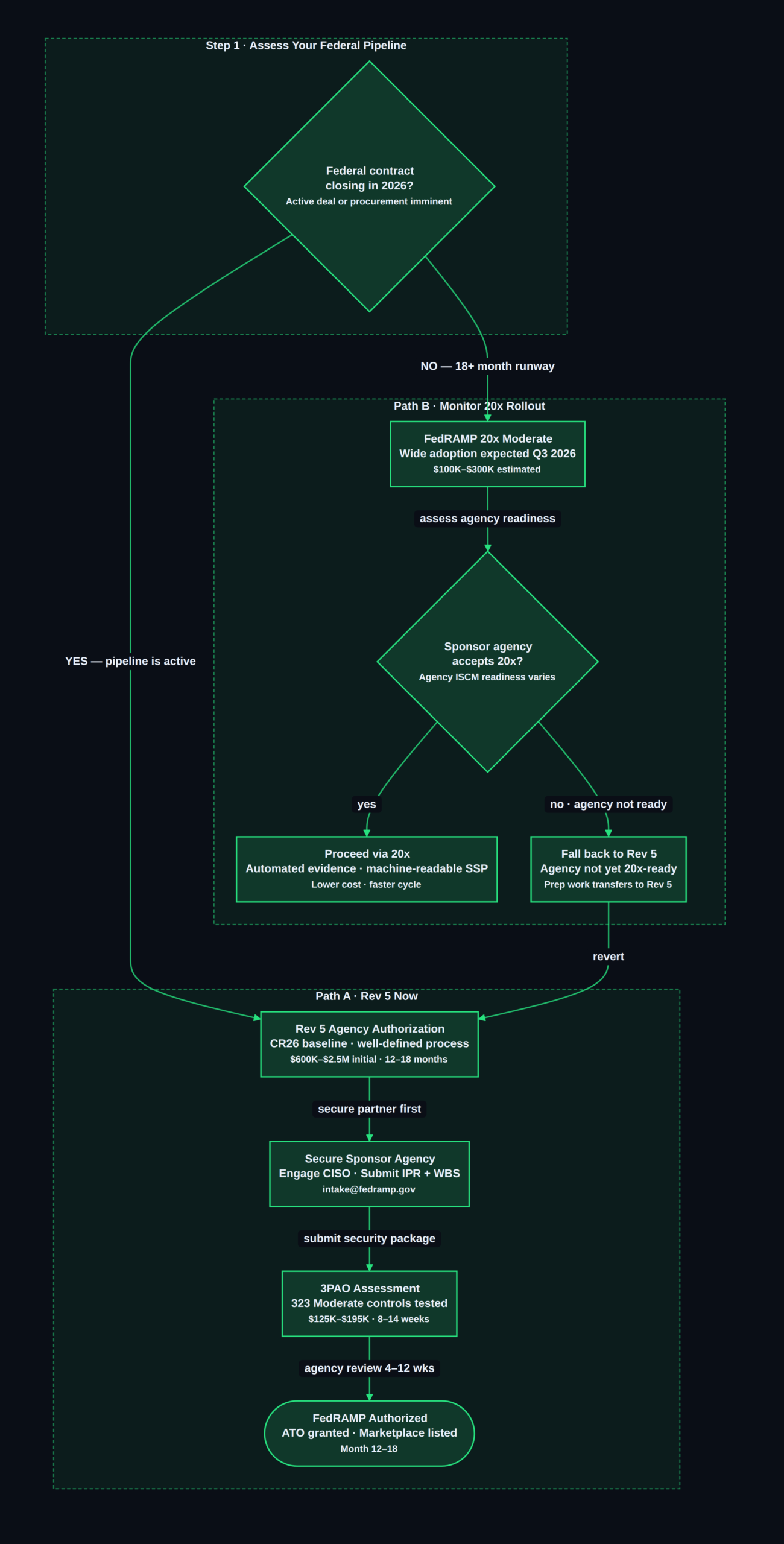
FedRAMP 20x is a program redesign launched in 2025 that aims to reduce authorization cost through machine-readable security documentation, automated evidence collection, and persistent validation rather than point-in-time 3PAO assessments. Phase 2 of the Moderate pilot completed its cohort cycles in early 2026; wide adoption for Moderate is projected for Q3 2026.
Early estimates for 20x Moderate initial authorization: $100,000–$300,000 — a significant reduction if those figures hold at scale.
| Factor | Rev 5 Now | Wait for 20x |
|---|---|---|
| Timeline certainty | High — stable CR26 baseline, defined 3PAO market | Low — wide adoption still finalizing Q3 2026 |
| Estimated initial cost | $600K–$2.5M | $100K–$300K (unconfirmed at scale) |
| Agency acceptance | Universal — all agencies accept Rev 5 | Variable — agency ISCM readiness differs significantly |
| Process risk | Known requirements, mature 3PAO ecosystem | RFC process still in progress; tooling relatively immature |
| Best for | Active 2026 federal pipeline | Teams with 18+ month runway before federal sales pressure |
If you have a federal contract opportunity closing in 2026, start Rev 5 now. Your gap assessment and boundary documentation transfers to 20x if you decide to switch — none of that work is wasted.
// 09 Phase 3: Continuous Monitoring (Month 18+)
Authorization is the beginning, not the end. FedRAMP Moderate ConMon imposes a permanent operational burden:
- Weekly: Automated vulnerability scanning across all in-scope components with results tracked in the POA&M
- Monthly: Vulnerability reports submitted to the FedRAMP PMO (Program Management Office), POA&M updates, asset inventory review
- Annually: 3PAO penetration test, contingency plan test, full POA&M audit
The FedRAMP 20x program's "persistent validation and assessment" model aims to replace manual monthly PMO reporting with automated data feeds into agency ISCM (Information Security Continuous Monitoring) platforms — but implementing those integrations requires its own engineering investment.
Build ConMon into your FedRAMP business case from the start. A $1,200,000 initial authorization alongside $400,000 per year in ConMon costs represents a $2,400,000 three-year commitment before accounting for staff time. For CSPs applying zero trust principles to their authorization boundary — particularly micro-segmentation and continuous workload verification — see our analysis of zero trust data movement gaps, which covers controls that align with FedRAMP Moderate boundary monitoring requirements and can reduce ConMon scope.
// 10 Conclusion
FedRAMP Moderate authorization timeline cost comes down to three variables: how much remediation your platform needs, whether you use automated or manual SSP tooling, and how quickly you can secure a sponsor agency. Budget 12–18 months and $600,000–$2,500,000 initial spend, with $200,000–$500,000 per year in continuous monitoring. The single most important action — and the most consistently deferred — is identifying and engaging a sponsor agency before any documentation work begins. Without a sponsor, nothing else moves.
Start with a gap assessment to understand your real remediation scope. Use automated SSP tooling to control documentation costs. Interview three 3PAOs before selecting one. And if your federal pipeline is 18 or more months out, monitor the FedRAMP 20x Moderate rollout through Q3 2026 before committing to a path.
Next step: complete the CSP Information Form on fedramp.gov to receive your FedRAMP ID, then use that ID in your IPR when submitting to intake@fedramp.gov once your sponsor agency relationship is confirmed.
See also:
- SOC 2 Type II Compliance Checklist for SaaS Companies: 2026 Audit Guide
- Federal Cybersecurity Logging 2026: OMB M-26-14 SIEM Requirements
- Zero Trust Data Movement Gaps
For any query contact us at contact@cipherssecurity.com