
The best DSPM tool 2026 for regulated industries is the one that finds your PHI in a forgotten S3 bucket, maps it to a specific HIPAA privacy rule, and shows you exactly who can access it — before your auditor does. This guide ranks six enterprise-grade platforms on what actually matters to data security architects in finance, healthcare, and insurance.
DSPM (Data Security Posture Management — a category that continuously discovers, classifies, and risk-scores sensitive data across cloud, SaaS, and on-premises environments) emerged as the fastest-growing data security discipline of 2025. Unlike DLP (Data Loss Prevention), which monitors data in motion at egress points, or CASB (Cloud Access Security Broker) tools, which govern user access to cloud services in real time, DSPM focuses on data at rest. It answers the question that DLP and CASB cannot: where does sensitive data actually exist right now, regardless of how it got there?
For regulated industries, the stakes are concrete. HIPAA (the Health Insurance Portability and Accountability Act) requires covered entities and business associates to implement technical safeguards protecting ePHI (electronic Protected Health Information — any individually identifiable health data stored or transmitted electronically). GLBA (the Gramm-Leach-Bliley Act) mandates that financial institutions maintain a written information security program protecting customers' nonpublic personal information (NPI — financial records, account numbers, credit histories). PCI DSS (the Payment Card Industry Data Security Standard, currently version 4.0) requires organizations that handle cardholder data to restrict access, encrypt storage, maintain audit logs, and verify those controls continuously.
When shadow data — sensitive records that have been copied, synced, or migrated outside controlled pipelines into dev sandboxes, misconfigured object stores, or auto-synced SaaS folders — sits undetected, it violates all three frameworks simultaneously and often invisibly.
Six platforms define the 2026 enterprise DSPM market: Cyera, Sentra, Varonis, Proofpoint DSPM (formerly Normalyze, acquired by Proofpoint in late 2024), Symmetry Systems DataGuard, and BigID. This guide evaluates each against the compliance requirements and operational realities of regulated-industry deployments.
// 01 Best DSPM Tool 2026: Evaluation Criteria
Each platform is assessed on six criteria that matter most to finance, healthcare, and insurance buyers:
- Classification accuracy: Reliable identification of PHI, NPI, cardholder data (CHD), and PII across structured databases and unstructured file stores.
- Shadow data discovery: Detection of sensitive data in non-approved environments — dev accounts, SaaS sync folders, forgotten backups, misconfigured buckets.
- Regulatory framework mapping: Direct mapping of findings to HIPAA Technical Safeguards (45 CFR § 164.312), GLBA Safeguards Rule controls (16 CFR Part 314), and PCI DSS 4.0 requirements.
- Cloud and on-premises coverage: Multi-cloud (AWS, Azure, GCP) plus hybrid on-premises coverage, including legacy systems present in large banking and hospital networks.
- Deployment model: Agentless or agent-based, and realistic time-to-value.
- Identity and access correlation: Whether the platform connects data sensitivity to actual human identities, service accounts, and effective permissions — not just policy intent.
// 02 1. Cyera — Best Overall for Fast Deployment and Explicit GLBA Coverage
Cyera is a fully agentless DSPM platform that uses LLM-based classification engines — built on foundation models including FLAN T5 and Mistral — to classify sensitive data at petabyte scale. The platform connects to AWS, Azure, and GCP alongside major SaaS platforms and on-premises storage, all from a single control plane, and claims a verified three-day deployment timeline.
What distinguishes Cyera in a regulated-industry context is its explicit GLBA compliance support. Cyera maps findings to 13+ regulatory frameworks including HIPAA, GLBA, PCI DSS, GDPR, and ISO 27001, with out-of-the-box policies and automatic violation surfacing. GLBA is notable because it is the only framework in this group where Cyera has published documented, marketed support — every other platform in this guide lists GLBA as a gap to confirm during evaluation. For US financial institutions (banks, credit unions, mortgage servicers, insurance underwriters subject to GLBA), this matters.
Cyera's auto-surface-and-remediate workflow takes posture findings directly to pinpointed remediation steps: not just "this bucket contains sensitive data" but "this specific IAM role grants excessive access to this specific data class, here is the fix." This makes it practical for compliance officers who need audit-ready evidence packages, not just dashboards.
Limitations: No public pricing. Enterprise procurement patterns suggest starting prices around $50,000 annually for approximately 25 TB of coverage (~$2,000 per TB). Squarely enterprise budget territory.
| Criterion | Cyera |
|---|---|
| HIPAA | ✓ Documented |
| GLBA | ✓ Explicitly documented |
| PCI DSS | ✓ Documented |
| Cloud | AWS · Azure · GCP · SaaS |
| On-premises | ✓ |
| Deployment | Agentless · ~3 days |
// 03 2. Sentra — Best for Data Sovereignty and In-VPC Classification
Sentra makes one architectural decision that sets it apart from every other platform in this guide: scanning happens entirely within the customer's own VPC (Virtual Private Cloud — a private, isolated network segment within the cloud provider's infrastructure). Sensitive data never leaves the customer's environment, and neither does the metadata about that data.
This matters significantly for HIPAA covered entities and business associates, where the act of transmitting PHI metadata to a third-party platform may itself require a Business Associate Agreement and risk assessment. It also matters for financial institutions with strict data residency requirements under state-level regulations. Sentra's in-VPC model eliminates the residency question entirely.
Sentra's classification engine reports greater than 95% accuracy across structured and unstructured data, achieved partly through a "data reduction" technique that compresses billions of raw file system objects down to hundreds of thousands of scannable assets before processing — reducing false positives and compute cost simultaneously. The platform builds a unified data inventory tagged with sensitivity level, regulatory residency context, encryption status, backup configuration, and audit logging presence as posture attributes.
Limitations: GLBA-specific framework documentation is not prominently published. Financial data classifiers are present, but organizations subject to GLBA should request a specific safeguards-rule mapping during evaluation. No public pricing.
| Criterion | Sentra |
|---|---|
| HIPAA | ✓ |
| GLBA | Confirm during evaluation |
| PCI DSS | ✓ |
| Cloud | AWS · Azure · GCP · SaaS |
| On-premises | ✓ (including private cloud) |
| Deployment | Agentless · In-VPC |
// 04 3. Varonis — Best for UBA Integration and Microsoft 365 Environments
Varonis brings a capability to DSPM that most platforms in the category do not attempt: user behavior analytics (UBA — automated detection of anomalous user activity patterns against a baseline) built directly into the data posture layer. Where other DSPM platforms identify that a data store contains PHI and that a role has access to it, Varonis also tells you that a specific user has been accessing that store at unusual hours, downloading unusually large volumes, or accessing data outside their normal workflow.
The access graph is technically sophisticated. It factors in Active Directory group memberships, nested group inheritance, sharing links, delegated permissions, and muting permissions to produce effective access — the permissions a user actually has, not the permissions policy says they should have. Varonis extends this model to AWS S3, Microsoft 365, SharePoint, OneDrive, and Salesforce.
For organizations under HIPAA's Access Control standard (45 CFR § 164.312(a)(1)), which requires unique user identification and automatic logoff plus emergency access procedures, Varonis's combination of DSPM posture data with behavioral monitoring is a strong compliance fit. The built-in forensic audit trails — which record exactly which ePHI records were accessed, by whom, and when — directly support HIPAA's required audit controls and breach notification procedures.
Limitations: GLBA is not explicitly listed in Varonis's primary compliance documentation — worth confirming with a vendor rep before shortlisting for financial services use cases. Varonis is strongest in Microsoft-heavy environments; Google Workspace–primary organizations may find coverage thinner on the collaboration side. No public pricing.
| Criterion | Varonis |
|---|---|
| HIPAA | ✓ |
| GLBA | Confirm during evaluation |
| PCI DSS | ✓ |
| Cloud | AWS · Azure · GCP · Microsoft 365 · Salesforce |
| On-premises | ✓ |
| Deployment | Agentless |
// 05 4. Proofpoint DSPM (formerly Normalyze) — Best for Financial Risk Quantification
Normalyze was acquired by Proofpoint in late 2024 and is now sold as Proofpoint DSPM, bundled into Proofpoint's broader human-centric security platform alongside email security, insider threat detection, and information protection. The acquisition brings Normalyze's core technology — its agentless One-Pass Scanner and its Data Risk Navigator — to the large base of enterprises already running Proofpoint for email security.
The One-Pass Scanner is agentless and performs in-place scanning without backhauling data to Proofpoint infrastructure, similar to Cyera's architecture. The differentiating capability is DataValuator: an engine that assigns a monetary dollar value to individual data stores based on the type, volume, and sensitivity of the records they contain. Rather than a risk score of "High" or a CVSS-style number, DataValuator outputs "this Azure Blob Storage container containing 2.3 million customer financial records has an estimated data value of $4.7 million" — the language that boards, CFOs, and cyber insurance underwriters want to see.
The Data Risk Navigator complements this by visualizing attack paths from misconfigured access points to sensitive data stores — building a data-centric kill chain that shows how an attacker could reach cardholder data or NPI in the fewest steps from any exposed entry point.
Limitations: Post-acquisition, standalone Normalyze pricing is no longer available. Proofpoint DSPM is sold as part of enterprise platform agreements; organizations that do not use other Proofpoint products may find the bundled model adds cost without added utility. GLBA-specific framework documentation was not prominently published by Normalyze prior to acquisition.
| Criterion | Proofpoint DSPM |
|---|---|
| HIPAA | ✓ |
| GLBA | Financial risk outputs applicable; confirm mapping |
| PCI DSS | ✓ |
| Cloud | AWS · Azure · GCP · SaaS · On-prem |
| On-premises | ✓ |
| Deployment | Agentless · One-Pass Scanner |
// 06 5. Symmetry Systems DataGuard — Best for Air-Gapped and Mainframe Deployments
Symmetry Systems DataGuard targets the highest-security segment of the regulated-industry market: federal agencies, defense contractors operating under DFARS (Defense Federal Acquisition Regulation Supplement) requirements, and healthcare delivery organizations with classified or highly sensitive patient populations. DataGuard is positioned as the first air-gapped DSPM platform — capable of operating in environments with no internet connectivity — which is a hard requirement for classified healthcare networks and certain financial market infrastructure systems.
The identity graph is DataGuard's technical centerpiece. Most DSPM platforms map data stores to IAM roles. DataGuard maps data stores to the full identity universe: human users, machine service accounts, AI agents, and third-party vendor identities — producing a complete picture of who and what can reach regulated data stores, including supply-chain principals that other platforms miss entirely.
The DataEnforce module provides automated remediation: it can revoke excessive permissions, correct storage misconfigurations, and enforce access policy without requiring a separate PAM (Privileged Access Management) tool or a standalone DLP engine. DataGuard also supports mainframes and legacy systems, which matters for large banking institutions and insurance companies running core processing on IBM Z-series hardware — environments that most DSPM platforms explicitly exclude.
DataGuard explicitly supports PCI DSS 4.0, the version that moved from "best practice" to mandatory in March 2024, as well as HIPAA and SOC 2. The open-source classification taxonomy includes 500+ semantic data types and 400+ sensitive data identifiers.
Limitations: Custom pricing; no public rates. GLBA is not prominently documented — likely covered by financial data classifiers but should be confirmed during evaluation.
| Criterion | Symmetry DataGuard |
|---|---|
| HIPAA | ✓ |
| GLBA | Confirm during evaluation |
| PCI DSS | ✓ (v4.0 explicit) |
| Cloud | AWS · Azure · GCP · SaaS |
| On-premises | ✓ (incl. mainframe, air-gapped) |
| Deployment | Agentless · Air-gapped capable |
// 07 6. BigID — Most Comprehensive for Data Governance Breadth
BigID is the category's most comprehensive offering and its most expensive. Where the other five platforms focus on DSPM as a defined scope, BigID combines DSPM, DLP policy enforcement, access intelligence, privacy management, data labeling, retention and deletion automation, and risk remediation under a single control plane it calls the Data Security Platform (DSP). It is the platform for organizations that want to unify data security and data governance rather than assemble point solutions.
BigID's classification engine includes over 1,000 pre-trained classifiers spanning more than 100 languages — the deepest multilingual coverage in this group, directly relevant to multinational insurance carriers and global financial institutions with cross-border data obligations. The platform is FIPS 140-2 certified (FIPS 140-2 — the U.S. federal cryptographic module standard required for government and defense procurement) and has undergone independent third-party assessments for both HIPAA and PCI DSS. This is a meaningful distinction: those compliance certifications come from external auditors, not self-attestation.
Over 100 connectors cover cloud infrastructure (AWS, Azure, GCP), SaaS applications, on-premises file systems and databases, and developer toolchains. ML clustering runs across 60+ services for shadow data discovery — the engine that finds data where it should not be, not just where it is supposed to be.
For organizations that also manage privacy program operations — DSAR (Data Subject Access Requests), consent management, retention schedules, data minimization — BigID eliminates the need for a separate privacy management platform alongside DSPM. Organizations automating compliance evidence collection alongside their DSPM deployment should also evaluate Drata and Vanta for GRC automation.
Limitations: BigID is consistently reported as the highest-priced option in the category. For organizations that need pure DSPM without privacy management and data governance capabilities, it is likely over-engineered and overpriced. No public pricing; custom enterprise quotes only.
| Criterion | BigID |
|---|---|
| HIPAA | ✓ (independently certified) |
| GLBA | Financial classifiers present; confirm mapping |
| PCI DSS | ✓ (independently certified) |
| Cloud | AWS · Azure · GCP · SaaS |
| On-premises | ✓ |
| Deployment | Agentless · Cloud-native |
// 08 Side-by-Side Comparison
| Platform | HIPAA | GLBA | PCI DSS | On-Prem | Key Differentiator |
|---|---|---|---|---|---|
| Cyera | ✓ | ✓ documented | ✓ | ✓ | Only vendor with explicit GLBA support; 3-day deploy |
| Sentra | ✓ | Confirm | ✓ | ✓ | In-VPC scanning; >95% accuracy; data sovereignty |
| Varonis | ✓ | Confirm | ✓ | ✓ | UBA + data correlation; Microsoft 365 depth |
| Proofpoint DSPM | ✓ | Financial risk | ✓ | ✓ | DataValuator dollar-value risk; attack path viz |
| Symmetry DataGuard | ✓ | Confirm | ✓ (v4.0) | ✓ (incl. mainframe) | Air-gapped DSPM; identity graph + AI agents |
| BigID | ✓ certified | Confirm | ✓ certified | ✓ | 1,000+ classifiers; FIPS; full DSP suite |
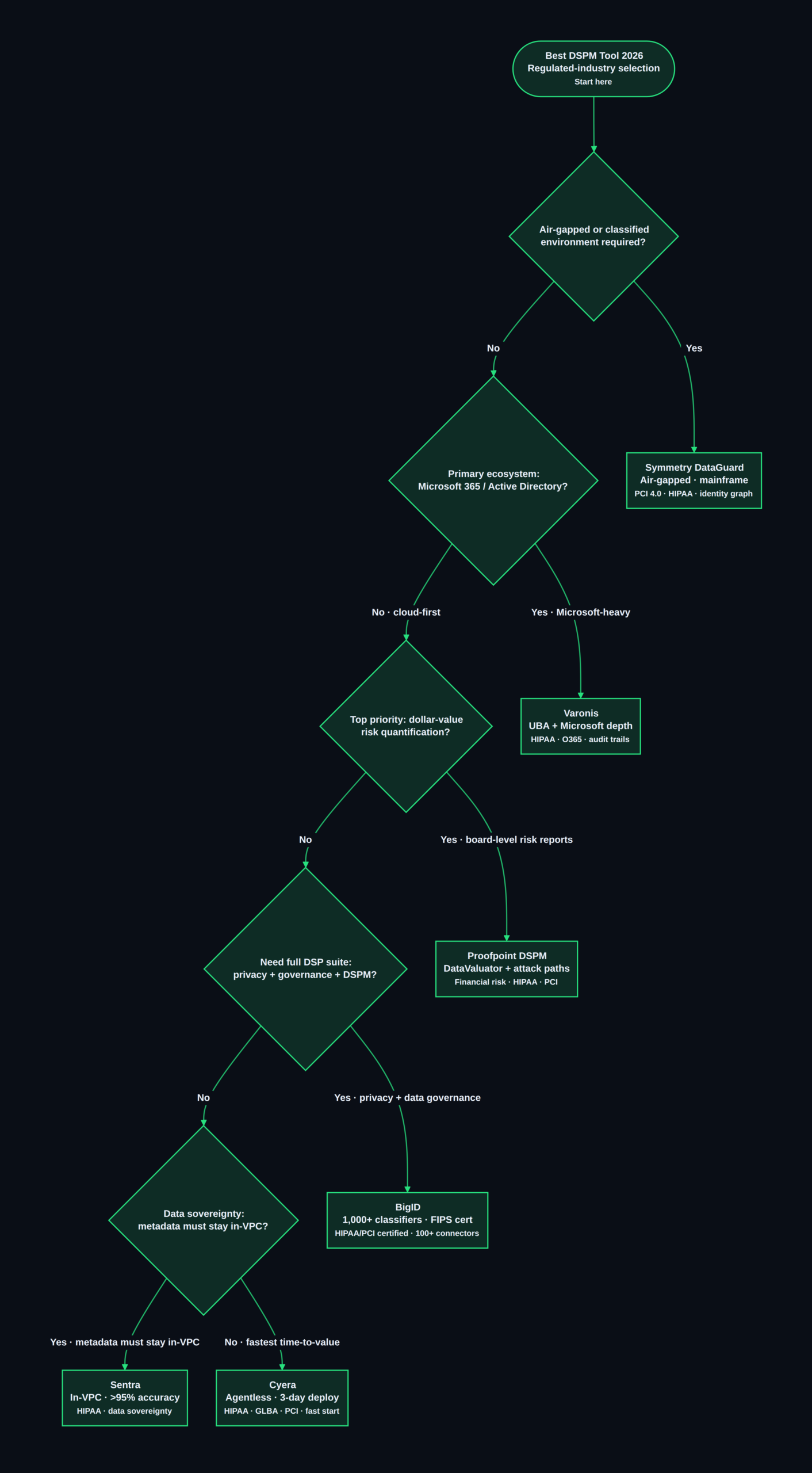
// 09 How to Choose: Decision Framework
// 10 What to Ask Every DSPM Vendor Before You Shortlist
Regardless of which platform you evaluate, put these questions in writing before the first demo:
- Shadow data discovery scope: "Demonstrate finding sensitive data in a non-approved environment — a dev sandbox, a SaaS app, an auto-synced employee folder." Classification of approved repositories is table stakes; shadow data discovery is the differentiating capability.
- GLBA Safeguards Rule mapping: Request a specific mapping between platform posture findings and the FTC GLBA Safeguards Rule controls under 16 CFR Part 314. "We support financial data" is not the same as mapping to the rule's nine required elements — encryption, access controls, multi-factor authentication, data retention, and secure disposal.
- False positive rate in production: Request a reference customer in your industry and their reported classification accuracy at scale. For PHI specifically, false positives create audit noise; false negatives create HIPAA liability. Neither is acceptable.
- Remediation scope: Does the platform auto-remediate (revoke permissions, encrypt buckets, disable sharing links) or only alert? Auto-remediation reduces MTTR (Mean Time to Remediate) significantly, but requires change management controls to prevent accidental production impact.
- Metadata residency: Where is the posture metadata itself stored? For HIPAA covered entities, the database of "which patient record files exist in which S3 bucket with which access model" may itself be PHI-adjacent and subject to the same residency and transmission safeguards as the underlying records.
Understanding how DSPM fits into the broader cloud security posture stack — alongside CNAPP capabilities covering cloud workload protection and container security — is equally important for organizations building a complete posture program. See the best CNAPP platforms for enterprise 2026 for a complementary view of how these categories interlock. DSPM also overlaps with CSPM (Cloud Security Posture Management) on infrastructure configuration — the CSPM vs. CWPP comparison covers where each category's scope ends.
// 11 Conclusion
The best DSPM tool 2026 for most regulated-industry organizations depends on a short set of factors. Cyera is the strongest default choice for organizations that need fast deployment, explicit GLBA documentation, and petabyte-scale LLM classification. Varonis wins for Microsoft-heavy environments where behavioral monitoring of ePHI access is a HIPAA audit priority. BigID is the right call for enterprises that need DSPM embedded in a full data security and privacy governance platform with independently verified HIPAA and PCI certifications. Sentra fits organizations with hard data sovereignty requirements. Symmetry DataGuard serves air-gapped and mainframe environments that every other vendor in this category cannot reach.
Run a proof-of-concept against your most sensitive shadow data environment — a dev account, a forgotten SaaS integration, a legacy backup — before committing. The platform that finds what you did not know you had is the one worth buying.
→ Subscribe to the CiphersSecurity weekly threat digest for DSPM updates, regulatory change alerts, and new platform coverage as it publishes.
For any query contact us at contact@cipherssecurity.com