
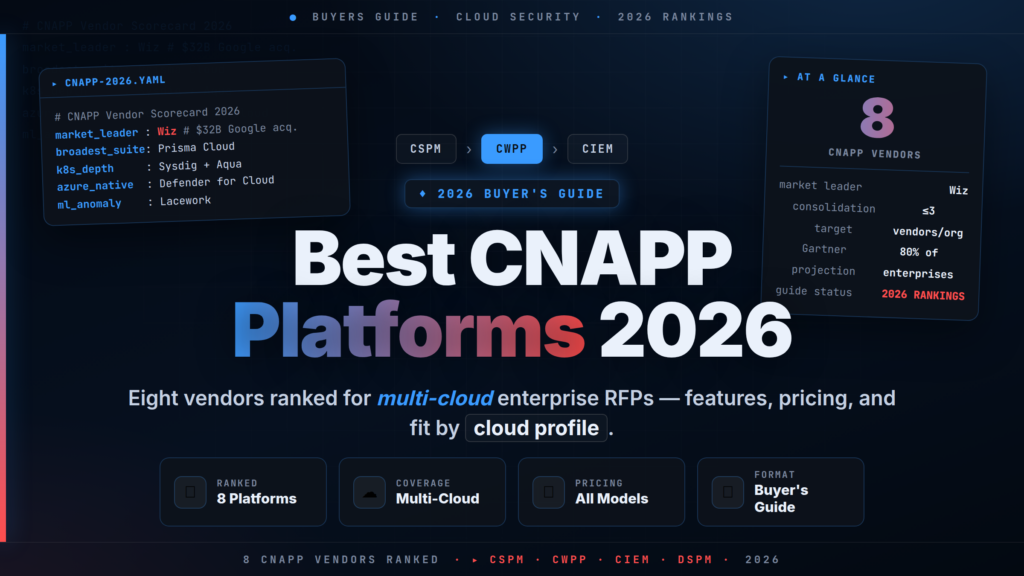
The best CNAPP platforms 2026 shortlists have shifted significantly: agentless-first architectures now dominate, Gartner projects that 80% of enterprises will consolidate cloud-native application protection to three or fewer vendors by year-end, and the $32 billion Google-Wiz acquisition has reshuffled competitive positioning across the board. This guide ranks eight platforms — Wiz, Palo Alto Prisma Cloud, CrowdStrike Falcon Cloud Security, Microsoft Defender for Cloud, Orca Security, Lacework, Sysdig, and Aqua Security — on feature coverage, deployment model, pricing, and fit by cloud profile, giving cloud security architects a structured starting point for 2026 RFPs.
// 01 What Is a CNAPP and Why It Matters in 2026
A CNAPP — Cloud-Native Application Protection Platform — is a unified security platform that fuses capabilities that security teams historically managed as separate point tools. The core modules are:
- CSPM (Cloud Security Posture Management): continuously checks cloud configurations — IAM policies, storage bucket permissions, network security groups — against security benchmarks such as CIS Controls and NIST 800-53
- CWPP (Cloud Workload Protection Platform): protects running virtual machines, containers, and serverless functions from vulnerabilities and runtime threats
- CIEM (Cloud Infrastructure Entitlement Management): governs identities and permissions across cloud environments, finding roles with excessive access or privilege escalation paths
- DSPM (Data Security Posture Management): discovers and classifies sensitive data (PII, PCI card data, PHI) stored in cloud resources and identifies who can reach it
- IaC scanning (Infrastructure as Code): catches misconfigurations in Terraform, CloudFormation, and Helm templates before they deploy to production
- CDR (Cloud Detection and Response): correlates runtime signals — API calls, network flows, process events — into incident-grade alerts
- AI-SPM (AI Security Posture Management): a newer module that governs AI model permissions, training data access, and inference endpoint exposure
The consolidation pressure driving CNAPP adoption is quantifiable. Gartner found the average enterprise operated ten discrete cloud security tools in 2022. By 2026, 80% of enterprises are expected to compress that to three or fewer vendors. Three forces drive this: alert fatigue from disconnected tools generating contradictory findings, the operational overhead of managing multiple agents and consoles, and the recognition that isolated risk signals — a misconfiguration here, an exposed secret there — only become actionable when correlated into a complete attack path.
Generative AI is now embedded in every mature CNAPP: natural-language query interfaces, AI-generated remediation code, and anomaly detection models that adapt to environment-specific baselines rather than matching against static rules.
// 02 Best CNAPP Platforms 2026: Evaluation Criteria
Each platform in this guide is assessed across seven dimensions that matter most to enterprise cloud security architects building multi-cloud RFPs:
- Feature breadth — how many of CSPM, CWPP, CIEM, DSPM, IaC, CDR, and AI-SPM are native, not OEM'd via a third-party integration
- Deployment model — agentless, agent-based, or hybrid; and how quickly first risk findings appear after account connection
- Multi-cloud coverage — AWS, Azure, and GCP parity, plus support for Oracle Cloud, Alibaba Cloud, or on-premises Kubernetes
- Kubernetes and container depth — admission control, image scanning, KSPM (Kubernetes Security Posture Management), and eBPF-based runtime telemetry
- Pricing model — whether pricing is workload-based, resource-based, or consumption-based, and realistic entry-point cost
- SOC integration — native SIEM/SOAR connectors, alert fidelity, and mean time to resolution (MTTR) tooling
- Time to value — how long from account creation to first actionable findings
// 03 Feature Comparison: At a Glance
| Platform | CSPM | CWPP | CIEM | DSPM | IaC | CDR | AI-SPM | Deploy Model |
|---|---|---|---|---|---|---|---|---|
| Wiz | ✓ | ✓ | ✓ | ✓ | ✓ | ✓ | ✓ | Agentless |
| Palo Alto Prisma Cloud | ✓ | ✓ | ✓ | ✓ | ✓ | ✓ | ✓ | Hybrid |
| CrowdStrike Falcon Cloud | ✓ | ✓ | ✓ | — | ✓ | ✓ | — | Agent |
| Microsoft Defender for Cloud | ✓ | ✓ | — | Partial | ✓ | ✓ | Partial | Agentless/Agent |
| Orca Security | ✓ | ✓ | ✓ | ✓ | ✓ | ✓ | Partial | Agentless |
| Lacework | ✓ | ✓ | ✓ | — | ✓ | ✓ | — | Hybrid |
| Sysdig | ✓ | ✓ | Partial | — | ✓ | ✓ | — | Agent (eBPF) |
| Aqua Security | — | ✓ | — | — | ✓ | ✓ | — | Agent |
// 04 1. Wiz — Best for Agentless Multi-Cloud Visibility
Wiz is the current CNAPP market leader by most measures. The $32 billion Google acquisition agreement confirmed the market's verdict. Agentless deployment works via cloud provider API integrations and snapshot scanning — a new customer connecting an AWS organization typically receives first risk findings within hours, not weeks. The core differentiator is the Wiz Security Graph, which correlates misconfigurations, vulnerabilities, exposed secrets, and identity risks into prioritized attack paths. A "toxic combination" alert surfaces multi-factor risks like an internet-exposed VM running an unpatched kernel that holds read access to an S3 bucket containing PII — findings no single point tool can produce independently.
Modules covered: Full CSPM, CWPP, CIEM, DSPM, IaC scanning (Wiz Code), CDR (via the Gem Security acquisition), KSPM, and AI-SPM for AI/ML workload governance. Wiz now covers more than 50% of Fortune 100 companies.
Multi-cloud: AWS, Azure, GCP, Oracle Cloud Infrastructure (OCI), and Alibaba Cloud with documented feature parity across all three major hyperscalers.
Pricing: Not publicly listed; requires a custom quote. Based on reported customer data, annual contracts range from $50,000 for environments under 1,000 workloads to $500,000+ for large enterprises. Pricing is workload-count-based with modular add-ons for DSPM, CDR, and AI-SPM.
Best fit: Enterprises prioritizing speed-to-coverage, unified attack path analysis, and a single data model across multiple clouds. Particularly strong for organizations that need DSPM and CIEM correlated with vulnerability findings in the same graph rather than separate consoles.
Limitations: The Google acquisition introduces integration uncertainty for some procurement and compliance teams. At scale, per-workload pricing grows fast — enterprises with 10,000+ workloads should model costs carefully before contracting. Agentless-only means less real-time behavioral telemetry than eBPF-based agents for highly dynamic container workloads.
// 05 2. Palo Alto Networks Prisma Cloud — Best for Single-Vendor Coverage
Prisma Cloud delivers the broadest CNAPP feature set under a single licensing agreement. CSPM, CWPP, CIEM, DSPM, IaC scanning, API security inventory, and AI-SPM are all native — not OEM'd from third parties. The platform is the product of several acquisitions (Twistlock for container security, Bridgecrew for IaC, Dig Security for DSPM), and that history is visible in the console: customers consistently report navigating what feel like separate products with shared authentication rather than a unified interface.
Modules covered: Full CSPM, CWPP, CIEM, DSPM, code security (IaC scanning plus CI/CD pipeline scanning across GitHub, GitLab, and Azure DevOps), API security inventory, and AI-SPM for AI/ML model governance. See Prisma Cloud's full platform overview for current module documentation.
Multi-cloud: AWS, Azure, GCP, OCI, Alibaba Cloud, on-premises Kubernetes (including OpenShift), and VMware private cloud — the widest coverage of any vendor in this guide.
Pricing: Credit-based consumption model. Enterprises purchase Prisma Cloud credits and allocate them to modules. Entry points for mid-size deployments typically fall between $100,000 and $200,000 annually; organizations running the full suite often exceed $500,000 per year.
Best fit: Large enterprises running formal RFPs that require a single vendor to cover the complete cloud security lifecycle, or organizations deeply invested in Palo Alto's broader portfolio — Cortex XDR for endpoint, XSIAM for SOC operations — who want unified telemetry across products.
Limitations: Complexity is the dominant complaint. Security engineers new to the platform face a steep learning curve, and the console's UX inconsistencies across acquired modules slow down incident investigation workflows. Professional services engagement is often required for initial deployment.
// 06 3. CrowdStrike Falcon Cloud Security — Best for Unified Endpoint + Cloud
CrowdStrike's CNAPP story builds on the Falcon platform's existing endpoint footprint. The same Falcon agent that provides EDR (Endpoint Detection and Response — monitoring process behavior on endpoints to detect and respond to attacks in real time) also delivers CWPP and container runtime protection, eliminating a separate cloud security sensor deployment entirely. The Threat Graph correlates endpoint, identity, and cloud telemetry into unified detections — an attacker moving from a compromised developer laptop to a cloud workload appears as a single alert chain rather than isolated events in separate consoles.
Modules covered: CSPM (via Falcon Horizon), CWPP with runtime protection, container image scanning and runtime defense, CI/CD pipeline scanning, and ITDR (Identity Threat Detection and Response). CrowdStrike Threat Graph draws on telemetry from over 350 million endpoints, giving its cloud detections threat intelligence context that pure-play CNAPP vendors cannot replicate.
Multi-cloud: AWS, Azure, and GCP, with notable AWS depth reflecting the company's cloud-native architecture.
Pricing: Module-based, stacked on the base Falcon license. CSPM (Falcon Horizon) and CWPP are separate SKUs. Per-workload pricing at enterprise scale can exceed Wiz or Orca for large environments where both endpoint and cloud modules are active.
Best fit: Enterprises already running CrowdStrike Falcon for endpoint protection. The unified agent eliminates sensor sprawl, and Threat Graph intelligence ties cloud and endpoint incidents together in a way no other CNAPP vendor matches.
Limitations: For organizations not yet on Falcon, onboarding requires an agent deployment project before cloud security coverage begins — there is no agentless quick-start. DSPM coverage is limited compared to Wiz or Prisma Cloud. Container-heavy environments may still need supplemental tooling for deep Kubernetes runtime telemetry.
// 07 4. Microsoft Defender for Cloud — Best for Azure-Heavy Enterprises
Microsoft Defender for Cloud (formerly Azure Security Center) is the natural starting point for organizations with significant Azure footprint. The foundation CSPM tier covers Azure resources at no additional cost for Enterprise Agreement customers; paid Defender for Servers, Defender for Containers, and Defender for DevOps plans extend coverage to workloads, containers, and code repositories. Integration with Microsoft Sentinel (the SIEM/SOAR platform) and Microsoft Entra ID (cloud identity platform, formerly Azure Active Directory) is native and deeper than any external CNAPP integration can replicate.
Modules covered: CSPM across free and paid tiers, CWPP (Defender for Servers, covering Azure VMs, AWS EC2, and GCP Compute via connector), container security (Defender for Containers for AKS, EKS, and GKE), IaC scanning (Defender for DevOps covering GitHub and Azure DevOps pipelines), and partial DSPM via Microsoft Purview integration for Azure data services.
Multi-cloud: AWS and GCP supported via native connectors, but Azure-native features — Secure Score, regulatory compliance dashboards, resource graph queries — do not reach the same depth on non-Azure clouds.
Pricing: Foundation CSPM is free for Azure. Paid plans add per-resource cost: Defender for Servers runs approximately $15 per server per month; Defender for Containers runs approximately $7 per core per month. Microsoft 365 E5 Security customers already pay for substantial overlap through included entitlements, making Defender for Cloud among the most cost-effective options for existing Microsoft customers.
Best fit: Azure-primary organizations with Microsoft E5 licensing seeking to minimize additional security vendor spend. The Sentinel integration produces the strongest SIEM-native incident workflow of any CNAPP in this guide, and the Secure Score dashboard provides regulatory compliance reporting that maps to SOC 2, PCI-DSS, and ISO 27001 without third-party configuration.
Limitations: Multi-cloud feature parity is meaningfully weaker than purpose-built CNAPP vendors. CIEM is limited — identity risk analysis across cloud providers requires supplemental tooling or Microsoft Entra Permissions Management (a separate SKU). Organizations with large AWS or GCP footprints frequently supplement Defender for Cloud with a dedicated CNAPP for non-Azure environments.
// 08 5. Orca Security — Best for Fast Deployment with Zero Agents
Orca's patented SideScanning technology reads workload data from cloud storage snapshots and cloud provider APIs without deploying any agents or network scanners. A large enterprise can achieve full cloud asset inventory and risk findings across hundreds of accounts within a single business day. The unified data model — Orca's Cloud Security Graph — connects asset inventory, vulnerability findings, identity permission risks, and sensitive data exposure into prioritized alerts that rank real-world impact rather than raw vulnerability count.
Modules covered: CSPM, CWPP (agentless vulnerability scanning across OS packages, application libraries, and container images), CIEM, DSPM (sensitive data discovery across object storage, databases, and running workloads), IaC scanning, and CDR via runtime anomaly detection using API audit logs and network flow analysis.
Multi-cloud: AWS, Azure, and GCP with strong feature parity. DigitalOcean and Alibaba Cloud support is available for organizations with non-hyperscaler deployments — broader than many competitors.
Pricing: Not publicly listed. Orca prices per cloud asset or workload. Reported entry points for mid-size environments fall between $50,000 and $80,000 annually, making Orca one of the more accessible options for organizations with 500–2,000 workloads.
Best fit: Security teams with limited engineering bandwidth who need maximum coverage with minimum deployment friction. Particularly effective for brownfield deployments — large existing cloud estates where an agent rollout project would take months. Also a strong fit for organizations running quarterly cloud security reviews that need rapid estate-wide scanning without persistent sensor infrastructure.
Limitations: Agentless-only architecture means less real-time behavioral telemetry than eBPF-instrumented agents. For workloads where sub-second process-level detection matters — PCI-DSS in-scope cardholder data environments, regulated financial systems — a hybrid approach pairing Orca's agentless posture management with a runtime agent may be required.
// 09 6. Lacework — Best for Behavioral Anomaly Detection
Lacework's differentiator is its ML-based behavioral detection engine, Polygraph. Rather than matching cloud events against static rule sets — which produce high false-positive rates in dynamic cloud environments — Polygraph builds a behavioral baseline for each cloud account and surfaces deviations. A service account that suddenly begins calling new AWS APIs at 3 a.m. triggers a Polygraph alert; a rule-based system would require a pre-defined rule for that exact API combination to fire. This approach substantially reduces the alert-to-investigation ratio for security operations teams.
Lacework is now part of Fortinet following the 2024 acquisition, extending its integration with the Fortinet Security Fabric — FortiGate firewalls, FortiSIEM, and FortiSOAR — for organizations running Fortinet network security alongside cloud workloads.
Modules covered: CSPM, CWPP (agent-based vulnerability management and runtime monitoring for Linux and Windows), CIEM with access activity analysis, IaC scanning, CI/CD pipeline scanning, and CDR via the Polygraph behavioral engine. Compliance automation covers PCI-DSS, SOC 2, HIPAA, and CIS benchmarks out of the box.
Multi-cloud: AWS, Azure, and GCP; on-premises Kubernetes clusters via Lacework agent deployment.
Pricing: Workload-based subscription. Mid-size deployments (1,000–5,000 workloads) typically fall between $80,000 and $200,000 annually. Fortinet partnership pricing may bundle Lacework entitlements for existing Fortinet infrastructure customers.
Best fit: Security operations teams drowning in false-positive alerts from rule-based tools who need a system that learns what normal looks like in their specific environment. Strong for organizations with complex multi-cloud environments where manual rule tuning is unsustainable, and for Fortinet-centric enterprises wanting a CNAPP with native Fabric integration.
Limitations: The Polygraph behavioral model requires two to four weeks to build an accurate baseline before alert quality stabilizes — a consideration for organizations with urgent compliance deadlines. DSPM is not a native module; data security posture management requires integration with third-party tools. The Fortinet acquisition has raised questions about Lacework's product roadmap independence, which some enterprise architects are monitoring closely.
// 10 7. Sysdig — Best for Kubernetes-Native Teams
Sysdig was built for containerized environments before CNAPP was a category. Its runtime detection engine is built on Falco, the open-source cloud-native runtime security project donated to the CNCF (Cloud Native Computing Foundation — the vendor-neutral home for Kubernetes and related open-source projects). eBPF (Extended Berkeley Packet Filter — a Linux kernel technology that captures system call data with negligible performance overhead) instrumentation gives Sysdig sub-second visibility into container and Kubernetes workload behavior without requiring kernel module installation.
Modules covered: CSPM, CWPP (runtime protection via eBPF instrumentation), KSPM (Kubernetes Security Posture Management — auditing cluster configuration against CIS Kubernetes Benchmark and NSA hardening guidelines), container image scanning (including supply chain analysis via Sysdig Secure), IaC scanning for Helm charts and Kubernetes manifests, CDR via Falco-based detection rules, and forensics capability via Sysdig Capture, which records all system calls for post-incident replay.
Multi-cloud: AWS (EKS), Azure (AKS), and GCP (GKE) Kubernetes clusters, plus strong on-premises Kubernetes support. Serverless and PaaS coverage is less comprehensive than agentless platforms.
Pricing: Per-node and per-core pricing for Kubernetes environments. Reported enterprise contracts range from $60,000 for small cluster fleets to $300,000+ for large multi-cloud Kubernetes deployments.
Best fit: Engineering-led organizations running Kubernetes-heavy workloads where runtime forensics and open-standard detection rules matter. Sysdig's Falco roots mean security engineers can write, share, and audit detection rules without vendor lock-in — a meaningful advantage for teams that contribute to or depend on the open-source security community.
Limitations: The agent-based model adds deployment complexity relative to agentless platforms. Serverless workload protection is weaker. CIEM and DSPM are limited compared to Wiz, Orca, or Prisma Cloud, making Sysdig a stronger complement than a complete replacement for cloud-wide posture management. For enterprises needing full CNAPP coverage, Sysdig often pairs with a CSPM-heavy platform. For real-world context on what Sysdig-style runtime detection catches in production, see our analysis of the PCPJack cloud worm that used Docker and Kubernetes credential theft.
// 11 8. Aqua Security — Best for Full Container Lifecycle Enforcement
Aqua Security covers the container security lifecycle from code commit to runtime enforcement with greater depth than any other platform in this guide. The platform does not merely alert — it can block. Container images that fail policy checks are stopped at the Kubernetes admission controller (a Kubernetes API gateway component that intercepts resource creation requests) before reaching production. Runtime policies enforce at the container level, blocking unexpected processes, unauthorized file system writes, and anomalous network connections rather than logging them after the fact.
Modules covered: Full container lifecycle security including image scanning (static analysis, SCA/Software Composition Analysis for open-source package vulnerabilities, secrets detection in image layers), Kubernetes admission control via Aqua Enforcer, KSPM, runtime protection via the Aqua Enforcer agent, IaC scanning for Terraform and Kubernetes manifests, and CI/CD pipeline security for Jenkins, GitHub Actions, and GitLab CI.
Multi-cloud: AWS, Azure, GCP, on-premises Kubernetes, Red Hat OpenShift (the enterprise Kubernetes distribution), and VMware Tanzu — the widest non-hyperscaler Kubernetes coverage in this guide.
Pricing: Module-based enterprise licensing. Container-focused deployments typically enter between $60,000 and $120,000 annually. Full platform licensing covering IaC, pipeline scanning, and runtime enforcement is substantially higher for large organizations.
Best fit: Regulated industries — financial services, healthcare, government — that require hard runtime enforcement on container workloads, not just alerting. PCI-DSS and HIPAA environments where containers must run only explicitly permitted processes, execute from approved image digests, and generate audit-ready logs benefit most from Aqua's enforcement model. The CI/CD pipeline security capability is also a strong fit given the rising supply chain threat profile — see our coverage of the Megalodon GitHub supply chain attack for a concrete case study of what pipeline scanning is designed to catch.
Limitations: CSPM coverage is narrower than Wiz, Orca, or Prisma Cloud. There is no native DSPM or CIEM module. For organizations that need holistic cloud posture management alongside container security, Aqua typically appears alongside a CSPM-centric CNAPP in the security architecture rather than replacing it. Agent deployment across large container estates requires an orchestrated rollout project.
// 12 How to Choose: Decision Framework by Cloud Profile
The right starting point depends on three architectural decisions — not feature checklists, since all eight vendors now cover the CNAPP core.
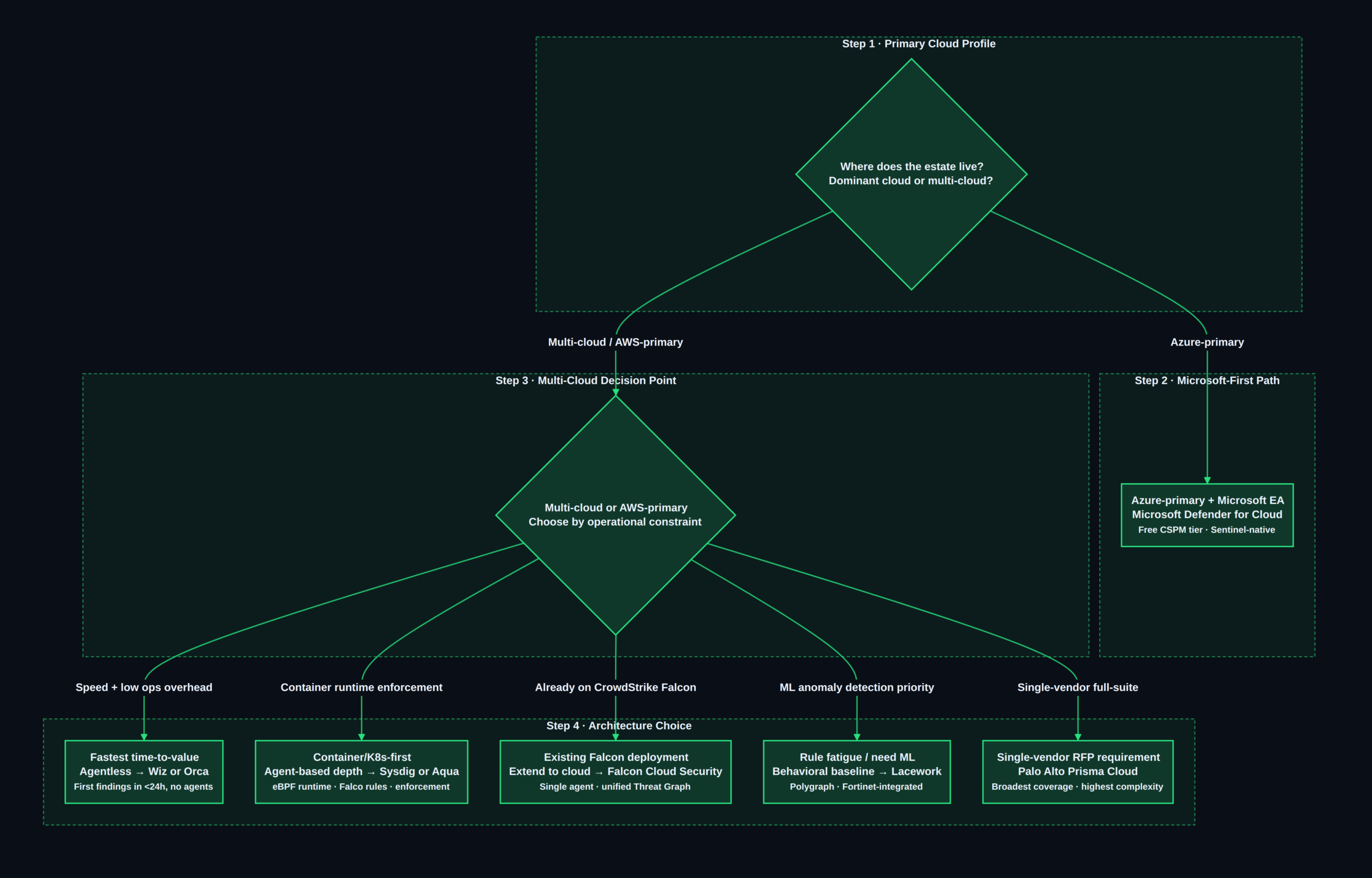
Use this tree as a first-pass filter. Every CNAPP shortlist should progress to a proof-of-concept against a representative workload sample — the delta between vendor demos and production behavior in your actual environment is where evaluation surprises live. Negotiate PoC access in the contract; every vendor in this guide offers it.
For the CSPM and CWPP foundations that sit at the core of any CNAPP, see our CSPM vs CWPP comparison for 2026 for a deeper look at how those two categories differ and where they overlap before evaluating full-platform vendors.
// 13 Conclusion
The best CNAPP platforms 2026 converge on the same feature vocabulary — CSPM, CWPP, CIEM, DSPM, IaC, CDR — but diverge sharply on architecture, pricing, and operational depth. Wiz leads on agentless breadth and attack path correlation. Prisma Cloud leads on single-vendor feature coverage and multi-cloud reach. Sysdig and Aqua lead on container runtime depth and enforcement granularity. Defender for Cloud leads on Azure-native integration and cost efficiency under Microsoft EA. Run a structured PoC with at least two shortlisted vendors against your actual environment before committing to a three- to five-year contract; Gartner's projection of 80% enterprise consolidation to three or fewer vendors means this decision is likely to stand for years.
Subscribe to the CiphersSecurity weekly threat digest for ongoing CNAPP vendor updates, new capability announcements, and enterprise pricing intelligence →
For any query contact us at contact@cipherssecurity.com