
The Druva vs Rubrik vs Cohesity immutable backup decision shapes your ransomware recovery outcome: these three platforms dominate enterprise data protection in 2026 but differ radically in architecture, immutability guarantees, and total cost. This guide breaks down what actually matters for CISOs and infrastructure leads designing ransomware recovery playbooks.
// 01 Why Immutable Backup Has Become a Board-Level Priority
Modern ransomware operators do not simply encrypt production data and wait. They specifically target backup infrastructure first — terminating backup agents, deleting Volume Shadow Copy Service (VSS) snapshots (Windows' built-in point-in-time copy mechanism), and encrypting any network-accessible backup server before the main payload fires. Traditional backup systems where administrators can delete or overwrite data become part of the attack surface rather than its remedy.
Immutable backup solves this by making backup data physically and logically impossible to modify or delete within a defined retention window, regardless of admin credentials or OS-level commands. Air-gapping (isolating backup data in a network segment or cloud environment completely separate from primary infrastructure) adds a second layer: even if an attacker compromises the primary environment entirely, the backup copy is unreachable.
The business case has hardened. Average enterprise ransom payments exceeded $1.2M in 2025, while organisations with properly architected immutable backup systems routinely recovered without paying. Gartner's 2026 security investment survey ranks data protection as the highest-priority cybersecurity spend category for the second consecutive year. Enterprise backup contracts now run $200K–$2M annually — and board members understand the ROI arithmetic when the alternative is a $1M+ ransom.
// 02 Architecture at a Glance: Cloud-Native vs Appliance vs Hybrid
The three platforms diverge at the foundational architecture level, and that divergence determines every subsequent design and operational decision.
| Platform | Deployment Model | Hardware Required | Backup Destination |
|---|---|---|---|
| Druva | SaaS cloud-native | None | Druva-managed AWS cloud |
| Rubrik | Converged appliance + cloud extension | Proprietary hardware | On-prem Atlas cluster + Cloud Vault |
| Cohesity | Converged appliance + cloud extension | Proprietary hardware | On-prem DataProtect cluster + FortKnox |
Druva operates entirely as a managed SaaS (Software-as-a-Service — a model where the vendor manages all underlying infrastructure) platform hosted on AWS. There is no hardware to rack, no backup server to patch, and no local infrastructure to defend. The backup destination sits in a Druva-managed cloud tenant that customers cannot access at the storage layer, which is simultaneously its strongest security property and a constraint for organisations in regulated sectors requiring on-premises data residency.
Rubrik ships as a converged appliance — proprietary hardware running its Atlas distributed file system — combined with optional cloud tiers. Data protection runs on hardware the customer owns and operates, with Rubrik Cloud Vault extending protection into an air-gapped cloud environment using completely separate credentials and separate network access.
Cohesity DataProtect follows the same appliance-first model. Proprietary hardware clusters run the DataProtect backup software, with cloud extension via FortKnox — a managed cyber vault service that creates an immutable, air-gapped copy isolated from both the primary Cohesity cluster and the customer's network through a virtual air gap in the management plane.
// 03 Druva vs Rubrik vs Cohesity Immutable Backup: Core Technology
This is where engineering depth separates vendor marketing from real protection.
Druva: WORM Cloud with Safe Mode
Druva's immutability is enforced at the cloud-object level using WORM (Write-Once-Read-Many — a storage model where data is written once and cannot be subsequently overwritten, modified, or deleted) storage within its AWS-hosted infrastructure. Customers have no administrative access to the underlying storage layer at all: a fully compromised Druva admin account cannot delete backup data because the storage API does not expose a deletion path.
Druva layers Safe Mode on top of WORM immutability. When activated, Safe Mode applies granular restrictions across backup jobs, restores, and download operations — requiring multi-party approval (MPA, where two or more authorised individuals must approve high-risk actions) for changes that could affect recovery points. This mirrors the dual-control authorisation used by financial institutions for high-value transactions.
The platform also ships a Restore Scan feature that cross-references backup snapshots against a continuously updated ransomware IoC (Indicator of Compromise — file hashes, signatures, and behavioural patterns associated with known malware families) library combined with signature-based antivirus detection. The goal is to confirm that the snapshot you are restoring from was captured before the infection was active, not after a stealth pre-encryption phase.
Rubrik: Atlas File System with $10M Warranty
Rubrik's immutability lives inside Atlas, a purpose-built distributed file system designed from scratch for a single use case: storing backup data that cannot be deleted or modified. Snapshots captured via Rubrik's incremental-forever model are written to Atlas in WORM format. Unlike general-purpose file systems retrofitted with deletion locks, Atlas separates the metadata plane from the data plane — deleting a snapshot record in the index does not affect the underlying data blocks on disk.
Atlas snapshots cannot be altered by OS-level commands, modified by admin credentials, or removed by any external process. The air-gapped Rubrik Cloud Vault replicates Atlas data into a cloud environment with completely separate authentication and network paths from the primary deployment. Instant recovery mounts backup snapshots directly into production rather than copying data first, dramatically reducing time-to-operational.
The most commercially significant differentiator: Rubrik backs its immutability architecture with a $10M ransomware recovery warranty for Enterprise Edition and Enterprise Proactive Edition customers — a direct statement of engineering confidence, and a risk-transfer argument that resonates at board level.
Cohesity: FortKnox Vault with Instant Mass Restore
Cohesity's immutability operates at the snapshot level: snapshots are sealed on creation and cannot be accessed, mounted, or modified from outside the Cohesity service itself. The FortKnox Cyber Vault creates a further-isolated copy — physically and logically air-gapped, encrypted in transit and at rest — using a virtual air gap that severs the management plane connection between the primary cluster and the vault. Vault retention locks prevent deletion even by authenticated Cohesity administrators until the retention window expires.
Cohesity integrates hash-based threat scanning directly into the backup ingestion pipeline. This catches known-malicious file signatures before they are committed to immutable storage — important because certain ransomware strains deliberately contaminate backup targets before activating encryption. Cohesity's AI-based anomaly detection layer monitors backup jobs for unusual patterns: sudden spikes in changed-data volume, mass file rename activity, and entropy changes that precede most ransomware events.
// 04 Ransomware Recovery Features: Detection, Isolation, and Clean Restore
Immutability guarantees you have clean data. Recovery features determine how fast you regain operations.
| Feature | Druva | Rubrik | Cohesity |
|---|---|---|---|
| Backup threat scanning | IoC library + AV hash | Atlas-level built-in | Hash scanning + AI anomaly |
| Isolated sandbox recovery | Sandbox Recovery | Cloud Vault isolation | FortKnox isolated restore |
| Mass VM recovery | Orchestrated automation | Instant mount recovery | Instant Mass Restore |
| Admin lockout / MFA | Safe Mode + MFA | Zero Trust RBAC | Granular RBAC + MFA + SSO |
| SIEM/SOAR integration | Yes | Yes | Yes |
| Published recovery warranty | Not available | $10M | Not available |
The ransomware recovery flow — from attack detection through clean restoration — follows the same logical sequence across all three platforms, but the implementation at each stage differs:
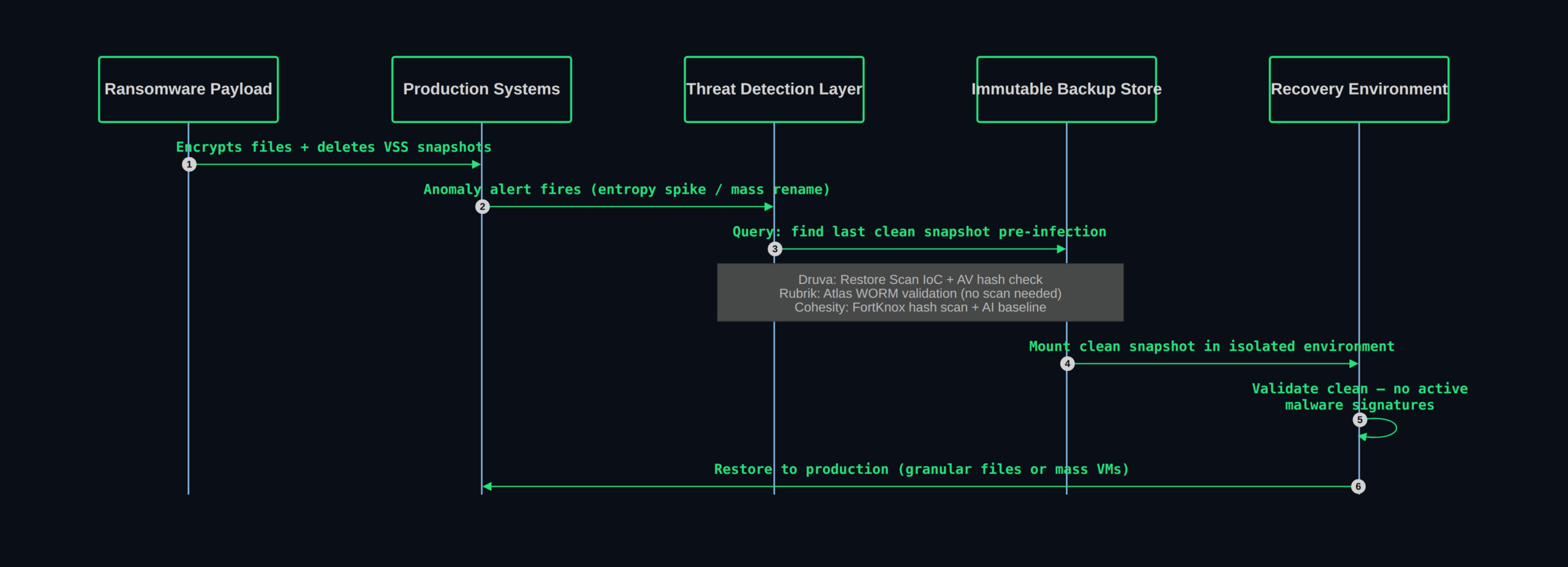
Druva's Sandbox Recovery restores data into a fully isolated cloud environment before production reintroduction. This controlled validation step catches reinfection — particularly relevant for strains like Qilin (a RaaS — Ransomware-as-a-Service — platform responsible for over 700 attacks in 2025) that leave dormant components in file systems.
Rubrik's recovery path is architecturally simpler: because Atlas immutability guarantees a clean copy by design, recovery begins immediately without a separate scan phase. The instant recovery feature mounts the snapshot directly into production at sub-minute intervals for VM workloads, making it the fastest architecture for local recovery from on-premises Atlas snapshots.
Cohesity's Instant Mass Restore addresses a specific enterprise scenario: recovering hundreds of virtual machines simultaneously from FortKnox-held snapshots. In large VMware vSphere or Nutanix AHV environments, sequential VM restoration is a recovery-time killer. Cohesity's architecture parallelises this across the entire cluster.
// 05 RTO and RPO: How Fast Can You Actually Recover?
RTO (Recovery Time Objective — the maximum acceptable downtime duration before operations must be restored) and RPO (Recovery Point Objective — the maximum acceptable data loss window, expressed as time since the last clean backup) are the operational metrics that determine whether backup architecture translates into actual business continuity.
No vendor publishes contractual RTO guarantees in public documentation because recovery time depends on data volume, network bandwidth, and incident scope. Architecture, however, strongly predicts performance:
Druva RPO is set by backup policy frequency — minimum one-hour intervals for most workloads, lower with Continuous Data Protection (CDP) for supported platforms. Recovery time from cloud depends on network egress bandwidth from AWS. Druva's orchestration layer automates recovery sequencing, reducing human decision time significantly. The model performs best for geographically distributed organisations with mature cloud connectivity.
Rubrik achieves sub-minute VM mount times from local Atlas snapshots because instant recovery mounts the snapshot in-place rather than copying data to a new location first. The VM boots from the Atlas snapshot and data migrates to permanent storage in the background. Cloud Vault recovery adds egress latency from the air-gapped cloud tier but remains the fastest model for large-volume local restores.
Cohesity wins on parallel VM recovery speed. Instant Mass Restore can simultaneously restore hundreds of VMs from FortKnox snapshots across a Cohesity cluster, making it the right architecture for recovery scenarios that require an entire data centre segment to come back at once rather than serially.
// 06 Pricing and Total Cost of Ownership
TCO (Total Cost of Ownership — the full lifecycle cost including capital, licensing, operations, and support) for enterprise backup extends well beyond the initial purchase.
| Cost Factor | Druva | Rubrik | Cohesity |
|---|---|---|---|
| Pricing model | Per-TB/month SaaS subscription | Appliance + annual licensing | Appliance + annual licensing |
| Published list price | ~$0.001/TB/month storage | Not publicly disclosed | Not publicly disclosed |
| Hardware capital expenditure | None | Required (proprietary) | Required (proprietary) |
| Hardware refresh cycle | None | Every 3–5 years | Every 3–5 years |
| Operational overhead | Very low — vendor-managed | Moderate — appliance ops team | Moderate — appliance ops team |
| Cloud egress costs | Potential (AWS) | Potential (Cloud Vault) | Potential (FortKnox) |
| Recovery warranty value | None published | $10M | None published |
| Typical enterprise contract | $200K–$2M/year | $200K–$2M/year | $200K–$2M/year |
Druva's consumption model is the most transparent in the market. The published storage rate of approximately $0.001 per TB per month represents the raw storage component; full platform licensing — covering servers, endpoints, Microsoft 365, and cloud workloads — scales the actual annual spend significantly above that baseline. The advantage is predictability: costs track data growth rather than hardware refresh cycles, and there is no capital expenditure to depreciate or procurement cycle to manage.
Rubrik and Cohesity both require capital investment in proprietary appliance hardware plus annual software licensing and maintenance agreements. The appliance model often delivers better per-TB economics at large scale (above 500 TB of managed data) once hardware is fully amortised, but introduces 3–5 year refresh cycles, physical data centre capacity requirements, and a dedicated operations function to manage appliance health, software upgrades, and hardware replacements.
For cloud-native organisations and MSPs (Managed Service Providers) that have eliminated on-premises data centre capacity, Druva's model eliminates appliance capital entirely. For organisations with existing data centre investments and large on-premises estates, Rubrik or Cohesity's appliance models may deliver better recovered-GB economics when the full hardware lifecycle is accounted for.
// 07 Real-World Recovery: A Hospitality Company Defeats Qilin Without Paying Ransom
In April 2026, a hospitality company sustained a Qilin ransomware attack targeting its VMware infrastructure, file systems, and SQL Server databases. Qilin operates as a RaaS (Ransomware-as-a-Service) platform where the malware is licensed to affiliate attackers who execute campaigns independently — making it one of the highest-volume ransomware families of 2025, responsible for over 700 confirmed attacks across healthcare, manufacturing, government, and financial sectors.
The company successfully restored full operations without paying ransom and without system reinfection, using Druva's three-layer recovery sequence:
- Safe Mode activation: Granular restrictions were applied immediately to backup jobs, restores, and download operations, preventing further tampering with recovery points while the incident was being assessed.
- Restore Scan: Affected workloads were scanned against Druva's ransomware IoC library and hash-based antivirus detection to identify the last recovery point captured before Qilin's pre-encryption dormancy phase had begun writing to the file system.
- Sandbox Recovery: Data was restored into Druva's isolated cloud environment, validated as containing no active malware, and then pushed to production.
This represents one of the most detailed public case studies available for any of the three vendors in 2026. Rubrik and Cohesity reference customers report comparable outcomes in analyst briefings and private case studies, but public documentation with specific recovery timelines remains sparse across all three platforms. The underlying architectures of all three are sound; documented proof points are asymmetric.
// 08 Druva vs Rubrik vs Cohesity: Which Platform Fits Your Organisation?
The Druva vs Rubrik vs Cohesity immutable backup decision maps more cleanly to operational constraints than to absolute capability rankings. All three platforms solve the core problem competently.
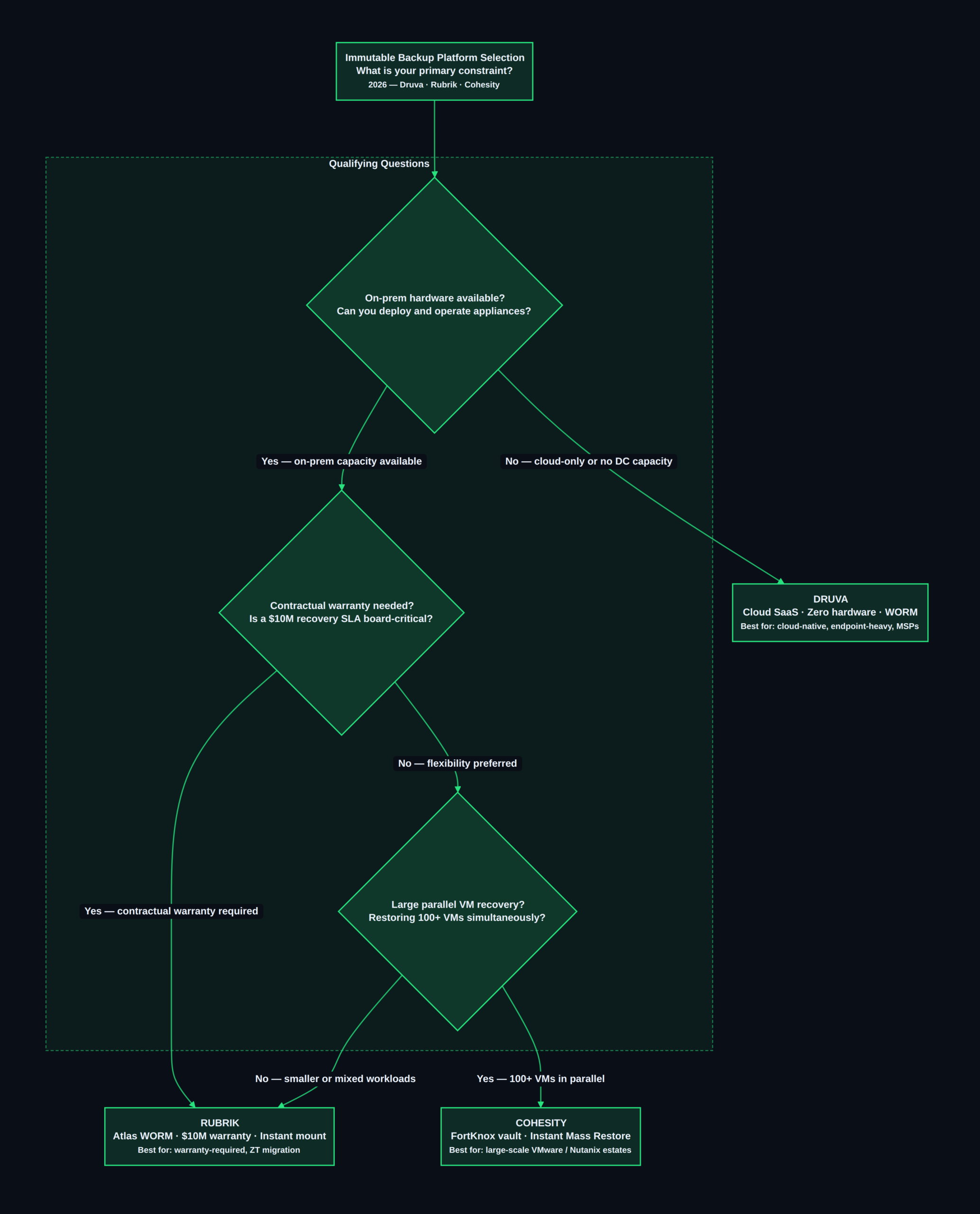
Choose Druva if your organisation is cloud-native, has no existing data centre capacity for appliances, needs transparent per-TB pricing, manages a large distributed endpoint fleet, or has already committed to a SaaS-first operational model. Druva is also the lowest operational overhead: no appliance firmware to patch, no hardware to physically manage, no backup server exposed to the network.
Choose Rubrik if immutability must be contractually backed at the $10M level, if you need sub-minute VM mount times from on-premises Atlas snapshots, or if your organisation is migrating from traditional backup to a Zero Trust (the security model where no user, device, or system is trusted by default, and access is continuously verified) architecture. Rubrik's Atlas file system is also the most purpose-built immutable storage design of the three.
Choose Cohesity if your recovery scenario requires restoring hundreds of VMs simultaneously, if your organisation manages multi-vendor environments (VMware vSphere, Nutanix AHV, AWS, Azure) from a single management plane, or if you want AI-based anomaly detection embedded into the backup pipeline rather than bolted on as a third-party integration.
// 09 Conclusion
Druva vs Rubrik vs Cohesity immutable backup is not a ranking exercise — it is a requirements-matching exercise. Druva eliminates infrastructure complexity and cost at the price of hardware control and potential cloud egress dependency. Rubrik delivers the deepest immutability engineering and the only published financial warranty. Cohesity wins for large-scale parallel VM recovery and multi-environment management. Define your recovery scenario concretely — how many systems, how fast, from what infrastructure — and the right platform follows from that specification rather than from vendor comparisons.
For enterprises designing end-to-end incident response playbooks, see our guide on dual ransomware attack response and enterprise IR for the operational steps that run alongside backup-led recovery. If you are building out compliance documentation, SOC 2 Type II backup requirements for SaaS companies covers how immutable backup maps to Trust Services Criteria. And for government and regulated organisations, federal cybersecurity logging requirements under OMB M-26-14 includes SIEM integration guidance that complements backup-based detection.
For any query contact us at contact@cipherssecurity.com