
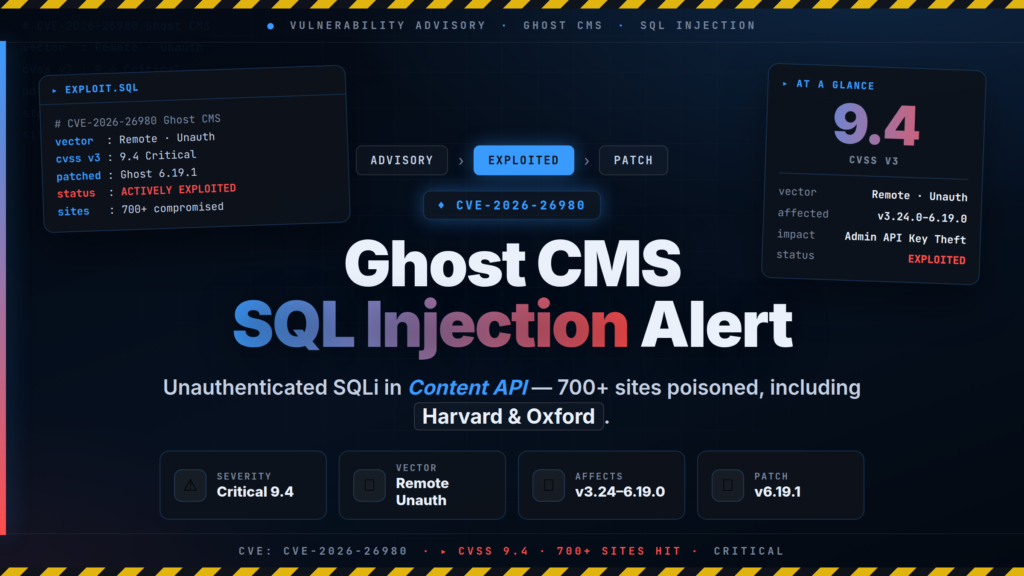
Ghost CMS CVE-2026-26980 is a CVSS 9.4 (Critical) SQL injection (SQLi — a class of attack where user-supplied input is embedded directly into a database query, allowing the attacker to read or modify data they should not have access to) vulnerability in Ghost’s Content API that lets unauthenticated attackers extract admin API keys directly from the database, granting complete site write access. As of late May 2026, active exploitation has compromised more than 700 websites — including portals belonging to Harvard University, Oxford University, Auburn University, and DuckDuckGo — with attackers injecting ClickFix malware into article pages served to millions of readers. Ghost version 6.19.1, released February 19, 2026, contains the fix. If your Ghost installation has not been updated, treat it as compromised until proven otherwise.
// 01 CVE-2026-26980: Root Cause and Technical Analysis
Ghost CMS is a Node.js-based open-source publishing platform used by newsrooms, universities, and SaaS companies worldwide. Its Content API (an Application Programming Interface — a programmatic endpoint that external applications use to fetch content) is public and unauthenticated by design, enabling headless frontends, newsletter tools, and search integrations to query posts without credentials.
The vulnerability in versions 3.24.0 through 6.19.0 resides in the slug-based filtering mechanism exposed via the order query parameter. When a caller requests posts filtered by slug, the Ghost framework concatenates that value directly into a SQL CASE statement — the ordering clause of the database query — without using parameterized queries (a secure coding technique that separates SQL logic from user data so injected syntax cannot be interpreted as a command) or input sanitization of any kind:
-- Simplified representation of the vulnerable SQL pattern in Ghost 3.24.0–6.19.0
SELECT id, title, slug, html FROM posts
ORDER BY
  CASE WHEN slug = '<unsanitized_user_input>' THEN 0 ELSE 1 END
Because the user-supplied value is raw-concatenated into the SQL string, an attacker can close the CASE expression and append a UNION SELECT or subquery targeting any table in the Ghost database. The exploit pivots from the posts table to the api_keys table, where Ghost stores admin API keys in a format that can be used directly for authentication. CWE-89 (Common Weakness Enumeration entry for Improper Neutralization of Special Elements used in an SQL Command) is the formal classification.
The Ghost Content API is publicly accessible on any self-hosted instance with no firewall rule or authentication required. The full exploit path — from HTTP request to admin API key — requires a single network request. Ghost’s official security advisory confirmed the flaw and the February 19 patch.
The National Vulnerability Database entry for CVE-2026-26980 notes that the vulnerability was discovered by Anthropic using Claude.
// 02 Ghost CMS CVE-2026-26980: Affected Versions and CVSS Breakdown
The vulnerability spans a wide release range, covering multiple major versions:
| Component | Detail | |———–|——–| | Affected versions | Ghost 3.24.0 through 6.19.0 (inclusive) | | Fixed version | Ghost 6.19.1 (released 2026-02-19) | | CVSS v3.1 Score | 9.4 (Critical) | | CWE | CWE-89: SQL Injection | | Authentication required | None | | User interaction required | None |
CVSS v3.1 (Common Vulnerability Scoring System version 3.1 — the industry-standard framework for rating vulnerability severity on a 0–10 scale) breaks the score of 9.4 into the following components:
- Attack Vector: Network — The exploit is fully remote; no physical or local access is needed.
- Attack Complexity: Low — No race conditions or prior knowledge of the target are required.
- Privileges Required: None — The Content API endpoint is unauthenticated. Any internet-connected host can trigger it.
- User Interaction: None — No action by the site administrator is required; exploitation is entirely server-side.
- Confidentiality Impact: High — Admin API keys, user email addresses, and all database rows are readable.
- Integrity Impact: High — Stolen admin keys enable arbitrary write operations: post injection, settings modification, user management.
- Availability Impact: Low — No direct service disruption, though downstream malware distribution causes significant secondary impact.
The three-month gap between patch release (February 19, 2026) and confirmed mass exploitation (first detected May 7, 2026) is a textbook example of patch-diffing: attackers analyzed the code change in Ghost 6.19.1, reverse-engineered the vulnerable pattern, and weaponized it at scale after the vulnerability was sufficiently widespread among unpatched installations.
// 03 Exploitation: The Four-Stage ClickFix Kill Chain
ClickFix is a social engineering payload delivery technique (MITRE ATT&CK technique T1566.002: Phishing via link/web interface) that presents victims with a fake Cloudflare bot-verification prompt. The prompt instructs users to press WIN+R (the Windows Run dialog shortcut) and paste an attacker-supplied command, silently downloading and executing malware without triggering standard browser download warnings or file-manager prompts.
QiAnXin XLab researchers identified at least two competing threat clusters exploiting Ghost CMS CVE-2026-26980. The campaign follows a four-stage kill chain:
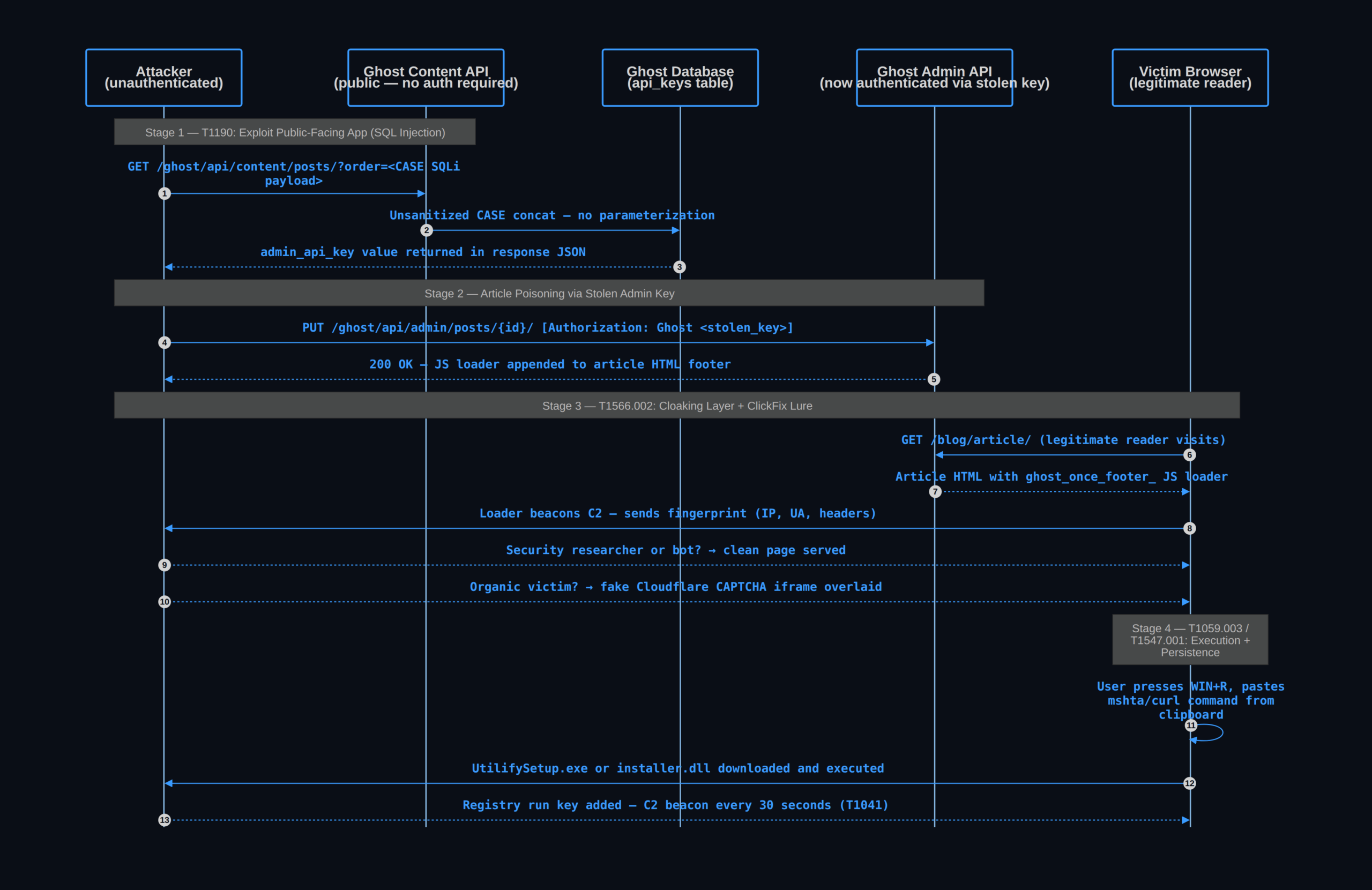
Stage 1 — Database extraction (T1190: Exploit Public-Facing Application): A single crafted GET request to the Content API’s order parameter extracts the admin API key from the api_keys table. No prior credentials or access are needed.
Stage 2 — Article poisoning: With the stolen admin API key, the attacker authenticates to the Ghost Admin API and issues HTTP PUT requests to update article content. Malicious JavaScript is appended to the HTML body of high-traffic posts — frequently recent articles on sites with large academic or professional audiences.
Stage 3 — Cloaking and delivery (T1566.002): The injected JavaScript is a two-stage loader. On first execution it fingerprints the visitor: IP geolocation, browser characteristics, HTTP headers. Known scanner IP ranges, security researcher browser fingerprints, and bots receive clean page content. Organic visitors who pass the filter encounter a full-viewport <iframe> rendering a fraudulent Cloudflare verification page. The page is styled to precisely mimic Cloudflare’s real bot-challenge UI.
Stage 4 — Payload execution (T1059.003: Windows Command Shell, T1547.001: Registry Run Keys): The fake verification prompt instructs users to “prove they are human” by pressing WIN+R and pasting a command copied automatically to their clipboard. The command executes via mshta or curl, downloading either UtilifySetup.exe — an Electron-based trojan (Electron is a framework for building desktop applications using JavaScript; attackers abuse it because Electron-bundled payloads are large, signed-looking executables that bypass many file-reputation checks) — or installer.dll, a DLL (Dynamic Link Library) loader. Both establish persistence via Windows registry run keys and beacon attacker infrastructure every 30 seconds (T1041: Exfiltration Over C2 Channel).
Two threat clusters competed for access to compromised sites. Actor B was observed overwriting Actor A’s injected scripts on already-compromised sites, meaning site owners who removed one actor’s payload may have left the second actor’s loader intact.
// 04 Step-by-Step Detection Checklist
Run all steps even if your Ghost instance is already patched. Stolen admin API keys remain valid after the underlying SQL injection is closed — patching prevents new theft, but does not invalidate previously exfiltrated keys.
1. Verify your Ghost version
# Ghost CLI installation
ghost version

# Docker-based installation
docker exec <container_name> ghost version

# Expected output for patched instances:
# Ghost-CLI version: 1.26.x
# Ghost version: 6.19.1 (or higher)
2. Query the database for injected JavaScript fingerprints
Both threat clusters leave identifiable strings in article HTML. Run this directly against your Ghost MySQL or MariaDB instance:
-- Connect to Ghost database, then run:
SELECT id, title, status, updated_at
FROM posts
WHERE html LIKE '%ghost_once_footer_%'
   OR html LIKE '%sj.ssc/ipa/%'
   OR (html LIKE '%atob(%' AND html LIKE '%appendChild%');
Any result indicates compromised article content. Log the article IDs for remediation in the patching section below.
3. Audit Admin API write activity in server logs
Search your reverse proxy logs for authenticated PUT requests to the Ghost Admin API between May 7 and May 27, 2026 — the confirmed exploitation window:
# Nginx: extract PUT requests to Ghost admin posts endpoint
grep 'PUT /ghost/api/admin/posts' /var/log/nginx/access.log
  | awk '{print $1, $7, $9, $12}'
  | sort | uniq -c | sort -rn | head -30
Bursts of PUT requests from IP addresses not associated with your admin team indicate unauthorized use of a stolen admin API key.
4. Scan network and DNS logs for known C2 domains
# Search for connections to known campaign infrastructure
grep -Ei
  'clo4shara.xyz|cloud-verification.com|jalwat.com|com-apps.cc|web-telegram.ug|staticcloudflare.pro|script-dev.digital|cdnupdatenews.top'
  /var/log/nginx/access.log
  /var/log/syslog
  2>/dev/null
Matches confirm that injected JavaScript was executed in a visitor’s browser and phoned home from your server’s context (if the loader runs server-side) or appear in your CDN or WAF (Web Application Firewall) request logs from visitor IPs.
5. Inspect article HTML in the Ghost Admin editor
Log into Ghost Admin → Content. For each article published or modified since May 7, 2026:
- Open the article and switch to the HTML editor (the
< >icon in the toolbar) - Press Ctrl+F to search for
atob(,ghost_once_footer_, andsj.ssc - Any
<script>tag added below your last legitimate edit is attacker-injected
6. Check file hashes of known malicious payloads on exposed Windows endpoints
These files appear on victim endpoints — Windows machines whose users visited compromised Ghost-powered pages — not on the Ghost server itself:
# Linux/Mac — check if either payload was downloaded to a shared drive
md5sum /path/to/suspected/UtilifySetup.exe
md5sum /path/to/suspected/installer.dll

# Known-malicious MD5 hashes:
# 18a7251ddde77ed24bc54700d84d9be1  — UtilifySetup.exe (Electron trojan)
# 5659292833ec421da11ebde005d9c9a8  — installer.dll (DLL loader)
7. Check Windows registry run keys for persistence on user machines
# Run as the affected user account (not Administrator — persistence is per-user)
Get-ItemProperty "HKCU:SoftwareMicrosoftWindowsCurrentVersionRun" |
  Select-Object * -ExcludeProperty PS*

# Any entry pointing to %APPDATA%, %TEMP%, or a random alphanumeric executable path
# that you did not intentionally install warrants immediate investigation.
8. Check for Microsoft Sentinel or Splunk detections
// Microsoft Sentinel KQL — detect atob-pattern injection in web request bodies
// Requires WAF or CDN logs forwarded to Sentinel
SecurityAlert
| where AlertName contains "Ghost" or AlertName contains "ClickFix"
| union (
    W3CIISLog
    | where csUriStem contains "/ghost/api/content/posts"
      and csUriQuery contains "CASE"
    | project TimeGenerated, cIp, csUriQuery, scStatus
)
| order by TimeGenerated desc
index=web_logs uri_path="/ghost/api/content/posts*" method=GET
| rex field=uri_query "order=(?<order_param>[^&]+)"
| where like(order_param, "%CASE%") OR like(order_param, "%UNION%") OR like(order_param, "%SELECT%")
| stats count by src_ip, order_param, _time
| sort -count
// 05 Patching and API Key Rotation Guide
Patching the Ghost CMS binary closes the SQL injection vector. Rotating API keys revokes stolen credentials. Both steps are mandatory — completing only one leaves a residual attack surface.
Step 1 — Update Ghost to version 6.19.1 or later
# Ghost CLI (most common self-hosted setup)
ghost update

# Verify the installed version after update
ghost version
# Expected: Ghost version: 6.19.1

# If running Ghost in Docker, pull the patched image
docker pull ghost:6.19.1-alpine

# Recreate the container (assumes Docker Compose)
docker compose down && docker compose up -d

# Verify the running version
docker exec <container_name> ghost version
Ghost 6.19.1 replaces the vulnerable raw string interpolation in the Content API’s ordering mechanism with parameterized queries, eliminating the injection vector at the framework level.
Step 2 — Rotate all Ghost Admin API keys via the Admin UI
Navigate to Ghost Admin → Settings → Integrations. For every integration listed:
- Click the integration name
- Click Regenerate API key next to the Admin API Key field
- Also regenerate the Content API Key for that integration
- Update any downstream application (headless frontend, newsletter tool, Zapier workflow) with the newly generated key before re-enabling it
There is no bulk rotation endpoint in Ghost’s current API surface; each integration must be rotated individually through the UI.
Step 3 — Restore clean article content for flagged posts
For each article returned by the SQL query in detection step 2:
- Open the article in Ghost Admin → HTML editor
- Locate and delete any
<script>tag that does not belong to your theme or embed configuration — specifically anything containingatob(,ghost_once_footer_, or base64-encoded strings withappendChild - Compare against a known-clean version in version control, a database backup, or your content management system’s revision history if available
- Re-save and republish the article
Step 4 — Restrict the Content API at the network layer (recommended hardening)
If your Ghost instance does not serve the Content API to external consumers, block it entirely at the reverse proxy:
# Nginx: restrict Content API to localhost and internal networks only
location /ghost/api/content/ {
    allow 127.0.0.1;
    allow 10.0.0.0/8;
    deny all;
    return 403;
}
For sites that must expose the Content API publicly, add a WAF (Web Application Firewall) rule to block CASE-injection patterns in the order query parameter:
# Cloudflare WAF Custom Rule — expression syntax
(http.request.uri.path contains "/ghost/api/content/" and
 http.request.uri.query contains "CASE")
Step 5 — Enable admin API access logging for 30-day forensic retention
XLab recommends retaining Ghost admin API call logs for at least 30 days to support incident investigation. Forward Ghost process logs to your SIEM or a log aggregation service to preserve a complete record of authenticated write operations.
// 06 Indicators of Compromise
Network IOCs — Known Campaign C2 Infrastructure
| Type | Indicator | Threat Cluster | |——|———–|—————| | Domain | clo4shara[.]xyz | Actor A | | Domain | cloud-verification[.]com | Actor A | | Domain | jalwat[.]com | Actor A | | Domain | com-apps[.]cc | Actor A | | Domain | web-telegram[.]ug | Actor A | | Domain | staticcloudflare[.]pro | Actor B | | Domain | script-dev[.]digital | Actor B | | Domain | cdnupdatenews[.]top | Actor B |
Defang notation: replace [.] with . when adding to blocklists or SIEM lookups.
File IOCs — Confirmed Malicious Binaries
| Type | MD5 Hash | Associated File | |——|———-|—————-| | File | 5659292833ec421da11ebde005d9c9a8 | installer.dll — DLL loader | | File | 18a7251ddde77ed24bc54700d84d9be1 | UtilifySetup.exe — Electron trojan |
Article Content Signatures
| String | Meaning | |——–|———| | ghost_once_footer_ | Actor A injection identifier — present in article HTML | | sj.ssc/ipa/ | Actor B C2 URL path prefix — present in injected script source | | atob( combined with appendChild | Obfuscated JavaScript loader pattern common to both clusters |
// 07 Impact: Real-World Compromise Scenarios
The combination of an unauthenticated SQL injection against a trusted publishing platform produces outsized risk. Harvard and Oxford’s Ghost-powered portals serve academic audiences who implicitly trust content served from .edu domains — making them effective launchpads for ClickFix lures. A graduate student reading a research summary on a university blog has no reason to expect a fraudulent Cloudflare prompt, and that misplaced trust is what drives ClickFix’s success rate.
Malwarebytes researchers confirmed that DuckDuckGo — a brand explicitly associated with privacy and security — was among the compromised sites, further undermining visitor skepticism toward the Cloudflare verification pages.
For fintech and SaaS organizations in the compromised set, the secondary risk is persistent credential theft. Both UtilifySetup.exe and installer.dll establish 30-second C2 beacon intervals (T1041), suggesting continuous data exfiltration from infected endpoints rather than a single-stage payload drop. The Electron packaging of UtilifySetup.exe makes it difficult to detect with file-reputation heuristics, since Electron bundles are large, signed-looking binaries that resemble legitimate commercial software.
The competitive behavior between the two threat clusters adds a remediation complexity that is easy to miss: a site owner who identifies and removes Actor A’s script may leave Actor B’s loader intact. The detection SQL query in step 2 above uses pattern matching that catches both clusters’ fingerprints — running it once is not sufficient if the content was re-infected between cleanups.
Ghost administrators who run their instances behind corporate reverse proxies without centralized log forwarding may have no visibility into the May 7–27 exploitation window at all, since the injected API write requests are authenticated (using stolen keys) and appear as legitimate admin activity in Ghost’s own audit trail. Network-layer log analysis is the only reliable way to distinguish unauthorized key use from legitimate admin sessions for this reason.
// 08 Conclusion
Ghost CMS CVE-2026-26980 is a textbook case for why patch cadence matters: a CVSS 9.4 remote, unauthenticated SQL injection with a publicly released fix was left unpatched across hundreds of installations for three months, and the result is 700+ compromised sites serving ClickFix malware to readers who trust those domains implicitly. Update to Ghost 6.19.1 now, rotate every admin API key, and run the content SQL audit before your next article publishes. If you serve a large readership, assume at minimum that some of your visitors have already been targeted.
For end users who visited Ghost-powered sites in May 2026 and encountered a Cloudflare verification prompt: do not execute commands prompted by any webpage. If you did press WIN+R and paste a command, run a full endpoint scan immediately and check your Windows registry run keys for unknown persistence entries using the PowerShell command in detection step 7.
See our guide on SQL injection detection and parameterized query hardening for broader database-layer detection patterns, or review the cPanel CVE-2026-41940 zero-day hardening checklist if you manage additional web hosting infrastructure alongside Ghost.
For any query contact us at contact@cipherssecurity.com