
The environment of cyber threats is always changing, therefore defense tactics need to be proactive and flexible. Conventional models such as the Cyber Kill Chain and MITRE ATT&CK have yielded insightful information, but as attacks get more complex, a unifying framework is required.
This brings us to the Unified Kill Chain (UKC), a thorough model that integrates different methods to provide a more comprehensive understanding of cyberattacks.
We will examine the elements of the Unified Kill Chain in this post, as well as how it varies from previous models and why it is quickly becoming a vital resource for security teams across the globe.
// 01 Understanding the Kill Chain Principle
The kill chain framework, which describes the stages of an attack from reconnaissance to execution, is derived from military tactics.
A seven-step cybersecurity paradigm centered on external threats was presented by Lockheed Martin’s Cyber Kill Chain. This made it easier for security professionals to see the stages of a cyberattack and pinpoint areas that needed to be addressed.
But the terrain of cyber threats has changed. Attackers today employ multi-stage, more intricate methods that call for a greater comprehension of reaction mechanisms. As a result, the Unified Kill Chain was created.
// 02 What is the Unified Kill Chain?
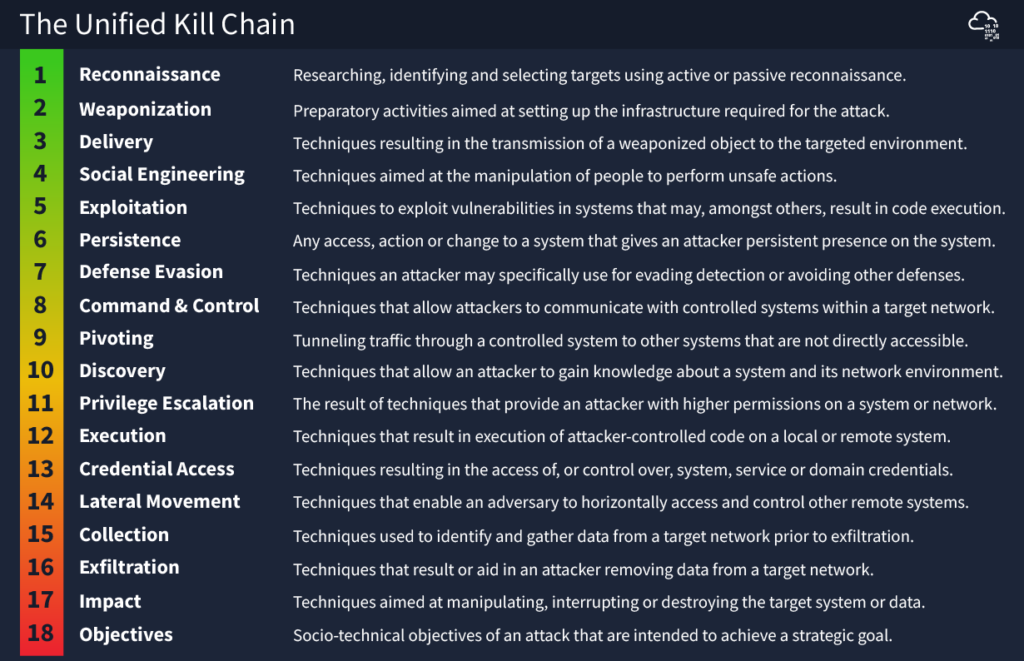
The Unified Kill Chain incorporates both internal and external attack vectors, expanding on the ideas of previous models. It provides a more thorough understanding of the complete attack lifecycle by combining the Cyber Kill Chain and the MITRE ATT&CK methodology.
The UKC encompasses the initial compromise, post-compromise activities, and the actions on objectives in eighteen discrete phases. This makes it possible for defenders to better predict, identify, and neutralize attackers.
// 03 The 18 Phases of the Unified Kill Chain
Initial Access Phases (External Attack Vector)
- Reconnaissance
Attackers gather information about the target’s infrastructure, employees, or systems. Techniques include scanning public networks, footprinting, and social engineering. - Weaponization
Based on the intelligence gathered, attackers create a malicious payload (such as malware, ransomware, or an exploit) to compromise the target. - Delivery
The payload is delivered to the target. Common methods include spear phishing emails, malicious attachments, or exploiting vulnerabilities in software or web services. - Exploitation
The attacker uses a vulnerability to execute the malicious payload. This could be through code execution on a vulnerable application or exploiting an OS-level vulnerability. - Installation
Once the exploit is successful, attackers install malicious software, backdoors, or tools for persistence. - Command and Control (C2)
Attackers establish communication channels with the compromised system to issue commands and control the attack.
Post-Compromise Phases (Internal Attack Vector)
- Privilege Escalation
Attackers elevate their privileges on the compromised system, allowing them to access sensitive resources. - Defense Evasion
To avoid detection, attackers use tactics like obfuscating files, disabling security software, or manipulating logs. - Credential Access
Attackers attempt to harvest credentials (passwords, tokens) from compromised systems to facilitate further access. - Discovery
Attackers map out the internal network, identifying additional targets, configurations, or vulnerabilities. - Lateral Movement
After gaining a foothold, attackers move laterally within the network to compromise other systems or access sensitive data. - Collection
Information of interest, such as intellectual property, customer data, or credentials, is gathered and staged for exfiltration.
Actions on Objectives
- Exfiltration
The stolen data is transferred to an external server controlled by the attacker. - Impact
The final objective is achieved—whether it’s data theft, sabotage, or ransomware deployment.
Additional Phases for Internal Threats
- Persistence
Attackers ensure long-term access to the system, often by installing additional malware or creating hidden user accounts. - Execution
Running malicious scripts or executables to further the attack, such as launching ransomware or performing destructive actions. - Data Manipulation
Attackers modify, corrupt, or manipulate data for financial or operational damage. - Data Destruction
In some cases, attackers will destroy data to disrupt operations or cover their tracks, leading to operational chaos.
// 04 How Previous Models Are Extended by the Unified Kill Chain
Because it integrates external and internal viewpoints, the Unified Kill Chain offers a comprehensive understanding of the assault lifecycle, making it unique.
This sets it apart from models like the MITRE ATT&CK, which stresses tactics and procedures without necessarily following a linear assault path, or the Cyber Kill Chain, which focuses mostly on external attacks.
Combining the two models, the UKC aids security teams in comprehending:
the entire range of an assault, including post-compromise activities and initial access.
the attack methods and strategies that correspond to particular phases.
When and how to use defense mechanisms to stop, identify, and address threats at every turn.
// 05 Using the Integrated Kill Chain in Defensive Strategies
Once the 18 steps are well understood, security professionals can concentrate on a few crucial tactics to lessen threats:
Early Detection: Full-blown breaches can be avoided by thwarting attacks during their reconnaissance, delivery, and exploitation phases.
Monitoring Lateral Movement: One way to identify when attackers are moving laterally is to keep an eye out for odd activity occurring between internal systems.
Threat Intelligence: Early warning indicators can be obtained by analyzing intelligence streams to comprehend the tactics of attackers.
Incident Response: Teams can quickly isolate compromised systems and eliminate threats with the use of a well-structured incident response plan that makes use of the UKC.
// 06 Why the Unified Kill Chain is Critical for Modern Cybersecurity
Modern attacks are so complicated that a more sophisticated and all-encompassing strategy is needed. The Unified Kill Chain offers a more comprehensive perspective of attacks, addressing the drawbacks of previous models.
Security teams can foresee threats more accurately, react more quickly, and build defenses that cover every phase of an assault.
In addition, the UKC’s incorporation of the MITRE ATT&CK framework guarantees that the most recent methods and strategies are taken into consideration, keeping defenders one step ahead of their opponents.