
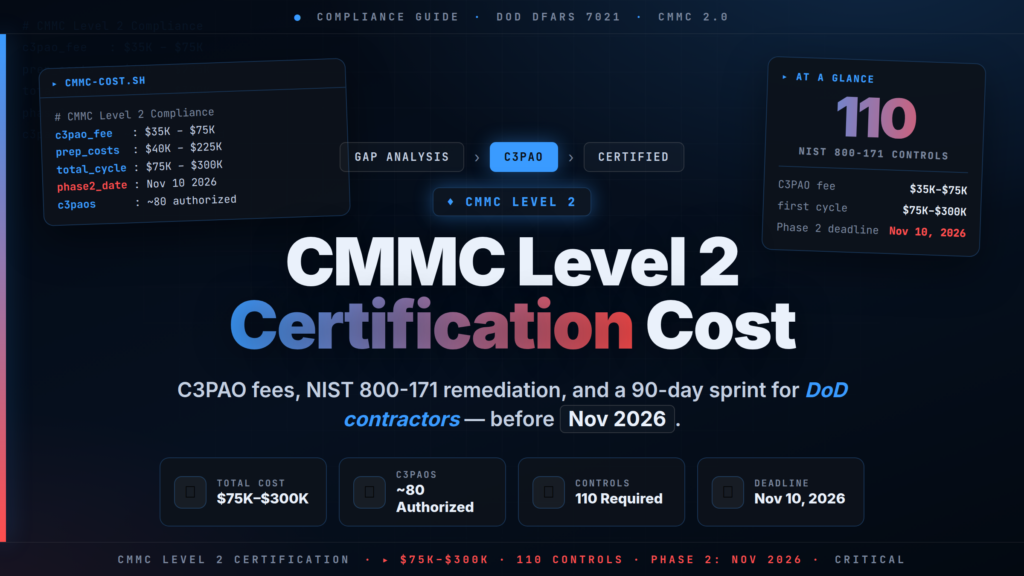
CMMC Level 2 certification cost for most defense contractors runs between $75,000 and $300,000 for the first compliance cycle — and that figure only matters if you are still eligible to bid on DoD contracts when Phase 2 mandatory C3PAO (Certified Third-Party Assessment Organization) assessments take effect on November 10, 2026. With roughly 80 authorized C3PAOs serving 80,000 contractors and assessor wait times already stretching past 12 months in several regions, the procurement problem is as urgent as the technical one.
This guide covers exactly what Level 2 certification requires, what it costs broken down by component, how to select and book a C3PAO before capacity disappears, and a structured 90-day remediation sprint to move from gap analysis to certification-ready.
// 01 Where CMMC 2.0 Enforcement Stands in 2026
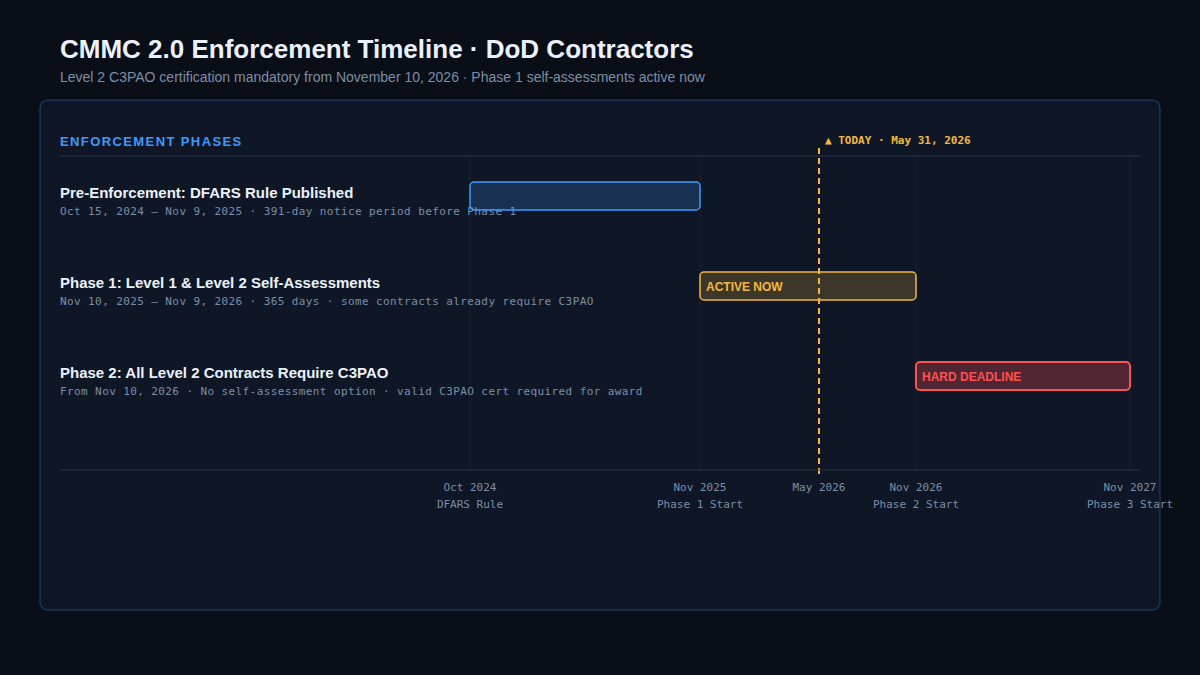
CMMC 2.0 (Cybersecurity Maturity Model Certification 2.0 — the DoD's mandatory cybersecurity certification program for defense contractors) is fully in force. The 48 CFR final rule updated DFARS (Defense Federal Acquisition Regulation Supplement — the procurement rules governing all DoD contracts) on September 11, 2025, with CMMC clause DFARS 252.204-7021 going live 60 days later on November 10, 2025.
Three enforcement phases structure the rollout:
Phase 1 (November 10, 2025 – November 9, 2026): Contracts involving FCI (Federal Contract Information — any information provided by or generated for the government under a contract that is not intended for public release) require Level 1 self-assessments. Contracts involving less sensitive CUI (Controlled Unclassified Information — a broad category of sensitive but unclassified government data defined under 32 CFR Part 2002, including export-controlled technical data, law enforcement sensitive information, and defense procurement data) may use Level 2 self-assessments at the contracting officer's discretion. Some solicitations are already requiring C3PAO-assessed Level 2 certification even during Phase 1.
Phase 2 (November 10, 2026 onward): C3PAO-conducted third-party assessments become mandatory for all new and renewing contracts requiring CMMC Level 2 certification. Self-assessments are no longer accepted. This is the hard deadline: if your organization does not hold a valid C3PAO certification by this date, you cannot be awarded covered contracts.
Phase 3 (November 10, 2027 onward): Level 3 certification — conducted by DIBCAC (the Defense Industrial Base Cybersecurity Assessment Center, a DoD-operated body) — is required for contractors on programs involving the most sensitive CUI. This affects an estimated subset of fewer than 1,000 programs.
The average enterprise CMMC readiness effort takes 6–12 months end-to-end. Starting today leaves five months before Phase 2 enforcement — achievable, but only with immediate action.
// 02 What CMMC 2.0 Level 2 Requires: 110 NIST 800-171 Controls
CMMC Level 2 maps directly to NIST SP 800-171 Revision 3 (the National Institute of Standards and Technology's framework for protecting CUI in non-federal systems). The framework covers 110 security requirements across 14 control families:
| Domain | Controls | Focus Area |
|---|---|---|
| Access Control (AC) | 22 | User permissions, remote access, least privilege |
| Audit & Accountability (AU) | 9 | Log retention, audit trail, event review |
| Configuration Management (CM) | 9 | Baseline configs, change control, software inventory |
| Identification & Authentication (IA) | 11 | MFA, password policies, credential management |
| Incident Response (IR) | 3 | IR capability, incident handling, testing |
| Maintenance (MA) | 6 | Controlled maintenance, remote diagnostic protection |
| Media Protection (MP) | 9 | CUI sanitization, transport controls, media disposal |
| Personnel Security (PS) | 2 | Screening, termination/transfer procedures |
| Physical Protection (PE) | 6 | Physical access controls, visitor management |
| Risk Assessment (RA) | 3 | Risk assessments, vulnerability scanning |
| Security Assessment (CA) | 4 | POA&M management, security assessments |
| System & Comm. Protection (SC) | 16 | Network segmentation, encrypted comms, boundary protection |
| System & Info. Integrity (SI) | 7 | Malware protection, security alerts, patching |
| Awareness & Training (AT) | 3 | Security awareness program, role-based training |
Every control is evaluated using the "Examine, Interview, and Test" methodology defined in NIST SP 800-171A — meaning C3PAOs will request documentation, interview personnel, and actively test controls, not accept policy documents alone.
SPRS Scoring: What Determines Your Certification Status
The DoD SPRS (Supplier Performance Risk System) score quantifies your organization's implementation of the 110 controls. The scale runs from 110 (full compliance) downward — unimplemented controls subtract from the total based on a weighted value system defined in the DoD Assessment Methodology.
Two certification outcomes are possible:
- CMMC Level 2 Certified: All 110 controls fully implemented, zero open POA&M items.
- Conditional CMMC Level 2: SPRS score at or above 88 (approximately 80%), with remaining gaps formally documented in a POA&M (Plan of Action and Milestones — a time-bound document listing each unmet control, the responsible party, planned remediation actions, and a completion date). All POA&M items must close within 180 days of receiving Conditional status; a follow-up closeout assessment then verifies completion.
Critical constraint: Approximately 20 "non-deferrable" practices — including multi-factor authentication enforcement, access control for CUI, and incident response capability — cannot be placed on a POA&M. These must be fully implemented before your C3PAO assessment begins, or you will not receive even Conditional status.
// 03 CMMC Level 2 Certification Cost: Full Breakdown
CMMC Level 2 certification cost is not a single line item. It has three components, each with wide variance depending on company size, existing security maturity, and geography.
C3PAO Assessment Fees: $35,000–$75,000+
The C3PAO assessment fee covers the formal, third-party audit. C3PAOs set their own rates — the Cyber AB (CMMC Accreditation Body) does not regulate pricing. Published market rates for 2026:
| Contractor Size | C3PAO Assessment Fee | Typical Assessment Duration |
|---|---|---|
| Small (< 50 employees) | $30,000–$45,000 | 3–5 days |
| Mid-market (50–500 employees) | $45,000–$75,000 | 5–10 days; multiple sites add cost |
| Large (500+ employees) | $75,000–$150,000+ | 10+ days; complex scoping, multiple enclaves |
According to DoD cost modeling, a Level 2 triennial assessment plus two annual affirmations carries an estimated total of $105,000–$118,000 over the three-year certification cycle. Geography matters: West Coast organizations pay up to 54% more than Midwest contractors due to premium labor markets and regional C3PAO capacity constraints.
Preparation Costs: $40,000–$225,000
Preparation — not assessment — is typically the largest cost category. Organizations with immature security programs spend proportionally more:
- Gap assessment and consulting: $10,000–$40,000 for a qualified RPO (CMMC Registered Practitioner Organization — a firm authorized by Cyber AB to help contractors prepare for CMMC, though they cannot perform assessments) to baseline your environment against all 110 controls.
- Technical remediation: $20,000–$150,000. MFA rollout, EDR (Endpoint Detection and Response) deployment, network segmentation to isolate CUI-handling systems, and encrypted communications for all CUI in transit and at rest are the most common high-cost items.
- Documentation — SSP development: $5,000–$20,000. The SSP (System Security Plan — the primary artifact a C3PAO reviews, documenting how each of the 110 controls is implemented, by whom, and with what evidence) must be complete before the assessment clock starts.
- Security awareness training: $3,000–$15,000 for programs meeting the AT control family requirements.
Organizations that have already completed a SOC 2 Type II audit or ISO 27001 certification can typically reuse significant evidence and policy infrastructure, cutting preparation cost by 30–50%.
Total First-Cycle Cost Benchmarks
| Company Profile | Estimated First-Cycle Cost |
|---|---|
| Strong existing security program (SOC 2 / ISO 27001) | $75,000–$120,000 |
| Average security maturity | $138,000–$200,000 |
| Building controls from scratch | $200,000–$300,000+ |
Per IBSSCORP's Level 2 assessment cost analysis and Red River's compliance research, C3PAO assessment fees represent only 18–25% of total investment — preparation dominates the budget.
// 04 C3PAO Selection: How to Find and Book an Assessor
The Capacity Problem
Approximately 80 authorized C3PAOs serve roughly 80,000 DoD contractors requiring Level 2 certification. Fewer than 600 Certified CMMC Assessors (CCAs — the individual assessors who conduct interviews and testing on behalf of a C3PAO) currently hold active authorization from Cyber AB. Industry estimates put demand at 2,000–3,000 CCAs to clear the backlog before Phase 2.
The math creates a serious scheduling constraint: wait times for new C3PAO clients in high-demand regions can already exceed 12–18 months. If you have not initiated contact with a C3PAO, do so this week.
How to Evaluate C3PAOs
All authorized C3PAOs are listed in the Cyber AB Marketplace — the only authoritative DoD-sanctioned registry. Any C3PAO not listed here is not authorized. Use the marketplace as your starting point, then evaluate on these criteria:
- Sector experience. C3PAOs with experience in your defense vertical (aerospace, manufacturing, IT services, logistics) recognize common system configurations and complete assessments faster. Request references from organizations in your industry.
- Assessor availability. Confirm actual CCA assignment — not just firm capacity — before signing a contract. Some C3PAOs carry large client pipelines with limited assessor bench depth, leading to significant scheduling delays.
- Pre-assessment readiness review. Reputable C3PAOs offer a paid pre-assessment (typically $5,000–$15,000) that identifies evidence gaps before the formal clock starts. This investment consistently reduces the risk of findings that delay certification.
- Remote vs. on-site scope. C3PAOs can conduct remote assessments for many controls, but Physical Protection (PE) and Maintenance (MA) controls require on-site visits. Factor travel costs into your assessment budget if your C3PAO is not local.
- Fixed-fee vs. time-and-materials. Fixed-fee engagements provide budget certainty. T&M contracts can balloon when scoping was inaccurate or remediation is discovered mid-assessment.
- First-attempt outcome rate. Ask what percentage of their clients achieve Certified (versus Conditional) status on the first assessment. A high Conditional rate can indicate the C3PAO accepts underprepared clients; that saves you nothing in the long run.
// 05 The 90-Day Remediation Sprint: Step-by-Step
A 90-day sprint is achievable for organizations with existing security infrastructure and specific gaps to close — not for organizations building controls from zero. Here is the structured approach:
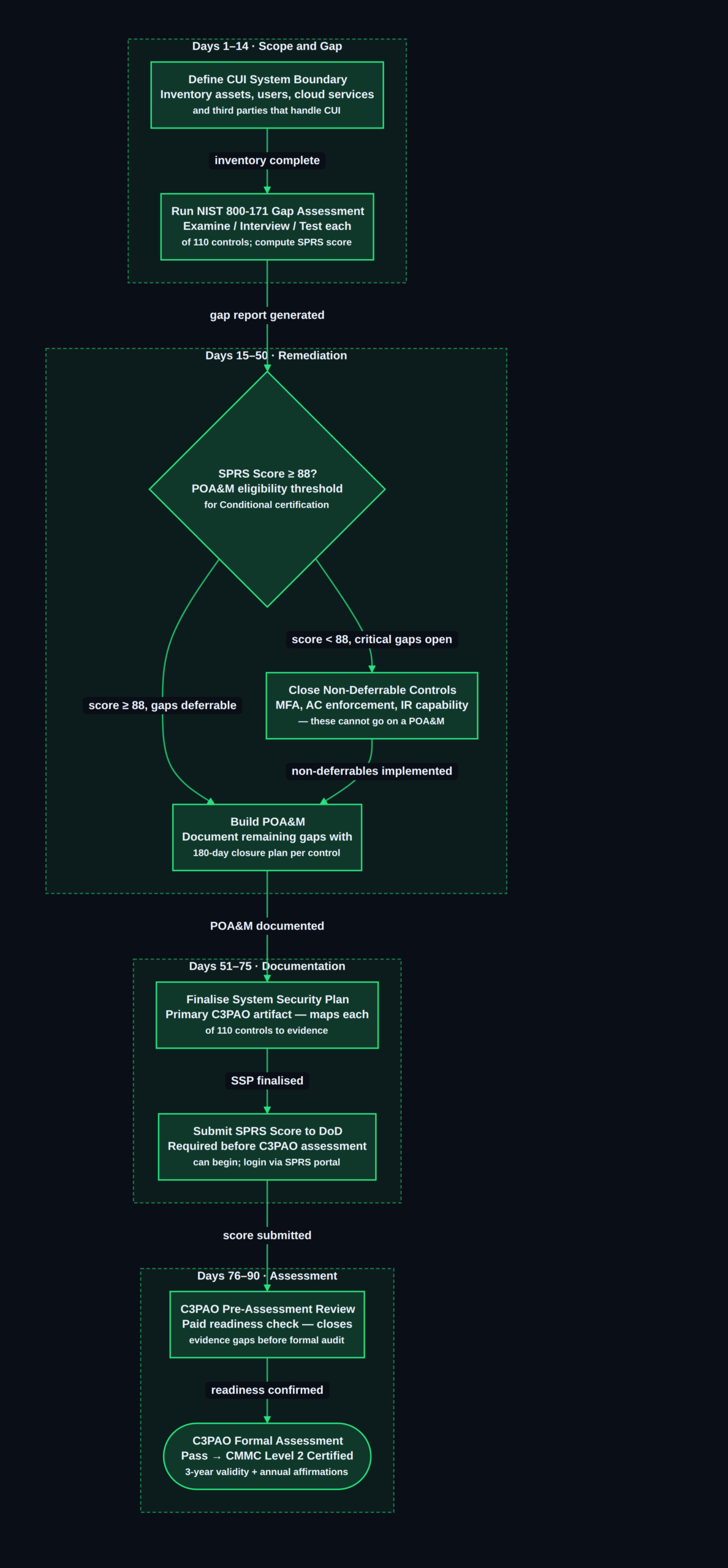
Days 1–14: Scope and Gap
- Define your CUI boundary. Document every system, network segment, cloud service, and third-party provider that creates, processes, stores, or transmits CUI. The boundary determines your assessment scope — and your cost. Enclave segmentation (physically or logically isolating CUI-handling systems from the rest of your network using firewall rules, VLANs, or dedicated hardware) can dramatically reduce scope and assessment fees. A well-scoped CUI enclave covering 5 servers costs far less to assess than an organization-wide assessment covering 200 endpoints.
- Run your baseline gap assessment against all 110 controls. Use the NIST SP 800-171A test procedures for each control — the same procedures your C3PAO will use — to ensure your self-assessment is objective and defensible. Record each control as: Fully Implemented, Partially Implemented, Not Implemented, or Not Applicable. Calculate your preliminary SPRS score. If your score is below 88, identify and segregate the non-deferrable controls requiring immediate attention.
- Book your C3PAO during this window. Do not wait until preparation is complete. Given 12–18 month wait lists in major defense contracting regions, book during days 1–5 and negotiate an assessment date 60–90 days out. You can push the date; you cannot manufacture assessor availability at the last minute.
Days 15–50: Remediation
- Prioritize non-deferrable controls in dependency order. Access Control is the prerequisite for meaningful Audit and Accountability logging — fix AC first. The highest-frequency gaps in DoD contractor environments:
# IA.3.083 — Verify MFA enforcement for all CUI-system accounts (Azure AD / Entra ID)
# Identifies accounts with no MFA registration
Get-MsolUser -All | Where-Object {
    $_.StrongAuthenticationRequirements.Count -eq 0 -and
    $_.BlockCredential -eq $false
} | Select-Object UserPrincipalName, DisplayName | Export-Csv -Path "no-mfa-accounts.csv" -NoTypeInformation
# SC.3.177 — Verify TLS 1.2+ on all CUI-handling web services (Linux/curl check)
# Replace TARGET_HOST with your CUI application hostname
openssl s_client -connect TARGET_HOST:443 -tls1_1 2>&1 | grep -E "Cipher|Protocol|CONNECTED"
# Should fail for TLS 1.1; if it connects, TLS 1.1 is still enabled — disable it
- Enable encrypted storage for all CUI at rest. SC.3.187 (SC.28 in NIST 800-171 Rev 2) requires encryption of CUI at rest. Verify and document:
# Windows — verify BitLocker full-disk encryption status across all volumes
Get-BitLockerVolume | Select-Object MountPoint, EncryptionMethod, ProtectionStatus, EncryptionPercentage |
  Format-Table -AutoSize
# ProtectionStatus must be "On" and EncryptionPercentage must be 100 for CUI-bearing drives
- Implement vulnerability scanning (RA.3.138). Many mid-market contractors lack a formal, documented scanning program. Deploy a tool such as Nessus Essentials, OpenVAS, or a commercial alternative, run an authenticated scan of all in-scope systems, and document remediation of findings rated High or Critical.
Days 51–75: Documentation
- Build or update your System Security Plan. The SSP must cover: system boundary and all CUI-processing components; how each of the 110 controls is implemented (or why it is not applicable); evidence references (screenshots, configuration exports, policies with date stamps); and the POA&M for unimplemented controls. Your C3PAO will spend the majority of day one reviewing the SSP before moving to interviews and technical testing.
- Submit your SPRS score to the DoD portal. Log into SPRS and submit your current self-assessed score under DFARS 252.204-7019. This is a contractual obligation and must be on file before a C3PAO assessment can formally begin. First-time SPRS submission requires a CAGE code and DoD-issued PKI certificate — factor in provisioning lead time if you do not yet have these.
Days 76–90: Assessment Preparation
- Conduct a paid pre-assessment readiness review. The pre-assessment — typically offered by your selected C3PAO or an independent RPO — surfaces evidence gaps that would produce findings during the formal audit: undated screenshots, controls described in the SSP but not demonstrably tested, missing policy sign-off records. Resolving these before the formal audit is far cheaper than remediating findings and scheduling a reassessment.
- Organize your evidence repository by control family. C3PAOs expect to navigate a structured folder structure (one folder per NIST 800-171 domain, named files with the control ID) — not an undifferentiated SharePoint library. Tools like Drata or Vanta automate continuous evidence collection, timestamp artifacts automatically, and map controls to policy documents, reducing pre-assessment evidence prep from days to hours.
// 06 CMMC Level 2 vs Level 3: Key Differences
Most defense contractors will require Level 2. Level 3 applies to a narrow set of programs involving the most sensitive CUI — primarily advanced weapons systems development and programs with elevated nation-state adversary targeting.
| Dimension | CMMC Level 2 | CMMC Level 3 |
|---|---|---|
| Control framework | 110 NIST SP 800-171 r3 requirements | 110 NIST 800-171 + 24 NIST 800-172 requirements |
| Who assesses | Authorized C3PAO | DIBCAC (DoD-operated) |
| Self-assessment option | Yes, for some Phase 1 contracts | No — DIBCAC only |
| Estimated first-cycle cost | $75K–$300K | $200K–$500K+ |
| Phase 2 / Phase 3 enforcement | November 10, 2026 | November 10, 2027 |
| Number of contractors affected | ~80,000 | < 1,000 programs |
NIST SP 800-172 (the 24 additional controls required for Level 3) focuses on enhanced threat-resistant requirements including cyber deception technologies, advanced supply chain risk management, and security orchestration capabilities — well beyond the baseline Level 2 program.
If your contracts reference DFARS 252.204-7021 without explicitly specifying Level 3 requirements, assume Level 2 applies. When in doubt, review the contract's DD Form 254 (DoD Contract Security Classification Specification) or ask your contracting officer directly.
// 07 After Certification: Annual Affirmations and POA&M Closeout
CMMC Level 2 certification carries a three-year validity period from the assessment date. Two ongoing compliance obligations apply throughout the cycle:
Annual affirmations. A senior company official — typically the CISO, CEO, or authorized representative — must formally affirm CMMC compliance annually via SPRS. This is a legal attestation under the False Claims Act (31 U.S.C. § 3729 — a federal statute that imposes treble damages and civil penalties on contractors that submit false claims to the government, including false compliance attestations). A DOJ enforcement action based on a knowingly false CMMC affirmation would expose the organization to liability far exceeding certification costs.
POA&M closeout assessment. Organizations that received Conditional CMMC status must close all POA&M items within 180 days. A follow-up closeout assessment — conducted by the same C3PAO and typically costing $10,000–$25,000 — verifies that every deferred control is now fully implemented. Plan this into your budget from the start; the 180-day clock begins at the date of initial certification, not at your convenience.
Continuous SPRS maintenance. Any significant system change that extends your CUI boundary — a cloud migration, acquisition, new software deployment — should trigger a reassessment of affected controls and an updated SPRS score submission. A gap discovered during an annual affirmation that was not previously documented creates contractual and legal exposure.
For the federal logging infrastructure that feeds your AU (Audit and Accountability) controls — one of the most evidence-intensive families during a C3PAO assessment — see Federal Cybersecurity Logging Requirements 2026: OMB M-26-14 SIEM Guide.
// 08 What CMMC Certification Means for Subcontractors
Prime contractors are required under DFARS 252.204-7021 to flow CMMC requirements down to any subcontractor that will handle CUI under the contract. This means a sub receiving CUI from a prime must hold the same CMMC Level 2 certification as the prime — at the sub's own cost and on the same Phase 2 timeline.
For small subcontractors (fewer than 50 employees) where CMMC Level 2 certification cost of $75,000–$120,000 represents a substantial share of annual DoD revenue, three strategic options exist:
- CUI enclave hosted by a CMMC-scoped MSP. Contract with a managed security service provider operating a FedRAMP-authorized or CMMC-compliant hosting environment for CUI. The provider's controls reduce your in-scope systems, cutting both technical remediation effort and assessment scope. You still need your own SSP and must assess the controls not covered by the provider.
- Teaming arrangements that exclude CUI handling. Negotiate subcontract scope so your work involves only non-CUI deliverables. This requires careful legal review of the prime's flow-down clauses, but eliminates the CMMC requirement entirely for that contract.
- Shared RPO support. Multiple small subs can collectively retain an RPO for gap assessment and SSP development, spreading consulting costs. Each company still requires its own C3PAO assessment, but preparation costs can be reduced significantly with shared documentation frameworks.
// 09 Conclusion
CMMC Level 2 certification cost is substantial, the timeline is non-negotiable, and the capacity constraint among authorized C3PAOs means delay compounds the problem. The Phase 2 enforcement date of November 10, 2026 is a hard deadline — contracts will not be awarded to organizations without a valid certification. Book a C3PAO assessment this week, run your NIST 800-171 gap assessment immediately, and treat non-deferrable controls like MFA and access control enforcement as day-one priorities.
For organizations that have previously completed a SOC 2 Type II audit, the control families overlap substantially — read How to Pass SOC 2 Type II in 90 Days: 2026 Cost Breakdown for a sprint methodology that transfers directly to CMMC preparation.
See our guide on automating compliance evidence collection to reduce the SSP documentation burden and ensure your annual affirmations are supportable with timestamped, mapped evidence rather than manual screenshots taken the week before the audit.
For any query contact us at contact@cipherssecurity.com