
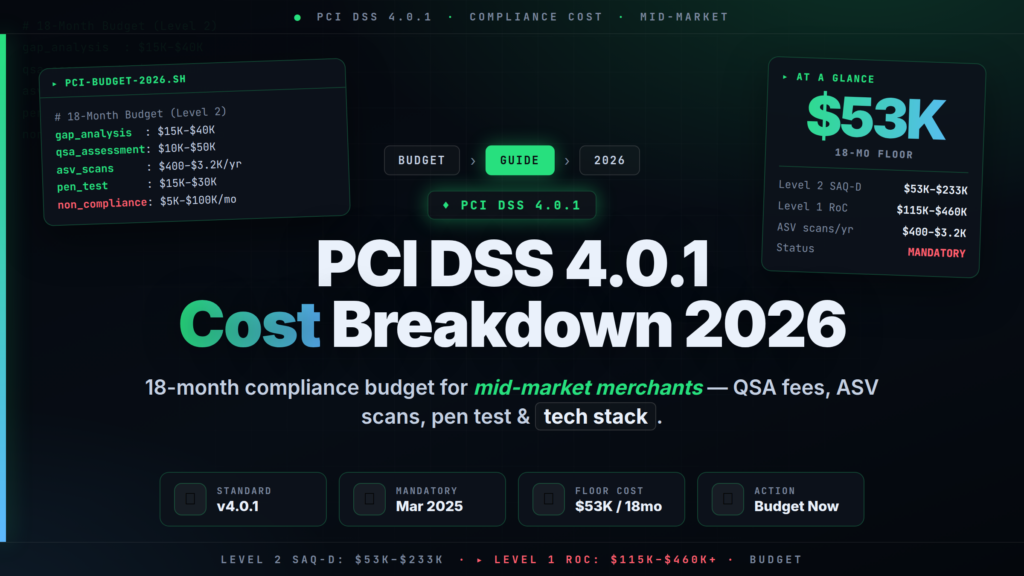
PCI DSS 4.0.1 compliance cost is the critical budget question for every payment-processing organisation right now. Since March 31, 2025, every requirement in PCI DSS version 4.0.1 (Payment Card Industry Data Security Standard — the global ruleset governing how organisations store, process, and transmit cardholder data) is fully mandatory and enforceable. For mid-market merchants processing one million to six million card transactions annually, building an honest 18-month compliance budget means accounting for QSA assessment fees, quarterly ASV scans, annual penetration testing, technology stack upgrades driven by version 4.0's new controls, and the policy and documentation overhead the standard now demands as a continuous practice rather than an annual event. This guide maps every line item with current market pricing sourced from QSA firms and compliance vendors operating in 2026.
// 01 PCI DSS 4.0.1 Compliance Cost: How Merchant Level Shapes Your Spend
Before any dollar figures land, you need to know which tier of compliance you occupy. The Payment Card Industry classifies merchants into four levels based on annual card transaction volume across Visa, Mastercard, American Express, and Discover:
| Merchant Level | Annual Transaction Volume | Primary Validation Method |
|---|---|---|
| Level 1 | More than 6 million Visa or Mastercard transactions | Report on Compliance (RoC) — mandatory on-site QSA audit |
| Level 2 | 1 million to 6 million transactions | SAQ or voluntary RoC |
| Level 3 | 20,000 to 1 million e-commerce transactions | SAQ (Self-Assessment Questionnaire) |
| Level 4 | Fewer than 20,000 e-commerce, under 1 million total | SAQ |
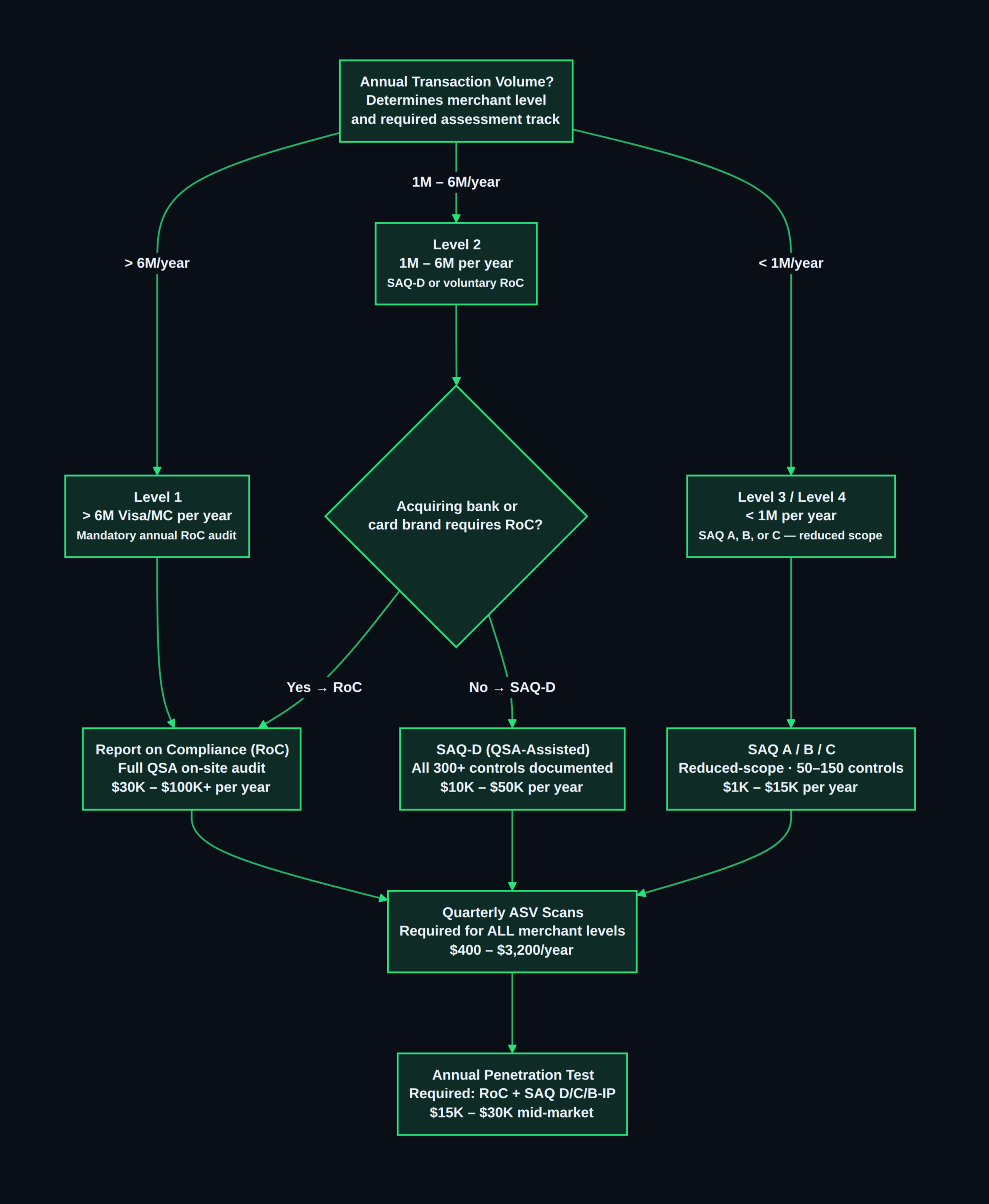
Mid-market merchants typically sit at Level 2. That classification matters enormously: a Level 2 merchant can choose to self-assess using a SAQ-D (Self-Assessment Questionnaire type D — the most comprehensive SAQ form, covering all 300+ PCI DSS controls), but their acquiring bank or card brand may push them toward a full RoC (Report on Compliance — a formal audit document prepared by a QSA, or Qualified Security Assessor, after an on-site assessment). That fork in the road changes total spend by $20,000 to $90,000 per assessment cycle.
The diagram below maps the decision path from merchant level to assessment type and flags the cost bracket each route carries.
// 02 QSA Assessment Fees: The Biggest Single Line Item
A QSA engagement typically runs in two phases.
Phase 1: Gap assessment or readiness review. Before the formal certification audit, most mid-market merchants commission a gap analysis. A QSA reviews current controls against PCI DSS 4.0.1's requirements and produces a prioritised remediation roadmap. For mid-market environments — hybrid cloud, 50 to 200 in-scope systems, multiple payment channels — expect to pay $15,000 to $40,000 for a thorough readiness engagement. Smaller, simpler environments can bring this down to $8,000 to $15,000.
Phase 2: The certification assessment.
For a Level 2 merchant with a QSA-assisted SAQ-D, budget $10,000 to $50,000. A QSA walks through all 300+ controls with your team, validates evidence, and signs the completed SAQ. The lower end applies to clean, well-documented environments; the upper end reflects complex CDEs (Cardholder Data Environments — the set of systems, networks, people, and processes that store, process, or transmit payment card data) with legacy infrastructure, multiple data centres, or e-commerce platforms carrying significant v4.0 gaps.
For a Level 1 RoC, budget $30,000 to $100,000 per annual cycle. A QSA firm dispatches assessors on-site, reviews all controls against the full PCI DSS requirements, and produces a formal Report on Compliance. Some enterprise engagements — multiple locations, international scope, complex cloud and containerised environments — exceed $200,000 per cycle.
Self-completed SAQ without QSA involvement costs $0 to $5,000 for tooling and templates. This is realistic only for Level 3 and Level 4 merchants with genuinely simple, reduced-scope CDEs, not for mid-market organisations.
// 03 ASV Scanning: The Quarterly Cost Most Merchants Underestimate
An ASV scan (Approved Scanning Vendor scan — an automated external vulnerability scan performed by a vendor certified by the PCI Security Standards Council) is required every 90 days for all merchant levels under PCI DSS Requirement 11.3.2. Every external-facing IP address and domain within CDE scope must achieve a passing scan result each quarter.
2026 pricing by environment size:
| Environment | IPs in Scope | Estimated Annual Cost |
|---|---|---|
| Small (<10 IPs) | 1–10 | $400 – $1,200 |
| Mid-market (10–50 IPs) | 10–50 | $1,200 – $3,200 |
| Enterprise (50–200 IPs) | 50–200 | $5,000 – $15,000 |
Most mid-market merchants land in the $1,200 to $3,200 annual range. Per-IP pricing across vendors such as Qualys, Tenable, SecurityMetrics, and Coalfire runs $80 to $200 per IP per year. Many PCI-focused ASV vendors bundle quarterly scans inside broader compliance platform subscriptions.
The hidden cost: a single failing scan result that requires remediation and a rescan adds $200 to $800 per vendor for the rescan fee, plus one to three weeks of engineering remediation time. Budget for two rescans per year if your external attack surface includes legacy web applications or internet-exposed management interfaces.
// 04 Annual Penetration Testing Requirements Under PCI DSS 4.0.1
PCI DSS 4.0.1 Requirements 11.4.3 and 11.4.4 mandate annual penetration tests — independent offensive security assessments of your external and internal CDE boundaries conducted by a qualified tester. Requirement 11.4.5 adds a segmentation test: a dedicated exercise to verify that network segmentation controls actually isolate the CDE from out-of-scope systems. If CDE segmentation boundaries change during the year, a follow-up segmentation test is required within six months of the change.
Version 4.0 added a further wrinkle: penetration tests must now validate the payment-page security controls introduced in Requirements 6.4.3 and 11.6.1 (covered in the technology section below). Some QSA firms scope this as a separate line item of $2,000 to $5,000.
Mid-market penetration test pricing (2026):
| Scope | Typical Cost |
|---|---|
| External boundary test only (SMB) | $5,000 – $15,000 |
| External + internal + web apps (mid-market: 50–200 IPs, 3–5 apps) | $15,000 – $30,000 |
| External + internal + segmentation test | $20,000 – $40,000 |
| Enterprise (200+ IPs, multi-cloud, containers, APIs) | $30,000 – $50,000+ |
An 18-month compliance cycle requires two annual penetration tests. Build $30,000 to $60,000 into your mid-market budget for this line item alone.
// 05 Technology Stack: What PCI DSS 4.0.1's New Requirements Actually Cost
The 51 future-dated requirements that became mandatory in March 2025 introduced real technology spend for most mid-market merchants. Below are the highest-cost new mandates and their implementation ballparks.
Requirements 6.4.3 and 11.6.1 — Payment Page Script Integrity and Tamper Detection.
Every script loaded on a payment page must be explicitly authorised, have its integrity validated, and be monitored continuously for unauthorised modification. This is the PCI Council's direct response to Magecart-style attacks (JavaScript card-skimming campaigns in which adversaries inject malicious code into checkout pages to silently exfiltrate payment card numbers as customers type them). Implementation options:
- Dedicated client-side integrity platforms (Jscrambler, Feroot, DataDome): $5,000 to $20,000 per year depending on transaction volume and page count
- WAF with page integrity monitoring (Cloudflare Page Shield, Akamai Page Integrity Manager, Imperva): $3,000 to $10,000 per year as an add-on to an existing WAF subscription
- Self-built CSP and SRI controls (Content Security Policy — an HTTP response header restricting which scripts a browser will execute; Subresource Integrity — a browser mechanism that verifies third-party scripts match a known cryptographic hash): near-zero licence cost, but 40 to 80 hours of developer implementation and ongoing maintenance work
Requirement 8.4.2 — MFA for All CDE Access.
PCI DSS v3.2.1 required MFA (Multi-Factor Authentication — a login process requiring two independent verification factors, such as a password plus a one-time push notification) only for remote and administrative access. Version 4.0 expanded this to all non-console access into the CDE, including standard user accounts. Implementation costs:
- Extending an existing enterprise IdP (Okta, Microsoft Entra ID, Duo Security): $3,000 to $8,000 for configuration, policy enforcement, and enrolment of all CDE-accessing users at mid-market scale
- Greenfield MFA deployment: $4,000 to $15,000 including annual licences and integration engineering
Scope reduction technologies: P2PE and tokenization.
These are not new in 4.0.1, but the version 4.0 controls create a stronger economic case for investing in scope reduction upfront, since every system removed from CDE scope is a system that requires no ongoing compliance controls, no PCI evidence collection, and no inclusion in pen test scope:
| Technology | Implementation Cost | Scope Impact |
|---|---|---|
| Hosted checkout redirect | ~$8,000 | Removes web application layer from CDE scope |
| Network tokenization | ~$18,000 | Removes stored PANs from database scope |
| P2PE terminal validation | ~$24,000 | Reduces in-store CDE to near-zero |
| Network segmentation redesign | ~$32,000 | Required regardless; limits CDE blast radius |
P2PE (Point-to-Point Encryption — a PCI-validated solution that encrypts card data at the physical terminal before it can be read by any other system) is cost-effective for merchants with multiple physical retail locations. For pure e-commerce merchants, a hosted checkout redirect paired with tokenization typically delivers the highest ROI.
Requirement 12.6 — Security Awareness Training.
Version 4.0 added specificity to the longstanding training requirement: phishing simulations, role-based curricula for personnel with CDE access, and documented annual attestation. Platforms such as KnowBe4, Proofpoint Security Awareness Training, and Cofense: $500 to $5,000 per year at mid-market headcount.
// 06 The 18-Month Budget Breakdown
The timeline below maps every major spend category across an 18-month cycle for a mid-market Level 2 merchant beginning a compliance programme in June 2026.
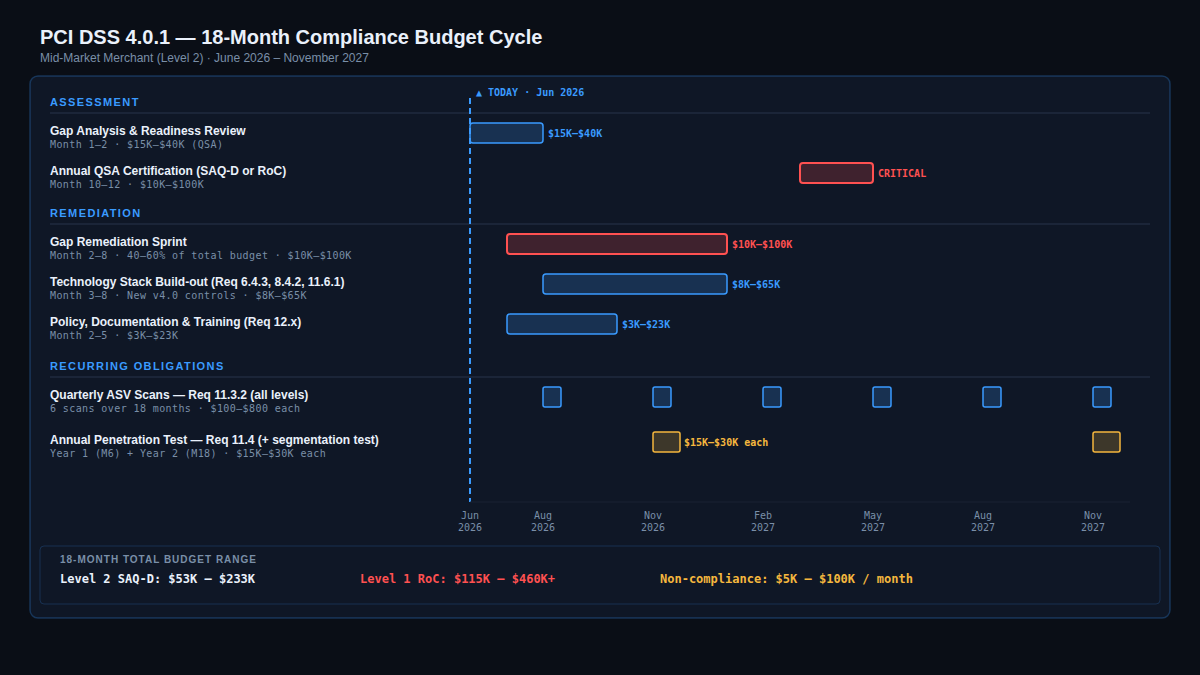
Full 18-month cost breakdown by merchant assessment path:
| Cost Category | Level 2 SAQ-D (QSA-Assisted) | Level 1 RoC |
|---|---|---|
| Readiness / gap assessment | $15,000 – $40,000 | $20,000 – $50,000 |
| Certification assessment | $10,000 – $50,000 | $30,000 – $100,000+ |
| ASV scanning (18 months, 6 quarters) | $1,800 – $6,400 | $7,500 – $30,000 |
| Penetration testing (2× over 18 months) | $30,000 – $60,000 | $40,000 – $100,000 |
| Technology stack (new v4.0 controls) | $8,000 – $65,000 | $15,000 – $80,000 |
| Gap remediation | $10,000 – $50,000 | $20,000 – $100,000 |
| Policy, documentation, training | $3,000 – $23,000 | $5,000 – $30,000 |
| 18-Month Total | $53,000 – $233,000 | $115,000 – $460,000+ |
The spread within each band is wide because remediation dominates the budget — and remediation depends on how far your current environment diverges from the standard. Organisations maintaining continuous security programs consistently land in the lower third of each range. Those catching up from a v3.2.1 baseline with unresolved gaps in the 51 new v4.0 requirements will land in the upper half.
// 07 SAQ-D vs Level 1 RoC: The Fork in the Road
The single largest cost lever for a Level 2 merchant is whether you self-assess with a QSA-assisted SAQ-D or commission a full RoC.
When SAQ-D is sufficient:
- Your acquiring bank permits Level 2 self-assessment (most do, unless you have had a prior breach or your bank's risk programme escalates the requirement)
- Your card brand agreement does not explicitly mandate a RoC
- You are not sub-processing payment data on behalf of Level 1 service providers that contractually require RoC validation from their merchant clients
When you will likely need a RoC:
- Your acquiring bank or card brand requires it — increasingly common for Level 2 merchants above three million annual transactions
- You have experienced a confirmed cardholder data breach within the previous 36 months
- You are a service provider handling cardholder data for other merchants (service providers operate under separate PCI DSS requirements with higher scrutiny thresholds)
- Your cyber liability insurer or a major enterprise retail partner contractually requires RoC evidence as a condition of partnership
The practical cost difference is $20,000 to $90,000 per assessment cycle. Engage your acquiring bank's risk team before selecting a QSA engagement structure — a single conversation can clarify which path applies to your merchant agreement.
// 08 Reducing Scope to Reduce PCI DSS 4.0.1 Compliance Cost
The most effective cost-reduction strategy in PCI DSS 4.0.1 is shrinking the CDE before the assessment begins. Every system removed from CDE scope requires no PCI controls, no evidence, and no inclusion in penetration test scope — which compounds savings across every recurring cost category.
Hosted payment page or iFrame checkout. If payment card data never touches your web servers because the checkout page is hosted entirely by a PCI-compliant payment processor, your e-commerce environment typically drops to SAQ A (the lowest-complexity SAQ form, covering roughly 50 controls versus SAQ-D's 300+). For a pure e-commerce Level 2 merchant, this is the highest-ROI single investment in scope reduction. Implementation: approximately $8,000. Annualised savings: $20,000 to $80,000 in reduced assessment and remediation cost.
Tokenization of stored payment data. If your databases store tokens (surrogate values held in a PCI-compliant processor's vault rather than raw PANs — Primary Account Numbers, the 16-digit card numbers) rather than live card numbers, those databases exit CDE scope entirely. Implementation: approximately $18,000. Payback period: first assessment cycle.
P2PE certification for physical retail. P2PE (Point-to-Point Encryption — a PCI-validated solution that encrypts card data at the physical payment terminal before any downstream system can read it) removes POS terminals and the supporting in-store network from CDE scope. Cost-effective when you operate three or more physical retail locations. Implementation: approximately $24,000 for terminal validation and deployment.
These investments are documented in detail in our guide to automating compliance evidence collection, which covers how tools like Drata and Vanta can accelerate evidence gathering and reduce QSA billable time during the certification phase.
// 09 The Cost of Non-Compliance
Non-compliance fines levied by acquiring banks range from $5,000 to $100,000 per month, scaled by merchant level and the duration of the violation. A mid-market Level 2 merchant that misses a quarterly ASV scan and falls out of compliance for 90 days could face $15,000 to $45,000 in monthly fines before any breach occurs.
In the event of an actual cardholder data breach:
- Forensic investigation (PFI — PCI Forensic Investigator — required): $15,000 to $100,000+
- Card replacement costs: card brands pass replacement fees to the merchant through the acquiring bank, estimated at $3 to $10 per compromised card number
- Total breach cost for Level 1–2 merchants: $1 million to $50 million across forensics, card replacement, regulatory fines, legal fees, and reputational damage, per enterprise breach cost benchmarks
The business case for compliance investment is straightforward: an 18-month SAQ-D compliance budget of $53,000 to $233,000 compares favourably against a breach cost floor of $1 million. Even the upper bound of the RoC path — $460,000 — is a fraction of the average breach impact for merchants at this volume tier.
For organisations that also maintain SOC 2 programs, the control overlap between PCI DSS and SOC 2 Type II requirements is significant: network monitoring, access control, encryption, and incident response controls satisfy requirements in both frameworks. Dual-framework programmes typically reduce combined assessment cost by 20 to 35 percent compared to running each independently. Our comparison of compliance automation platforms Drata, Vanta, and Tugboat Logic covers which tools best support PCI DSS evidence collection alongside SOC 2.
// 10 Conclusion
PCI DSS 4.0.1 compliance cost for a mid-market Level 2 merchant runs $53,000 to $233,000 over 18 months under a QSA-assisted SAQ-D path, and $115,000 to $460,000+ under a Level 1 RoC. The most important lever you control is CDE scope: implement hosted checkout, tokenize stored card data, and resolve the 51 new v4.0 requirements — especially Requirements 6.4.3, 8.4.2, and 11.6.1 — before your QSA engagement begins, and you will land in the lower half of those ranges. Start with a formal gap assessment; the roadmap it produces is worth far more than its cost.
See our guide on how to automate compliance evidence collection with Drata and Vanta →
For any query contact us at contact@cipherssecurity.com