
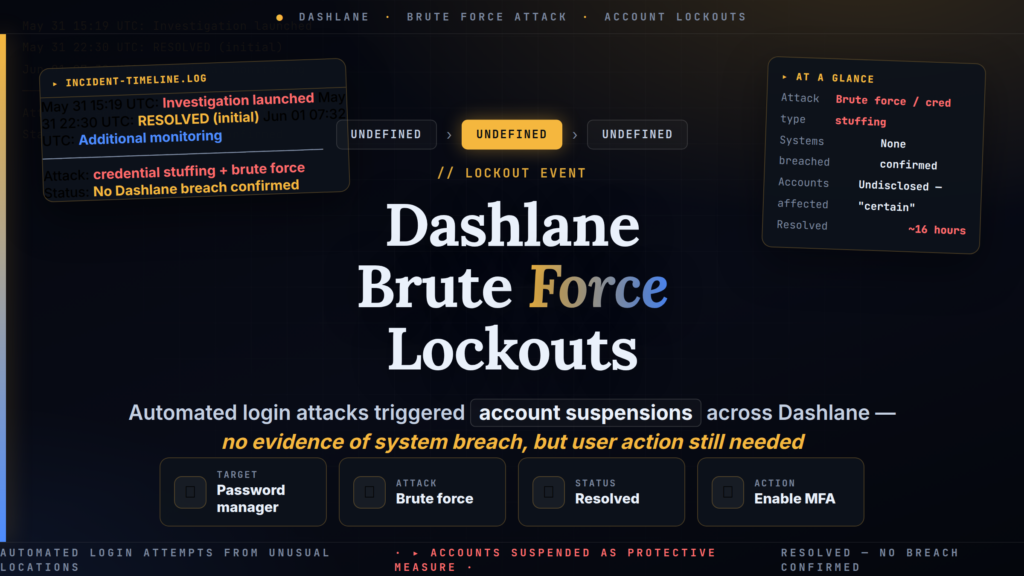
Dashlane (a popular cloud-based password manager used by individuals and enterprises to securely store login credentials, credit card numbers, and other sensitive data) suspended multiple user accounts between May 31 and June 1, 2026 following automated brute force attacks (systematic attempts to gain unauthorized access by trying large numbers of password combinations in rapid succession). Affected users found themselves locked out of their accounts after Dashlane's security systems detected login attempts originating from unfamiliar geographic locations and devices. Dashlane confirmed no breach of its own systems and stated that no password data was exposed, but the incident highlights the particular sensitivity of credential stuffing attacks targeting password managers.
// 01 Dashlane Brute Force: What Happened
Dashlane users reported receiving security alerts about login attempts from unusual locations, followed by account suspension notices. The incident timeline ran as follows:
- May 31, 15:19 UTC — Dashlane launched an investigation into anomalous authentication activity.
- May 31, 22:30 UTC — Dashlane marked the issue as resolved after implementing protective account suspensions.
- June 1, 07:32 UTC — Dashlane confirmed the resolution with additional monitoring in place.
The attack methodology was standard brute force and credential stuffing (a variant of brute force that uses username/password combinations harvested from previous data breaches rather than randomly generated guesses — more efficient because many users reuse passwords across services). Attackers attempted sequential or breach-derived password combinations against Dashlane account login endpoints from various IP addresses.
Dashlane's automated security systems detected the anomalous pattern — high-volume login attempts from unfamiliar locations — and suspended the targeted accounts as a protective measure rather than allowing authentication to continue until lockout thresholds were reached. This proactive suspension is the intended behavior of modern authentication security systems but resulted in legitimate users being unable to access their password vaults during the suspension period.
// 02 Why Password Managers Are High-Value Targets
Brute force and credential stuffing attacks against password managers are operationally rational from an attacker's perspective. A successful compromise of a password manager account does not yield a single stolen credential — it yields every credential the victim stores in their vault. For users who rely on their password manager for hundreds of accounts including banking, email, and corporate systems, a single compromised password manager account represents a complete credential compromise.
The attack dynamic creates a compounding risk: users who reuse their master password (the single password that unlocks a password manager account) across other services are particularly vulnerable to credential stuffing, because breaches of those other services expose the exact credential needed to access the password manager. This is the precise scenario password managers are designed to prevent for other accounts — but the password manager's own master password falls outside the scope of what the tool can protect.
Password managers also typically hold authentication tokens for connected services, passkeys, secure notes containing sensitive data, and payment card details — broadening the potential impact of a successful account breach beyond credential theft alone.
// 03 Who Was Affected
Dashlane has not disclosed the number of accounts targeted or suspended. The company characterized the affected accounts as "certain" and emphasized that the suspensions were intentional protective measures. Some users reported continued difficulty accessing their accounts and difficulty reaching Dashlane support in the immediate aftermath of the incident, even after the company marked the issue resolved.
Dashlane's core vault data — the encrypted database containing stored passwords — was not accessed. The attack targeted the authentication layer, not the encrypted storage layer. Dashlane uses zero-knowledge architecture (a design where the service provider cannot decrypt user vault data because the encryption key is derived from the user's master password, which Dashlane never receives in plaintext) for vault data storage, which means that authentication bypass alone is insufficient to access stored passwords without the master password.
// 04 What You Should Do Right Now
- Enable multi-factor authentication (MFA) on your Dashlane account. Open Dashlane → Settings → Security → Two-Factor Authentication. MFA requires a second verification step — typically a time-based one-time password (TOTP) from an authenticator app — in addition to the master password. Even if an attacker guesses or steals your master password, MFA prevents account access.
- Use a unique, strong master password. Your Dashlane master password should never be used anywhere else. If you have reused it, change it immediately and also change the passwords for any services where the same credential was used.
- Review recent login activity. Log in to Dashlane and check the account activity log for any login attempts or successful logins from devices or locations you do not recognize.
- Check if your email has appeared in breach databases. Services like Have I Been Pwned track known data breaches by email address. If your email appears in a breach that includes a password you have used for Dashlane, treat your master password as compromised.
- Audit stored credentials for password reuse. Use Dashlane's built-in password health tools to identify any stored accounts where you have reused passwords. Reused passwords should be changed to unique, randomly generated passwords using Dashlane's password generator.
// 05 Background: Understanding the Risk
The Dashlane incident sits within a broader pattern of increasing attacks against identity and credential management infrastructure. Password managers, single sign-on (SSO) providers, and identity platforms represent aggregation points for authentication — compromising one yields disproportionate access. Attackers who historically targeted individual service accounts are increasingly focusing on the aggregation layer.
Credential stuffing campaigns are fueled by the continuous leakage of username/password pairs from breached services. Estimates put the total number of unique compromised credentials in circulation at multiple billions of records. Automated tooling can test large sets of credentials against a target's authentication endpoint at high speed, often distributed across residential proxy networks to avoid IP-based rate limiting.
Modern password managers have implemented defenses against these attacks: rate limiting on authentication attempts, anomaly detection for unusual login patterns, geographic blocking, and mandatory account suspensions when suspicious activity is detected. Dashlane's response — detecting and suspending accounts rather than allowing authentication to proceed to traditional lockout thresholds — demonstrates these controls functioning as designed.
The primary residual risk after an incident of this type is credential stuffing that succeeds before protective systems detect and suspend the account. Dashlane's statement that no accounts were confirmed compromised suggests the detection and suspension mechanisms operated within a sufficiently short window, but some uncertainty remains given the undisclosed scope of affected accounts.
// 06 Conclusion
The Dashlane brute force incident resolved without confirmed account compromises or data exposure, but it underscores that password managers are high-value targets that require the same security hygiene applied to the accounts they protect. Dashlane users should enable MFA immediately, confirm their master password is unique and not reused elsewhere, and review recent account activity — the combination of a unique master password and MFA makes brute force attacks against the authentication layer effectively infeasible.
For any query contact us at contact@cipherssecurity.com