
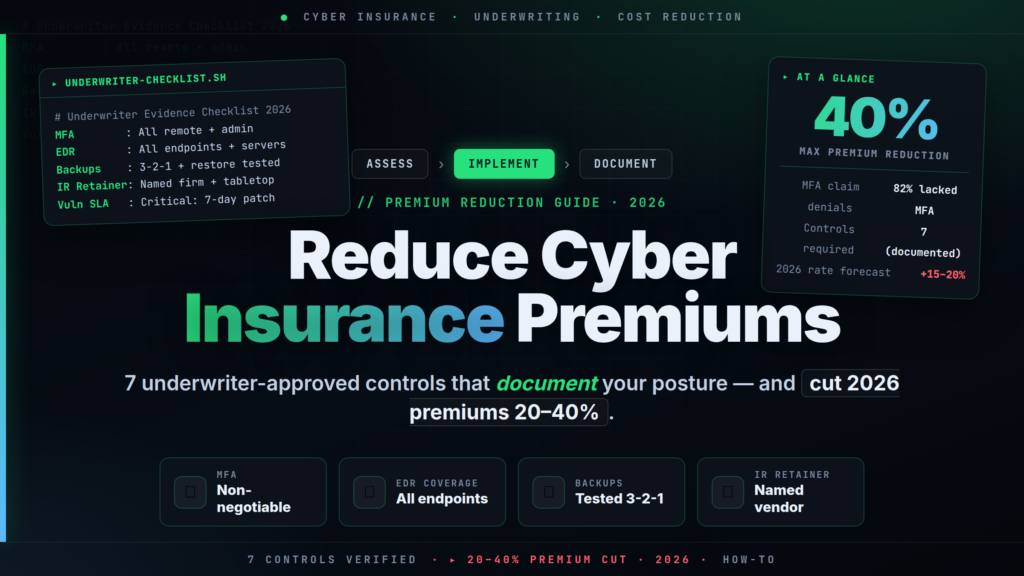
The fastest lever to reduce cyber insurance premiums in 2026 is documented proof of security controls — underwriters have shifted from checkbox questionnaires to evidence-based technical audits, and organizations that cannot produce documentation before renewal will absorb the full 15–20% rate increase S&P Global Ratings has forecast for the year. This guide covers the seven controls that demonstrably cut premiums by 20–40%, the specific evidence each carrier requires, and how to structure your documentation package for maximum negotiating leverage.
// 01 The 2026 Market Window: Why Premium Pressure Is Returning
The cyber insurance market has been unusually soft for two consecutive years. Marsh's Global Insurance Market Index recorded a 5% US rate decline in Q4 2024 and a 7% global drop in Q2 2025, as loss ratios fell below 50% according to AM Best and carriers competed for premium volume. The US cyber direct written premium market hit approximately $9 billion in 2024 — new capacity flooded in and prices fell.
That window is closing. Several forces are driving the 2026 hardening:
- Ransomware severity is rising: Average ransomware incident cost climbed 17% year-over-year to $1.18 million per claim, according to industry data compiled by SentinelOne.
- Infostealer-driven credential theft: Credential theft via infostealer malware (software designed specifically to harvest passwords, session cookies, and authentication tokens) increased approximately 800% in 2024–2025, fueling account-takeover claims.
- AI-accelerated BEC: AI-assisted spearphishing and synthetic voice fraud are materially increasing business email compromise (BEC — fraud that impersonates executives or vendors to redirect payments) claim volume.
- Carrier recalibration: After three years of sub-50% loss ratios, reinsurers are tightening terms and raising retentions; primary carriers are following.
For 2026 renewals, organizations with documented controls will lock in stable or reduced rates. Those relying on self-attestation without evidence will face surcharges of 30–40% or reduced coverage sublimits (a sublimit caps carrier payout on a specific loss type, such as ransomware, below the full policy limit).
// 02 Reduce Cyber Insurance Premiums: How Evidence-Based Underwriting Works
Approximately 75% of cyber insurance carriers now run external attack surface management (ASM) scans during underwriting, according to broker analysis published by Emerge IT. ASM — automated reconnaissance of your internet-facing infrastructure — allows carriers to independently verify patch posture, exposed ports, and TLS certificate health before you submit an application.
This creates a two-tier structure:
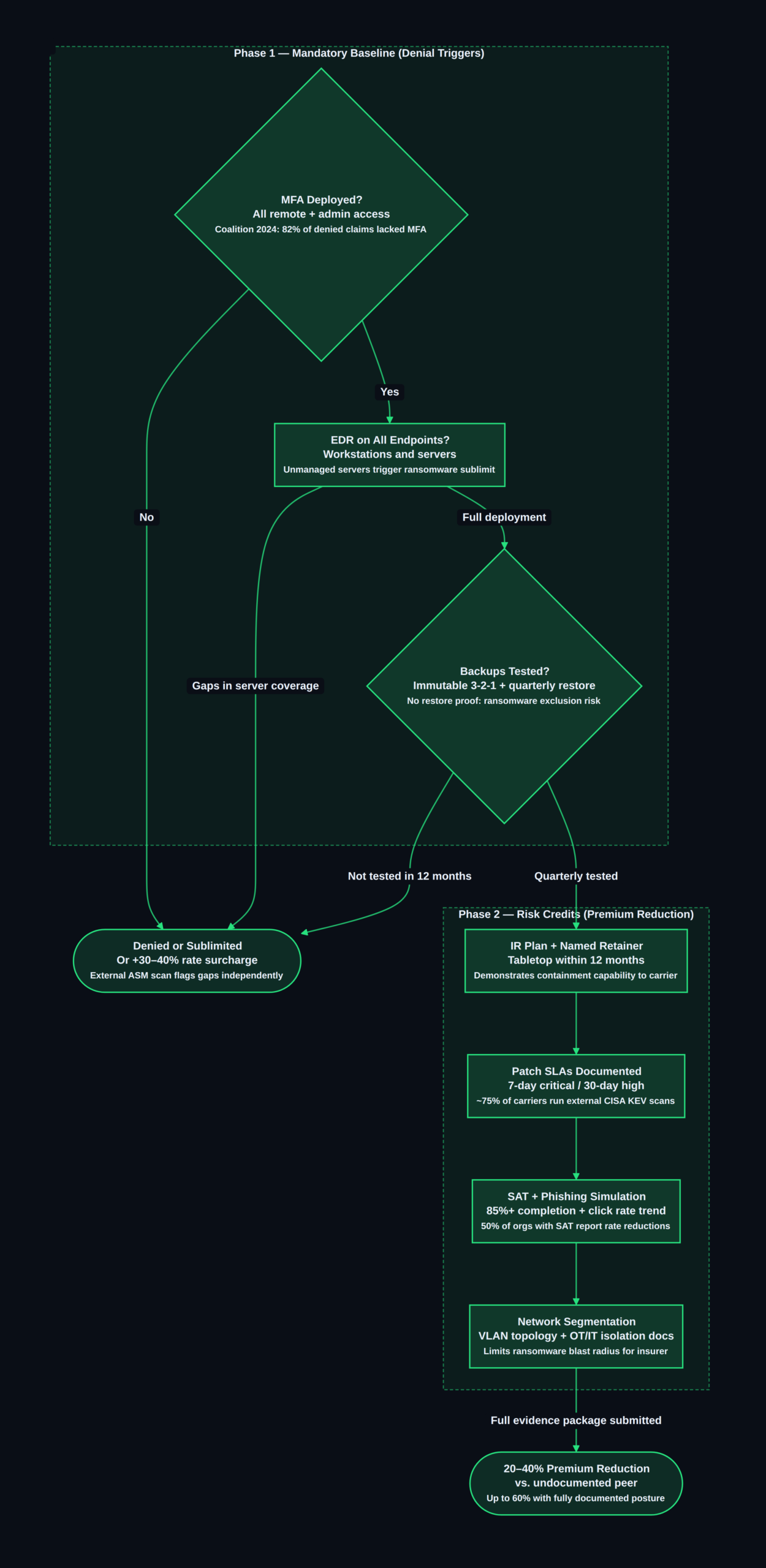
- Mandatory baseline controls: Absence of any of these triggers denial, sublimit application, or ransomware exclusion. These are eligibility gates, not discount levers.
- Premium credit controls: Once the baseline passes, documented secondary controls earn measurable credits. The aggregate reduction for a well-documented posture is 20–40% versus a comparable peer, with best-case scenarios reaching 60% for organizations with fully evidenced programs.
The diagram below shows how underwriters move from denial triggers to credit evaluation:
// 03 Control 1: Multi-Factor Authentication (MFA)
MFA (Multi-Factor Authentication — requiring a second verification step beyond a password, such as a push notification, TOTP code, or hardware security key) is the single most scrutinized control in cyber underwriting. It is also the most common reason for claim denial, not just a lever to reduce cyber insurance premiums.
What underwriters ask:
- Is MFA enforced for all employees accessing email via web or cloud?
- Is MFA required for all remote access (VPN, RDP, remote desktop)?
- Is MFA enforced for privileged accounts: directory services, backup management consoles, cloud infrastructure (AWS/Azure/GCP), and network devices?
- What authentication methods are in use — FIDO2 hardware keys, TOTP app (e.g., Authy, Google Authenticator), or SMS?
Why MFA is an eligibility gate, not a discount lever:
Coalition's 2024 Cyber Threat Index found that 82% of denied cyber claims involved organizations without MFA enforcement. Coalition, Chubb, Travelers, and AXA XL all treat MFA on email, remote access, and privileged accounts as a binding coverage condition.
The standard has also shifted beyond SMS-based one-time passwords. Underwriters increasingly ask whether FIDO2-based authentication (hardware security keys such as YubiKey, or passkeys stored on devices) is deployed for admin accounts, because SMS and standard TOTP codes remain vulnerable to AiTM (Adversary-in-the-Middle — a real-time phishing technique that intercepts authentication codes as they are entered, allowing attackers to bypass MFA) attacks.
Evidence required:
- Identity provider enrollment report: Export from Azure AD/Entra ID, Okta, or Duo Security showing MFA enrollment rates by user group. Target: 100% for privileged accounts, 95%+ for all users.
- Conditional Access policy screenshots: Demonstrate that unenrolled users are blocked at authentication — not just prompted. Policies should show enforcement, not advisory mode.
- Coverage scope documentation: Explicitly list every system requiring MFA. Underwriters probe specifically: VPN concentrators, AWS/Azure/GCP management consoles, Microsoft 365 admin portals, and backup management interfaces.
- Phishing-resistant MFA statement: If FIDO2 or passkeys are deployed for admin accounts, note this explicitly. It is a meaningful differentiator at renewal.
// 04 Control 2: Endpoint Detection and Response (EDR)
EDR (Endpoint Detection and Response — security software that runs on individual computers and servers, continuously monitors for malicious behavior, records system telemetry, and can automatically isolate compromised machines) has replaced traditional antivirus as the minimum endpoint security requirement in cyber underwriting.
What underwriters ask:
- Is EDR deployed on all workstations AND servers — not workstations only?
- Is 24/7 MDR (Managed Detection and Response — third-party monitoring of your EDR telemetry around the clock) in place, or is the EDR essentially unmonitored?
- What is your mean time to detect (MTTD) and mean time to respond (MTTR) for endpoint threats?
The server gap is the most common underwriting failure. Many organizations deploy EDR on workstations but leave servers — the highest-value ransomware targets — running legacy antivirus or nothing. Carriers treat server coverage gaps as a material underwriting deficiency, often applying ransomware sublimits as a result.
Coalition explicitly credits MDR adoption with premium discounts for named enterprise MDR platforms including CrowdStrike Falcon Complete and SentinelOne Vigilance Respond. The discount percentage is account-specific. According to the 2024 Delinea Cybersecurity Insurance Report, 86% of surveyed insurers offered premium reductions for AI-powered threat detection capabilities — making fully-managed EDR one of the most rewarded controls on a cost-per-credit basis.
Evidence required:
- Coverage report: Export from your EDR console (CrowdStrike Falcon, SentinelOne, Microsoft Defender for Endpoint, Sophos Intercept X) showing agent installation status and health across all managed assets, explicitly including servers. Carriers look for zero orphaned endpoints.
- Alert volume and response metrics: 30-day summary of alert volume, mean time to detect, and mean time to respond — demonstrating the EDR is actively monitored.
- MDR contract or SOC statement: If using a managed service, provide a contract summary confirming 24/7 monitoring scope and response SLAs.
// 05 Control 3: Immutable Backups with Tested Restores
Ransomware — malicious software that encrypts organizational data and demands payment for the decryption key — is the primary driver of large cyber insurance claims. The average ransomware recovery cost now exceeds $1 million, which is why tested backups are a hard underwriting requirement and a foundational way to reduce cyber insurance premiums through documented recovery capability.
What underwriters ask:
- Do you maintain immutable backups using a 3-2-1 architecture?
- When was your last full restore test conducted?
- Are backup systems network-isolated from production environments — would a ransomware infection reach the backup infrastructure?
The 3-2-1 architecture means: 3 copies of data, on 2 different storage media types, with 1 copy offsite or in immutable cloud storage. Immutable means the backup data cannot be modified or deleted for a defined retention period, even by administrators. Cloud-native immutability is available via Azure Blob Storage WORM policies, AWS S3 Object Lock, and Wasabi Cloud Storage — all accepted by underwriters.
The restore test is the most commonly missing evidence. Organizations routinely maintain backups but never test a full system restore. Underwriters require a dated restore test report — a partial file recovery is insufficient. A full server restoration to an isolated environment, with documented recovery time, is the standard evidence carriers want to see.
Evidence required:
- Backup topology diagram: A clear diagram showing the 3-2-1 architecture, immutability configuration, and network isolation from production systems.
- Restore test report: A dated document (within 12 months) showing a successful full system restore to an isolated environment, including the recovery time objective (RTO — the maximum acceptable time to restore operations) achieved.
- Encryption configuration export: Demonstrate that backups are encrypted at rest and in transit.
- Backup job logs: 30-day log showing successful completion, with any failures and their documented resolutions.
// 06 Control 4: Incident Response Plan and IR Retainer
An IR (Incident Response) plan is a documented procedure covering how an organization detects, contains, eradicates, and recovers from a cybersecurity incident. An IR retainer is a pre-paid contract with an external forensics firm that guarantees response SLAs in the event of a breach.
What underwriters ask:
- Do you have a written incident response plan?
- When was a tabletop exercise — a structured walkthrough of the plan with key stakeholders, without live systems — last conducted?
- Do you have a retainer with a named IR/forensics provider?
- What is your breach notification timeline? Most carriers require notification within 24–72 hours of discovering a potential cyber event.
Failure to notify within the required window is one of the most common grounds for claim denial — and it is entirely preventable with a documented escalation procedure.
Why the retainer matters to your insurer: A named retainer with a recognized firm (Mandiant/Google Cloud, CrowdStrike Services, Palo Alto Networks Unit 42, Secureworks) signals to underwriters that your breach response will be efficient, well-documented, and legally sound. This directly reduces the carrier's expected claim duration and total loss cost — which translates into a premium credit.
Evidence required:
- IR plan document: The written plan covering at minimum: detection and triage procedures, containment steps, eradication and recovery actions, communication procedures (internal and external), and breach notification timelines.
- Tabletop exercise after-action report: A dated document within the past 12 months summarizing the scenario tested, participants, findings, and remediation items. The date matters: exercises older than 12 months are treated as insufficient by most carriers.
- On-call escalation roster: Contact names, roles, and phone numbers for both internal responders and external vendors.
- IR retainer agreement summary: Vendor name, response SLA (typically 4-hour call-back, 24-hour on-site), and scope of services.
// 07 Control 5: Vulnerability Management with Documented SLAs
Vulnerability management is the ongoing process of discovering, classifying, prioritizing, and remediating known security weaknesses across your environment. Documented SLAs (Service Level Agreements — binding internal commitments to patch vulnerabilities within defined timeframes by severity) are what distinguish a mature program from ad-hoc patching in underwriter eyes.
What underwriters ask:
- What is your SLA for critical vulnerabilities? (Current standard: 7–15 days)
- How do you verify that patches were applied — change tickets, not just scan-and-forget?
- Are you tracking CISA KEV (Known Exploited Vulnerabilities — the U.S. Cybersecurity and Infrastructure Security Agency's catalog of vulnerabilities confirmed as actively exploited in the wild) compliance?
The external scan reality: Approximately 75% of carriers run external ASM scans specifically looking for CISA KEV-listed vulnerabilities on internet-facing assets. Unpatched KEVs found during underwriting have triggered mid-term coverage modifications at multiple carriers. You can check your own exposure proactively:
# Download the CISA KEV catalog and build a local reference
curl -s https://www.cisa.gov/sites/default/files/feeds/known_exploited_vulnerabilities.json
  | jq '[.vulnerabilities[] | {cveID, vendorProject, product, dateAdded, dueDate}]'
  > cisa-kev-$(date +%Y%m%d).json

# Cross-reference against your Tenable.io vulnerability scan output
# to identify any open KEV findings before submission to underwriters
The current patch SLA standard that underwriters expect is 7 days for CISA KEV-listed vulnerabilities and CVSS v3.1 (Common Vulnerability Scoring System — the industry standard 0–10 scale for rating vulnerability severity) scores of 9.0–10.0 (Critical). 30 days for high severity (CVSS 7.0–8.9). Exceptions must be documented with compensating controls.
Evidence required:
- Vulnerability scan trend report: A 90-day report from Tenable Nessus, Qualys, or Rapid7 InsightVM showing open vulnerability counts by severity tier, mean time to remediate (MTTR) by tier, and closure rates trending downward.
- Patch SLA policy document: A written, management-approved policy defining SLA targets by CVSS score band.
- Remediation evidence: Change tickets or work orders with closed-date stamps proving patches were applied. Self-attestation without documented tickets is increasingly rejected by carriers.
- CISA KEV attestation: A signed statement that all KEV-listed vulnerabilities in scope have been patched or carry documented compensating controls with a remediation timeline.
// 08 Control 6: Security Awareness Training
Security awareness training (SAT — structured programs that educate employees to recognize and resist phishing, social engineering, and other human-factor attacks) addresses the largest volume driver of cyber claims. BEC (Business Email Compromise) and phishing-initiated breaches together account for approximately 60% of cyber claim count volume, per Coalition's claims data.
What underwriters ask:
- Is SAT conducted at minimum annually? (Quarterly is the preferred frequency)
- What is the employee completion rate?
- Are phishing simulations conducted? What is the current click rate, and is it trending down?
According to the 2024 Delinea cybersecurity insurance survey, 50% of organizations that reported reduced cyber insurance rates cited SAT as a contributing factor — making it one of the highest-return controls relative to implementation cost for the average mid-market organization.
Evidence required:
- Training completion report: Export from your SAT platform (KnowBe4, Proofpoint Security Awareness, Cofense, SANS Security Awareness) showing completion rates by department. Target: 85%+ all staff, 100% finance and IT staff.
- Phishing simulation results: A 12-month trend report showing simulation frequency (minimum quarterly), click rates per campaign, and reporting rates. Declining click rates over time are the key signal underwriters look for.
- Training content documentation: Confirm coverage includes phishing, BEC/wire fraud procedures, social engineering, password hygiene, and secure remote work.
- Escalation documentation: Show the closed-loop process between a reported phishing simulation and the security operations function — carriers want evidence the training connects to real detection.
// 09 Control 7: Network Segmentation
Network segmentation is the division of a network into isolated zones — using VLANs (Virtual Local Area Networks), firewalls, and access control lists — so that a compromise in one zone cannot automatically propagate to others. In the context of ransomware, segmentation is the architectural control that limits blast radius: the total volume of systems and data an attacker can encrypt from a single foothold.
What underwriters ask:
- Is your network segmented to limit lateral movement (the technique attackers use to spread from one compromised system to adjacent ones)?
- Are OT/ICS systems (Operational Technology / Industrial Control Systems, found in manufacturing, healthcare, utilities, and critical infrastructure) network-isolated from corporate IT?
- Is RDP (Remote Desktop Protocol — Microsoft's built-in remote access tool that, when exposed to the internet, is one of the most common ransomware entry vectors) accessible from the internet?
Exposed RDP is a critical underwriting red flag. Coalition's 2024 claims data shows that claims from organizations with internet-exposed RDP were 40% more frequent than peers, with average claim severity 103% higher. Carriers increasingly apply mandatory ransomware sublimits or deny coverage outright when external scans detect open RDP.
Evidence required:
- Network topology diagram: A current logical diagram showing network zones, VLAN assignments, trust boundaries, and firewall placement. It does not need to be architectural-grade — a clear, accurate diagram is sufficient.
- Firewall rule summary: A high-level export demonstrating inter-zone restrictions and that east-west traffic (lateral movement between internal segments) is controlled, not open by default.
- OT/IT isolation statement: If OT systems are present, written documentation and network evidence of separation via dedicated firewall, DMZ (Demilitarized Zone — an isolated network segment between untrusted external and trusted internal networks), or air-gap.
- Remote access inventory: Confirm RDP is not exposed to the internet. Document the replacement: VPN with MFA, or ZTNA (Zero Trust Network Access — a modern architecture that verifies every connection regardless of network location before granting access).
// 10 Building Your Underwriter Evidence Package
The controls above deliver maximum premium impact when submitted as a structured evidence package 60–90 days before renewal. Early submission gives your broker time to negotiate before the underwriting deadline and to address any follow-up questions before binding. Last-minute submissions at renewal lose this leverage.
| Control | Classification | Core Evidence Required | Premium Lever |
|---|---|---|---|
| MFA | Mandatory baseline | IdP enrollment report, Conditional Access policy screenshots, coverage scope | Denial prevention |
| EDR | Mandatory baseline | Agent coverage report (all endpoints + servers), MDR contract, alert metrics | Sublimit prevention + credit |
| Tested Backups | Mandatory baseline | Restore test report (dated, ≤12 mo), backup topology diagram, encryption config | Ransomware exclusion prevention |
| IR Plan + Retainer | Required credit | IR playbook, tabletop after-action report (≤12 mo), retainer agreement | Loss severity credit |
| Vulnerability Management | Required credit | Patch SLA policy, scan trend report, remediation tickets, KEV attestation | External ASM scan pass |
| Security Awareness Training | Premium credit | Completion rates >85%, phishing simulation trend report (quarterly) | BEC/phishing claim reduction |
| Network Segmentation | Premium credit | Network topology, firewall rule summary, RDP inventory, OT/IT isolation docs | Ransomware blast radius credit |
Framework alignment shortcut: CISA's Cybersecurity Performance Goals 2.0 (CPG 2.0), released December 2025, maps almost exactly to the underwriter checklist above. It covers MFA for privileged accounts, asset inventory (prerequisite for full EDR deployment), backup and recovery, vulnerability management including KEV compliance, and incident response planning — with Cost, Impact, and Ease of Implementation ratings that help prioritize which controls to complete and document first. Organizations working toward CPG 2.0 compliance will satisfy the majority of carrier requirements as a byproduct.
For organizations pursuing simultaneous SOC 2 Type II certification, most of the evidence above — especially vulnerability management tickets, SAT completion reports, and IR plan documentation — satisfies both frameworks. Our SOC 2 Type II 90-day guide covers evidence collection workflows that serve both purposes concurrently.
Broker platform tip: Marsh's myCyber and Aon's CyberQuotient platforms allow you to pre-score your security posture before the formal underwriting review — identifying gaps while there is still time to remediate before the renewal window closes.
// 11 Conclusion
The 2026 cyber insurance market will not be uniformly more expensive — it will be more expensive for organizations that cannot prove their controls. Implementing and documenting the seven controls above can reduce cyber insurance premiums by 20–40% compared to undocumented peers at the same risk level, with the three mandatory controls (MFA, EDR on all endpoints, and tested immutable backups) functioning as coverage eligibility requirements rather than discount levers. Start building your evidence package 90 days before renewal; the documentation gap between what most organizations can produce today and what underwriters expect is the primary source of preventable premium increases in 2026.
For context on the financial exposure that cyber insurance is designed to transfer, see our full ransomware cost breakdown for 2026. If you are also evaluating which carriers to work with, our cyber insurance provider comparison for SaaS startups covers underwriting standards across six major platforms.
Subscribe to our weekly threat digest for ongoing coverage of the 2026 cyber insurance market →
For any query contact us at contact@cipherssecurity.com