
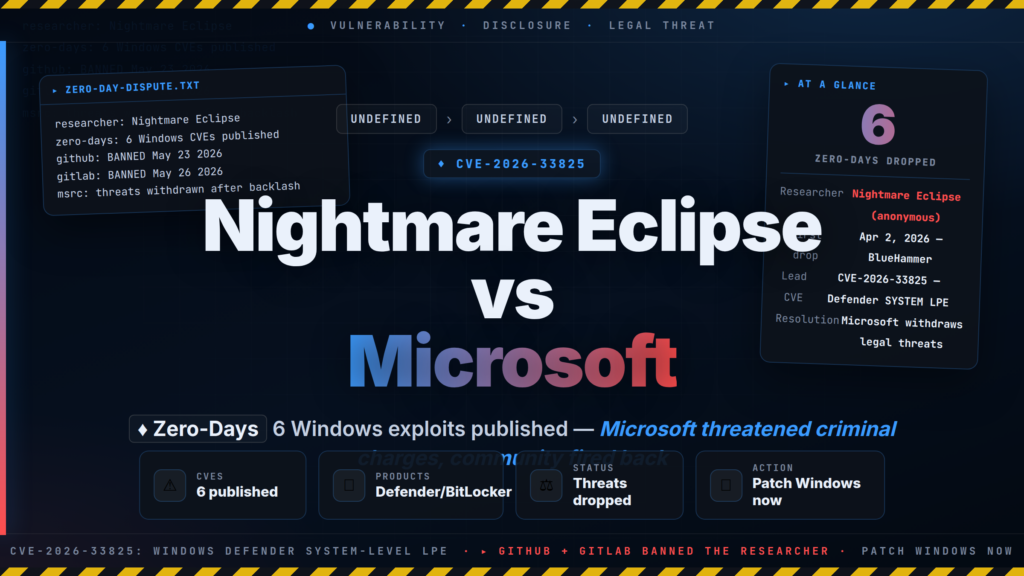
An anonymous security researcher operating as "Nightmare Eclipse" published six Windows zero-day exploits — including CVE-2026-33825 (a privilege escalation vulnerability in Windows Defender that grants SYSTEM-level access to any logged-in user) — between April and May 2026, after alleging that Microsoft deleted their MSRC (Microsoft Security Response Center) bug-reporting account and withheld earned bounty payments. Microsoft's Digital Crimes Unit responded on May 28 by threatening criminal prosecution, triggering swift backlash from prominent voices in the security research community. Microsoft subsequently walked back the threats, clarifying it had "no intention to pursue action against individuals conducting or publishing their security research" — but the six zero-days remain publicly available, and exploitation risk for Windows Defender, BitLocker, and Windows 11 users is real.
// 01 Nightmare Eclipse: Technical Details
The six zero-day exploits disclosed by Nightmare Eclipse span Windows' core security components. Those with assigned CVE numbers include:
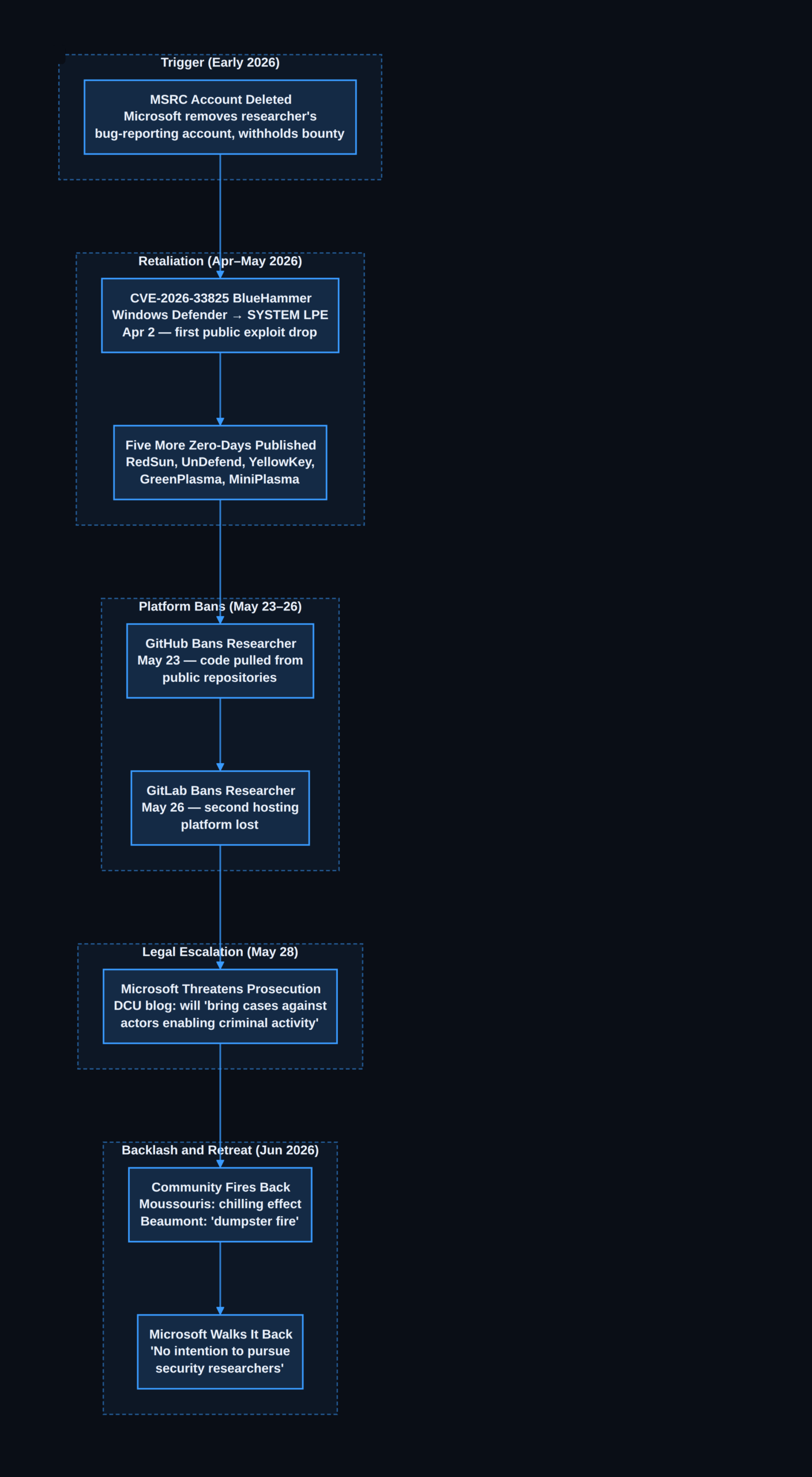
CVE-2026-33825 ("BlueHammer") — Windows Defender privilege escalation granting SYSTEM privileges (the highest-permission account on a Windows machine) to any authenticated local user. Published April 2, 2026. Microsoft had not issued a patch as of the Dark Reading report on June 1.
CVE-2026-41091 ("RedSun") — A Windows vulnerability; precise technical details were not disclosed in MSRC advisories but the researcher provided working proof-of-concept code.
CVE-2026-45498 ("UnDefend") — Related to Windows Defender; the name suggests a defensive capability bypass.
CVE-2026-45585 ("YellowKey") — A Windows vulnerability with published exploit code.
Two additional exploits — "GreenPlasma" and "MiniPlasma" — were released without CVE assignments at time of reporting.
Microsoft assigns CVSS (Common Vulnerability Scoring System — a standardized 0–10 scale for vulnerability severity) scores through its MSRC process; as of June 2, those scores had not been published for all six CVEs, consistent with Microsoft's posture that the disclosures were "never justifiable." However, a privilege escalation to SYSTEM with no authentication barrier beyond a local user session — the BlueHammer description — maps to a CVSS v3.1 score in the High-to-Critical range (7.8–8.8 for local privilege escalation with low attack complexity and no privileges required beyond user-level access).
The exploits were originally published to GitHub on April 2 and between April and May 2026. GitHub banned Nightmare Eclipse's account on May 23, followed by GitLab on May 26, removing the primary hosting platforms. The researcher's signed statements on Blogger indicate additional disclosures were planned for July 14, 2026 — the next Microsoft Patch Tuesday.
// 02 Exploitation Status and Threat Landscape
CVE-2026-33825 (BlueHammer) carries active exploitation risk. The proof-of-concept (PoC — working exploit code published publicly, lowering the technical bar for attackers) was available on GitHub from April 2 until account termination on May 23 — a 51-day window of public availability. While GitHub hosting was removed, PoC code shared during that window is almost certainly archived and circulating in private channels. Any threat actor monitoring security research repositories had weeks to obtain a working Windows Defender privilege escalation exploit.
No CISA KEV (Known Exploited Vulnerabilities list — the U.S. Cybersecurity & Infrastructure Security Agency's catalog of flaws confirmed to be actively exploited in the wild) entry exists for these CVEs as of June 2, 2026. However, absence from KEV does not indicate absence of exploitation, particularly for a local privilege escalation (LPE) payload that would be used post-initial-access — a stage that often goes undetected.
Microsoft has not released patches for all six Nightmare Eclipse CVEs. The researcher's stated intent to drop additional exploits on July 14 means more unpatched Windows vulnerabilities may become publicly accessible in six weeks.
MITRE ATT&CK: T1068 (Exploitation for Privilege Escalation) is the primary technique applicable to BlueHammer and similar LPE exploits.
// 03 Who Is Affected
Windows Defender ships enabled by default on all Windows 10 and Windows 11 installations. A CVE-2026-33825 (BlueHammer) exploitation scenario requires:
- Local access: An attacker already present on the machine, either through physical access, remote desktop, a previous phishing or drive-by compromise, or a malicious insider
- No additional privileges: Any standard user account is sufficient to trigger the escalation
BitLocker (disk-encryption tool) and Windows 11 installations are in scope for at least two additional CVEs. The affected deployment surface is essentially all managed Windows endpoints, including enterprise workstations and servers where Windows Defender is used as the primary endpoint security tool — not replaced by a third-party EDR.
Organizations running third-party antivirus in place of Windows Defender may have reduced exposure to CVE-2026-33825 specifically, depending on whether Windows Defender services remain active in passive mode.
// 04 What You Should Do Right Now
- Apply all available Windows security updates immediately: Check Windows Update or WSUS (Windows Server Update Services — Microsoft's enterprise update management platform) for June 2026 updates. Any patches Microsoft releases before the July 14 Patch Tuesday that address these CVEs should be treated as emergency deployments.
- Monitor MSRC advisories for the six CVEs: Subscribe to the Microsoft Security Update Guide and set alerts for CVE-2026-33825, CVE-2026-41091, CVE-2026-45498, and CVE-2026-45585. Patch as soon as fixes are available.
- Restrict local access to sensitive systems: Since BlueHammer requires local user access, reducing the number of accounts with interactive login rights to servers and privileged workstations limits the blast radius of an LPE exploitation.
- Enable Windows Defender Application Control (WDAC): WDAC (a Windows feature that restricts which applications can run) can block execution of unsigned or untrusted scripts and binaries that LPE exploits typically require for post-escalation payload delivery.
- Audit logs for suspicious privilege escalation events: In Windows Event Logs, monitor for Event ID 4624 (logon) and 4672 (special privileges assigned) associated with unexpected SYSTEM-level sessions. Configure SIEM (Security Information and Event Management system) alerts for these event codes on non-standard accounts.
- Brief incident response teams: The July 14 potential additional disclosure date means IR (Incident Response) teams should be briefed on the dispute timeline and prepared for a sudden influx of new Windows PoC code in approximately six weeks.
// 05 Background: Understanding the Risk
The Nightmare Eclipse dispute crystallizes a long-running tension in vulnerability disclosure that affects every security researcher and every software vendor.
The bug bounty payment dispute as a root cause. Nightmare Eclipse's stated grievances are specific: Microsoft allegedly deleted the MSRC account they used to submit bug reports, preventing access to their own vulnerability submissions, and withheld bounty payments they claimed to have earned. The researcher stated publicly: "You literally deleted the Microsoft account I used to report bugs to you with, and I got zero pennies from doing so." Whether Microsoft's account action was procedurally justified is unknown; what is known is that a researcher who believed they were owed thousands of dollars for Windows vulnerability discoveries responded by publishing working exploits.
Microsoft's legal threat and why it backfired. Microsoft's May 28 Digital Crimes Unit blog post included language that "our Digital Crime Unit will continue bringing cases against these actors and those that enable their criminal activity." The post described public zero-day disclosures as "never justifiable" — a framing that made no distinction between malicious exploitation and frustrated security researchers who have exhausted vendor channels. The reaction from the security community was immediate and harsh:
- Katie Moussouris (founder of the first bug bounty program at Microsoft): warned of a "chilling effect" where fewer researchers would come forward to report bugs, "making it less safe for all of us"
- Kevin Beaumont (former Microsoft security engineer, now independent researcher): called the situation "a dumpster fire of their own making," pointing out that Microsoft has historically hired researchers who disclosed vulnerabilities publicly before contacting vendors
- Casey Ellis (founder of Bugcrowd, a major bug bounty platform): described the threat as "an insanely myopic move"
- Andrew Case (Volexity): said Microsoft's blog post "decided to kill off all the goodwill it has built up over the last decade"
Microsoft's subsequent clarification — "We have no intention to pursue action against individuals conducting or publishing their security research" — was read by many researchers as a face-saving retreat rather than a policy change. The original blog post remains live.
The systemic issue with full disclosure. The security research community has debated coordinated disclosure (notifying a vendor and allowing a fix period before publishing) versus full disclosure (publishing immediately) for decades. Most researchers accept that a 90-day coordinated disclosure period balances vendor remediation time against public interest. What Nightmare Eclipse represents is a third category: retaliatory disclosure triggered by perceived vendor misconduct. This scenario — where a researcher exhausts vendor channels and receives no response or active harm — is a known failure mode of coordinated disclosure programs. Microsoft's response to this case, threatening prosecution rather than investigating the underlying bounty dispute, will make other researchers in similar situations less likely to attempt coordination at all.
// 06 Conclusion
Six Windows zero-days affecting Windows Defender, BitLocker, and Windows 11 are publicly known as of June 2026, with working proof-of-concept code having been available for weeks. Organizations should apply all available Windows security patches immediately, monitor MSRC advisories for CVE-2026-33825 and related fixes, and brief incident response teams ahead of the researcher's stated July 14 additional disclosure date. The most important immediate step is ensuring Windows Update is current on all endpoints — Nightmare Eclipse's exploits require local access, so an already-patched system removes the escalation path entirely.
For any query contact us at contact@cipherssecurity.com