
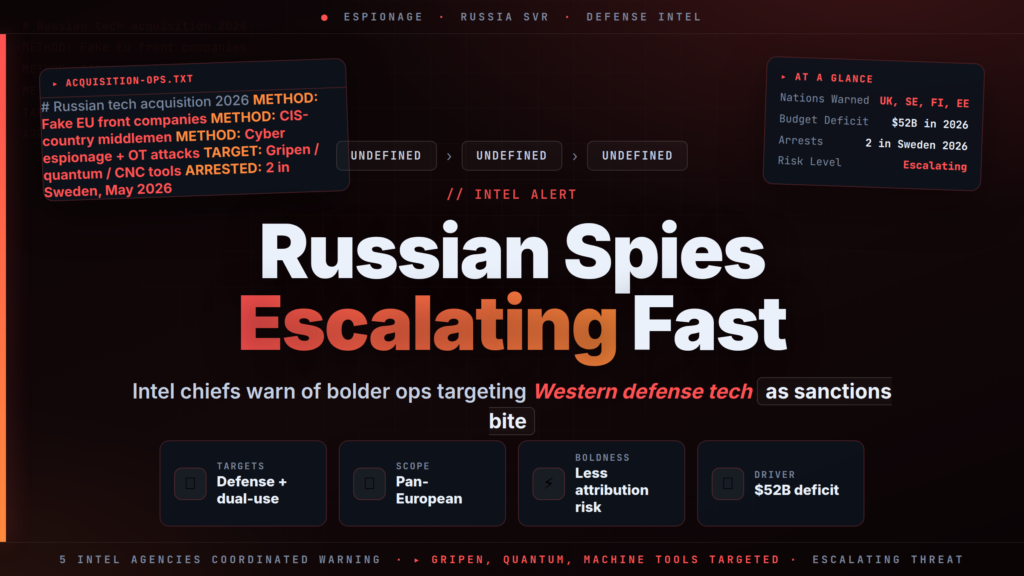
Russian intelligence services are intensifying their efforts to steal Western defense technology and dual-use (civilian-military, export-controlled) equipment as four years of international sanctions deplete Moscow's industrial supply chains, according to a coordinated advisory from senior intelligence officials in Sweden, Finland, the United Kingdom, and Estonia published May 30, 2026. Moscow's agents are constructing fake European companies, recruiting sanctions-busting middlemen, and deploying cyber espionage teams against defense industrial targets — and are now doing so with decreasing concern for attribution risk, officials say. For security teams at defense contractors, manufacturers of controlled technology, and critical infrastructure operators, this assessment represents a direct operational warning.
// 01 Russian Espionage Methods and Targets
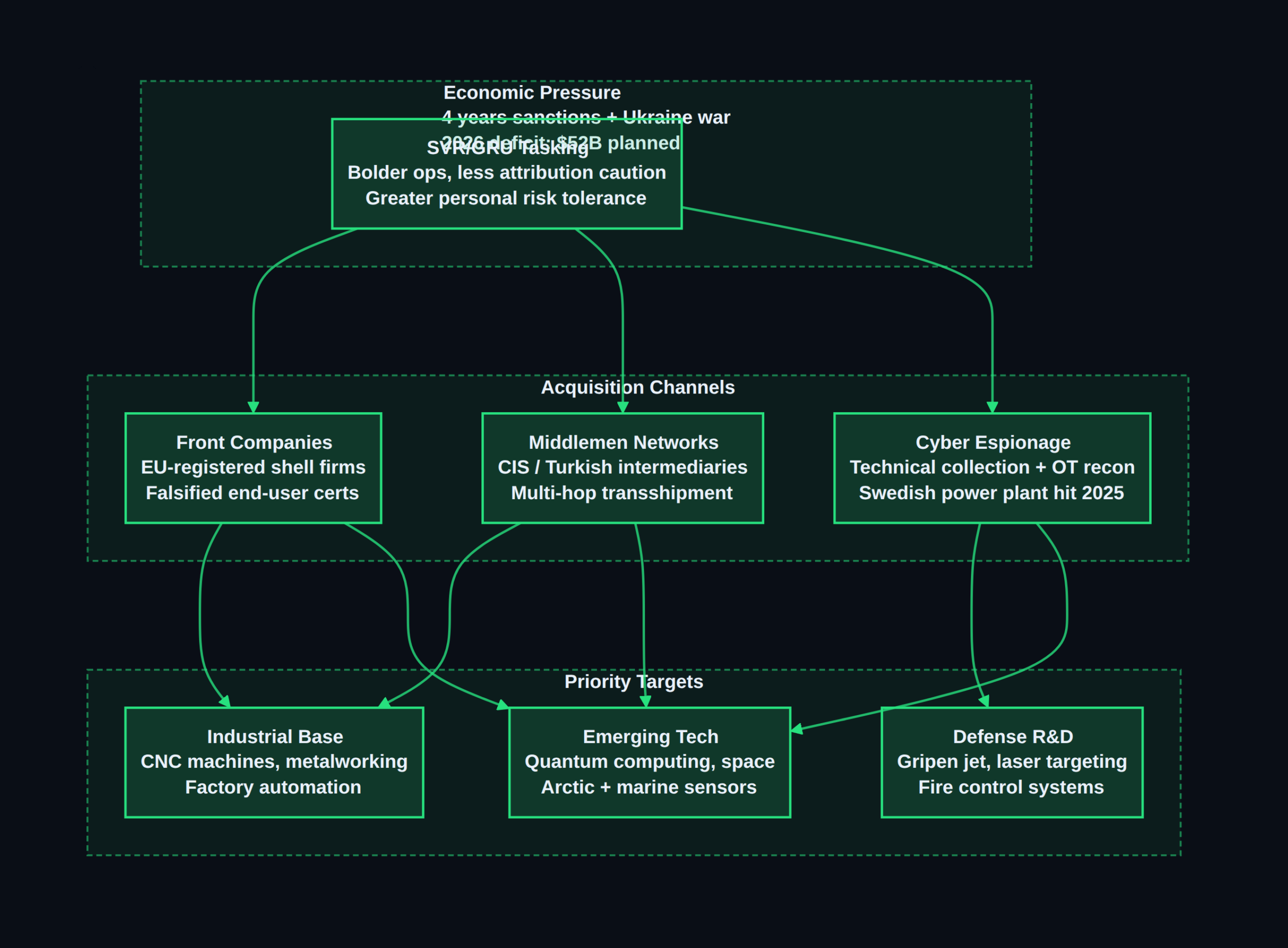
The intelligence advisory, coordinated across four national agencies, details a systematic shift in Russian acquisition tradecraft that has accelerated since 2024. Russian intelligence is simultaneously running three distinct acquisition channels:
Front companies: Russia's intelligence services are establishing legally registered European corporations — shell entities, typically in jurisdictions with lighter trade compliance enforcement — to place orders for export-controlled goods using falsified end-user certificates. In one identified case, a Turkish company was used to ship metalworking equipment to Russia despite active EU export restrictions, demonstrating how front company networks extend beyond Europe.
Middlemen networks: Intermediaries in CIS (Commonwealth of Independent States — the loose confederation of post-Soviet states that maintain trade relationships with Russia) countries and other non-sanctioning jurisdictions route hardware from Western manufacturers through multiple transshipment points. Each transit leg adds plausible deniability for the original exporter while obscuring the final Russian end user.
Cyber espionage and sabotage reconnaissance: Russian cyber operators are conducting technical collection against defense research institutions, aerospace manufacturers, and critical infrastructure. A cyberattack against a Swedish power plant in 2025 is attributed to Russian actors, and officials specifically warn that reconnaissance data gathered through cyber operations is being compiled for use in physical infrastructure sabotage planning.
The six priority technology categories targeted by Russian intelligence in 2026:
- Advanced machine tools and factory equipment — precision CNC (Computer Numerical Control — computer-controlled precision manufacturing machines) machines, metalworking equipment, and industrial automation hardware essential to weapons production
- Defense systems research — Sweden's JAS 39 Gripen fighter jet, camera and laser targeting integration, and fire control system specifications
- Quantum computing and space technology — components applicable to navigation, communications, and weapons guidance systems
- Arctic and marine technology — sensor systems, communications equipment, and underwater vehicle technology for Arctic warfare
- Computer technology and software updates — including patches and firmware updates for machine tools that were legally exported to Russia before sanctions began
- Dual-use electronics — microchips, sensors, and components not individually classified as military but aggregated for defense applications
// 02 Threat Landscape and Current Incidents
Christoffer Wedelin, deputy head of Sweden's Security Service (SÄPO — Säkerhetspolisen, the Swedish domestic intelligence agency), stated that Russian agents are "no longer caring as much about potential attribution after their activities, so they are taking greater risks to achieve their goals." This shift from the historically cautious approach that characterized Soviet-era intelligence operations reflects the acute economic desperation driving current operations.
The economic context is stark: Russia's federal budget deficit reached 3.4 trillion rubles ($47.9 billion) by the end of February 2026 against a full-year planned deficit of 3.7 trillion rubles ($52.1 billion) — indicating Russia is consuming fiscal reserves at a pace that requires external technology inputs to sustain wartime production. International sanctions have specifically restricted Russia's access to precision manufacturing equipment, advanced semiconductors, and defense-grade electronics, creating capability gaps that intelligence services are directed to close through theft and sanctions evasion.
The warning is unusual in its cross-agency coordination. Juha Martelius, director of Finland's Security and Intelligence Service (SUPO), specifically briefed Finnish defense industry partners. Anne Keast-Butler, director of GCHQ (Government Communications Headquarters — the UK's signals intelligence and cybersecurity agency), and Kaupo Rosin, head of Estonia's Foreign Intelligence Service (EFIS — Välisluureamet), jointly participated in the disclosure — a rare four-nation intelligence statement indicating the campaign is assessed as broad, active, and materially significant. Swedish police arrested two individuals in May 2026 related to sanctions violations as part of ongoing enforcement against Russian acquisition networks.
// 03 Who Is Affected
Russian technology acquisition operations in 2026 are targeting a wide set of organization types across allied nations:
- Defense prime contractors and subcontractors manufacturing components with any military application, regardless of company size
- Aerospace and aviation manufacturers, particularly those working on fighter aircraft, unmanned systems, drones, or precision guidance
- Academic and applied research institutions with quantum computing, materials science, advanced sensor, or dual-use technology programs
- Industrial equipment manufacturers producing CNC machines, precision tooling, industrial robots, or factory automation
- Semiconductor distributors and electronics wholesalers handling goods subject to EU or US export controls
- Energy and critical infrastructure operators — the Swedish power plant incident indicates that offensive cyber operations targeting infrastructure have already begun, with sabotage planning the next logical step
Small and mid-size companies in European defense supply chains face disproportionate risk: they typically lack the intelligence-sharing relationships and security resources of prime contractors while holding technical specifications, manufacturing know-how, and supply chain positions that are equally valuable to Russian intelligence.
// 04 What You Should Do Right Now
- Register with your national NCSC industrial partnership program. Sweden's NCSC, Finland's NCSC-FI, the UK's NCSC, and Germany's BSI all operate programmes that provide direct threat briefings, IoC (Indicator of Compromise — observable evidence of malicious activity) sharing, and incident response support to defense-sector companies. Enrollment is typically free.
- Conduct rigorous Know Your Customer (KYC) verification on all export-controlled orders. Verify purchasing entities are genuine operating businesses — check corporate registration dates, beneficial ownership, physical premises, and end-user declarations. Treat newly registered companies requesting controlled goods through unexpected routing as high-risk until verified.
- Audit export control compliance against current classifications. The EU Dual-Use Regulation (2021/821) and US Export Administration Regulations (EAR) have expanded substantially since 2022. Items including certain CNC controllers, specific electronic components, and software may have changed classification status. Engage legal counsel with current export compliance expertise.
- Implement insider threat detection and access controls. Russian intelligence services actively recruit insiders at defense firms. Implement behavioral analytics on sensitive data access, enforce least-privilege access controls, and monitor for anomalous bulk export of technical documentation or design files.
- Harden OT (Operational Technology — industrial control systems, manufacturing equipment, and building automation) network segmentation. The Swedish power plant attack demonstrates that cyber operations targeting critical infrastructure are live, not theoretical. Segment OT networks completely from corporate IT, implement unidirectional data diodes where feasible, and deploy anomaly detection on industrial control traffic.
- Train procurement and sales staff to recognize front company approaches. Russian front companies contact targets through normal business channels — trade show networking, LinkedIn outreach, unsolicited RFQ (Request for Quotation) emails. Staff who handle technical inquiries or export-controlled product lines need awareness training on recognizing suspicious patterns: unusual routing requests, vague end-use descriptions, or urgency pressure on compliance documentation.
// 05 Background: Understanding the Risk
Russia's aggressive technology acquisition posture traces to Soviet-era programmes that systematically collected Western industrial intelligence during the Cold War. The VPK (Voyenno-Promyshlennoye Kommissiya — the Soviet Military-Industrial Commission, which coordinated technology espionage from the 1970s onward) operated extensive HUMINT (Human Intelligence — intelligence gathered through human agents and informants) networks across Europe and the United States to acquire manufacturing equipment, electronics, and defense research. When French intelligence disrupted a major arm of this network in the 1980s, it demonstrated how systematically organized and economically motivated the campaign was.
What is qualitatively different in 2026 is the integration of cyber espionage with traditional human collection, the economic desperation driving operation tempo, and the abandonment of cautious attribution avoidance. Russia's manufacturing base has been stretched by wartime consumption of precision weapons, electronic components, and advanced materials faster than domestic production can replace them. The combination of a grinding war with high technology consumption and an international sanctions regime cutting off legitimate procurement has created a gap that intelligence operations are being directed to fill — not as opportunistic collection, but as a strategic industrial imperative.
The four-nation coordinated advisory itself is an operational signal. Allied intelligence agencies do not publish joint disclosures lightly — doing so exposes collection methods and alerts targets. The decision to release publicly indicates that law enforcement and compliance disruption — raising awareness so that targets recognize and reject Russian acquisition approaches — is now assessed as more valuable than intelligence advantage from keeping the campaign assessment classified.
// 06 Conclusion
Russia's economic pressure from sanctions is translating directly into more aggressive, attribution-risk-tolerant intelligence operations against Western defense and industrial targets. Defense contractors, dual-use technology manufacturers, and critical infrastructure operators should treat this coordinated four-nation advisory as an actionable threat assessment: implement enhanced export compliance screening now, segment OT networks before an incident forces the issue, and engage national cybersecurity partnership programs to receive specific intelligence on current Russian acquisition tradecraft targeting your sector.
For any query contact us at contact@cipherssecurity.com