
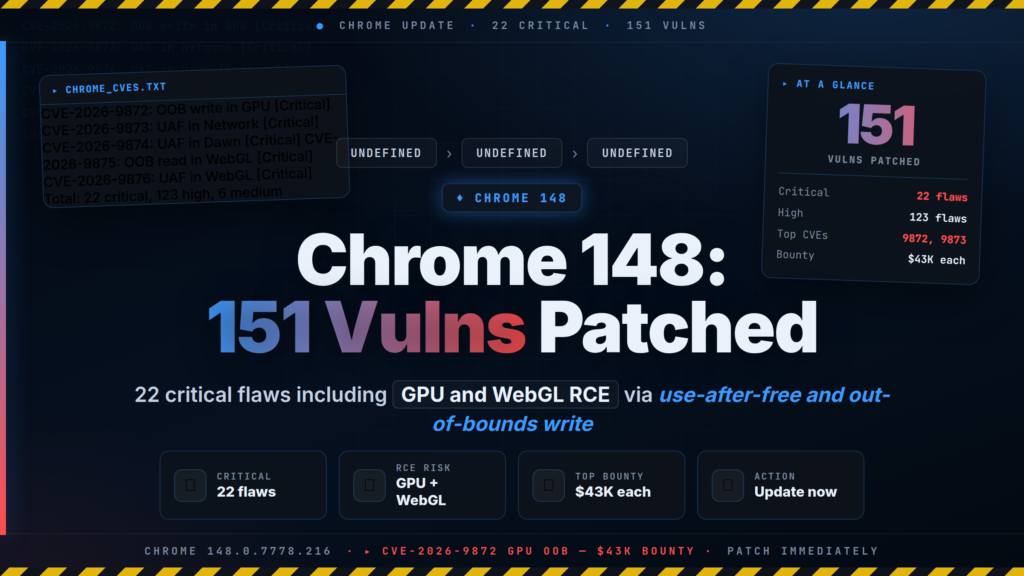
Google has released Chrome 148.0.7778.216/217 for Windows, 148.0.7778.215/216 for macOS, and 148.0.7778.215 for Linux, addressing 151 security vulnerabilities including 22 rated Critical — the highest severity level, indicating flaws that are remotely exploitable and can lead to Remote Code Execution (RCE — an attacker running arbitrary commands on the victim's machine). The Chrome 148 vulnerabilities include five named critical CVEs (Common Vulnerabilities and Exposures — standardized identifiers assigned to publicly known security flaws), with CVE-2026-9872 and CVE-2026-9873 earning the highest individual bug bounties paid by Google in this update at $43,000 each. All users should update Chrome immediately.
// 01 Chrome 148 Vulnerabilities: Technical Details
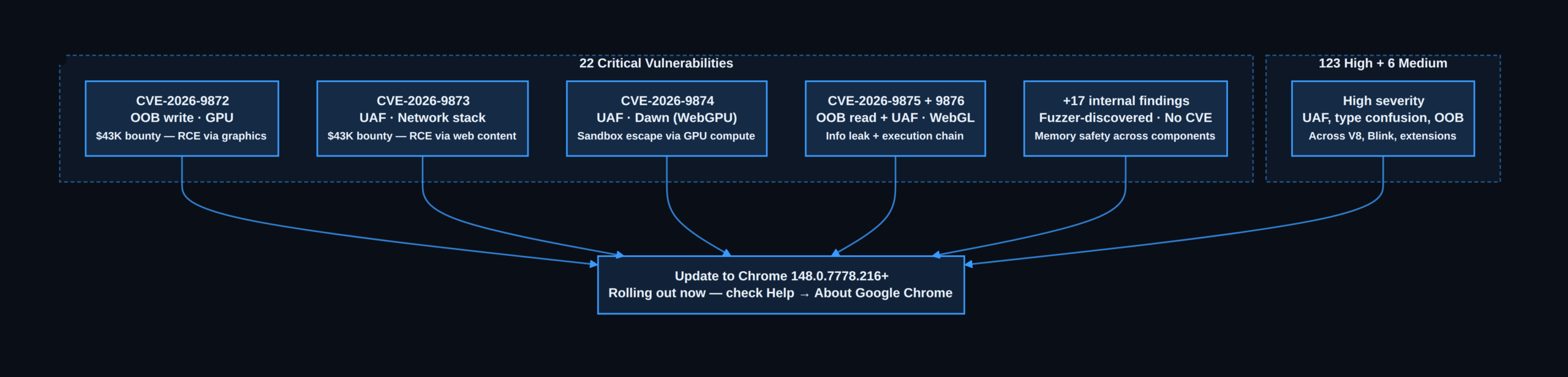
The Chrome 148 update addresses vulnerabilities across three severity tiers: 22 Critical, 123 High, and 6 Medium. The bulk of the critical-severity issues are memory-safety bugs — specifically use-after-free (UAF) vulnerabilities and out-of-bounds (OOB) read/write issues — concentrated in Chrome's GPU processing, WebGL rendering, and network stack components.
CVE-2026-9872 — Out-of-bounds write in GPU (Critical, $43,000 bounty) An out-of-bounds write occurs when code writes data beyond the allocated memory buffer, potentially overwriting adjacent memory with attacker-controlled content. In GPU processing, which operates with elevated privileges to access graphics hardware, this class of bug can lead to arbitrary code execution. The $43,000 bounty indicates Google's assessors consider this high-impact and difficult to mitigate.
CVE-2026-9873 — Use-after-free in Network (Critical, $43,000 bounty) A use-after-free (UAF) vulnerability occurs when code continues to reference a memory region after it has been freed and potentially reallocated to another object. An attacker who can control the timing and content of memory reuse can redirect program execution to arbitrary code. Network-component UAFs are particularly dangerous in a browser context because they can be triggered through crafted web content without requiring any additional user interaction.
CVE-2026-9874 — Use-after-free in Dawn (Critical) Dawn is Chrome's WebGPU implementation — the web standard that gives JavaScript access to GPU hardware for compute-intensive applications. UAF vulnerabilities in Dawn are concerning because WebGPU is a relatively new API with a large attack surface, and exploitation could allow a malicious web page to escape Chrome's sandboxing.
CVE-2026-9875 — Out-of-bounds read in WebGL (Critical) WebGL (Web Graphics Library) is the older graphics API that has been the source of numerous Chrome vulnerabilities. An OOB read in this component can leak memory contents to an attacker, enabling information disclosure and bypassing Address Space Layout Randomization (ASLR — a defense that randomizes where code is loaded in memory to prevent attackers from knowing where to redirect execution).
CVE-2026-9876 — Use-after-free in WebGL (Critical) A companion WebGL UAF that, combined with CVE-2026-9875's information disclosure potential, could enable a complete sandbox escape chain.
Beyond the five named critical CVEs, Google's security team identified an additional 17 critical-severity issues through internal fuzzing and security audits. These are not assigned individual CVE numbers in this release but are included in the 22-critical count.
// 02 Exploitation Status and Threat Landscape
Google has not confirmed active in-the-wild exploitation of any of the 151 patched vulnerabilities at the time of release. Per Google's standard policy, detailed technical information about individual bugs is restricted until the majority of Chrome users have received the update, reducing the window during which attackers could exploit the bugs against unpatched users.
The surge in vulnerability discoveries is partially attributed to increased AI-assisted fuzzing — automated tools that generate massive volumes of test inputs to find crashes — which Google and external researchers have deployed at scale. Google has acknowledged this trend drives higher raw vulnerability counts in recent Chrome updates.
A notable security context: Google lowered Chrome bug bounties in late 2025, citing improved internal security processes and the AI-driven increase in fuzzer-discovered bugs. Despite the lower per-bug payouts at lower severity tiers, the top-tier critical bounties remain at $43,000+ as demonstrated by CVE-2026-9872 and CVE-2026-9873.
// 03 Who Is Affected
Chrome has approximately 3 billion active users across all platforms, making this one of the widest-exposure vulnerability disclosures in cybersecurity. Affected versions include all Chrome releases prior to:
- Windows: 148.0.7778.216 or 148.0.7778.217
- macOS: 148.0.7778.215 or 148.0.7778.216
- Linux: 148.0.7778.215
Chromium-based browsers — including Microsoft Edge, Brave, Opera, and Vivaldi — typically incorporate upstream Chromium security patches with a short lag. Users of those browsers should check for updates from their respective vendors.
Enterprise environments using Chrome via managed deployment (Active Directory, Google Admin Console, Intune) should prioritize forcing the update through their device management platform, as auto-update may not reach all endpoints promptly.
// 04 What You Should Do Right Now
- Update Chrome immediately. Navigate to the three-dot menu → Help → About Google Chrome. Chrome will check for and install the update automatically. Restart Chrome to complete the update.
- Verify the version number. After updating, confirm the version shows 148.0.7778.216 or higher (Windows/macOS) or 148.0.7778.215 (Linux).
- Force enterprise updates. If managing Chrome via Google Admin Console, push the update through device policy. For Intune deployments, verify the Chrome update ring is current.
- Update Chromium-based browsers. Microsoft Edge, Brave, and other Chromium browsers share the underlying engine. Check each for updates through their respective update mechanisms.
Verify installed version via command line:
# Linux / macOS
google-chrome --version
# or
/Applications/Google Chrome.app/Contents/MacOS/Google Chrome --version

# Windows (PowerShell)
(Get-Item "C:Program FilesGoogleChromeApplicationchrome.exe").VersionInfo.ProductVersion
- Enable automatic updates if not already active. Chrome's auto-update silently installs security patches in the background for users who have it enabled — the most reliable defense against fast-moving browser exploits.
// 05 Background: Understanding the Risk
Use-after-free and out-of-bounds vulnerabilities in browser engines represent the most reliable class of memory corruption bugs for achieving sandbox escapes — the ability to break out of Chrome's sandboxing (the isolation mechanism that prevents a compromised renderer process from accessing the rest of the OS) and execute code with full system privileges.
Chrome's multi-process architecture provides defense-in-depth: even if a renderer process is compromised through a WebGL or GPU vulnerability, a second exploit is required to escape the sandbox and achieve OS-level code execution. The 22 critical bugs in this update represent potential renderer-compromise primitives; Google's Chromium security team has not indicated that any complete sandbox-escape chains are included in this release.
However, "renderer compromise" alone is sufficient for significant harm in an enterprise context: an attacker who compromises a Chrome renderer process can read the content of the current browser tab, extract cookies and session tokens for authenticated services, and access the browser's local storage — which may include MFA recovery codes, password manager integrations, and other sensitive data.
The practical risk for unpatched users: visiting a single malicious web page — or a legitimate page serving a malicious advertisement — is sufficient to trigger exploitation of a renderer-level vulnerability. No additional user interaction is required beyond loading the page.
// 06 Conclusion
Chrome 148.0.7778.216+ patches 151 vulnerabilities including 22 Critical-rated flaws concentrated in GPU processing, WebGL rendering, and the network stack. CVE-2026-9872 (GPU out-of-bounds write) and CVE-2026-9873 (network use-after-free) represent the highest-severity confirmed vulnerabilities, each earning $43,000 bug bounties. Given Chrome's 3-billion-user base and the absence of a safe "wait and see" period — any unpatched user visiting a malicious page can be exploited — this update should be treated as urgent. Update Chrome now, verify the version number, and push updates to enterprise-managed fleets immediately.
For any query contact us at contact@cipherssecurity.com