
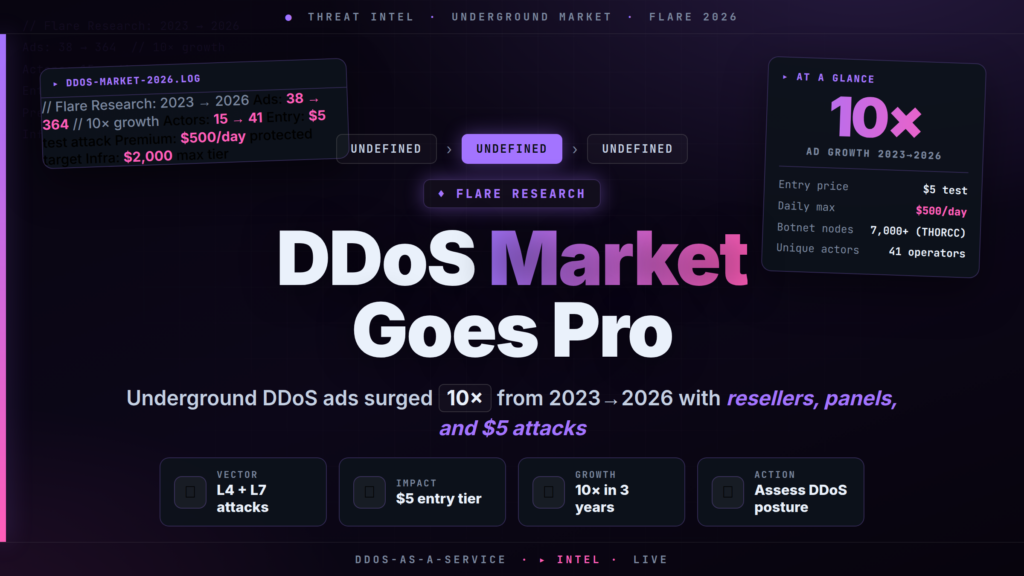
DDoS-as-a-Service — the market for purchasing Distributed Denial-of-Service attacks (attacks that flood a target with traffic to knock it offline) as a subscription product — has undergone a dramatic commercial transformation. New research from Flare, published via BleepingComputer on May 29, 2026, documents a nearly ten-fold surge in high-signal DDoS service advertisements when comparing the first five months of 2023 to the first five months of 2026. What was once a niche underground commodity built on scattered scripts and leaked tools has become a professionalized market complete with tiered pricing, customer support, reseller programs, and Cloudflare bypass guarantees — all starting at $5 per attack.
// 01 DDoS-as-a-Service: How the Underground Market Evolved
The DDoS-as-a-Service market mirrors the maturation arc of legitimate software-as-a-service (SaaS) businesses. Three years ago, would-be attackers seeking DDoS capabilities faced fragmented tutorials, leaked source code from aging botnets, and low-quality forum posts promising questionable results. Executing a sustained attack required at least rudimentary technical knowledge.
Flare's comparison of underground DDoS-related activity from the first five months of each year tells a markedly different story for 2026:
- High-signal DDoS service advertisements: 38 → 364 (10x increase)
- Unique ad clusters: 31 → 123 (4x increase)
- Unique actors: 15 → 41 (3x increase)
These figures reveal a market that has grown not just in volume but in structure. Advertisements now emphasize ease of use, automation, botnet-backed capacity, web control panels, API access, monthly plans, and multi-tier support — the same vocabulary used to market legitimate cloud services.
The shift reflects a deliberate product philosophy: operators have recognized that lowering technical barriers expands the customer base. An attacker who cannot configure a botnet can still purchase a week of sustained attack capacity against a competitor, an extortion target, or a political adversary for the cost of a streaming subscription.
// 02 How Much Does a DDoS Attack Cost in 2026?
DDoS-as-a-Service pricing spans an enormous range depending on target hardness, attack duration, and protocol layer:
| Tier | Price | Use Case |
|---|---|---|
| Test attack | $5 | Proof of capability |
| Website attack | $10–$25 | Single site, limited hours |
| Daily (weak target) | $100/day | Unprotected hosting |
| Daily (medium target) | $200/day | Standard CDN-backed sites |
| Daily (strong target) | $500/day | Protected/mitigated targets |
| Monthly subscription | €20–$40 | SatelliteStress, RebirthStress |
| Infrastructure tier | Up to $2,000 | ISP and network-level targeting |
Named services documented in Flare's research include:
- POWERDDOS — tiered pricing from $5 tests to $500/day; one of the more explicit pricing sheets observed
- SatelliteStress — advertised with a user-friendly panel, API access, game-server targeting methods, and monthly plans from €20
- RebirthStress — monthly subscription starting at $15, positioned for recurring use cases
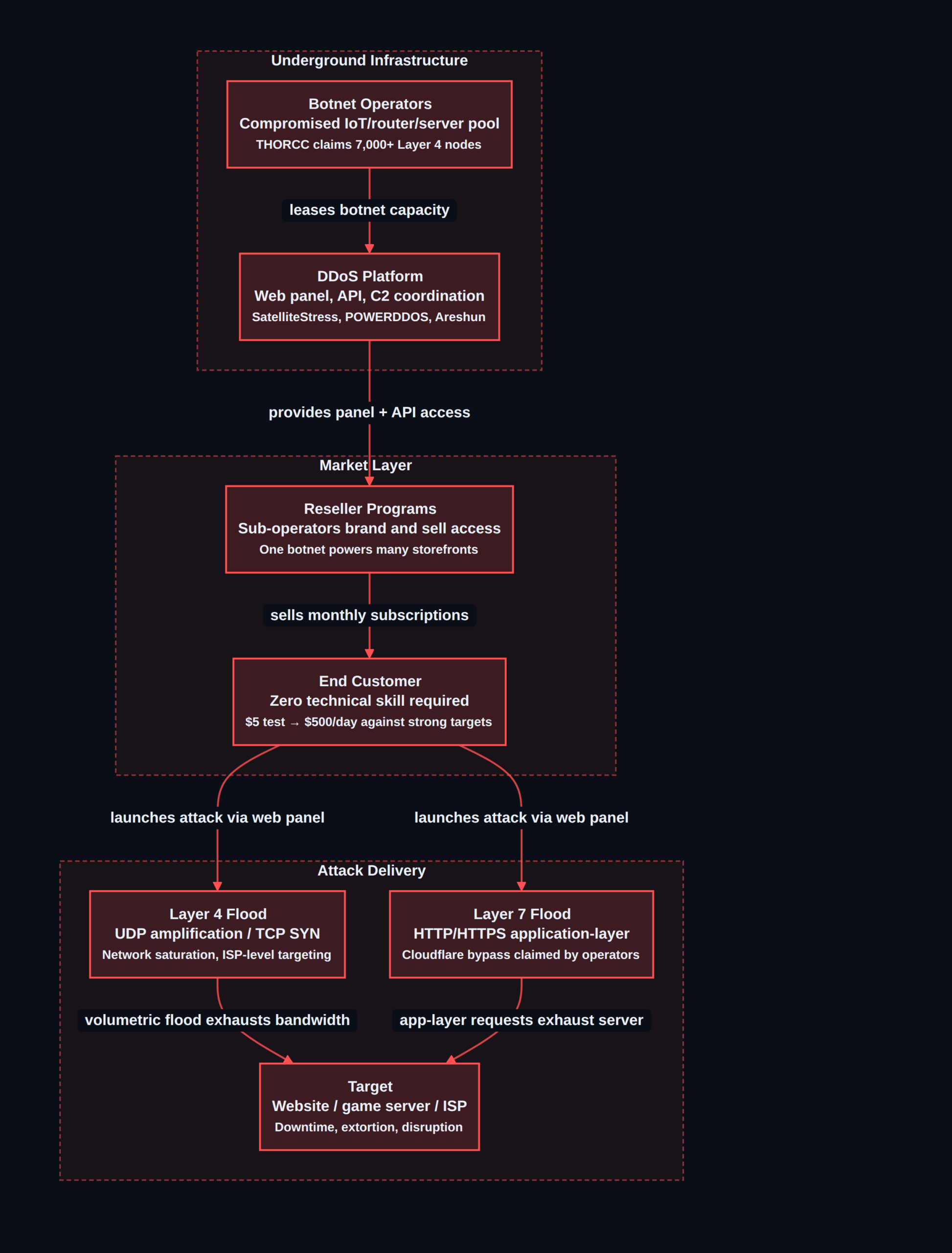
- THORCC — claims 7,000+ active Layer 4 bots; explicitly markets infrastructure-scale capacity
- Areshun — premium tier with infrastructure-focused offerings reaching $2,000
Layer 4 (transport layer, such as UDP amplification floods and TCP SYN floods that exhaust server connection tables) and Layer 7 (application layer, such as HTTP GET floods that consume web server processing capacity) attacks are both offered. Layer 4 typically commands higher prices due to raw volumetric throughput requirements, while Layer 7 attacks are increasingly valuable as more organizations deploy volumetric scrubbing at the network edge.
Critically, multiple service advertisements explicitly claim Cloudflare bypass and DDoS-Guard bypass capabilities. While not all services deliver on these claims, the explicit targeting of DDoS protection infrastructure demonstrates that operators are engineering around the defenses most organizations already rely on.
// 03 Who Uses DDoS-as-a-Service?
The 3x increase in unique actors (15 to 41) combined with the market's shift toward accessibility means the attacker profile has broadened significantly. Use cases observed across underground forums and incident reports span a range that extends well beyond the script-kiddie harassment campaigns associated with earlier DDoS-for-hire services:
- Extortion campaigns: A brief proof-of-capability attack — delivered with a $5 test — is followed by a demand for payment to prevent a full sustained assault. The low cost of demonstrating capability has made this a commonplace extortion opener.
- Competitive disruption: E-commerce operators, gaming platforms, and cryptocurrency exchanges have emerged as high-value targets during peak revenue windows. A competitor paying $100/day for a week-long attack can cause millions in lost transactions.
- Hacktivist campaigns: The subscription model allows politically motivated groups to sustain attacks over weeks without ongoing technical investment. A €20/month service subscription is accessible to virtually any organized group.
- Nation-state-adjacent operations: A CISA and NCSC-UK joint advisory from 2026 documents that covert botnet networks operated by China-aligned actors include infrastructure used for both DDoS operations and espionage. Commercial DDoS-as-a-Service operators provide a convenient layer of attribution ambiguity.
The 2026 Cloudflare Threat Report documents that DDoS attacks more than doubled in 2025, with hyper-volumetric attacks (exceeding 1 Tbps) growing 700%. The commoditization Flare documents is a direct driver: more operators with more botnet capacity means more attacks at higher peak volumes.
// 04 Operation PowerOFF and Law Enforcement Response
Law enforcement has not been passive. On April 13, 2026, authorities across 21 countries executed Operation PowerOFF, seizing 53 DDoS-for-hire domains in a coordinated takedown targeting the commercial DDoS ecosystem's storefront layer. The operation specifically targeted stresser and booter services — the front-end layer connecting paying customers to botnet capacity.
Previous PowerOFF iterations have temporarily disrupted activity. However, Flare's research covering the first five months of 2026 — which post-dates earlier PowerOFF actions — shows the market has absorbed these disruptions. The 10x advertising growth confirms a fundamental economics problem: capital costs for running a DDoS-for-hire service are low (leveraged botnet infrastructure, cheap VPS hosting), while potential returns are high (recurring subscription revenue from many simultaneous customers). For every domain seized, multiple replacement services emerge on new infrastructure within days.
The reseller layer further complicates enforcement. A single botnet operator powers dozens of independent storefronts, each with distinct branding, pricing, and customer bases. Seizing a storefront domain removes one reseller but leaves the underlying botnet intact.
// 05 What You Should Do Right Now
- Audit your DDoS mitigation coverage for both Layer 4 and Layer 7 vectors. CDN-based scrubbing handles volumetric floods but may not cover application-layer attacks targeting expensive server operations. Confirm your protection addresses both.
- Document your DDoS incident response contacts before an attack. Know your ISP null-route procedure, your CDN provider's emergency escalation number, and your scrubbing service SLA. Locating these during an active attack wastes critical minutes.
- Enable rate limiting and WAF rules at the application layer. HTTP flood attacks exploit server-side processing cost (database queries, session lookups, rendering). Rate limiting by IP, geographic region, and request pattern reduces impact without requiring full DDoS scrubbing engagement.
- Treat brief unexplained traffic spikes as pre-attack reconnaissance. DDoS-as-a-Service operators market $5 test attacks as a standard pre-purchase demonstration. A short measurable spike may indicate your organization has been selected as a target before the full attack order is placed.
- For real-time services (gaming, financial APIs), evaluate anycast routing. Anycast distributes attack traffic across multiple geographically dispersed points of presence, preventing a single-node saturation that downs the entire service.
- Monitor BGP advertisements for your ASN. Infrastructure-level DDoS attacks — the $2,000 tier — may involve BGP route hijacking. Alerting on unexpected route announcements for your IP space provides early warning of the most sophisticated campaigns.
// 06 Background: Understanding the DDoS-as-a-Service Threat Model
DDoS-as-a-Service platforms derive power from botnets — networks of compromised devices (consumer routers, IoT cameras, cloud servers, and infected desktops) that execute attack commands from a central command-and-control (C2) infrastructure. Unlike rented datacenter bandwidth, botnet traffic originates from millions of legitimate-looking, globally distributed IP addresses. Source-based blocking is therefore ineffective: blocking one attacking IP simply shifts load to the next of 7,000.
The commercialization trend Flare documents is part of a broader cybercrime-as-a-service ecosystem. The same productization has occurred in ransomware (Ransomware-as-a-Service), phishing infrastructure (Phishing-as-a-Service), and infostealer distribution (Malware-as-a-Service). The underlying model is consistent: technically sophisticated operators build and maintain the core infrastructure, then license access to non-technical customers who supply targets and payment.
The Masjesu Botnet, documented by The Hacker News in April 2026, illustrates the current operational model: IoT devices compromised globally, pooled into attack capacity, then sold to operators running commercial panels with explicit Cloudflare and DDoS-Guard bypass marketing. This is the infrastructure layer behind the $5 pricing that Flare's research quantifies.
The reseller model is particularly significant for defenders: it means that the operator launching an attack against your organization is almost certainly not the same entity that owns the botnet. Attribution tracing through a reseller back to a botnet operator requires law enforcement-level capability, which most targeted organizations do not have. This practical attribution barrier is one reason the market has grown with relative impunity despite high-profile enforcement actions.
// 07 Conclusion
DDoS-as-a-Service has completed its transition from underground niche to accessible commercial market. With entry-level attacks at $5, monthly subscriptions under €20, and premium infrastructure targeting available for $2,000, the barrier to launching sustained DDoS campaigns has never been lower. Security teams that have not revisited their DDoS posture since 2023 are operating against a threat surface that has grown 10x more accessible in that time — and Flare's data suggests the growth trajectory shows no signs of reversing.
For any query contact us at contact@cipherssecurity.com