
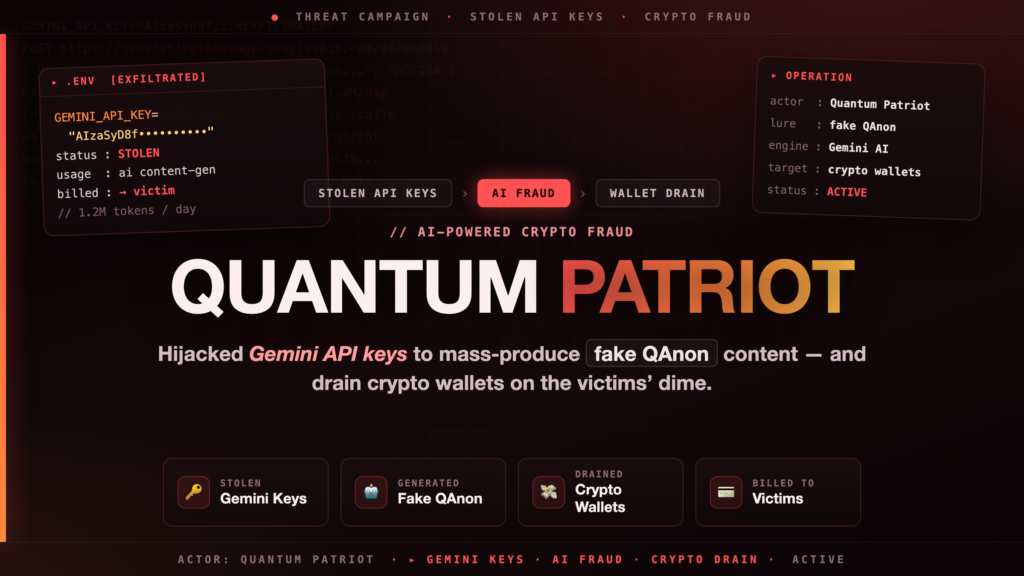
Security researchers at TrendAI discovered in May 2026 a fully operational AI-assisted fraud operation targeting politically-aligned cryptocurrency holders, internally dubbed "Quantum Patriot" by the attacker. The operation used 73 stolen Google Gemini API keys — not a jailbreak of Gemini itself, but stolen credentials providing access to Google's Gemini (a large language model family developed by Google DeepMind, capable of generating text, code, and structured content) API — to generate fake QAnon "Q drop" (political posts styled as cryptic intelligence communiqués from the anonymous "Q" persona associated with the QAnon conspiracy theory) content for delivery via Telegram. The attacker bundled a wallet-draining application called StellarMonster with GoToResolve remote access software to steal cryptocurrency seed phrases from victims. TrendAI's investigation also found 29 compromised WordPress administrator accounts used to amplify the campaign.
// 01 Technical Details: How Quantum Patriot Worked
The Quantum Patriot operation was a multi-stage fraud pipeline orchestrated by Python automation scripts. Unlike genuine AI jailbreaking — which exploits prompt injection or safety filter bypasses within a model — this operation succeeded through API key theft: the attacker obtained 73 Gemini API keys that likely belonged to legitimate developers, researchers, or organizations, and used those keys to make Gemini API calls without Google's safety controls flagging the requests as originating from a suspicious actor. Stolen API keys bypass rate-limit restrictions and abuse detection tied to individual accounts.
The pipeline operated across several layers:
Layer 1 — AI content generation. Gemini API calls generated Telegram posts mimicking QAnon Q drops, targeting the aesthetic, syntax, and thematic conventions of authentic QAnon content (numerology, "trust the plan" rhetoric, references to shadow governments and suppressed financial systems). This AI-generated content was specifically tuned to resonate with politically-aligned cryptocurrency holders who overlap with QAnon-adjacent communities.
Layer 2 — Fake financial system lure. A separate AI component, powered by Venice.ai (a third-party AI chatbot platform), presented victims with a fake "Quantum Financial System" (QFS) terminal — a fraudulent concept promoted in QAnon communities as a hidden gold-backed financial system that will replace central banks. The Venice.ai chatbot impersonated a QFS access portal, creating the illusion of exclusive financial access to draw victims into the next stage.
Layer 3 — Malware distribution. The attacker distributed StellarMonster, a fake cryptocurrency wallet application bundled with GoToResolve (a legitimate remote access and remote desktop software product from GoTo, formerly LogMeIn). Packing RAT (Remote Access Trojan) capability inside legitimate remote support software is a common evasion technique — security tools and users are less suspicious of recognized software brands. StellarMonster's fake wallet import function targeted seed phrases and mnemonics (the 12 or 24-word backup phrases used to recover cryptocurrency wallets — anyone who knows a seed phrase has full, irrevocable control of the corresponding wallet and all funds it contains).
Layer 4 — Credential brute-forcing. An AI-powered brute-forcing script exploited predictable password mutation patterns (e.g., appending years, common substitutions like @ for a) to crack cryptocurrency exchange and wallet accounts.
Layer 5 — WordPress amplification. 29 compromised WordPress administrator accounts were used to publish and amplify campaign content, providing distribution infrastructure with real domain reputations.
// 02 Victim Impact and Discovery
The operation was discovered when TrendAI researchers found the attacker's infrastructure exposed in May 2026, revealing the entire operational environment including scripts, API credentials, and victim data. The investigation confirmed:
- At least one victim had their cryptocurrency wallet fully drained — the attacker cracked the victim's password, extracted the 12-word seed phrase, and harvested over 40 wallet addresses across major blockchain networks including Bitcoin, Ethereum, and Solana
- 29 WordPress administrator accounts confirmed compromised
- 73 Gemini API keys confirmed stolen and actively used
Total financial losses across the full victim pool have not been quantified. Google and Venice.ai did not respond to comment requests from The Register at time of publication.
// 03 Who Is Affected
This campaign specifically targeted:
- QAnon-affiliated and MAGA-aligned cryptocurrency holders — individuals active in Telegram communities promoting QAnon or politically-adjacent financial conspiracy content
- Users of cryptocurrency wallets that support seed phrase import — virtually all non-custodial (self-custody) cryptocurrency wallets
- Developers and organizations whose Gemini API keys were stolen — the 73 stolen keys may belong to legitimate businesses or individuals whose accounts were compromised through credential theft, phishing, or repository exposure
Exposure of API keys in public GitHub repositories, .env files committed to version control, or leaked through prior data breaches are common sources for attacker-acquired API credentials.
// 04 What You Should Do Right Now
- Audit your Gemini API key usage. Log in to Google AI Studio and review your API key list. Rotate any keys that have unexplained usage spikes, access from unfamiliar IP addresses, or that were ever stored in a location that could have been exposed (public repos,
.envfiles, shared Slack channels).
# Check for .env files commited to git history
git log --all --full-history -- .env
git log --all --full-history -- "*.env"
- Scan repositories for committed API keys. Use tools like truffleHog or gitleaks to scan your git history for accidentally committed secrets:
trufflehog git file://. --since-commit HEAD~100 --only-verified
- Never store seed phrases digitally. Cryptocurrency seed phrases should exist only on paper or metal backup, stored physically and never typed into any software application, website, or AI interface. No legitimate wallet application or financial service will ask for your seed phrase except during wallet recovery — and only into the wallet software itself.
- Treat unsolicited cryptocurrency investment or access opportunities with extreme skepticism — particularly those framed around politically-charged narratives (QFS, central bank alternatives, insider information). The Quantum Financial System does not exist; any "QFS terminal" or access portal is fraud by definition.
- Verify WordPress administrator account access. If you manage WordPress sites, audit administrator accounts for unfamiliar additions, check recent activity logs, rotate all admin passwords, and ensure two-factor authentication is enforced on all admin accounts.
- Set API key scope restrictions. For any AI platform API key, apply the minimum necessary permissions. Google AI Studio allows restricting keys by API, HTTP referrer, or IP address. A stolen key with restricted scope causes significantly less damage than an unrestricted key.
// 05 Background: Understanding the Risk
The Quantum Patriot operation illustrates a threat model that will become more common as AI APIs become infrastructure: AI-as-a-tool for social engineering at scale. The attacker did not break Gemini's safety filters or discover a new vulnerability in the model itself. Instead, they solved a simpler problem — obtaining working API keys — and used Gemini as a content generation utility to produce high-volume, targeted, contextually plausible fraud content that would be difficult and expensive to produce manually.
The combination of AI-generated content and targeted community infiltration is a qualitative shift from generic mass phishing. Traditional phishing sends identical emails to millions of recipients and relies on volume to succeed despite low conversion rates. Quantum Patriot used AI to generate Telegram content specifically tailored to the beliefs, language, and trust networks of its target demographic — reducing the detection probability of individual messages while maintaining scale.
The use of stolen API keys rather than jailbreaks is also significant. Jailbreaks are a cat-and-mouse game that AI providers continuously patch. Stolen credentials are a stable, difficult-to-detect attack vector. A compromised developer account or a leaked .env file provides API access that is indistinguishable from legitimate use — it generates the same API calls from the same key, just from different infrastructure.
This connects to a broader pattern: the primary risk surface for AI APIs is not model behavior but credential security. Developers building AI applications should apply the same rigorous secret management practices to AI API keys as they do to database credentials or cloud provider keys — treating them as high-value credentials that enable significant harm if stolen.
// 06 Conclusion
Quantum Patriot is an early but well-documented example of AI-assisted targeted fraud: stolen Gemini API keys enabling AI-generated content at scale, wrapped in community-specific political narratives to maximize victim targeting precision. The attacker's exposure of their full operational infrastructure provides a rare window into how these AI-assisted fraud pipelines are built. The defensive lessons are practical — rotate exposed API keys, never enter seed phrases into third-party applications, enforce MFA on all admin accounts, and scan repositories for committed secrets.
For any query contact us at contact@cipherssecurity.com